AP Psychology Unit 1
1.2 AP Psychology: Parts of the Nervous System and Their Functions
1. The two main divisions
Part | Function (easy definition) |
|---|---|
Central Nervous System (CNS) | made up of the brain and the spinal cord process information and controls how the body responds. |
Peripheral Nervous System (PNS) | connects the CNS to the rest of the body all of the nerves outside of the brain/spinal cord - carries messages between the CNS and the rest of the body |
2. The Peripheral Nervous System (PNS)
The PNS is divided into two parts:
Part | Function |
|---|---|
Somatic Nervous System | controls VOLUNTARY movements - walking, rasising hand ***SKELETON**** |
Autonomic Nervous System | controls INVOLUNTARY movements - heart rate, digestion, breathing |
3. The Autonomic Nervous System
The autonomic nervous system has two divisions:
Part | Function |
|---|---|
Sympathetic Nervous System | FIGHT or FLIGHT - activates body during stress or danger —— uses energy for arousal or for action |
Parasympathetic Nervous System | calms your body down — REST and DIGEST - slows heart rate and supports digestion |
4. The three types of neurons
Type | Function |
|---|---|
Sensory Neurons (afferent) | Carrys' information from the body TO the CNS this is why you pull your hand away from a flame |
Interneurons | processes information and connects the neurons with the CNS |
Motor Neurons (efferent) | carrys information FROM the CNS to the muscles or glands |
Afferent - TO the CNS
efferent - FROM the CNS
Example: you touch a hot pan
sensory neurons detect the heat
interneurons in the SPINAL cord relay and process the infromation
motor neurons sends a message to your muscles
your hand pulls away: this is a reflex - can happen before you consciously process the pain


1.3a Neuron and Neural Firing
Neurons and their parts
Term | Definition and function |
|---|---|
Neuron | A nerve cell that receives and sends messages throughout the body. |
Cell body (soma) | Contains the nucleus and keeps the neuron alive. |
Dendrites | Receive messages from other neurons. |
Axon | Carries messages away from the cell body. |
Myelin sheath | A fatty covering around the axon that speeds up messages. |
Glial cells | Support, protect, and nourish neurons; some make myelin. |
How neurons send messages
Term | Definition and function |
|---|---|
Action potential | An electrical impulse that travels down the axon to send a message. |
Threshold | The minimum stimulation needed to trigger an action potential. |
Refractory period | A brief recovery period when a neuron cannot fire again normally. |
All-or-none response | A neuron either fires a full action potential or doesn't fire at all. |
How neurons communicate with each other
Term | Definition and function |
|---|---|
Synapse | The tiny gap between neurons where messages are passed. |
Neurotransmitters | Chemical messengers that carry signals across the synapse. |
Reuptake | When the sending neuron takes neurotransmitters back in after releasing them. |
Endorphins | Natural chemicals that reduce pain and can create feelings of pleasure. |
Agonist | A substance that increases a neurotransmitter's effects by mimicking it or helping it work. |
Antagonist | A substance that blocks a neurotransmitter's effects. |
The endocrine system
Term | Definition and function |
|---|---|
Endocrine system | A system of glands that releases hormones into the bloodstream to regulate body functions. |
Hormones | Chemical messengers that travel through the blood and affect organs and body processes. |
Quick memory tricks
Dendrites = receive
Axon = sends
Myelin = speeds up
Threshold = trigger point
All-or-none = fires or doesn't
Reuptake = takes back
Agonist = activates or boosts
Antagonist = blocks
Neurotransmitters = chemical messages between neurons
Hormones = chemical messages through the blood
Important AP Psych distinction: Neurotransmitters usually carry messages between neurons across synapses, while hormones travel through the bloodstream to target cells.
Neurotransmitter | Function | Examples of Malfunctions |
|---|---|---|
Acetylcholine (Ach) | muscle action, learning, and memory | alzheimers disease, ACh-producing neurons deteriorate |
Dopamine | movement, learning, attention, and emotion | oversupply linked to schizophrenia, undersupply linked to tremors and decreased mobility in Parkinsons disease |
Serotonin | affects mood, hunger, sleep, and arousal | undersupply linked to depression. some drugs that raise serotonin levels are used to treat depression |
norepinephrine | helps control alertness and arousal | undersupply can depress mood |
GABA | inhibitory neurotransmitter | undersupply linked to seizures, tremors, and insomnnia |
glutamate | excitatory neurotransmitter; invlovled in memory | oversupply can overstimulate the brain, producing migraines or seizure |
endophins | neurotransmitters that influence the perceptoin of pain or pleasure | overfsupply with opiod drugs can suppress the body’s natural endorphin supply |
supstance P | involved in pain perception and immune response | oversupply can lead to chronic pain |
1.3b Drugs
Type of drug | effect on CNS | Behavioral Impact | example of drugs |
|---|---|---|---|
depressants | calm neural activity which slows bodily functions | cause a person to process things slower —- slurred speech, disrupted memory | -alcohol -barbituates |
opiods | depress neural activity and lessens pain and anxiety | replace the feeling of pain —- breathing slows, pupils constrict LOW TOLERANCE | -heroin -methadone -pain relievers |
stimulants | excites neural activity - speeds bodily functions | pupils dialate, heart rate & breathing speeds up — reduces apatite | -nicotine -cocaine -energy drinks/caffine -meth |
hallucinogens | distorts perceptions and evokes sensory images | make people feel seperated from their bodies | -LSD -marajuana |
Agonist: Mimics a neurotransmitter or increases its effects.
Antagonist: Blocks a neurotransmitter’s effects.
Reuptake inhibitor: Prevents a sending neuron from reabsorbing a neurotransmitter, leaving more available in the synapse.
Quick memory trick:
Depressants = slow down
Stimulants = speed up
Hallucinogens = change perception
Opioids = relieve pain and may produce euphoria
1.4a AP Psychology: Brain Terms and Tools
Term | why? | Easy definition / function |
|---|---|---|
Neuroplasticity | hm | brains ability to change and reorganize as you learn and experience new things from your lifestyle |
Lesion | hm | damaged brain tissue — helps scientists understand what the brain area does |
EEG (electroencephalogram) | To see how quickly the brain sends signals and detect unusual activity, such as during seizures. | measures the brains electrical activity - puts electrodes on the scalp |
MEG (magnetoencephalography) | To find where brain signals happen and understand how different brain areas communicate. | measures the magnetic fields produced by the brains electrical activity |
CT scan | To look inside the brain and find injuries, bleeding, or damage. | X-Ray to create pictures of the brains structure |
PET scan | To see which brain areas use the most energy, helping scientists study brain activity and certain diseases. | radioactive tracer to show brain activity and sugar/glucose levels |
MRI | To get detailed pictures of brain structures and find damage or abnormalities. | uses magnets and radio waves to create detailed pictures of the brains structure |
fMRI | To see which brain areas become more active when someone thinks, remembers, or performs a task. | measures changes in blood OXYGEN levels to show which brain areas are more active |
Easy memory tricks
Neuroplasticity = brain changes.
Lesion = damage.
EEG = electrical activity. - brain waves
MEG = magnetic activity.
CT = X-ray picture.
PET: a little girl wants a pet a girl wants candy and sugar = glucose
MRI = detailed structure. - creates a picture of the brain structure
fMRI = function/activity.
1.4b AP Psychology: Brain Structures and Their Functions
Term | Easy definition / function |
|---|---|
Brain stem | keeps you alive — controls basic functions like breathing and heart rate |
Medulla | part of the brain stem — controls breathing, heart rate, and blood pressure |
Thalamus | sensory relay statoin - sends most sensory information eXCEPT FOR SMELL to the correct part of the brain |
Reticular formation | helps control alertness, arousal, and wakefullness |
Cerebellum | “little brain” - controls balance, coordination, and smooth movements |
Hippocampus | helps form new memories |
Hypothalamus | maintains body internal balance (homeostasis) by regulating hunger, thirst, body temperature, and sleep |
Cerebral cortex | brains outer layer; responsible for higher-level thinking, perception, and decision making |
Frontal lobes | planning, decision making, personality, and voluntary movement |
Parietal lobes | processes touch and other body sensations, helps with spatial awareness |
Occipital lobes | processes vision |
Temporal lobes | processes hearing; helps with language and memory |
Motor cortex | controls VOLUNTARY muscle movements |
Somatosensory cortex | recieves and processes sensations like TOUCH, PRESSURE, PAIN, and TEMPERATURE |
Amygdala | the part of the brain that processes emotions, especially fear and anger. |
Association areas | connect and interpret information to help with thinking, learning , memory, and problem-solving |
Easy memory tricks
Medulla = maintains life
Thalamus = sensory switchboard
Reticular formation = awake and alert
Cerebellum = coordination
Hippocampus = memories
Occipital = optical (vision)
Temporal = tunes (hearing)
Motor cortex = movement
Somatosensory cortex = body sensations
Association areas = putting information together
Limbic System
Amygdala
Hippocampus
Hypothalamus
Thalamus


1.5a AP Psychology: Sleep: Consciousness
Term | Simple definition |
|---|---|
Consciousness | being aware of yourself, your thoughts, and your surroundings |
Cognitive neuroscience | the study of how the brain affects thinking, learning, memory, and behavior. |
Dual processing | your brain processes information in two ways: HIGH ROAD consciously (aware) and LOW ROAD unconsciously (without realizing it). |
Blindsight | when someone who is blind because of brain damage can still respond to visual information without consciously seeing it. |
Parallel processing | your brain handles multiple pieces of information at the same time without you realizing it ex recognizing a face's color, shape, and movement all at once. |
Sequential processing | your brain handles information ONE step at a time. Example: solving a math problem one step at a time. |
Easy way to remember:
Dual = two ways of thinking.
Parallel = many things at once.
Sequential = one thing after another.
Blindsight = responding to something you can't consciously see.

1.5b AP Psychology: Sleep: Consciousness
Term | definition |
circadian rhythm | our biological clock; regular bodily rhythms that occur on a 24 hour cycle |
REM Sleep | rapid eye movement sleep; a recurring sleep stage during which vivid dream dreams commonly occur. Also known as paradoxical sleep, because the muscles are relaxed - body systems are active |
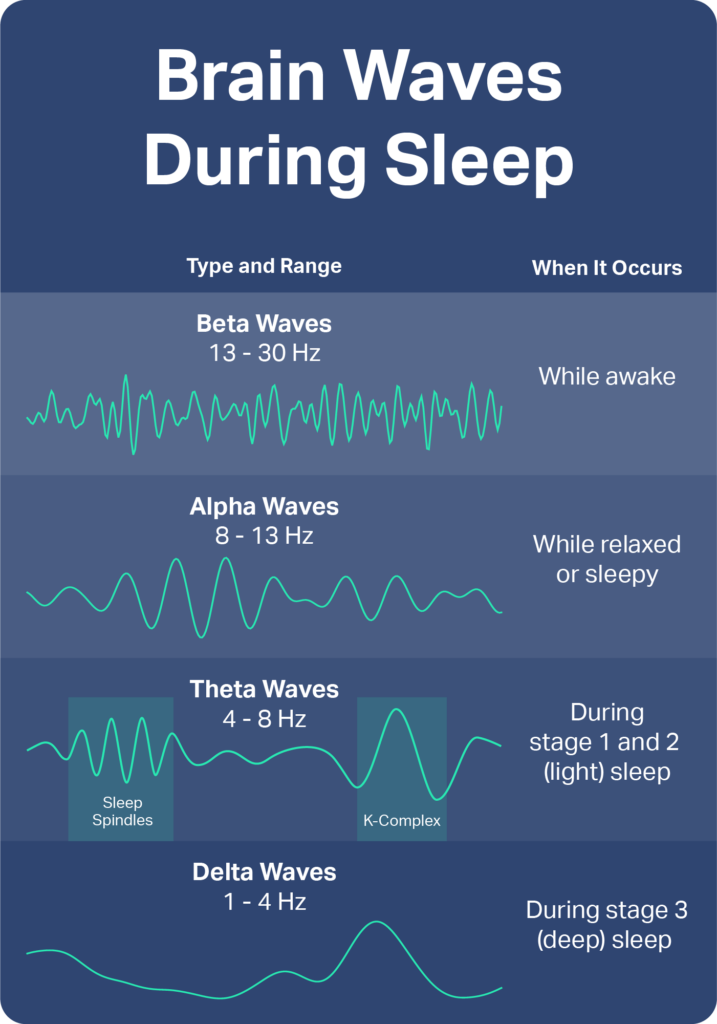
alpha waves | the relatively slow brain waves of a relaxed, awake state |
NREM Sleep | non-rapid eye movement sleep; encompasses all sleep stages except for REM sleep |
hallucinations | false sensory experiences, such as seeing something in the abscense of an external visual stimulus |
hypnagogic sensations | bizarre experiences, such as jerkign or a feeling of falling or floating weightlessly, while transitioning to sleep |
delta waves | the large, slow brain waves associated with DEEP sleep |
suprachiasmatic nucleus (SCN) | cell clusters in the hypothalamus that controls the circadian rhythm. In response to light, the SCN adjusts melatonin production, thus modifying our feelings of sleepiness |

1.5c AP Psychology: Sleep: Consciousness
term | definition |
insomnia | recurring problems in falling or staying asleep |
narcolepsy | a sleep disorder — uncontrollable sleep attacks. the affected person may lapse directly into REM sleep, often at inopportune times |
sleep apnea | a sleep disorder —temporary cessations of breathing during sleep and repeated momentary awakenings |
REM sleep behavior disorder | nromal REM paralysis does not occur — instead, twitching, talking, or kicking/punching may occur — acting out ones dream |
REM rebound | the tendency for REM sleep to increase the following REM sleep deprivation |
Activation-synthesis Theory | Memory consolidation theory |
Rem helps to preserve and develop neural connections | dreams provide a way to sort out the days events and serve to consolidate our memories for storage |
as REM cycles activate the brain, we make sense of the random activations and weave together a storyline that becomes a dream |
stage | wave name and characteristics | characteristics or common behaviors of this stage |
Awake, but relaxed | alpha waves - low frequency | aware of whats happening around you but pretty drowsy |
Non Rem 1 | theta waves | hallucinations, hypnagogic, visual images and feelings, feeling of falling, twitches |
Non Rem 2 | theta waves - k complex and spindle waves | ability to sleep through loud noises, help with memory |
Non rem 3 | delta waves | hard to wake up - deep sleep - talk and walk in sleep |
REM | rapid eye movement - Beta waves | active mind, paralized body, paradoxical |
steps of each cycle - Awake, NR1, NR2, NR3, NR2, REM