10 ATP, ENZYMES, REDOX
key words
free energy
exergonic
endergonic
adenosine triphosphate (ATP)
phosphorylation
dephosphorylation
activation energy
enzyme
substrates
reduced molecules
oxidized molecules
reduction
oxidation
redox reactions
class notes
ATP does cellular work, powering endergonic processes
i. transport work: trans-membrane transport with ATP
ii. mechanical work: motor proteins move with ATP
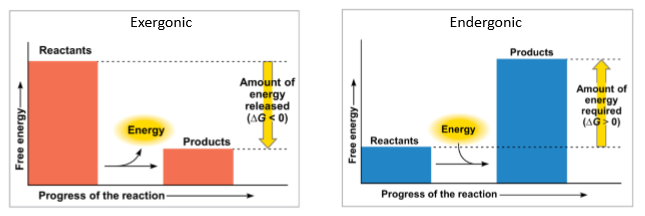
exergonic process: net release of energy, causing reactant energy > product energy
endergonic process: net absorption of energy, causing reactant energy < product energy
i. requires energyATP
i. used for short-term energy work
ii. structured like a nucleotide but with 3 phosphates
iii. hydrolysis releases energy: dephosphorylation turns ATP into ADP + inorganic phosphate + energy
a. exergonic reaction: ATP is higher energy than ADP, and energy released is used for cellular workactivation energy: energy required to break reactant bonds before product bonds are formed
i. can be provided via kinetic energy (molecules’ random collisions), but collisions too rare for this to be reliable
ii. cells thus use enzymes to catalyze reactionsenzymes catalyze reactions by holding reactants in the correct orientation
i. active site: substrates (reactants) enter and are bound by hydrogen/ionic bonds → held in correct orientation, allowing kinetic energy to break and form new bonds → products shaped differently and thus no longer fit in active site, are released
ii. don’t use ATP, are reusable
iii. reduce activation energy, making reactions more frequent
a. enzymes present → reactions more frequent
b. enzymes don’t affect actual free energy
iv. allows control point for cell via enzyme production
a. cell can produce enzymes to start reaction, stop producing to stop
OIL RIG
i. oxidated molecules: electrons and H+ ions have been removed
a. ex: O2, CO2
ii. reduced molecules: electrons and H+ ions have been added
a. ex: C6H12O6 (glucose), H2O
iii. usage: glucose is a reduced molecule, CO2 is reduced to glucosehigh-energy electrons: electrons have more PE in low electronegativity-difference bonds as opposed to strongly electronegative bonds like polar/ionic; held too tightly → electron cannot be removed to perform work
i. nonpolar covalent bond: held equally/loosely
a. ex: C6H12O6
ii. polar covalent bond: held more tightly (low-energy)
a. ex: H2O
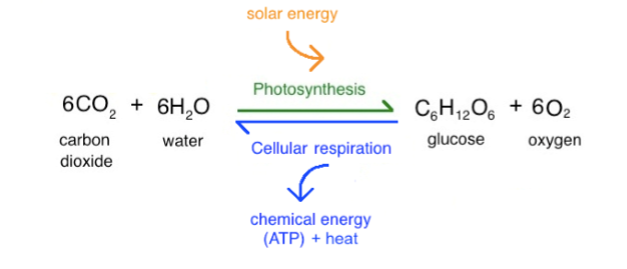
redox reaction: moving electrons/H+ from one reactant to another
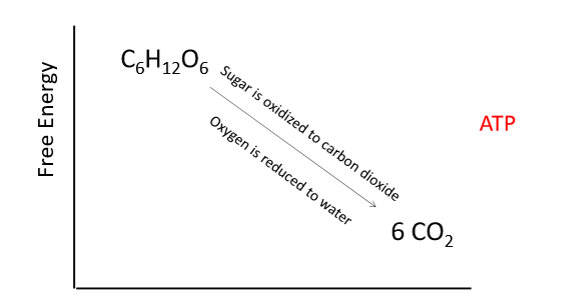
i. cellular respiration: removes glucose e- and puts them onto oxygen, producing water and carbon dioxide; makes ATP
a. high → low energy electrons and thus is exergonic (release energy via heat and ATP)
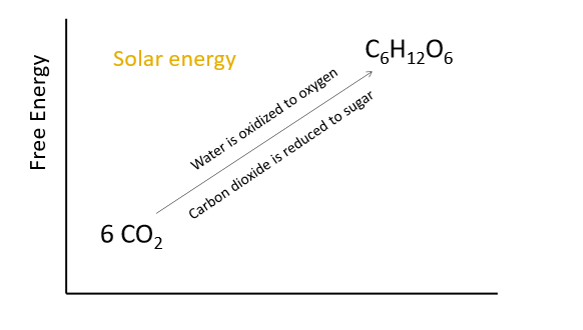
ii. photoysnthesis: removes water e- and puts them onto carbon dioxide, generating higher-energy electrons and making glucose
a. low → high energy electrons and thus is endergonic (energy from sun)
iii. glucose is a reduced molecule with high-energy electrons, making it valuable for energy
textbook notes
gibbs free energy (G): portion of system energy that can perform work
i. exergonic: net release of G (negative G)
a. spontaneous
ii. endergonic: net absorption of G (positive G)
b. non-spontaneousequilibrium: max stability and lowest possible G value; reactions move toward equilibrium
i. cannot do work at equilibrium (no energy) → cells never at metabolic equilibrium and must maintain imbalanceenergy coupling: using energy released from exergonic to power endergonic
i. usually ATP hydrolysis providing energy
a. energy due to phosphate neg. charge: mutually repel → unstable, lot of PE that’s released when hydrolyzed
ii. phosphorylation: transfer of phosphateenzyme: catalyst speeding up reactions without being consumed by lowering activation energy
i. endergonic reactions make reactant unstable by absorbing energy from surroundings → reactant bonds break, product bonds form → product returns to stable/lower energy than contorted state
a. energy often supplied via heat, but heat unreliable: too much is bad for biological systems, so enzymes must instead lower activation energy
b. activation energy: barrier controlling reaction rate
ii. enzymes cannot change free energy (e.g. can’t change endergonic to exergonic), only speeds up already-spontaneous reactions
iii. enzymes are specific to reactionssubstrate: reactants acted on by enzymes
i. binds to active site (catalyze reactions via R groups of constituent amino acids)
ii. induced fit: enzymes/active sites change shapes to increase substrate activityoxygen highly electronegative → most potent oxidizing agent (is reduced, gains electrons)
i. natural direction: electrons go from less to more electronegative, losing potential energy as they do (more tightly bound by electronegative atoms) → lost energy is used to perform workcellular respiration
i. glucose oxidized into carbon dioxide
ii. oxygen reduced into water
iii. ultimately, electrons transferred from glucose to oxygen (high to low energy state) → releases energy for ATP synthesis
study questions
give examples of cellular work
cellular work requires energy. one example is the movement of motor proteins, such as kinesin and dynein on microtubules.define endergonic and exergonic reactions
endergonic reactions absorb/require energy, as their reactants are lower energy than their products. exergonic reactions have a net release of energy, and their reactants are higher energy than their products as a result.recognize structure of ATP and why it is high-energy
ATP has three phosphate groups. phosphate groups, with their negative charges, repel each other, and thus the bonds within ATP have high potential energy that can be released when ATP is hydrolyzed into ADP + an inorganic phosphate. ATP is a higher-energy molecule compared to ADP, meaning that the hydrolysis of ATP results in a net energy release that makes ATP a high-energy molecule, since it stores energy that can be gleaned via its hydrolysis.explain how enzyme structure facilitates reactions
enzymes are proteins with active sites that can bind to specific substrates via H-bonds and ionic bonds (a result of the enzyme’s consituent amino acid R-chains), positioning the substrates in the correct orientation and allowing kinetic energy to to break reactant bonds and form product bondsexplain how enzymes affect activation energy
enzymes lower activation energy, making reactions more frequent/likely to occur. since the substrates are already positioned in the correct orientation, additional kinetic energy is only necessary to break/form bonds, ultimately lowering the amount of energy needed for the reaction.
recognize an oxidized or reduced molecule
an oxidized molecule has lost electrons/H+, while a reduced molecule has gained electrons/H+explain why respiration is an oxidation reaction and photosynthesis is a reduction reaction
respiration ultimately results in glucose being oxidized into carbon dioxide (and oxygen being reduced into water). respiration removes glucoses’s high-energy electrons, using that energy to ultimately generate ATP via chemiosmosis before putting the now low-energy electrons onto water. photosynthesis ultimately reduces carbon dioxide to glucose, adding electrons (extracted by splitting water molecules) to create half-glucose molecules. in photosynthesis, the low-energy electrons from water are made high-energy and put onto carbon dioxide.compare and contrast respiration and photosynthesis
respiration is an oxidation reaction, while photosynthesis is a reduction reaction. the ultimate goal of respiration is to extract energy from glucose to make ATP, while the ultimate goal of photosynthesis is to use energy from light in order to reduce carbon dioxide to make glucose. in this way, although both processes produce ATP, in cellular respiration, ATP is the primary product end goal, while in photosynthesis, glucose is the primary product end goal. both also utilize chemiosmosis to generate ATP, which accordingly requires the usage of electron transport chains to power a proton gradient. both also use electron shuttles to carry electrons: NADP+ and FAD in respiration, and NADPH in photosynthesis. cellular respiration is exergonic (high-energy electrons release energy), while photosynthesis is endergonic (low-energy electrons absorb energy to become high-energy)