Globalisation - Textbook
The increased interconnectedness and interdependence of people and countries resulting from the expanding integration of trade, finance, people and ideas in one global marketplace. Advancements in technology, communication, science, transport and industry have accelerated the pace of this integration over the past few decades.
Factors that affect globalisation:
TECHNOLOGY
TRANSPORT
TRADE
TOURISM
CULTURE
Diffusion:
Globalisation is not just trade, but it is the expansion or ‘diffusion’ of cultural elements from one group of people to another group of people.
^ Can be seen with global news coverage, social media, and streaming services. ➡ This makes it easy for political movements, cultural and social movements to all be accessible on a global level.
Adaption:
An increased global dominance of many companies causes trends and the adaptation of certain products to suit different countries or environments.
The alterations or adjustments in response to a change in the environment.
Sustainability:
Considers factors of current and future generations through simultaneous environmental, social and economic processes.
^ must be assessed considering both positive and negative effects and impacts.
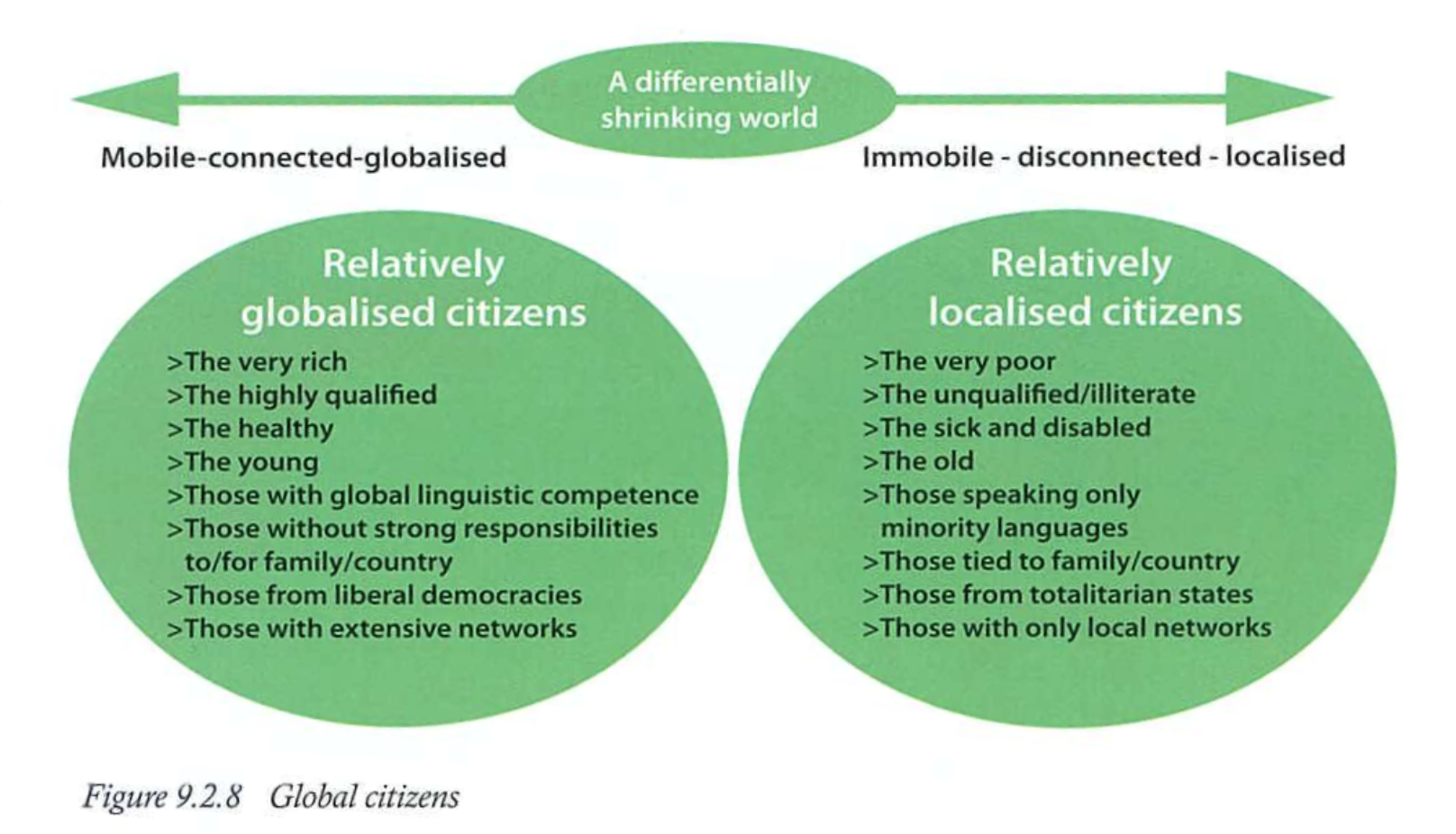
“A shrinking world”
Due to development in transport technologies, the physical distance between locations is not an adequate indication of the accessibility of one point from the other. Travel, time and cost have become more relevant factors how accessible a location is.
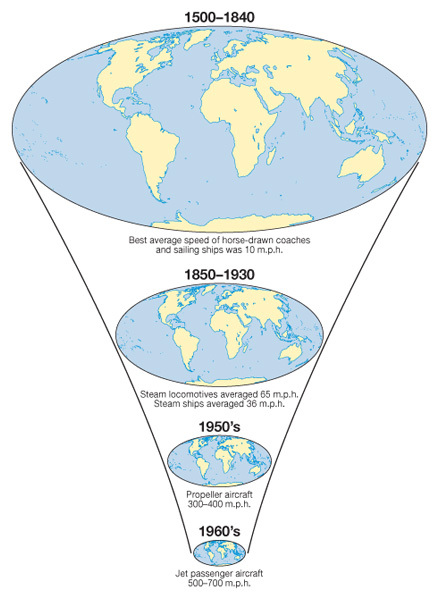
Time-space convergence:

By the increased desire to have more locations be more accessible, there also came a movement in the increase of transport and communication technologies to enable transportation between locations.
American geographer Donald Janelle developed Time-space convergence. A formula that states that while the measured distance between point A and point B does not change while the factors of perishability of goods do change. For example, transporting low-value and/or perishable commodities (resources) over long distances is increasingly feasible due to increased technologies such as planes, trains and other modes of transport.
^ above factors enable countries to specialise and focus more on specific products, and this creates comparative advantage For example, if you buy clothing from Shein it is cheaper and accessible but made in certain conditions where as you can buy something similar, more expensive and possibly produced in better conditions, that is produced in Australia. ➡ Comparative advantage.
Changes in the spatial distribution of products.
Early globalisation involves the Silk Road (a trade route that connects China, the Middle East and Europe).
Changes in the ^ occurred due to development in transport and communication. This led to increased interconnection (globalisation).