2.17 - Evolution & Biodiversity
Evolution is a change in allele frequencies in a population over time.
Alleles are the different versions of a gene
Allele frequencies describe how common (or rare) a particular allele is in a particular population
A population is a group of organisms of the same species that live in the same area & interbreed with each other
The size of the area in which a population lives varies widely based on the species. It may be huge, such as the entire Arctic region for polar bears, or tiny, such as a part of a tree for some species of insects in the Amazon.
Time is measured in generations so the amount of actual calendar time varies by species
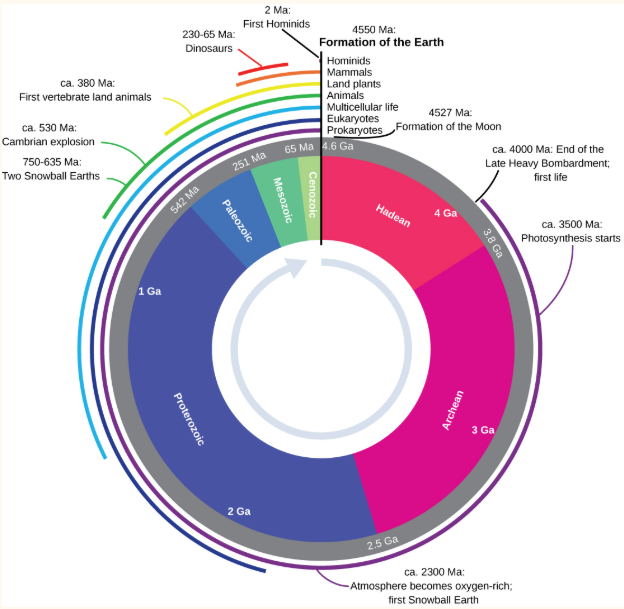
Based on fossil evident, there has been life on Earth for about 3.7 BILLION years, so the total amount of calendar time is immense
Humans usually have difficulty picturing this amount of time. The figure below illustrates the key events in the formation of the Earth & the evolution of major groups of organisms. Note that ALL oSf human evolution is essentially hidden by this scale of time!
Evolution Mechanisms
Although a popular misconception is that evolution only happens via natural selection, allele frequencies may change via FOUR different mechanisms of evolution:
Mutation is a spontaneous change in DNA sequence, and it is the ultimate source of new alleles
Gene flow may occur when individuals move between populations and have offspring in their new population. If the individuals that move carry alleles that are rare, or that are not originally found in the new population, then the allele frequencies of both the old & the new populations may change.
Natural selection is when an allele frequency changes because an allele provides a fitness advantage or disadvantage
Unlike physical fitness, evolutionary fitness focuses on the reproductive success of an individual — how many offspring an individual produces that mature to produce their own offspring
Fitness is highly dependent on the environmental conditions in which an organism lives. It changes as these conditions change. For example, the traits that help a plant survive a brought aren’t so important when water is plentiful, but become vital when water is scarce.
Genetic drift is the name we give to any random processes that produce a shift in allele frequencies that can’t be explained by any of the other evolutionary mechanisms
There are two special cases of genetic drift:
The founder effect occurs when a population is split in some random way. Natural disasters are frequent causes of this, such as when an island is separated from the mainland by a storm, but anything that causes one part of a population to be separated produces the founder effect. The distribution of alleles may be different in the two new populations than it was before the split.
The bottleneck effect is when a large population rapidly shrinks in a manner that does not involve natural selection. As the population expands again, it may have different allele frequencies simply based on the smaller collection of alleles that made it through the bottleneck events.
Humans have been a major source of bottleneck events for species that we once hunted to near extinction.
A common misconception when students are first learning about genetic drift is that these special cases are the ONLY examples of genetic drift.
Biodiversity
Evolutionary Mechanisms operating over billions of years on Earth have produced a tremendous amount of biodiversity.
The study of biodiversity involves exploring all the wide variety of organisms that have evolved.
Some of the biodiversity are still found on Earth, while some is extinct and can only be studied using evidence such as fossils.
Organisms can be grouped at various levels based on shared characteristics called traits.
The goal is to group organisms based on traits that have a shared evolutionary origin, such as the bones of the forelimbs of animals, rather than traits that share superficial similarities because of similar functions, such as the wings of birds, bats, & insects
These groupings range from domains (bacteria, archaea, & eukaryotes) down to species.
A generic name for any grouping is taxon (plural = taxa).
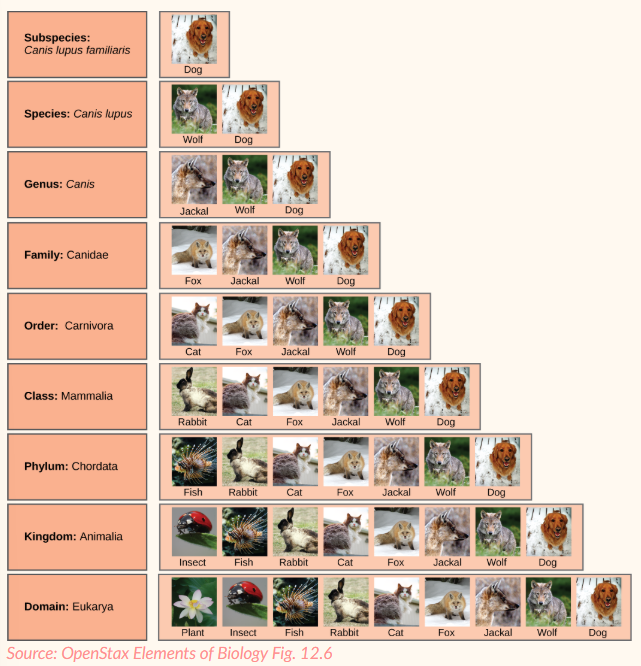
Organisms in the same domain share some traits, but more traits will be shared as you move to more specific taxa.
The figure below illustrates how the number of shared traits increases for more specific taxa.
Bacteria
Scientific name - Eubacteria
Single-celled microscopic living organisms
Common names - Bacterium (for one)
Major sub-groups - Included in the Phylogenetic Tree of Life (bacteria, archaea, eucarya), also included in the 7 kingdoms of organisms (bacteria, archaea, protoza, chromists, plants, fungi, animals)
Three types of bacteria
Spherical - called cocci, shaped like a ball; (EX. streptococcus)
Rod-shaped - known as bacilli, some are curved; (EX. Bacillus anthracis)
Spiral - known as spirilli, tight coils are called spirochetes; (EX. Leptospirosis, Lyme disease, syphilis)
Common species found in this group - Common pathogenic bacteria include:
Proteobacteria
Firmicutes
Actinobacteria
Cyanobacteria
Bacteroidetes
Similar characteristics of this taxon -
How diverse is this taxon?
Bacteria is everything and everywhere.
Incredibly diverse with over millions of types, and only few with official names
How do members of this taxon reproduce?
Bacteria multiplies asexually via binary fission
Steps to replication: DNA Replication, Cell Growth, Segregation of DNA, Septum Formation, Cell Division
Can also multiply via:
Conjugation: A form of genetic exchange where two bacteria physically connect via a pillus, and genetic material (like plasmids) is transferred from one bacterium to another.
Transformation: Bacteria can pick up free-floating DNA from their environment (from dead cells or other sources) and incorporate it into their own genomes.
Transduction: Bacteria can acquire DNA via bacteriophages (viruses that infect bacteria), which can introduce new genes into bacterial cells.\
Bacteria feed in different ways.
Heterotrophic bacteria get their energy through consuming organic carbon
Autotrophic bacteria make their own food via photosynthesis (photoautotrophs) or chemosynthesism (chemoautotrophs)
Bacteria can be found in soil, water, plants, animals, radioactive waste, deep in the earth’s crust, arctic ice and glaciers, and hot springs.
Do all species in this taxon reproduce in a similar manner, or is there some variability?
How does bacteria defend itself?
They can develop antibiotics to protect themselves
They can produce toxins to defend against other organisms (exotoxins, endotoxins)
They can form biofilms, dense bacterial communities that have a layer of protection
They can create spores which make their environment livable conditions for them, often harming their host