Human Nutrition (2.13-2.20)
Diet: The total nutrients that we need for our growth and development
Balanced Diet: The diet that provides all the required nutrients in appropriate proportions
- If the diet does not provide you nutrients we suffer from malnutrition
Components of a Balanced Diet:
- Carbohydrates
- Proteins
- Fats
- Vitamins
- Minerals
- Water
- Dietary fibre
Dietry Needs
- @@Energy requirements vary from one individual to the next@@ depending on age, sex, body composition and physical activity level
- The basal metabolic rate (BMR) is the rate at which a person uses energy to maintain the basic functions of the body
- Infants and young children tend to have a proportionately high BMR for their size due to their rapid growth and development.
- Men usually have a higher BMR than women since they tend to have more muscle.
- Older adults usually have a lower BMR than younger people since their muscle mass tends to decrease with age
- Energy is obtained, from the food and drink we consume by respiration
- To lose weight energy expenditure must exceed intake
- To gain weight energy intake must exceed expenditure
- Pregnant women need more energy than a non pregnant female likewise lactating mothers also need extra energy for the production of milk
- This is due to increased maternal and fetal metabolism for fetal and placental growth during pregnancy
Components of a balanced diet
Carbohydrates: Source of energy
- Bread, cereal, pasta, rice, potatoes
Protein: Growth and repair
- Meat, fish, eggs, pulses, nuts
Lipids: Insulation and energy storage
- Butter, oil, nuts
Dietary fibre: Provides bulk for intenstine to push food through
- Vegetables, whole grains
Water: Needed for chemical reactions to take place in cells
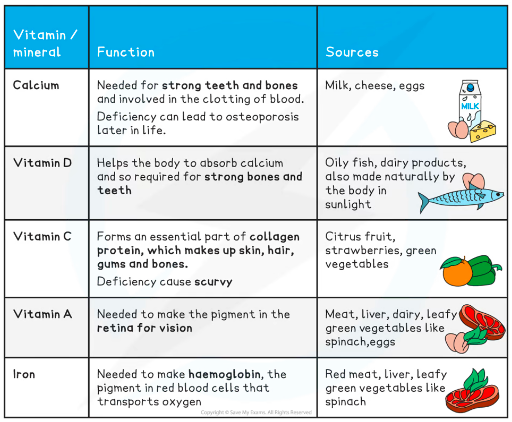
@@Malnutrition is caused by not eating a balanced diet@@
- Obesity: excessive nutrients
- Starvation: insufficient nutrients
- Coronary heart disease: excessive saturated fat and cholesterol
- Kwashiorkor: too much carbohydrates, too little protein
- Constipation: lack of fibre
Alimentary Canal
Ingestion: Taking in of substances e.g. food and drink into the body through the mouth
Egestion: Passing out of food (as feces) that has not been digested or absorbed via the anus
Mechanical digestion: Break down of food into smaller pieces without chemical change to food molecules
Chemical digestion: Break down of large insoluble molecules into small soluble molecules
Absorption: Movement of chemically digested food molecules through the small intestine walls into the blood
Assimilation: Movement of digested food molecules into the cells of the body where they are used and become a part of the cells
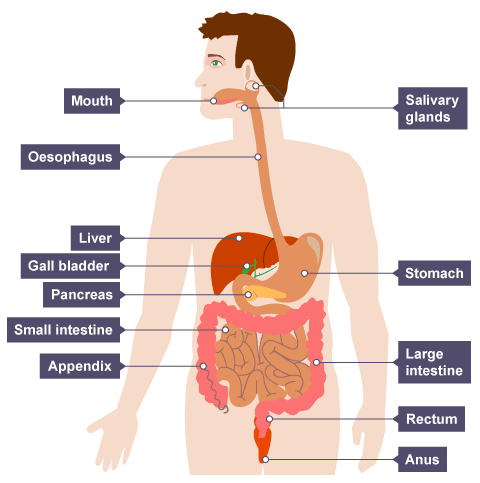
Mouth: Digestion of food starts in the mouth. Teeth break down the food (mechanical digestion) and mix it with the enzymes in saliva (chemical digestion)
Oesophagus: This is a thin tube that connects the mouth to the stomach
- Bolus are passed down by peristalsis from the mouth to the stomach.
- Peristalsis: the contraction and relaxation of the esophagus wall muscles which creates a wave-like motion that pushes the food down the canal.
Stomach: This is a muscular bag which mixes food and drink with acid
- Mechanical digestion occurs as the stomach walls squeeze the food to liquefy it
- Gastric juices contain pepsin (a protease) which chemically digests proteins. It also contains hydrochloric acid which kill bacteria, but also maintains an optimum acidic pH for pepsin
Liver: This releases a chemical called bile into the intestines
- Bile emulsifies fat into droplets to increase the surface area for lipases to come and digest them (mechanical digestion)
- Bile is also basic which assists in neutralizing the acidity of the food coming from the stomach into the intestine
Pancreas: Secretes pancreatic juice containing enzymes into the intestines which break down carbohydrates, protein and lipids in food
Small intenstine: Carbohydrates, proteins and lipids are digested here and absorbed into the blood
Duodenum: The first part of the small intestine. It receives pancreatic juice
Ileum: Second part of the small intestine
- Inner walls have finger like extensions (villi) which increases the surface area for nutrient absorption
Large intestine: Undigested food (mainly fibre) passes into the large intestine. Water reabsorbed here
- Colon: The second part of the large intestine.Reabsorbs water from undigested food and also bile salts to return back to the liver.
- Rectum: Stores faeces until egestion
- Anus: Muscles control egestion of feces
Diarrhoea
Diarrhoea: The loss of watery faeces
Can cause loss of significant amounts of water and ions causing tissues to stop working properly
Treated by Oral Rehydration Therapy
- Drink with small amount of salt and sugar dissolved
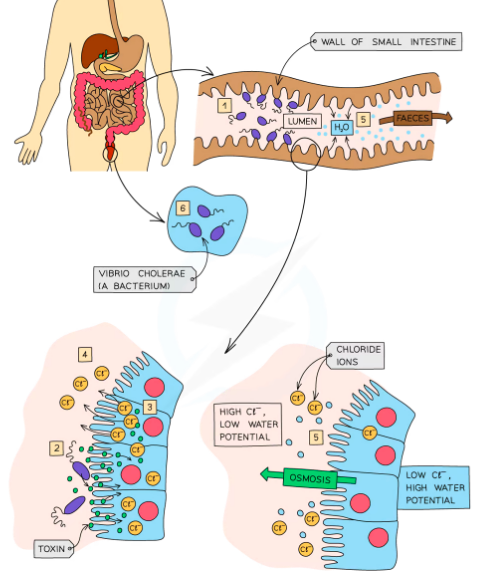
Caused by infection by vibrio cholerae bacteria
The Bacteria releases toxins which causes chloride ions to be secreted into the small intestine. This causes the @@osmotic movement of water into the gut@@, and leads to diarrhea.
Bacteria attach to the wall of the small intestine
They produce a toxin
Due to the toxin chloride ions are released from inside the cells and into the lumen of the intestine.
The chloride ions accumulate in the lumen of the small intestine and @@lower the water potential@@ there
When the water potential is lower than the cells lining the intestine, @@water moves out of the cells into the intestine by osmosis.@@
Large quantities of water are lost from the body in watery faeces
The blood contains too little chloride ions and water -dehydration
Mechanical Digestion
Mechanical digestion: breakdown of food into smaller pieces without chemical change to the food molecules
- @@Primarily done through chewing, stomach churning, and the emulsification of fats by bile in the duodenum@@
The teeth increase the surface area of food so it can be exposed to saliva for faster digestion
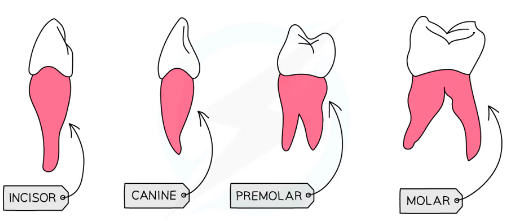
- Incisors - chisel-shaped for biting and cutting
- Canines - pointed for tearing, holding and biting
- Premolars and molars - larger, flat surfaces with ridges at the edges for chewing and grinding up food
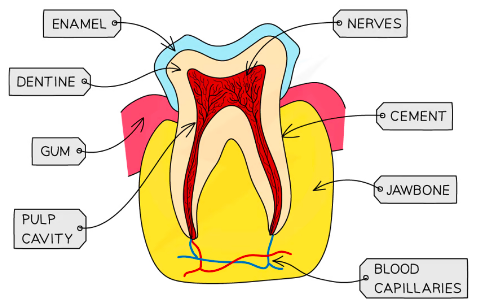
Dental decay
- Dental decay is caused by bacteria which is present on the surface of our teeth.
- The bacteria and food deposits form a layer called plaque.
- Bacteria in plaque feed on sugars which @@produce acid@@
- The acids gradually @@dissolve the enamel coating of the teeth@@, working its way into the dentine
- Dentine is softer than enamel and so dissolves more easily and quickly
- As the hole deepens it may eventually reach the nerves which result in pain
Dental Care
- Avoid sugary food so that bacteria cannot make acid
- Regular cleaning to remove plaque
- Use floss to remove trapped food
- Visit the dentist regularly for treating early decay and removal of thick plaque
Chemical Digestion
Chemical digestion: Breaking down large, insoluble food into smaller soluble nutrients that can be absorbed and used by the cells
- Carried out by enzymes
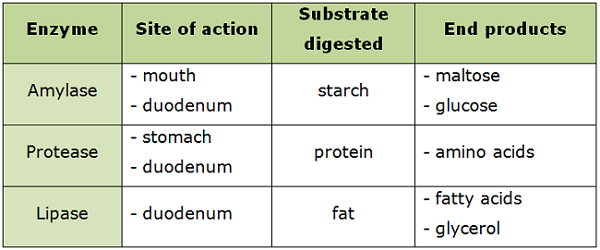
Bile has two main roles:
- It is alkaline to neutralise the hydrochloric acid which comes from the stomach
- The enzymes in the small intestine have a higher (more alkaline) optimum pH than those in the stomach
- It breaks down large drops of fat into smaller ones (emulsification). The larger surface area allows lipase to chemically break down the lipid into glycerol and fatty acids faster
Absorption
Absorption: movement of digested food molecules from the digestive system into the blood
- Absorption takes place in the second section of the small intestine, the ileum
Due to its long length, folded surface, and presence of microvilli the ileum is adapted for absorption.
- @@These adaptations largely increase the surface area allowing for faster more efficient absorption@@
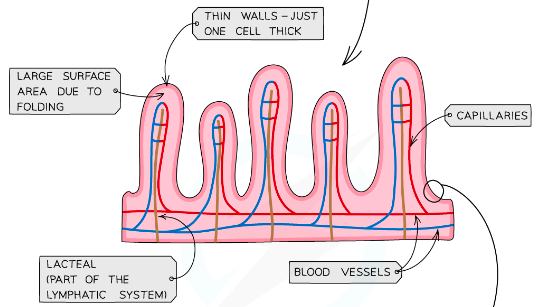
Microvilli on the surface of the villus increase surface area for faster absorption of nutrients
Wall of villus is one cell thick meaning that there is only a short distance for absorption to happen by diffusion and active transport
Well supplied with a network of blood capillaries that transport glucose and amino acids away from the small intestine in the blood
Lacteal runs through the centre of the villus to transport fatty acids and glycerol away from the small intestine in the lymph