HAZARDOUS ENVIRONMENTS - the whole chapter 🌪️🌋
Hazardous Environment
Hazard: An event that has the potential to cause harm to lives and property.
Example: An earthquake in unpopulated areas is a physical event; however, it becomes a hazard if the area is built up.
Disaster: A hazard that causes so much injury and damage that help is needed to recover.
Risk: The level of exposure of people to a hazardous event.
Vulnerability: Degree to which conditions make people more likely to experience an unexpected hazardous event that they cannot cope or recover from.
Resilience: How well people recover from a hazard.
Earthquake Processes
Tectonic Plates Movement:
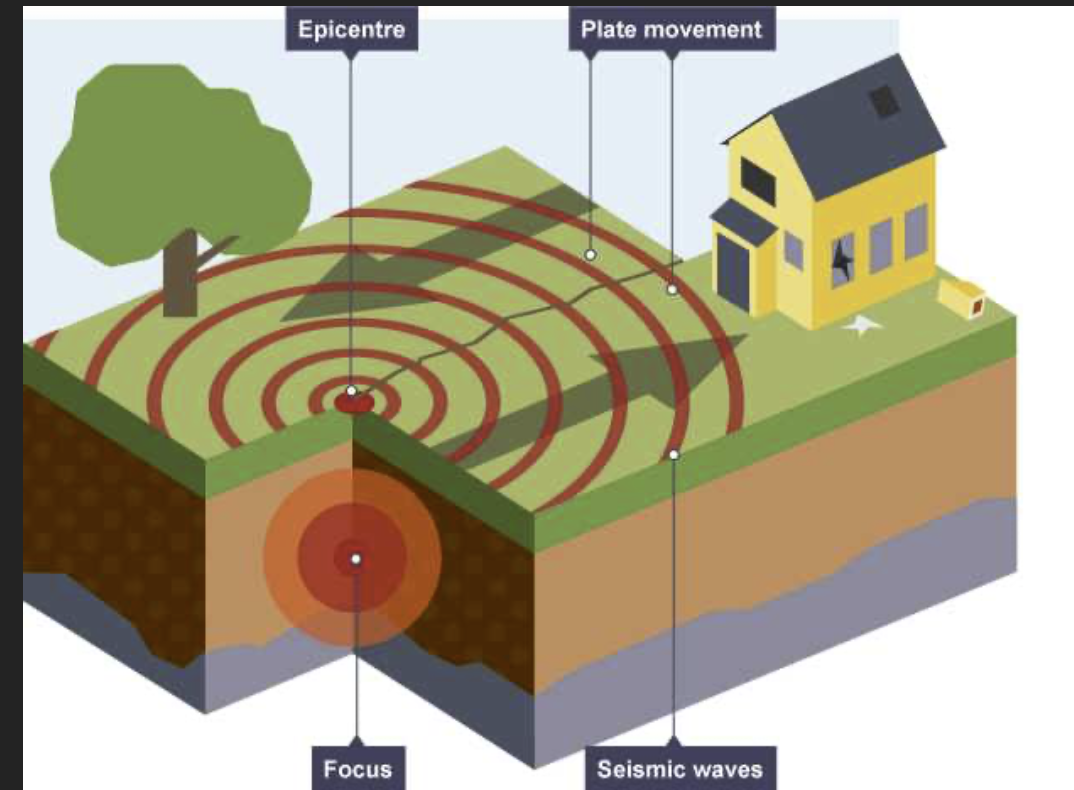
Plates move as a result of convectional currents in the mantle.
Movement is not smooth due to intense friction; they 'lock up' building tension.
When tension exceeds the frictional force, plates slip, leading to an earthquake, accompanied by foreshocks and aftershocks.
Epicentre: The point on the Earth’s surface directly above the focus of the earthquake.
Focus: The subsurface point where energy is released, and plates slip past each other, generating seismic waves.
Seismic Waves
Resultant waves produced from an earthquake are classified into:
Body Waves: Passed through the Earth’s structure, these include:
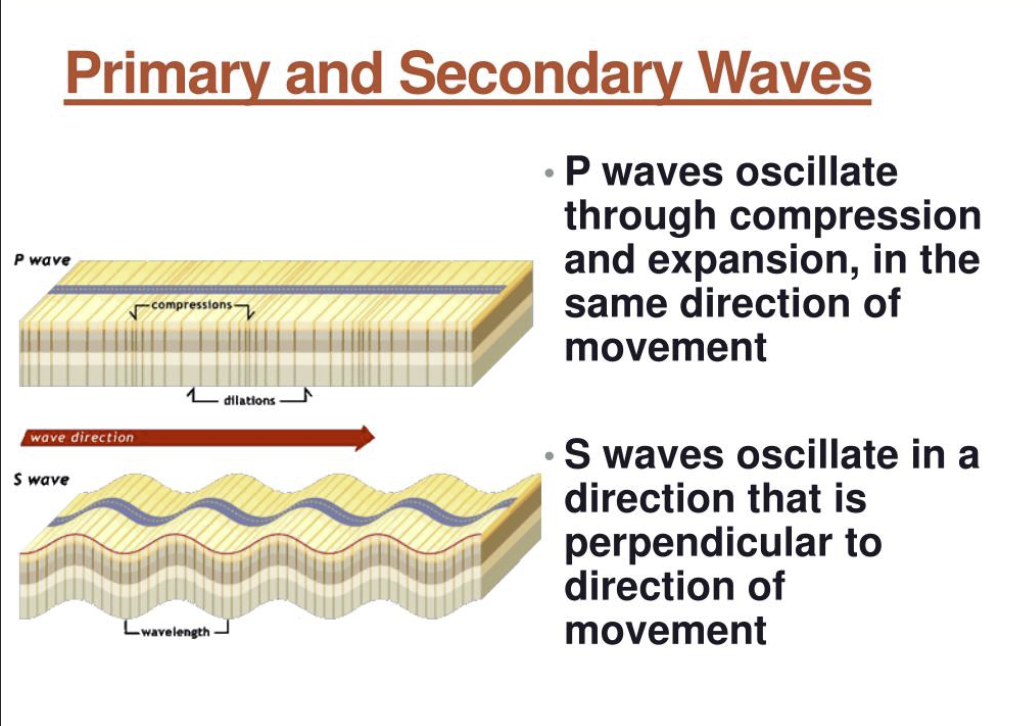
Primary Waves (P-waves): Compress rock and create high-density bands that move in the direction of the wave. These waves travel alongside the direction of energy propagation.
Secondary Waves (S-waves): Compress rock sideways, causing adjacent layers to move opposite the direction of energy propagation. These travel slower than P-waves and can only pass through solids.
Surface Waves: Result from body waves reaching the surface, generating:
Raleigh Waves: Exhibit motion similar to water waves, with ground particles rolling as they move.
Love Waves: Faster than Raleigh waves, moving sideways and perpendicular to the wave's energy path.
Surface waves cause most damage during earthquake events, derived from body waves.
Seismic Scales
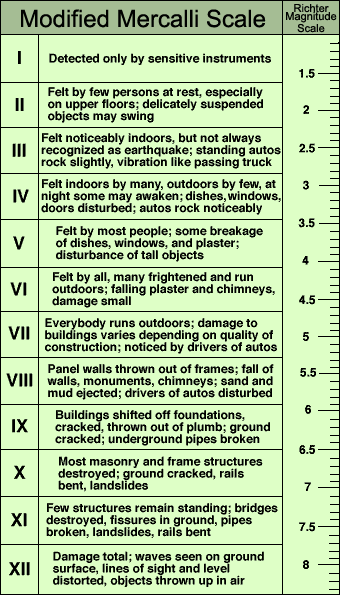
(Modified) Mercalli Scale: Measures qualitative damage experienced during an earthquake. Low Richter scale readings can correspond to high Mercalli results in areas with poorly constructed infrastructure.
Richter Scale: Quantitative measurement of earthquake amplitude, determined with a seismometer.
quantitative measurement of earthquake amplitude, measured with a seismometer. 0 10 scale, with 1 dp. Mapped to a logarithmic scale, so 1 integer increase = 10x quake strength = 32x energy release
Frequency of Earthquakes
Approximately one million earthquakes of Richter scale 2 occur annually globally, yet only three reach Richter scale 8.
Factors affecting damage include:
Strength, depth of focus, and number of shocks.
Population density and time of day.
Types of buildings, soil, and sediment influence damage severity.
Distance from the epicenter and economic development also play roles.
Secondary hazards can additionally exacerbate effects.
Human Interference and Earthquake Hazards
Activities augmenting seismic hazard include:
Disposal of liquid waste.
Underground nuclear testing.
Fracking, mining, explosions, and tunnelling.
Increased crustal loading.
Earthquake Hazards
Primary Hazards
Ground Shaking:
Seismic waves cause ground shaking, leading to infrastructure collapse.
Surface Faulting:
Displacement of the ground leading to failures of underground pipes and wires.
Secondary Hazards
Result from primary hazards, include:
Landslides and Avalanches:
Entire mass quickly descends a slope while retaining structural integrity.
Avalanches specifically refer to snow movement.
Triggered by a sudden increase in shear stress from seismic shocks.
Requires the presence of a pre-existing line of weakness or slip plane for disruption.
Effects of landslides include:
Destruction of infrastructure, e.g., sewage and water pipes, electrical cables, isolating populations.
Road blockages obstructing emergency access and aid delivery.
Flooding if mass detaches into a water body, potentially displacing water or failing dam walls.
Management of Landslide Hazards:
Measures include snow compaction, land use planning, pinning, netting, grading, and afforestation.
Soil Liquefaction: Occurs when ground shaking causes unconsolidated material to act as a liquid.
Most prone when soil is saturated or near a water body.
Effects include:
Gas and water pipe buckling: Due to instability of soil causing pipes to fail, cutting off services to residents.
Ground spreading: Soil behaves like a liquid during shaking, creating surface expansion.
Sinking buildings: Structures become unsupported as their foundation compresses.
Management of Soil Liquefaction Hazards:
Improve foundations and drainage; avoid construction on saturated soils; use flexible piping with automatic shut-off valves.
Tsunamis.
Formation:
Series of long waves (up to 200 km wavelength) caused by large oceanic disturbances (not tidal).
Result from sudden water displacement due to seismic events or seabed movements.
Build-up of pressure along an earthquake boundary sets off a 'stick and slip' mechanism between tectonic plates, eventually leading to a catastrophic slippage.
Energy released transfers to water, creating significant waves.
Effects:
Wave shoaling occurs as they approach the shore, compressing energy into a smaller water volume, resulting in height increases and speed decreases (roughly 800 km/h to 50 km/h).
Coastal retreat occurs as wave peaks approach.
Coastal flooding can result in substantial inland devastation over the course of several kilometers.
Management involves establishing coastal abatement and tsunami warning systems.
Volcanic Hazards
Prediction, Preparation, and Monitoring
Earthquakes
Prediction remains challenging; however, tools such as strain analysis and the seismic gap theory can help.
Preparedness involves designing resilient buildings and evacuation processes, with public knowledge of safe zones key in reducing casualties.
Monitoring Techniques: Use of gas emission sensors, ground tilt meters, and strain gauges.
Volcanic Hazards
Prediction often attainable through observing brewing activities and monitoring gas emissions or seismic activity.
Preparedness strategies may involve evacuations and construction of lava dams.
Tsunamis
Requires systems like the International Tsunami Warning System for timely alerts.
Preparation includes flood walls and coastal evacuations, hinged on effective communication and monitoring systems.
Risk Perceptions of Natural Hazards
Influenced by individual experience, affluence, and personality. Responses can vary from acceptance of risks to proactive measures such as evacuation or modification of infrastructures to enhance safety.