original (1)
Introduction to Complex Numbers
Quadratic equations of the form ax² + bx + c = 0 have a discriminant given by D = b² - 4ac.
If D > 0, there are two distinct real roots.
If D = 0, there are two equal real roots.
If D < 0, there are no real roots, necessitating the use of imaginary numbers.
Imaginary Number: Defined as the square root of a negative number, denoted by i, where i² = -1.
Euler introduced the symbol i as the imaginary unit.
Understanding Imaginary Numbers
An imaginary number can be expressed in the form of bi, where b is a real number.
Example: For √(-36), we can express it as 6i since √(-1) = i.
For √(-28), it can be represented as ±2√7 i.
Solving Quadratic Equations with Imaginary Roots
Example: Solve x² + 9 = 0.
Rearrange to x² = -9, hence x = ±3i.
Integral Powers of iota
Positive Integer Powers of i
i has distinct values based on its powers:
i⁰ = 1, i¹ = i, i² = -1, i³ = -i, i⁴ = 1, etc.
Pattern shows periodicity every four terms:
i⁴m = 1
i⁴m+1 = i
i⁴m+2 = -1
i⁴m+3 = -i
Negative Integer Powers of i
Similar periodicity exists for negative powers:
Example: i⁻¹ = -i
The reciprocal of i is -i.
Formulas for Integer Powers of i
General formulas can be used for evaluating powers of i based on the remainder when divided by 4:
i⁴m = 1
i⁴m+1 = i
i⁴m+2 = -1
i⁴m+3 = -i
Properties of Complex Numbers
Definition of Complex Numbers
Complex numbers are expressed as z = a + bi, where 'a' is the real part and 'b' is the imaginary part.
Example: For z = 2 + 3i, Re(z) = 2 and Im(z) = 3.
The set of real numbers (R) is a subset of complex numbers (C).
Operations on Complex Numbers
Addition: z₁ + z₂ = (a₁ + a₂) + i(b₁ + b₂)
Subtraction: z₁ - z₂ = (a₁ - a₂) + i(b₁ - b₂)
Multiplication:
z₁·z₂ = (a₁ + b₁i)(a₂ + b₂i)
= (a₁a₂ - b₁b₂) + i(a₁b₂ + b₁a₂).
Division: Multiplying by the conjugate to rationalize the denominator.
Example: (a + bi)/(c + di) becomes ((a + bi)(c - di))/ |c + di|².
Conjugate of a Complex Number
The conjugate of z = a + bi is defined as z̅ = a - bi.
Examples illustrating the properties of conjugates and their uses in calculations.
Argand Diagram
Complex numbers can be represented on a 2D plane, with real and imaginary axes.
The position of z in the Argand diagram corresponds to point (a, b).
Modulus and Argument of Complex Numbers
Modulus: |z| = √(a² + b²); represents the distance from the origin.
Argument: The angle made with the positive real axis.
Conversion from Cartesian to Polar Coordinates:
z = r(cos θ + i sin θ) where r = |z| and θ is the argument.
Cube Roots of Unity
Defined by the equation x³ = 1:
Roots: 1, ω = e^(2πi/3), ω² = e^(4πi/3).
Notably, 1 + ω + ω² = 0.
Additional Formulas
Include derivations of higher powers of i and solutions to polynomial equations involving complex roots.
Main Formulas
Discriminant: D = b² - 4ac
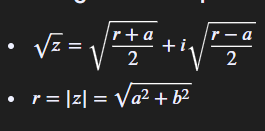
Square Root of a Complex Number: For a complex number z = a + bi,
Square root can be calculated using ( \sqrt{z} = \sqrt{\frac{r + a}{2}} + i \sqrt{\frac{r - a}{2}} ) where r = |z| = √(a² + b²).
General Formulas for Integer Powers of i:
i⁴m = 1
i⁴m+1 = i
i⁴m+2 = -1
i⁴m+3 = -i.
# Ways of Representing Complex Numbers ## 1. Standard Form Complex numbers can be expressed in standard form as: - **z = a + bi** - Where 'a' is the real part and 'b' is the imaginary part. - Example: For **z = 2 + 3i**, Re(z) = 2 and Im(z) = 3. ## 2. Argand Diagram Complex numbers can be represented on a 2D plane: - The horizontal axis represents the real part (a). - The vertical axis represents the imaginary part (b). - The point (a, b) corresponds to the complex number z. ## 3. Polar Form Complex numbers can also be expressed in polar coordinates: - **z = r(cos θ + i sin θ)** - Where r is the modulus |z| = √(a² + b²) and θ is the argument (the angle made with the positive real axis). ## 4. Exponential Form Utilizing Euler's formula, complex numbers can be represented as: - **z = re^(iθ)** - This is derived from polar form and links complex numbers to exponential