Practice Run
The popularity of Hollywood gangster films among theatergoers was a reflection of an important facet of American culture. During the 1930s, America experienced a significant spike in crimes of all kinds. The largest increase was not in small-time, petty crime but major, spectacular crimes carried out in broad daylight with remarkable ruthlessness. This new breed of criminal who engaged in these headline-grabbing crime sprees was either a member of organized criminal gangs or disaffected loners, wandering from one town to the next looking for an easy target. In response to this upsurge in violent criminal activity, the Federal Bureau of Investigation (FBI) assumed a new prominence in the public imagination that it had not held up to this point. FBI agents or “G-men" (short for “government men") assumed the status of romanticized heroes by the end of the decade.
The "Golden Age" of Organized Crime
The repeal of Prohibition shortly after President Roosevelt took office in 1933 scarcely put a dent in the power and profitability of the major crime syndicates. Prohibition indeed launched the careers of many criminals. Still, once they had perfected their organizational and business methods, gangsters were hardly eager to return to a boring, honest life. Just because alcohol could now be sold and transported legally, it did not mean that criminals were no longer involved in the process. After the repeal of Prohibition, legal alcohol was subject to Federal taxes to help pay for the New Deal, so bootleggers continued to manufacture and sell alcohol to customers eager to avoid paying the new taxes. Organized crime syndicates also increasingly diversified their operations into other kinds of crime. They ran underground lotteries, opened illegal gambling casinos and brothels, published and sold pornographic comic books known as “Tijuana Bibles,” carried out schemes to defraud state and local governments, and operated protection rackets and extortion and blackmail rings. The “Golden Age” of organized crime that had begun in the 1920s flourished even more in the 1930s; indeed, certain gangs that had begun during Prohibition would continue to control a majority of illegal activities in some cities until the early 1990s.
The Lindbergh Kidnapping and Rising Crime
As the 1930s progressed, America appeared to be descending further into criminal chaos. The first case to rock the nation came in March 1932 when the infant son of the famous aviator Charles Lindbergh was kidnapped from their family home in Hopewell, New Jersey. Despite prompt payment of the demanded ransom, Charles Jr. was never returned to his parents; three months later, his body was discovered in the woods a few miles from the Lindbergh home. Bruno Richard Hauptmann was found to have some of the ransom money in his possession and was tried, convicted, and executed for the crime, although he maintained his innocence to the last. Many referred to this act as “the crime of the century," and an outraged Congress rushed to pass the “Lindbergh Law,” making kidnapping a federal crime if the kidnapper or the victim crossed a state line.
The high-profile kidnappings and daring daylight robberies that occurred following the Lindbergh Kidnapping were not the work of Northeastern crime syndicates groups like the Mafia, but rather the handiwork of a small group of homegrown criminals. These were "murderous hillbillies" from the Midwest towns and cities that cobbled together ragtag gangs to do their bidding. Some of the most well-known groups were led by John Dillinger, Lester Gillis (a.k.a.“Baby Face Nelson”), Charles Arthur “Pretty Boy” Floyd, George Barnes (a.k.a.“Machine Gun Kelly”), Alvin “Ray” Karpis, and the Barker brothers, and Bonnie (Parker) and Clyde (Barrow). Remarkably, all of these criminal gangs were active simultaneously between 1931 and 1936, and in the same general part of the country - America's heartland from Chicago and Michigan’s Upper Peninsula in the North to New Orleans and San Antonio in the South, and from Cleveland in the East to Sioux Falls and Fort Worth in the West.
The FBI Strikes Back
The activities of these particular gangs became a priority for law enforcement following another sensational crime. On June 17, 1933, two FBI agents and several local police officers were escorting a wanted bank robber named Frank Nash to a waiting car outside the Kansas City train station. The men were getting into the car when assassins opened fire with sub-machine guns, killing two police detectives, an FBI agent, and Frank Nash. The recently-appointed director of the FBI, J. Edgar Hoover, and Attorney General Homer S. Cummings were determined to hunt down those responsible for the "Kansas City Massacre." Furthermore, they also wanted to launch an all-out “War on Crime.” President Roosevelt agreed and soon made the new "War on Crime" part of his overall New Deal agenda. Bringing the bank robbers and kidnappers plaguing the Midwest to justice would be a tangible sign that the federal government took the nation's crisis seriously.
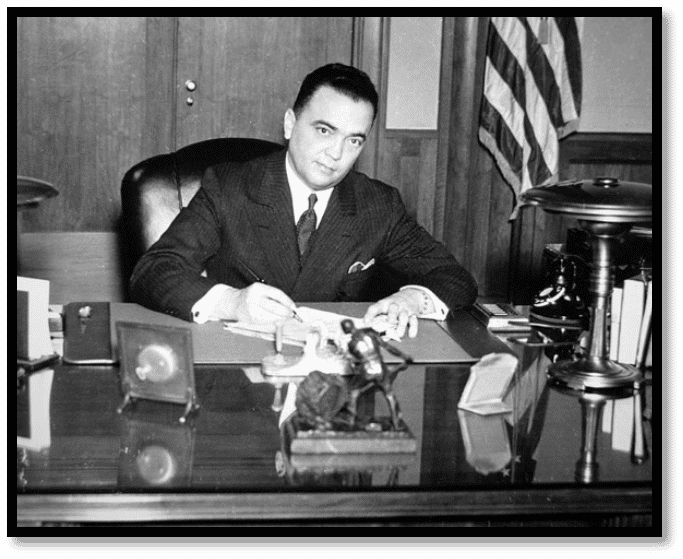
J. Edgar Hoover
Hoover had a lot of work to do to prepare his agency to achieve this goal. The Justice Department's Bureau of Investigation (“Federal” was not part of its original title) had been formed in 1908 to investigate antitrust violations. Throughout the 1920s, it was an agency adrift, beset with corruption and lacking the authority to investigate only a handful of crimes. Agents did not have the authority to arrest anyone, meaning that they had to call the local police whenever they caught a suspect, and only a few of the most senior agents were allowed to carry guns.
Immediately after the Kansas City Massacre, however, Hoover issued guns to all his agents. More importantly, he set his agents to work tracking down the gangs of outlaws crisscrossing the Depression-ravaged landscape in stolen cars and robbing filling stations, drugstores, and banks. The most serious crimes of all were the kidnappings, many of them probably carried out as imitation of the Lindbergh kidnapping. Thanks to the Lindbergh Law, the FBI now had the legal authority to investigate the kidnappings. The federal investigation of the other crimes proceeded despite the lack of legal jurisdiction by the FBI.
G-Men in the Public Imagination
By 1936, the FBI had won its war against all six of the major gangs that had been terrorizing the nation in the summer of 1933. Some gangsters, such as “Machine Gun Kelly” and Alvin Karpis, were hunted down and arrested by FBI agents. Others, such as Bonnie and Clyde, were ambushed and killed in a hail of gunfire. In the process, however, the FBI transformed from a small group of amateurish sleuths who lacked guns and the skills to shoot them into the nation’s first federal police force. The FBI was just as much a part of the New Deal as any of the job creation agencies since it was fully consistent with the New Dealers’ philosophy that the federal government needed to fix the nation’s problems through direct intervention.
The FBI differed from other New Deal agencies in one fundamental respect. Americans might appreciate the jobs provided by the CCC and the WPA or the relief money doled out by the FERA and the AAA, but the work these agencies performed was boring and mundane. By contrast, the FBI's War on Crime captured the public interest, and J. Edgar Hoover and his G-men became heroes in the public imagination. Hoover was not content to bask in the glory of his agency's accomplishments. He actively encouraged the G-men's public perception as valiant saviors of law and order who used rigorous scientific methods of detection to stop the crime spree that had gripped the nation. While individual agents no doubt acted with bravery and intelligence, the reality was less impressive. In the months after the Kansas City Massacre, the Bureau made numerous mistakes due to many of its agents' inexperience, ranging from failing to follow up on important leads to mistakenly arresting innocent people. Nevertheless, the heroic G-man's image became a staple of popular culture that lasted well beyond World War II.