Pigments - photosyn
organic molecules 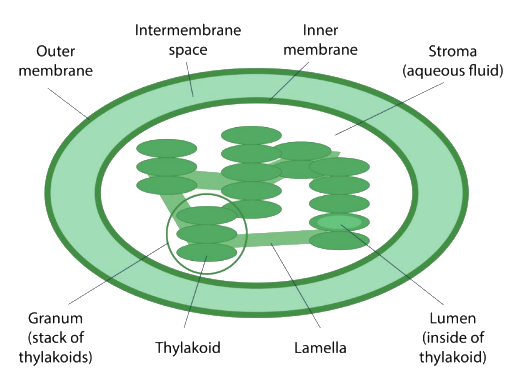
selectively absorb light of specific wavelengths
built in the thylakoid membranes
Wavelength of Light
Wavelengths of light that are not absorbed are reflected.
Reflected light gives each pigment its characteristic color.
Chlorophyll a
site for photosynthesis
found in the chloroplast
converts solar energy to chemical energy
 Chlorophyll b
present only in green algae and higher plants.
absorbs mainly blue and orange light but reflects olive green
and does not participate directly in light reactions.
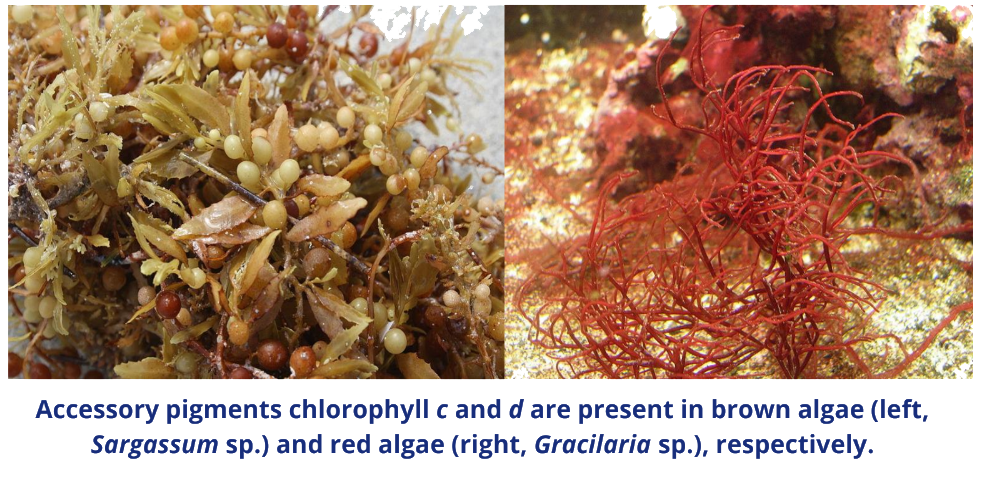 Accessory Pigments
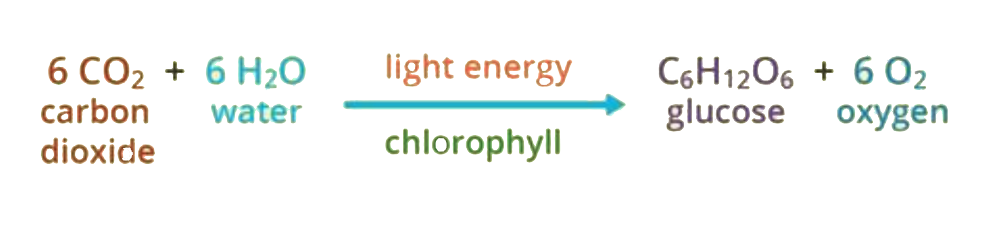
Photosynthesis
converts solar energy to chemical energy
autotrophs
occurs in the chloroplasts
The light-dependent reactions (or simply light reactions) are named so because they only occur when solar energy is available. Pigment molecules capture kinetic energy from photons and store it in the chemical bonds of two molecules, ATP and NADPH
Light absorption
Chlorophyll, the green pigment found in chloroplasts, absorbs light energy. This energy excites electrons, causing them to move to a higher energy level.
Photosystem II
The excited electrons then move to Photosystem II, which is a protein complex embedded in the thylakoid membrane. PSII absorbs light energy and uses it to split water molecules into oxygen, protons, and electrons. The electrons are then transferred to an electron transport chain.
Electron transport chain
The excited electrons then move through a series of electron carriers, forming an electron transport chain. As the electrons move down the chain, they release energy, which is used to pump protons across the thylakoid membrane.
Photosystem I
The electrons eventually reach Photosystem I, which is another protein complex embedded in the thylakoid membrane. PSI absorbs light energy and uses it to boost the energy of the electrons. The electrons are then used to reduce NADP+ to NADPH.
Proton gradient
The accumulation of protons on the inside of the thylakoid membrane creates a proton gradient. This gradient is used by ATP synthase to generate ATP.
Photolysis of water
To replenish the electrons that were lost in the first step, water molecules are split into oxygen, protons, and electrons. The electrons are then used to reduce NADP+ to NADPH.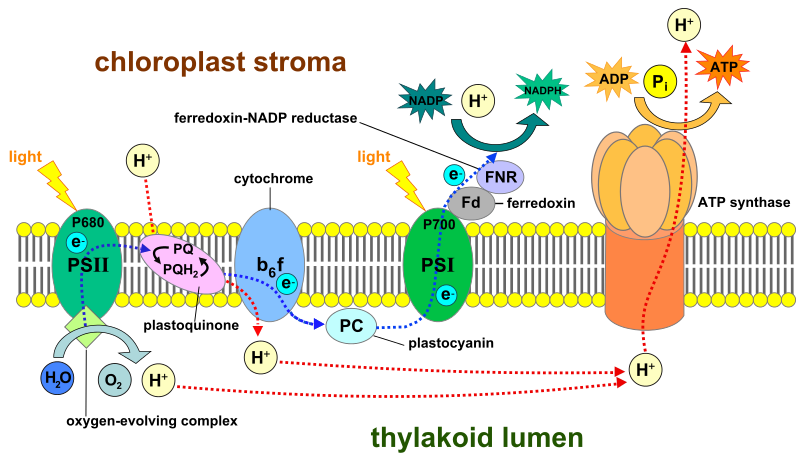
Chloroplast: The chloroplast is the overall structure that houses the components involved in photosynthesis. It is a double-membraned organelle that contains various internal components, including the stroma, grana, and thylakoids.
Stroma: The stroma is the fluid-filled space within the chloroplast that surrounds the thylakoids. It contains enzymes and other proteins that are involved in the Calvin cycle, the second stage of photosynthesis.
Grana: Grana are stacks of flattened, sac-like structures called thylakoids. They are the sites where the light-dependent reactions of photosynthesis take place.
Thylakoids: Thylakoids are the membranous sacs that make up the grana. They contain chlorophyll, the green pigment that absorbs light energy, and other proteins that are involved in light-dependent reactions.
Photosystem II: Photosystem II is a protein complex embedded in the thylakoid membrane that initiates the light-dependent reactions of photosynthesis. It absorbs light energy and uses it to split water molecules into oxygen, protons, and electrons.
1. Carbon fixation (RuBisCO activation)
The first step of the Calvin cycle is carbon fixation, in which carbon dioxide is attached to a five-carbon molecule called ribulose-1,5-bisphosphate (RuBP) by an enzyme called RuBisCO. This reaction forms two molecules of 3-phosphoglycerate (3PGA).
Mechanism:
a. RuBisCO is a large enzyme that contains multiple subunits, with each subunit having an active site.
b. Carbon dioxide binds to an active site on one of the subunits of RuBisCO.
c. The activated CO2 molecule is transferred to an adjacent RuBP molecule, forming two molecules of 3PGA.
2. Reduction
The two molecules of 3PGA are then converted into two molecules of glyceraldehyde 3-phosphate (G3P) using ATP and NADPH. This reaction is called reduction.
Mechanism:
a. 3PGA is phosphorylated by ATP to form 1,3-bisphosphoglycerate.
b. 1,3-bisphosphoglycerate is then reduced using NADPH to form G3P.
3. Regeneration
Some of the G3P molecules are used to synthesize glucose, while others are regenerated to form RuBP. This regeneration process requires ATP and allows the cycle to continue.
Mechanism:
a. Three G3P molecules are rearranged to form fructose-6-phosphate.
b. Fructose-6-phosphate is phosphorylated by another ATP molecule to form fructose-1,6-bisphosphate.
c. Fructose-1,6-bisphosphate is cleaved to form dihydroxyacetone phosphate (DHAP) and glyceraldehyde 3-phosphate (3PGA).
d. DHAP and one of the 3PGA molecules are used to regenerate RuBP.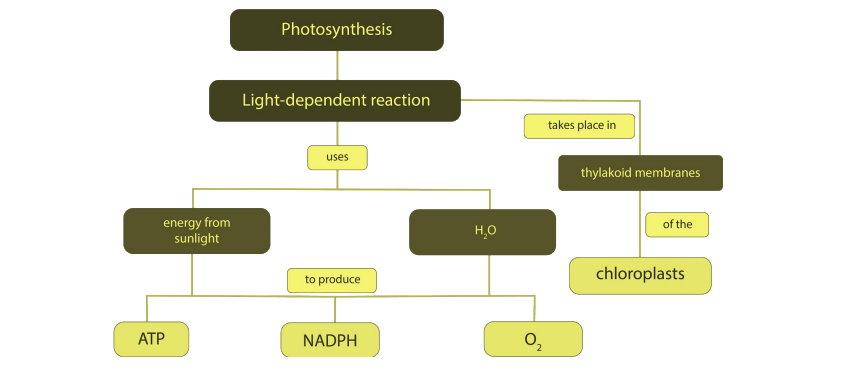
Requirements for Glucose (C₆H₁₂O₆) | Quantity |
|---|---|
ATP | 18 |
NADPH | 12 |
CO2 | 6 |
RUBP | 6 |
G3P | 2 |