Year 8 Biology Notes
7 characteristics for all living organisms (MRS NERG):
Movement
Respiration
Sensitivity
Nutrition
Excretion
Reproduction
Growth
Unicellular organisms: One cell organisms capable of all 7 life processes, e.g. amoeba
Parts of Animal cells:
Cell membrane- Selectively permeable- controls what enters and leaves the cell
Cytoplasm- Where chemical reactions take place, main part of cell, jelly-like substance
Nucleus- Control centre of cell where genetic information is stored in the form of chromosomes (DNA)
Mitochondria- The site of aerobic cellular respiration
Nuclear Membrane- Membrane that surrounds the nucleus
Respiration is the process by which an organism makes energy
Parts of Plant cells:
Cell wall: Provides support, made of cellulose
Vacuole: Contains cell sap, makes cell rigid and provides support
Chloroplasts: Contains chlorophyll, traps light, is used for photosynthesis
Plant cells have more chloroplasts than mitochondria
Chloroplasts are only found in the green parts of plants
Parts of bacterial cells:
Plasmids- Small circular loops of DNA
Non-cellulose cell wall
Their DNA is in the form of a loop
Some bacteria have a flagellum, this is a tail-like structure that helps them move/swim
They are not joined together with other cells and tissues
Microscopes:
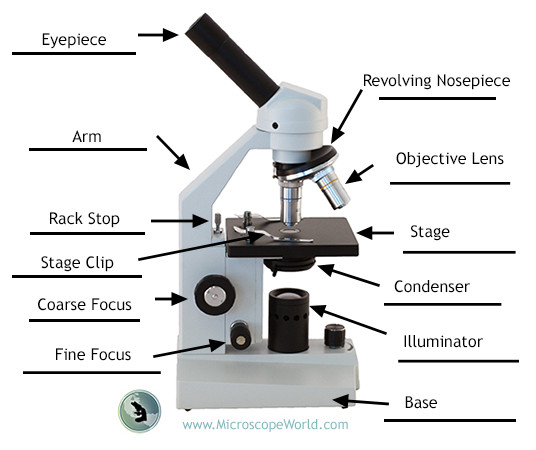
The specimen has to be very thin so light can pass through it
Coloured dye can be used to make the the features of the objects more visible:
Iodine- Plant cells Methylene blue: Animal cells
Specialised cells:
Root hair cells
Palisade cells
Guard cells
Red blood cells
White blood cells
Nerve cells
Sperm cells
Egg cells
Ciliated cells
Diffusion: The random movement of particles from a place of high concentration to a place of low concentration
Net movement- The number of particles moving in one direction, minus the number moving in the other
Levels of organisation: cell, tissue, organ, organ system, organism
Organ systems:
Circulatory- made up of Heart, blood, blood vessels and lymphatics. This is the body’s delivery system. I circulates blood to deliver oxygen and nutrients to each part of the body.
Digestive- made up of mouth, stomach, large and small intestines, liver and gallbladder. Breaks down food to be used for energy
Endocrine- made up of pituitary and thyroid glands, ovaries, testes, pancreas and renal glands. It regulates, coordinates and controls a number of body functions by secreting chemicals into the bloodstream. These secretions help control moods, growth, development and metabolism.
Muscular- made up of muscle fibres, tissue and tendons. Helps move the body and move materials through the body.
Nervous- made up of brain, spinal chord and nerves. Uses the information received from the brain to coordinate all of your actions and reactions by carrying messages (impulses) around the body.
Reproductive- made up of mammary glands, penis, uterus, epididymis, ovaries and testes. Ensures that humans are able to reproduce and survive as a species
Respiratory- made up of nose, larynx, trachea, diaphragm, bronchi and lungs. To supply the blood with oxygen in order for the blood to deliver oxygen to all parts of the body. The respiratory system does this through breathing.
Skeletal- made up of bones, cartilage and joints. Provides the shape and form for our bodies in addition to supporting and protecting our bodies, allowing bodily movement, producing blood cells and storing minerals.
Excretory- made up of kidneys, ureters, urinary bladder and urethra. To filter out excess fluid and other substances out of the bloodstream. Some fluid gets reabsorbed by your body but most gets expelled as urine.
Integumentary-made up of hair, skin and nails. Helps with body temperature regulation, cell fluid maintenance, synthesis of vitamin D and detection of stimuli
Immune- made up of thymus, lymph noes, spleen and lymphatic vessels. To keep germs and other foreign substances out of the body and destroy any that get in.
The circulatory system:
2 main functions: Transportation of substances, Protection against disease
3 main components: Heart (pump), Blood, Blood vessels
4 components of blood:
Red blood cell: carries oxygen. Contain haemoglobin (rich in iron). Biconcave shape to provide a large surface area for the diffusion of oxygen. No nucleus to provide more space for haemoglobin.
White blood cell: Defends the body against disease. Large cells that contain a nucleus. There are 2 types: lymphocytes- make antibodies and phagocytes- engulf and digest microorganisms
Platelets: Convert fibrogen to fibrin. Fibrin forms a mesh that traps blood, Important in blood clotting and scab formation.
Plasma: Transports blood cells, digested food molecules, carbon dioxide, urea and hormones. Yellow coloured liquid
There are more red blood cells than white blood cells
White blood cells are bigger than red blood cells
A red blood cell doesn’t have a nucleus, a white blood cell does
3 main blood vessels:
Arteries- Carry oxygenated blood away from the heart. Thick walls with muscle and elastic fibres to withstand high pressure, muscle and elastic fibres within the walls also allow the artery to expand and recoil with each surge of blood
Veins- Carry deoxygenated blood into the heart. The lumen is large and reduces friction as the blood moves through. Blood is moving at a low pressure, so the walls are thin. Very few muscle and elastic fibres because blood does not surge through veins. Valves are present to prevent the backflow of blood.
Capillaries- Allow the diffusion of substances between the blood and the body’s cells or vice versa. Walls are 1 cell thick, providing a large, thin surface for diffusion.
The heart:
The heart is a unidirectional pump- it pumps blood in one direction. Valves are present to prevent the backflow of blood. The right side pumps deoxygenated blood back to the lungs, the left side pumps oxygenated blood to the organs of the body.

Journey of the blood through the heart:
Deoxygenated blood enters the right atrium through the vena cava
Blood moves into the right ventricle
Blood is pumped into the pulmonary artery
The pulmonary artery carries deoxygenated blood to the lungs
The blood becomes oxygenated in the lungs
Oxygenated blood leaves via the pulmonary vein
Blood enters the left atrium
Blood moves into the left ventricle
Blood is pumped into the aorta, which carries oxygenated blood around the body to all the body cells where it is used in respiration
This unidirectional flow of blood through the heart shows that mammals have a double circulatory system l This means blood travels through the heart twice in one circulation of the body. Ventricular walls are thicker than atrial walls because the ventricles have to pump blood further. The left ventricle wall is thicker than the right because it pumps blood around the body while the right pumps blood to the lungs, located close to the heart.
Renal- associated with kidneys, Hepatic- associated with livers
Vena cava- Carries deoxygenated blood from the body back into the heart
Pulmonary artery -Carries deoxygenated blood from the heart to the lungs
Pulmonary vein- Carries oxygenated blood from the lungs to the heart
Aorta- Carries oxygenated blood from the heart around the body
Hepatic artery- Carries oxygenated blood to the liver
Hepatic vein- Carries deoxygenated blood back to the heart. Carries digested food (glucose and amino acids) from the liver around the body
Hepatic portal vein- Carries digested food from the small intestine to the liver
Renal artery- Carries oxygenated blood (rich in urea) to the kidneys for excretion
Renal vein- Carries deoxygenated blood (low in urea as it has been purified in the kidney) back to the heart
The excretory system:
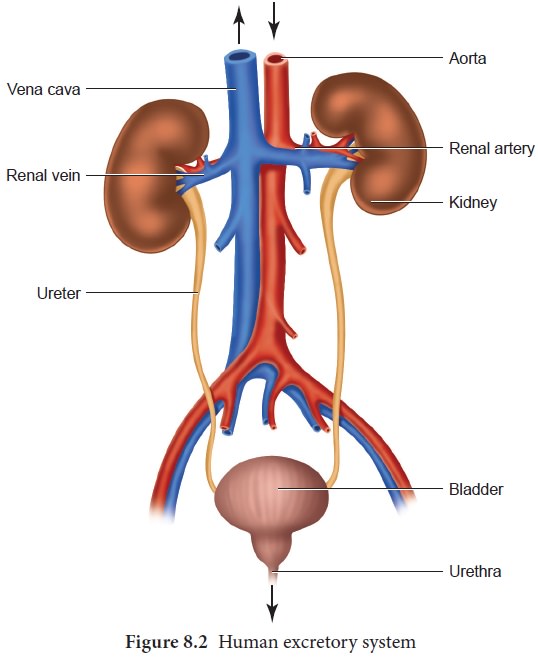
The main role of kidneys:
Regulates the water content in the blood to make sure we have just the right amount of water in the blood. They excrete/remove the toxic waste products of metabolism
How the kidney works:
Blood enters via the renal artery
Liquid and many dissolved substances are filtered out in the cortex
In the medulla, water and some of the substances are reabsorbed back into the blood in a controlled way until normal concentrations are reached
Any water and dissolved substances left over pass into the urine, which collects in the renal pelvis
Urine passes into the ureter
Urine is stored in the bladder
Urine is passed out via the urethra