Chemistry C.2 – Atomic Structure: The Nuclear Model
2.1 Introduction
Matter – the scientific term used to describe all materials and substances
The particulate nature of matter – the scientific theory which states that all substances consist of tiny, constantly moving particles with space between them
2.2 The development of the nuclear model of the atom
Atom – the smallest particle of an element that still has the properties of that element
Electrons – negatively charged subatomic particles
Electron charge: 1.6 × 10^(-16) coulomb
Electron mass: 9.1 × 10^(-31) coulomb
Cathode rays – streams of electrons
The Greek philosophers’ concept of the atom (400BC):
They were the first to propose that matter was composed of small particles. This was called Democritus’ atomic theory – that if you kept cutting a piece of matter into smaller and smaller pieces, you would eventually reach particles so small that they could not be broken down any further.
Dalton’s Atomic theory (1808):
1) All matters is made up of very small particles called atoms
2) All atoms are indivisible – they cannot be broken down into smaller particles
Proposed to explain experimental observations about how substances behave during chemical reactions.
Discovery of cathode rays – William Crookes (1875):
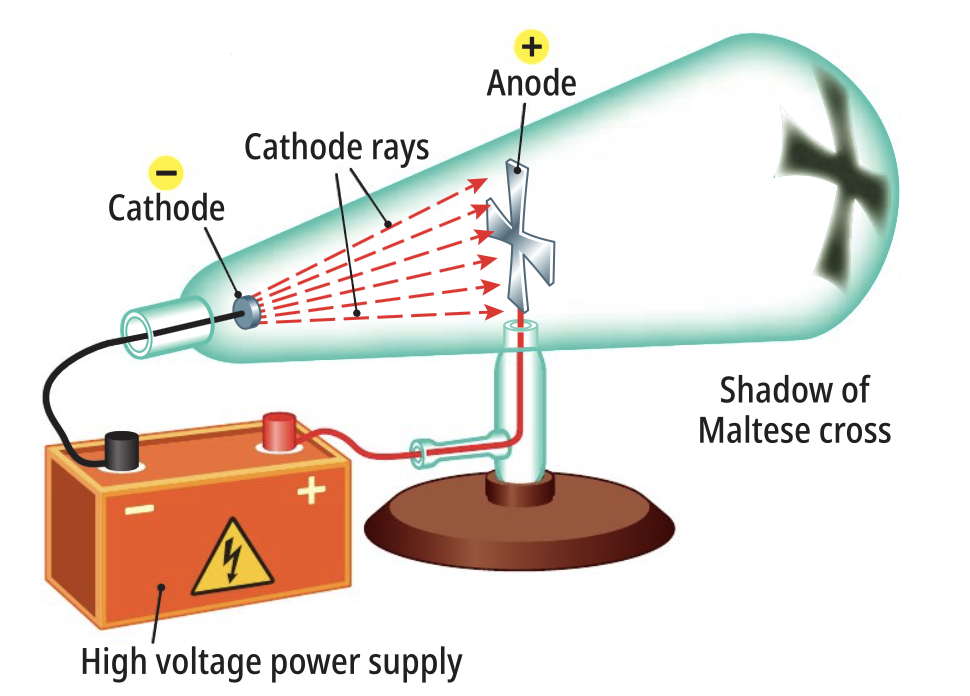
Passed an electric current through the air at a low pressure, showing that rays were coming from the negative electrode (cathode) and that these cast a shadow on glass when partially obstructed.
Discovery of the electron – J. J. Thomson (1897):
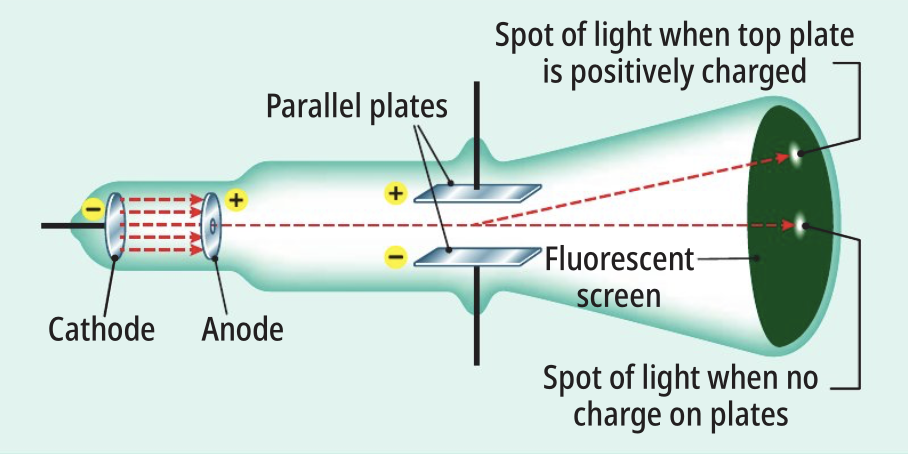
Produced a narrow beam of cathode rays passed through a small hole ina positive electrode, and passed it between two parallel metal plates which then struck a fluorescent screen at the far end of the tube. When there was no charge on the plates, the cathode ray beam passed straight down. When there was a positive charge on the top plate, the negatively charged electrons were attracted and the spot of light moved upwards.
2.3 The ‘plum pudding’ model of the atom
J. J. Thomson (1898)
An atom is like a sphere of positive charge
Electrons are embedded in the sphere at random
2.4 The nuclear model of the atom
Ernest Rutherford (1909)
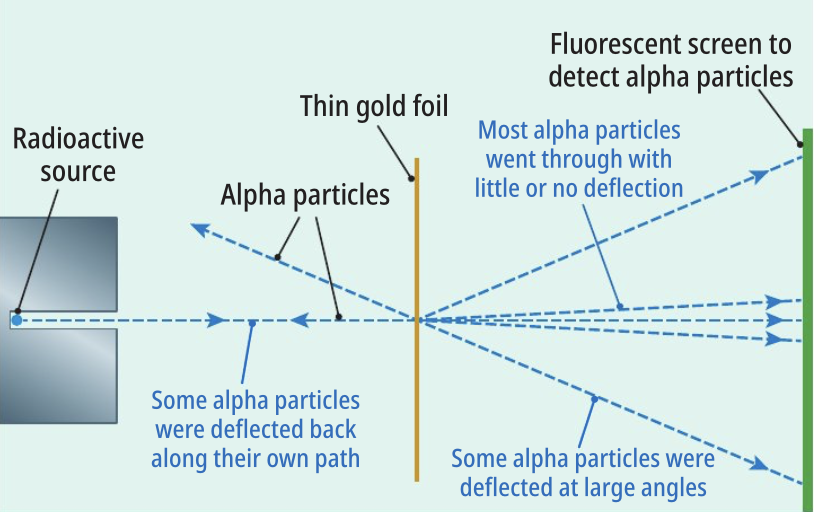
Bombarded a thin piece of gold foil with alpha particles and used a phosporescent screen to detect them after. Rutherford found that the vast majority of the alpha particles passed undeflected as expected, however some alpha particles were deflected at large angles and some wre deflected back altogether.
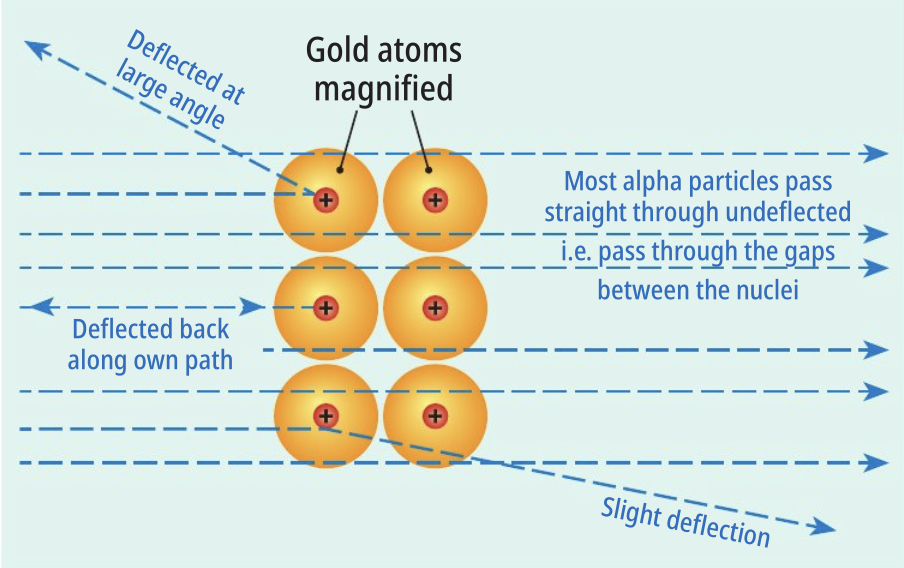
Observation | Conclusion |
Most alpha particles pass straight through the gold foil. | Most of the atom is empty space. |
Some alpha particles are deflected at large angles. | The alpha particles are repelled when they pass near the small positive nucleus. |
A small number of alpha particles are reflected back along of their own paths. | A small number of positively charged alpha particles collide head on with the positively charged nucleus. |
Careful study of the scattering angles showed that the nucleus of an atom had a diameter of approximately 1/100,000 of the size of the atom.
Alpha particles – positively charged particles consisting of groups of two neutroms and two protons stuck together
Nucleus – a small dense postively charged core of an atom comprised of protons and neutrons
2.5 Discovery of the proton
In the case of light atoms such as oxygen and nitrogen, small positively charged particles were given off as a result of the bombardment, or protons. This did not occur with the atoms of the heavier metals such as gold because the large positive nuclear change repelled the alpha particles before they had a chance to break up the nucleus.
Protons – positively charged subatomic particles
2.6 Assumptions and limitations of Rutherford’s nuclear model
Assumptions:
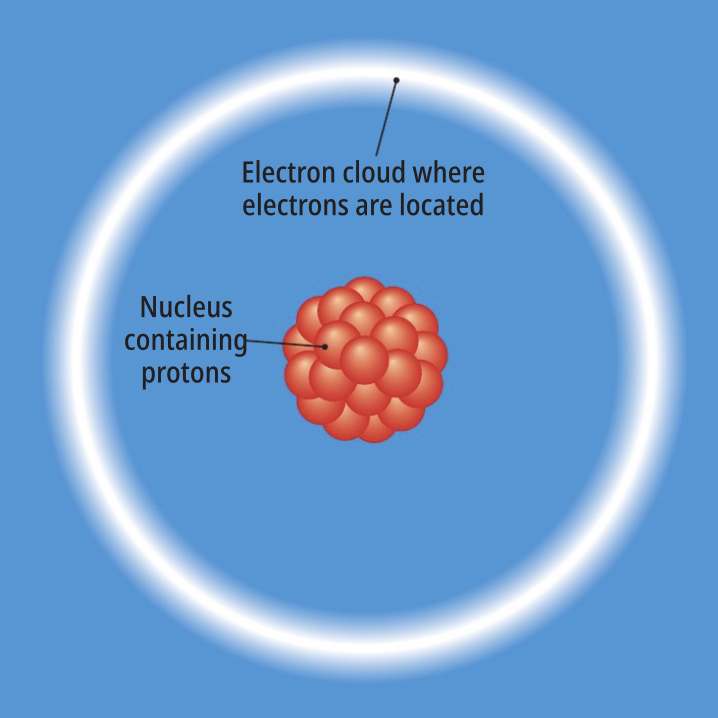
Atoms contain a small dense positive core called the nucleus. Most of the mass of an atom is concentrated in the nucleus.
Positive particles (protons) are located in the atom.
The atom is mostly empty space.
Electrons are scattered around in space surrounding the nucleus, also known as the electron cloud.
Note: Rutherford proposed that electrons were moving around the nucleus but did not describe exactly the motion of these electrons.
Limitations:
Since like charges repel, why does the nucleus not fly apart due to the repulsion between the protons in the nucleus?
Since opposite charges attract, why don’t electrons spiral into the nucleus