Lesson 2: Religious Support Fundamentals
Lesson Introduction
Welcome to the Religious Support Fundamentals Lesson. How do Soldiers receive religious support? This lesson will examine religious support, the basis and authority for support operations, and the coordination of support in the absence of a Chaplain. Knowledge of these procedures are paramount to your duty as a Religious Affairs Specialist.
There are three learning objectives for this lesson. You will learn to define religious support and the UMT's mission, identify the basis and authority for religious support operations, and identify the procedures for religious support in the absence of the Chaplain. At the end of this lesson you will complete the Lesson 2 posttest with a score of 70% or higher.
- Define religious support and the Unit Ministry Team’s (UMT’s) mission
- Identify Basis and Authority for Religious Support Operations
- Identify procedures for Religious Support in the Absence of the Chaplain
Topic 1: Religious Support
- Introduction
- In the previous lesson, you learned about the history of the Religious Affairs Specialist MOS, or Military Occupational Specialty, and some of the specific responsibilities of the Religious Affairs Specialist. In this lesson, we'll explain the Religious Affairs Specialist's role in the context of the unit. Specifically, we'll discuss how a unit provides religious support for its Soldiers. How do the Commander, Chaplain, and Religious Affairs Specialist work together to provide religious support to Soldiers and other personnel? What specific responsibilities do the Commander and Chaplain have in regards to providing religious support, and how does the Religious Affairs Specialist support them? In this topic, we'll begin to answer these questions by examining the nature of religious support and the roles of the Commander and Chaplain in providing that support.
- The Chaplain Corps
The Chaplain Corps is the Army's primary agency for ensuring the free exercise of religion for America's Soldiers, Army family members, Department of Army civilians, and other authorized personnel. The Chaplain Corps ensures the free exercise of religion by executing the command religious programs of Army Commanders.
- Ensures free exercise of religion for:
- Soldiers
- Army family members
- Department of the Army civilians
- Other authorized personnel
- Executes the command religious programs of Army Commanders
- The Unit Ministry Team
The primary arm of the Chaplain Corps at the unit level is the Unit Ministry Team, or UMT , which comprises at least one Chaplain and one Religious Affairs Specialist. The UMT is a task-organized, mission-based team designed to support the religious, spiritual, and ethical needs of Soldiers and their families, members of other services, and authorized civilians.
- Personnel of the Unit Ministry Team (UMT):
- Chaplain
- Religious Affairs Specialist
- Major tasks and missions:
- Provide religious, spiritual, and ethical support
- Support for Soldiers, families, and authorized civilians
- Religious Support
- The mission of the UMT is to provide religious support, but what is religious support? Many activities fall under the umbrella of religious support, but the primary goal is to ensure the right of the free exercise of religion for Soldiers on behalf of the Commander. Soldiers may exercise this right in a number of ways, such as worshiping according to their individual faith, seeking religious counsel and care, and participating in religious rites, sacraments, and ordinances.
- Primary goal: ensure the right of the free exercise of religion for Soldiers
- Individual expressions of the free exercise of religion:
- Worshiping in accordance with a faith
- Seeking religious counsel and care
- Participating in religious rites, sacraments, or ordinances
- The Importance of Religious Support
Field Manual 1-05 highlights the importance of religious support as follows: "In operations where lethality and intensity are high, religious support becomes increasingly important to Soldiers. UMTs provide hope, faith, encouragement, and compassion to Soldiers experiencing shock, fatigue, isolation, fear, and death. In the chaos and uncertainty of military operations, the UMT is a reminder of the presence of God." As this statement illustrates, Soldiers need strength and hope in the chaos and turbulence of combat, and the UMT helps to provide that. Spiritually fit Soldiers are more able to focus on accomplishing their mission, as they are less distracted by emotional and spiritual concerns.
- Religious support is particularly important for Soldiers in lethal and intense environments.
UMTs provide hope, faith, encouragement, and compassion in times of great stress.
“The UMT is a reminder of the presence of God” - FM 1-05
- Religious Support Roles
Now we've established that the main goal of religious support, and thus the primary mission of the UMT, is to ensure the right of the free exercise of religion for Soldiers on behalf of the Commander. Let's examine the roles of the Commander and the Chaplain in providing that religious support. The responsibilities of the Religious Affairs Specialist will be covered in a later topic.
- Goal of religious support: ensure the right of the free exercise of religion for Soldiers on behalf of the Commander
- Three facilitators of religious support:
- Commander
- Chaplain
- Religious Affairs Specialist
- The Commander
The ultimate responsibility of providing religious support for Soldiers falls to the Commander of the unit. For the Soldiers under his or her command and other relevant personnel, the Commander must ensure the free exercise of religion, provide religious support activities, and accommodate religious practice. The Commander does this by working with the UMT to draw up a Command Master Religious Program, or CMRP. The CMRP is a document that authorizes resources for religious activities and UMT training. Completing a CMRP is the primary process for supporting chaplaincy programs at all levels of the Army.
- The Commander is ultimately responsible for providing religious support
- Accomplishes this by working with the UMT to draw up a Command Master Religious Program (CMRP), which:
- Authorizes resources for religious activities and UMT training
- Primary process for supporting chaplaincy programs at all levels of the Army
- The Chaplain
The Chaplain is personally responsible for delivering religious support to those serving in the Commander's unit. Army Chaplains have a dual role as religious leaders and religious support staff officers. Chaplains remain fully accountable to the code of ethics and ecclesiastical standards of their endorsing faith group. In some instances, this may restrict the Chaplain from participating in a command event, but it does not relieve the Chaplain from providing adequate religious support to accomplish the mission.
- Characteristics of the Chaplain:
- Personally responsible for delivering religious support
- Both a religious leader and a staff officer
- Fully accountable to the code of ethics and ecclesiastical standards of their endorsing faith
- Chaplain Responsibilities to the Commander
For the Commander, the Chaplain must advise him or her on issues of religion, ethics, and morale as affected by religion, including the religious needs of all personnel for whom the Commander is responsible. In addition, the Chaplain is responsible for providing the Commander with personal religious support, including pastoral care, personal counseling, advice, and confidentiality.
- The Chaplain has two primary roles with regard to the Commander:
- Advise the Commander on issues of religion, ethics, and morale as affected by religion
- Provide the Commander with personal religious support
- Chaplain Religious Support Activities
After working with the Commander to draw up a CMRP, the Chaplain must put those plans into action to provide religious support to the relevant personnel. One major component of providing religious support for the Chaplain is conducting religious services and rites for Soldiers and other personnel. In addition, the Chaplain must accommodate religious services that he or she cannot personally perform. Another major component of religious support is providing religious counseling and personal spiritual support and confidentiality to Soldiers and other personnel.
- Components of religious support:
- Conducting services and rites for Soldiers and other personnel
- Accommodating religious services that the Chaplain cannot personally perform
- Providing religious counseling and confidentiality to Soldiers and other personnel
- Chaplain Administrative Responsibilities
Putting into action the plans of the CMRP may often call for coordinating with UMTs other than the Chaplain's own. It is the Chaplain's responsibility to coordinate with other UMTs of higher or adjacent units or with other services or multinational partners, if such coordination is necessary, to provide the proper religious support to Soldiers and personnel under the Commander's responsibility. In addition, it is the Chaplain's responsibility, along with the Civil Affairs staff officer, to advise the Commander and staff on the impact of the faith and practices of indigenous populations within the area of operation.
- When necessary:
- Coordinate with UMTs of other units
- Advise Commander and staff on the impact of faith and practices of indigenous populations within the area of operation
- Chaplain Non-Combatant Status
Notably, Chaplains are considered non-combatants. Chaplains do not bear arms in combat or in unit combat skills training. Chaplains function as protected personnel under the Geneva Convention and are noncombatants as a matter of Army policy.
- Chaplains do not bear arms in combat or have combat skills training
- Chaplains are classified as protected personnel under the Geneva convention
- Summary
As a Religious Affairs Specialist and as part of the Unit Ministry Team, your role is to support the Chaplain and Commander in providing religious support to the unit. In this topic, you learned that the main goal of religious support is to ensure the right of the free exercise of religion for Soldiers and other relevant personnel. To do this, the Commander and Chaplain draw up a Command Master Religious Program, or CMRP, which authorizes resources for religious activities. In addition, you learned about the role of the Chaplain in providing religious support, which includes conducting services and providing confidential religious counseling.
- Religious Support ensures the right of the free exercise of religion for Soldiers
- CMRP authorizes resources for religious activities
- Chaplain conducts services and provides counseling
Topic 2: Basis and Authority for Religious Support Operations
Introduction
As you learned in the last topic, the primary goal of religious support is to ensure the right to the free exercise of religion for Soldiers and other relevant personnel. As a Religious Affairs Specialist, your role is to ensure that the Chaplain can provide that religious support. However, this mandate to provide religious support is not simply something that is left up to the Commander's whim. Rather, the need for religious support has its roots in the United States Constitution and is backed up by other laws and military regulations. In this lesson, we'll take a look at this basis of religious support.
- The Legal Basis
The First Amendment to the United States constitution explicitly acknowledges the right to the free exercise of religion. However, simply acknowledging such a right is not enough. Soldiers often do not have the normal opportunities to express their freedom of religion. Thus, the Unit Ministry Team, or UMT, in coordination with the Commander, must facilitate the expression of that right in non-standard environments. This duty was first explicitly articulated in 1956 in the United States Code.
- First Amendment: “Congress shall make no law respecting an establishment of religion, or prohibiting the free exercise thereof…”
- Soldiers may lack normal opportunities to express this right
- Role of the UMT is to facilitate the expression of this right
- USC, Title 10, Section 3547: Chaplains must hold appropriate religious services
- Religious Accommodation
In addition to directly holding services, the Chaplain, along with the Commander and Religious Affairs Specialist, are tasked with accommodating a diverse range of religious practices. This responsibility is articulated in Department of Defense Directive 1300.17. According to this Directive, the Commander has the responsibility to ensure the accommodation of religious practices whenever possible, and the Chaplain must provide support for religiously diverse populations. Army Regulation 600-20 further details the responsibilities of the Commander in accommodating religious practices within the Army framework.
- DoD Directive 1300.17
- Commander must ensure the accommodation of religious practices whenever possible
- Commander must provide support for religiously diverse populations
Army Regulation 600-20: Guidelines for the Commander on accommodating religious practices
- UMT Responsibilities
- The most comprehensive document outlining the responsibilities of the Chaplains and Religious Affairs Specialists is Army Regulation 165-1. This regulation provides details on the role of the Chaplain and Religious Affairs Specialist as well as their responsibilities in protecting the right to exercise religion in accordance with the First Amendment, USC Title 10, Section 3547, and Department of Defense Directive 1300.17.
- Army Regulation 165-1
- Details responsibilities of Chaplains and Religious Affairs Specialists
- Puts into action the rights and duties established by the 1st Amendment, USC Title 10, Section 3547, and DoD Directive 1300.17
- Free Exercise vs. The Establishment Clause
Given that one of the main responsibilities of the Chaplain is to conduct religious services, it might seem like this directly contradicts the Establishment Clause of the First Amendment. However, several factors prevent the Chaplain's activities from being a serious violation. First, Chaplains are trained to perform religious support activities beyond just performing services, including facilitating the exercise of religion for a religiously diverse population. Second, there are several endorsing agents and associations, such as the National Conference on Ministry to the Armed Forces, that provide guidance to Chaplains in their role. Finally, free exercise of religion is such a critical right that Congress is willing to violate the Establishment Clause as long as the government does not become excessively entangled with a particular religion or practice.
- How Chaplains respect the Establishment Clause:
- Trained to perform religious support activities beyond just performing services
- Associations provide guidance for Chaplains in their role
- Free exercise of religion trumps establishment as long as “excessive entanglement” is avoided
- Summary
- In this lesson, you learned about the legal and regulatory basis of the Chaplain's role of providing religious support. First and foremost, the United States Constitution guarantees the right to free expression of religion. The United States legal code specifies the role of the Chaplain in ensuring this right, just as the DoD Directive specifies the responsibility of the Commander to ensure that religious support is provided for Soldiers of all religious persuasions. Finally, you learned about the Army Regulations that provide guidance to Commanders, Chaplains, and Religious Affairs Specialists in their goals of providing religious support to Soldiers.Topic 3: Coordinating Religious Support in the Absence of the Chaplain
- Constitution establishes right to free exercise of religion
- Chaplain’s responsibility made explicit in the USC
- DoD Directive specifies Commander’s responsibility
- Army regulations provide guidelines on how to fulfill responsibilities
Topic 3: Coordinating Religious Support in the Absence of the Chaplain
- Introduction
The mission of the Unit Ministry Team, or UMT, is to provide religious support to Soldiers under the Commander's authority. As we've seen, the main goal of religious support is to ensure the free exercise of religion. So far, we've covered the responsibilities and roles of the Commander and Chaplain in ensuring that right. In this topic, we'll look at the responsibilities of the Religious Affairs Specialist. In particular, we'll examine the unique responsibilities of the Religious Affairs Specialist when assisting the Chaplain and when the Chaplain is absent.
- Religious Support Responsibilities
- As part of the Unit Ministry Team, the Religious Affairs Specialist has a variety of responsibilities in helping the Chaplain provide religious support. One major responsibility is to provide logistical and administrative support for the Chaplain in all UMT activities. The Religious Affairs Specialist must also conduct equipment maintenance and ensure that all UMT equipment is properly serviced. In addition, the Religious Affairs Specialist must monitor and assess Soldier morale and relay this information to the Chaplain.
- Responsibilities of a Religious Affairs Specialist:
- Provide logistical and administrative support
- Conduct equipment checks and maintenance
- Monitor and assess Soldier morale
- Role as Combatant
- Unlike the Chaplain, the Religious Affairs Specialist is a combatant. In addition to specialized religious tasks, the Religious Affairs Specialist coordinates the necessary security to conduct religious support operations and minimize the personal security risks of the Chaplain.
- Religious Affairs Specialist:
- Coordinates the necessary security needed to conduct religious support operations
- Minimizes the personal security risks of the Chaplain
- Responsibilities in the Absence of the Chaplain
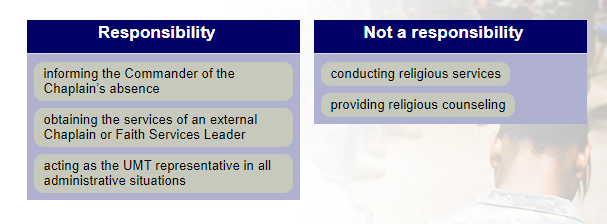
- When the Chaplain is absent, the Religious Affairs Specialist takes on additional administrative responsibilities. In such times, the Religious Affairs Specialist acts as the representative for the Unit Ministry Team in all administrative situations, such as staff meetings. Among specific responsibilities, the Religious Affairs Specialist must inform the Commander that the Chaplain is not available, and that the Religious Affairs Specialist will coordinate Unit Ministry Team activities as necessary in the Chaplain's absence.
- Additional administrative responsibilities:
- Acts as UMT representative in all administrative situations
- Informs the Commander of the Chaplain’s absence
- Coordinates UMT activities as necessary
- Obtaining the Services of an External Chaplain
- Soldiers' need for religious support will not simply be suspended while the unit's Chaplain is absent. Thus, the Religious Affairs Specialist needs to obtain the service of a Chaplain external to the unit. To do this, the instructions of the Religious Support Annex or the Installation SOP, also known as Standing Operating Procedure, must be followed. In doing so, the Religious Affairs Specialist must inform the unit Commander that the UMT will contact the next higher headquarters' UMT to request the support of a Chaplain. If no Chaplain can be provided from that headquarters, then the Unit Ministry Team of an adjoining battalion must be contacted.
- Follow the instructions of the Religious Support Annex or Installation SOP
- Contact the UMT at the next highest HQ
- If still no Chaplain is available, contact the UMT at an adjacent unit
- Referrals
- If no Chaplain is available from higher or adjoining units to perform a religious service, then the Religious Affairs Specialist should refer to the list of referrals put together by the Chaplain. The individuals on the referral list are usually authorized Distinctive Faith Group Service Leaders. Once an external Chaplain or other Faith Group Service Leader is contacted, the Religious Affairs Specialist is responsible for coordinating activities and handling logistics for any event in which the individual is to be involved. Finally, the Commander must be informed about the replacement and any related activities.
- If no Chaplain is available from another unit, consult the list of referrals:
- List put together by Chaplain
- Individuals on list are usually authorized Distinctive Faith Group Service Leaders
- The Religious Affairs Specialist must coordinate related activities and manage logistics
- Summary
In this lesson, you learned about the unique responsibilities of the Religious Affairs Specialist when assisting the Chaplain and when the Chaplain is absent. When assisting the Chaplain, the Religious Affairs Specialist must provide logistical and administrative support, assess and report on the morale of Soldiers in the unit, and ensure the safety and security of the Chaplain. When the Chaplain is absent, it is the responsibility of the Religious Affairs Specialist to acquire the services of a Chaplain from a higher or adjacent unit or, if the Chaplain is unavailable, an authorized Faith Group Service Leader. The Religious Affairs Specialist must also manage the logistics and administrative duties of any activities involving the external Chaplain or Service Leader. * Logistical and administrative support * Assess and report on Soldier morale * Ensure safety and security of Chaplain * Find proper replacement when needed \n