L5 Transport
Objectives
Explain the selective permeability of plasma membrane and the role of membrane proteins
Define and compare different types of transport: passive, active, diffusion, osmosis
Compare osmotic and hydrostatic pressure; explain the direction of water movement and the impact of osmosis on cell volume
Discuss types of passive transport and their characteristics
Explain types of active transport (primary and secondary)
What is the purpose of a selective permeable plasma membrane?
allows specific molecules for entry/exit
What is the purpose as a barrier?
protects/isolates the cytosol
What are the 3 main transmembrane proteins that facilitate transport?
Ion channels
Transporters
Pumps
What are the 4 types of transport?
Passive
Active
Diffusion
Osmosis
Explain Passive transport
particles follow the concentration gradient from high to low
Explain Active transport
particles that are moving against the concentration gradient
What does active transport require in order work?
energy
What is diffusion
Random movement of molecules in a solution INDEPENDENT on each other
What 3 things does the net movement/flux in diffusion depend on?
Concentration gradient
Size of molecule
Permeability of the barrier’s substance
Explain what happens when particles are added to a solvent i.e. water
initially clustered particles will undergo random movements in all directions but will become equally distributed within the space they occupy
Diffusion of one substance in a solution does not interfere with the diffusion of another substance within the same solution True or False
True
independent of each other
What is the barrier to diffusion?
Plasma membrane
allows small molecules (MW < 80 daltons), some ions and gases to cross
What type of molecules require specific transport proteins to gain access to the plasma membrane?
larger molecules
What does Osmosis depend on to transfer water through a semipermeable membrane?
Concentration gradient
How does water enter cells?
Water Channels (Aquaporins)
When solute concentration is LOWER what happens the concentration of Free Water?
Free water is HIGHER and would move towards lower concentration of water
The concentration of free water is INDEPENDENT of what?
Particle SIZE
What is the concentration of free water dependent on?
Number of solute particles
What is the difference between osmotic and hydrostatic pressure?
Osmotic Pressure is generated by differences in solute concentration on different sides of a barrier
Hydrostatic Pressure is applied to stop the water flow
Explain the relationship of Solute Concentration and Osmotic Pressure
directly proportional relationship
What changes in consequence of osmosis?
Cell volume
Distinguish Isotonic, Hypotonic, and Hypertonic. Which has the higher/lower/same osmotic pressure?
Isotonic — no net movement of water & no cell volume change
Hypotonic — water moves into cells & cell volume increases (can burst)
Hypertonic — water leaves cells & cell volume decreases
Erythrocytes are placed in a hypertonic solution of sodium chloride. Which of the following will be an effect of the osmosis that will occur?
Cells shrink in volume
What transmembrane proteins are used for PASSIVE Transport?
Ion Channels and Transports (Catalyzed Transport)
What are examples of Catalyzed Transporters?
various ligands
Glucose Transporter
Which glucose transporter has a higher affinity?
D-Glucose compared to L-Glucose
What is a Uniport?
PASSIVE transporter that facilitates movement of a SINGLE type of molecule across a cell membrane
follows the molecule’s concentration gradient and does NOT need energy
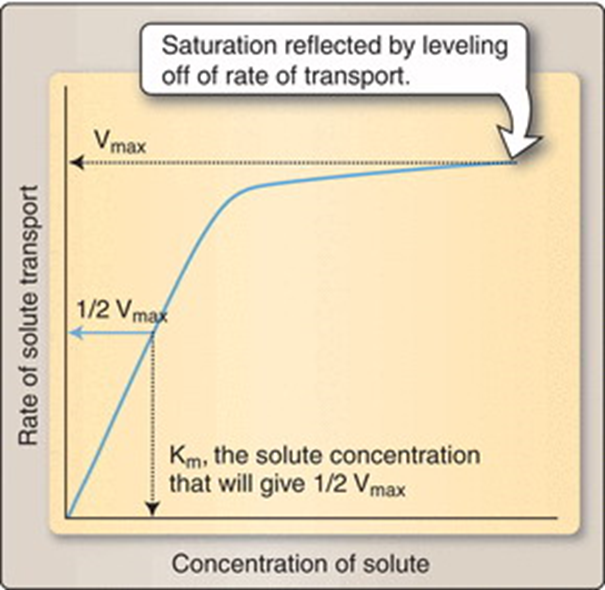
What are characteristics of transport catalyzed by transporters?
Affinity (Km), Maximal Velocity (Vmax), and Saturation
What type of transport moves substrates against their concentration gradients?
Active Transport
What are the two types of active transport?
Primary and Secondary Active Transport
What are the 4 Classes of PRIMARY ACTIVE transport that are ATP-powered pumps (ATPases)
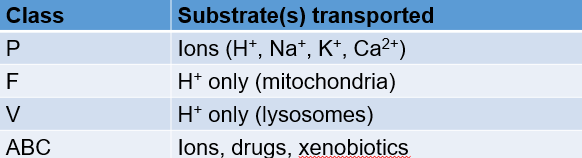
What class pump is an electrogenic transport?
P-Class Pump
Sodium-Potassium ATPase
ATP is hydrolyzed to ADP + Pi
Explain the electrogenic exchange that happens in a sodium-potassium ATPase
pumps out 3 Na+ for every 2 K+ that enters the cell — going against the chemical gradient
What are the domains of the ATP-Binding Cassette (ABC) superfamily
2 Cytosolic ATP-Binding Domains
2 Transmembrane Domains
What are the steps in an activated ABC-Class Pump
ATP binding
Conformational Change
Substrate Translocation
What does the ABC class pumps transports?
Ions, Drugs, Xenobiotic (foreign)
How many families does ABC transporters have?
7
What ABC transporter is associated with Multi-Drug Resistance (MDR)?
ABCB1 (P-Glycoprotein)
What is a Secondary Active Transport?
an Ion Gradient that provides energy for transport of other molecules/ions against their own concentration (Cotransport)
generated by ATP-powered pumps (primary transport)
What are the 2 types of secondary active transport?
Symporter & Antiporter
Explain the function of Symporters
Cotransport where one substrate is following its gradient (high to low) while the other substrate is going against its gradient (low to high) but both are transported into the cell
neither can be transported without the other
WHAT ARE EXAMPLES OR SYMPORTERS
Sodium-Glucose Transporter
Sodium-Bicarbonate Cotransporter
Sodium-Chloride Cotransporter
Explain the function of Antiporters
Cotransport where one substrate is following its gradient (high to low) while the other substrate is going against its gradient (low to high) but both going opposite directions
WHAT ARE EXAMPLES OF ANTIPORTERS
Sodium-Calcium Antiporter
Sodium-Proton Antiporter (exchanger)
Bicarbonate/Chloride Antiporter