New Testament
New Testament Overview
27 books
Written in koine Greek
Composed over a period of about 70 years beginning in 50 AD.
Types of writings = narratives and letters
Canon confirmed largely by the 200s Ad and officially by 367 AD
Testament
Means covenant
Open ended contract of love with God and humanity
Jesus's death and resurrection sealed God's new covenant of love for all time
New Testament proclaims that God established the new covenant for all people
New Testament
The climax of salvation history, the coming of Jesus, the fullness of God's revelation
About Jesus
For everyone
Fulfills OT, doesn't contradict it
Reveals that a loving God has extended his loving kindness and salvation to all people
4 Gospel Writers; Matthew, Mark, Luke, John
Each Gospel Writer was a uniquely talented author
Each writer wrote about Jesus for a particular people
Spoke to the needs and experiences of his audience
Formation of the Gospels
Stage 1: The Public Life and Teaching of Jesus (4-6 BC-AD 30-33)
Stage 2: Oral Tradition (AD 30-50)
Stage 3: The New Testament Writings (50-120)
Oral Tradition
Kerygma-preaching to the unbelievers
The Didache
Catechetical instruction to converts
The Liturgy- worship or way people reflect their beliefs in Eucharistic Celebrations
1st Century-ordinary way of teaching and learning was through oral transmission
But, it became important to write down the teachings of Jesus
Jesus' Life and Teachings Needed To be Written Down
The end of the world was not coming as quickly as the early Christians thought it would
Distortions were setting in
More instruction was needed
Criteria for Inclusion in the Canon
Apostolic Origin - Inspired by witness of the Apostles
Widespread Acceptance - widely spread
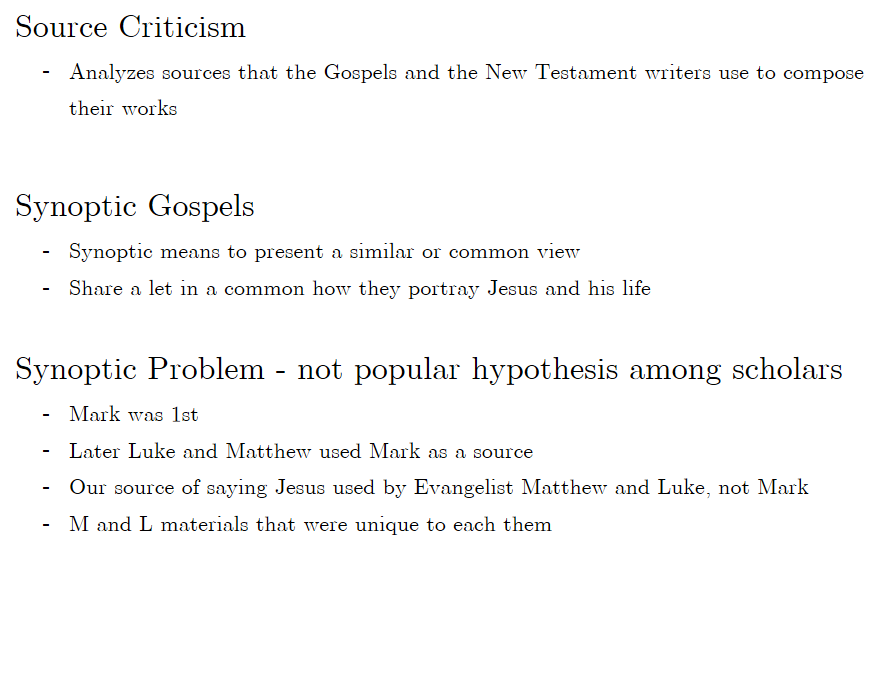
Conformity to the Rule of Faith -Source Criticism
Analyzes sources that the Gospels and the New Testament writers use to compose their works
Synoptic Gospels
Synoptic means to present a similar or common view
Share a let in a common how they portray Jesus and his life
Synoptic Problem - not popular hypothesis among scholars
Mark was 1st
Later Luke and Matthew used Mark as a source
Our source of saying Jesus used by Evangelist Matthew and Luke, not Mark
M and L materials that were unique to each them
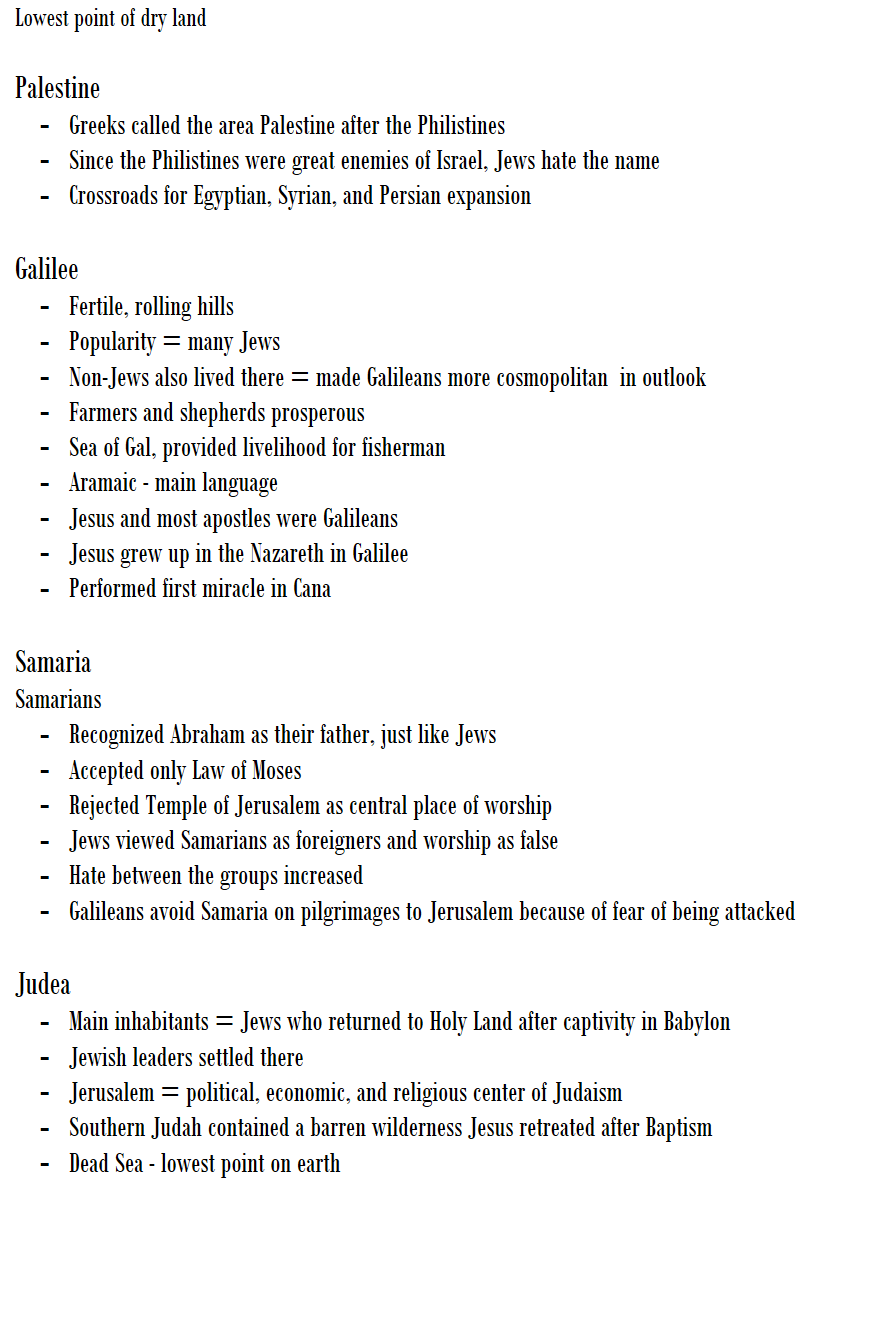
Lowest point of dry land
Palestine
Greeks called the area Palestine after the Philistines
Since the Philistines were great enemies of Israel, Jews hate the name
Crossroads for Egyptian, Syrian, and Persian expansion
Galilee
Fertile, rolling hills
Popularity = many Jews
Non-Jews also lived there = made Galileans more cosmopolitan in outlook
Farmers and shepherds prosperous
Sea of Gal, provided livelihood for fisherman
Aramaic - main language
Jesus and most apostles were Galileans
Jesus grew up in the Nazareth in Galilee
Performed first miracle in Cana
Samaria
Samarians
Recognized Abraham as their father, just like Jews
Accepted only Law of Moses
Rejected Temple of Jerusalem as central place of worship
Jews viewed Samarians as foreigners and worship as false
Hate between the groups increased
Galileans avoid Samaria on pilgrimages to Jerusalem because of fear of being attacked
Judea
Main inhabitants = Jews who returned to Holy Land after captivity in Babylon
Jewish leaders settled there
Jerusalem = political, economic, and religious center of Judaism
Southern Judah contained a barren wilderness Jesus retreated after Baptism
Dead Sea - lowest point on earth
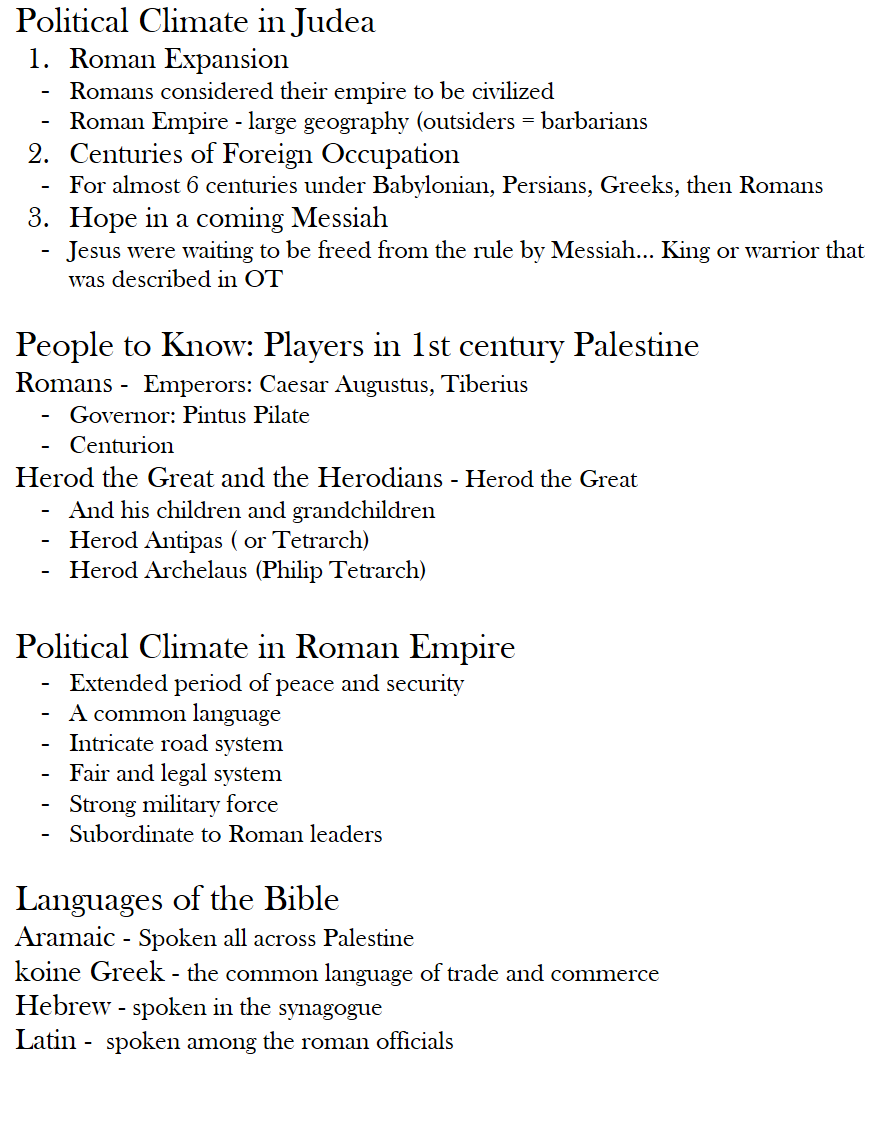
Political Climate in Judea
Roman Expansion
Romans considered their empire to be civilized
Roman Empire - large geography (outsiders = barbarians
Centuries of Foreign Occupation
For almost 6 centuries under Babylonian, Persians, Greeks, then Romans
Hope in a coming Messiah
Jesus were waiting to be freed from the rule by Messiah… King or warrior that was described in OT
People to Know: Players in 1st century Palestine
Romans - Emperors: Caesar Augustus, Tiberius
Governor: Pintus Pilate
Centurion
Herod the Great and the Herodians - Herod the Great
And his children and grandchildren
Herod Antipas ( or Tetrarch)
Herod Archelaus (Philip Tetrarch)
Political Climate in Roman Empire
Extended period of peace and security
A common language
Intricate road system
Fair and legal system
Strong military force
Subordinate to Roman leaders
Languages of the Bible
Aramaic - Spoken all across Palestine
koine Greek - the common language of trade and commerce
Hebrew - spoken in the synagogue
Latin - spoken among the roman officials
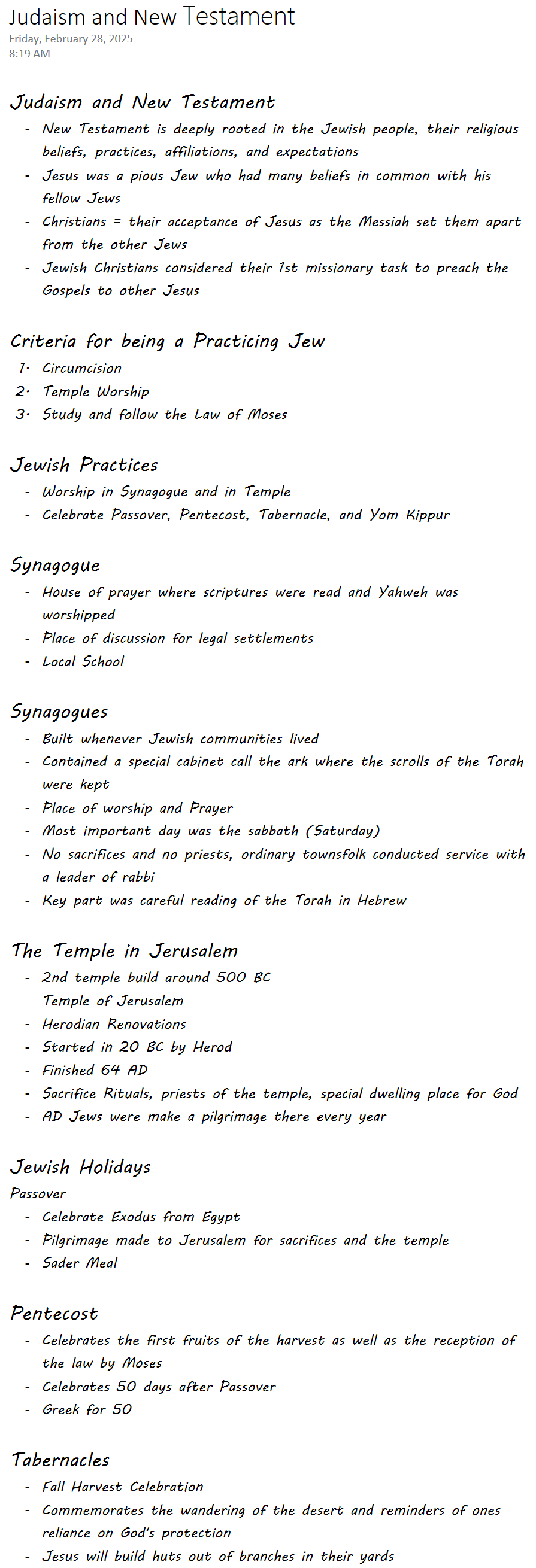
Judaism and New Testament
Friday, February 28, 2025
8:19 AM
Judaism and New Testament
New Testament is deeply rooted in the Jewish people, their religious beliefs, practices, affiliations, and expectations
Jesus was a pious Jew who had many beliefs in common with his fellow Jews
Christians = their acceptance of Jesus as the Messiah set them apart from the other Jews
Jewish Christians considered their 1st missionary task to preach the Gospels to other Jesus
Criteria for being a Practicing Jew
Circumcision
Temple Worship
Study and follow the Law of Moses
Jewish Practices
Worship in Synagogue and in Temple
Celebrate Passover, Pentecost, Tabernacle, and Yom Kippur
Synagogue
House of prayer where scriptures were read and Yahweh was worshipped
Place of discussion for legal settlements
Local School
Synagogues
Built whenever Jewish communities lived
Contained a special cabinet call the ark where the scrolls of the Torah were kept
Place of worship and Prayer
Most important day was the sabbath (Saturday)
No sacrifices and no priests, ordinary townsfolk conducted service with a leader of rabbi
Key part was careful reading of the Torah in Hebrew
The Temple in Jerusalem
2nd temple build around 500 BC
Temple of Jerusalem
Herodian Renovations
Started in 20 BC by Herod
Finished 64 AD
Sacrifice Rituals, priests of the temple, special dwelling place for God
AD Jews were make a pilgrimage there every year
Jewish Holidays
Passover
Celebrate Exodus from Egypt
Pilgrimage made to Jerusalem for sacrifices and the temple
Sader Meal
Pentecost
Celebrates the first fruits of the harvest as well as the reception of the law by Moses
Celebrates 50 days after Passover
Greek for 50
Tabernacles
Fall Harvest Celebration
Commemorates the wandering of the desert and reminders of ones reliance on God's protection
Jesus will build huts out of branches in their yards