CIE AS Level Accounting: Reconciliation and Correction of Errors
Bank Reconciliation
The closing balance of the bank statement may be different to the closing balance in the cash book due to a numberof reasons. These reasons include:
cheques not banked
bank charges not known until bank statement released
cheques credited but not debited
Unpresented cheques: cheques drawn and presented in the cash book but not yet presented to the bank
Uncredited/Outstanding bankings: cash/cheques received and paid into the bank and recorded in the cash book but have not yet appeared on the bank statement
Direct debits: an authority granted by the business to a third-party for a fixed or variable payment to be made of the request of the third-party e.g water bill
Standing orders: a fixed payment made at regular intervals by the bank
The bank reconciliation statement is important for the following reasons:
identifies errors in the cash book
however, there are errors that the trial balance will not identify, such as:
ommission — records are completely left out
compensating — errors on incorrect sides cancel each other out
commission — incorrect accounts of the same class
principle — incorrect accounts of different class
original entry — transferring amounts from source documents
reversal — accounts wrongly posted on their sides
identifies errors in the bank statement
enables missing entries to be accounted for
identifies out-of-date cheques
identifies dishonoured cheques
acts as a fraud deterrent
Method
update the cash book with any items appearing on the bank statement but not appearing in the cash book
pepare a bank reconciliation statement as follows:
Balance as per bank statement | XXX |
|---|---|
Less: Unpresented cheques | (XXX) |
Add: Oustanding bankings | XXX |
Balance as per cash book | XXX |
OR
Balance as per cash book | XXX |
|---|---|
Add: Unpresented cheques | XXX |
Less: Outstanding bankings | (XXX) |
Balance as per bank statement | XXX |
Suspense
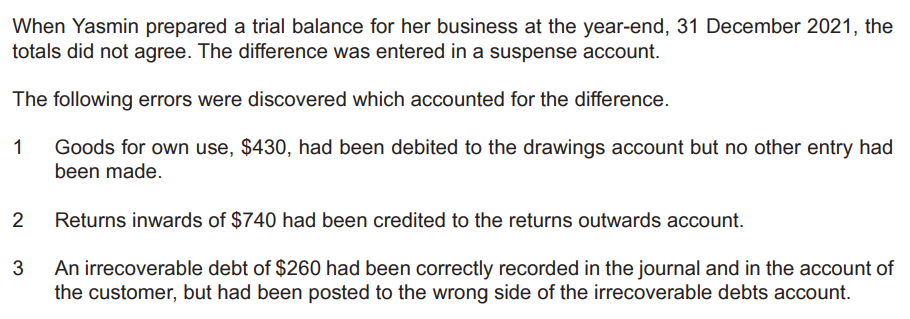
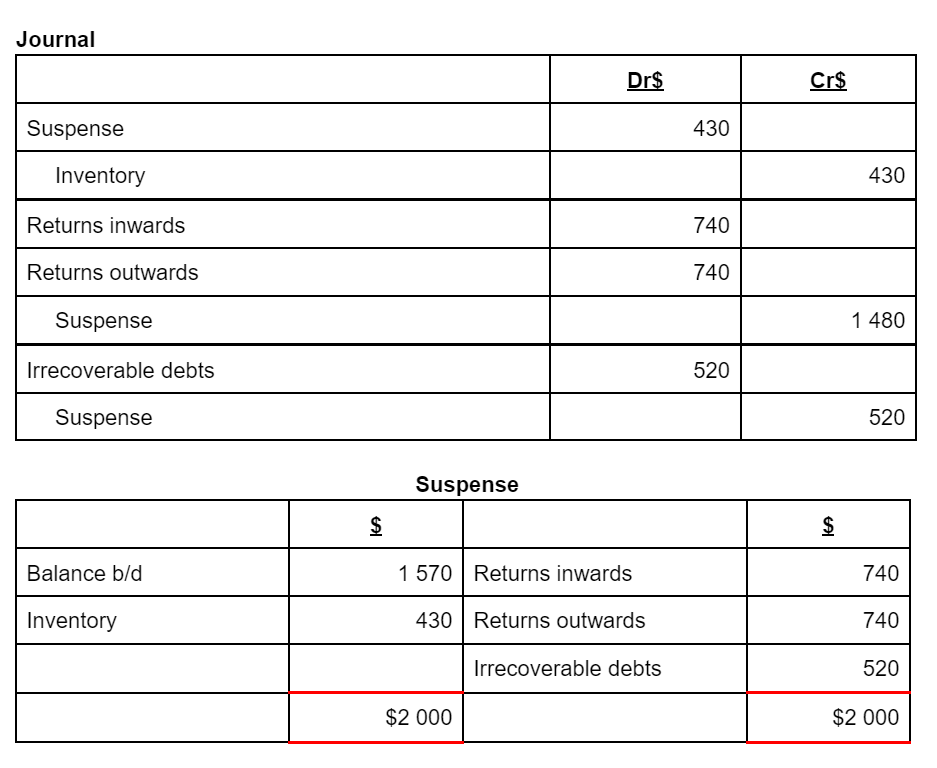
When errors are identified either in the trial balance or in various accounts, a suspense account will be opened.
Suspense accounts are used for the following reasons:
as a place for unusual items to be put until a decision can be made about the correction
as a temporary account to deal with errors that have caused a difference between debit and credit accounts
for single entry errors — only half of the financial transaction has been posted
for same side entry errors — both entries have been posted to the same sides rather than its respective debit and credit entry (duality concept)
for unequal entry errors — entries have been made on the correct sides but the figures differ
for arithmetical errors — one or more accounts being over or understated and therefore, the trial balance is not balancing
E.g.