Chapter 24- Alcohols and Carboxylic Acids
ALCOHOLS
- Alcohols are organic compounds with the hydroxyl functional group and the general formula C
nH2n+2. - Alcohols are soluble in water but their solubility decreases as the chain of carbon atoms becomes longer.
- Alcohols are neutral in pH and can undergo combustion and oxidation.
- The first four alchols are liquids at room temperature and pressure.

- In presence of potassium manganate (VII) which is an oxidising agent, alkenes are oxidised to alcohols. Potassium Manganate (VII) changes colour from purple to colourless.
- Ethene is oxdised to ethanol which is one way to produce this alcohol.
- Another way to produce ethanol is by fermentation of yeast in presence of enzymes, 37 degrees celsius temperature and a neutral (7) pH. When yeast respires anaerobically, glucose is broken into carbon dioxide and ethanol.
- Ethanol is used as a solvent, in alcoholic drinks, and as a fuel.
CARBOXYLIC ACIDS
- Carboxylic acids are organic acids with the functional group -COOH, and the general formula C
nH2n+1COOH. - As the chain of carbon atoms increases, the melting and boiling points of carboxylic acids also increases.
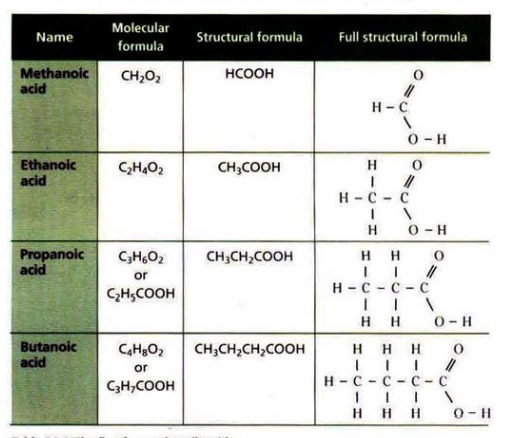
- Carboxylic acids undergo the same reactions as normal acids, i.e. with alkalis/bases, carbonates and metals.
- They are usually weak acids with pH ranging from 3 to 5.
ESTERS
- A carboxylic acid reacts with an alcohol to form an organic compound called ester in a process called esterification.
- The first part of the name of the ester is the name of the alcohol with -yl at the end. The second part is the name of the carboxylic acid with -oate at the end. For e.g. ethyl methanoate is made from ethanol and methanoic acid.
- Esters are found in fats and waxes.
- They are used as solvents, in perfumes, and food flavourings.