Electricity
Electricity
Vocab
Force: power, energy, potency
Electric field: a physical field that surrounds electrically charged particles.
Charge: a property of matter that causes it to experience a force in n electromagnetic field.
Static: an imbalance of electric charges on the surface of an object.
Electrons: a negatively charged subatomic particle that orbits the nucleus of an atom.
Static Electricity
Static electricity is due to electric charge that builds up on the surface of an insulator, such as a plastic comb. The charge that has built up cannot easily flow away from the insulator, which is why it is called static electricity.
All materials are made of atoms, which contain electric charges. Around the outside of an atom are electrons, which have a negative charge. The nucleus at the centre of an atom contains protons which have a positive charge. An atom has equal amounts of negative and positive charges which balance each other, so the atom has no overall charge. Electrons do not always stay attached to atoms and can sometimes be removed by rubbing.
Static charge can build up when to insulating materials are rubbed together, such as a plastic comb moving through hair. Friction between the materials causes electrons to be transferred from one material to the other:
One material ends up with more electrons, so it now has an overall negative charge.
One material ends up with fewer electrons, so it now has an overall positive charge.
Friction can be used to create a static charge. If an insulator is rubbed with a cloth, it can become charged in one of two ways; electrons move from the cloth to the insulator and the insulator ends up with an overall negative charge, or electrons move from the insulator to the cloth and the insulator ends up with an overall positive charge.
When two positively charged rods are placed near each other the rods repel each other because they have the same overall charge. When a positively charged rod is placed to a negatively charged rod, they attract each other because the overall charges of the rods are opposite and so they attract each other.
Electricity (again)
Current flow
Conventional current assumes that current flows out of the positive side of the battery through the circuit, and back to the negative side of the battery. This was the convention established when electricity was first discovered, but is not correct.
Electron flow is what actually happens. The electrons flow out of the negative side of the battery, through the circuit, and back to the positive side.
The direction that the current flows does not affect what the current is doing; thus, it does not make any difference which convention is used as long as you are consistent.
Moving Electricity
A moving circuit
Moving electricity is actually moving charges. The path along which these charges flow is called a circuit, and electricity will flow only if there is a complete circuit for it to go around. The four basic parts of a simple circuit are:
an energy source, such as a battery
a conductor (wires) for the electricity to flow through
something to use up the electrical energy such as a light bulb or motor
a switch to turn the current on and off
To save time describing circuits, symbols are used to form a circuit diagram. A circuit diagram shows the parts or components of a circuit, what each is connected to and the order in which they are connected.
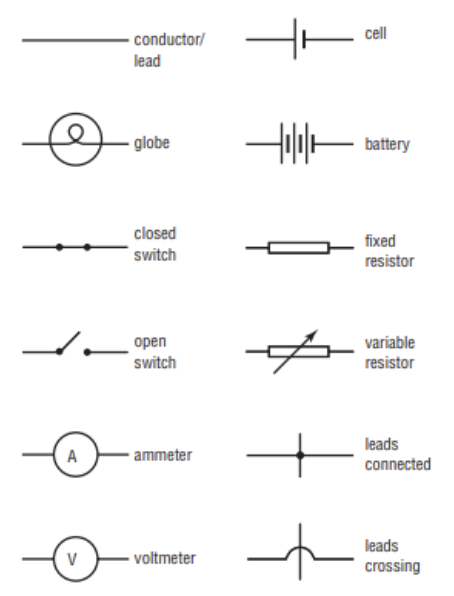
Current
The term electric current is used to describe moving electric charges. In circuits such as that shown, these charges are electrons.
A large current involves more electrons passing through a circuit each second that a small current does. Current is measured in a unit called amp. A milliamp (mA) is equal to one-thousandth of an ampere and is used to measure extremely small currents. Most parts of circuits are made up of metals. If you could magnify a metal enough, you would see a network of fixed positive atomic nuclei surrounded by a ‘sea’ of loose negative electrons. It is these electrons that flow in most circuits.
The flow of electric current is similar to the flow of water, but differs in one important aspect: water will flow out of a cut pipe, but electric current will not usually flow out of the end of a cut wire.
To measure the flow of current, an instrument called an ammeter is placed in the path of the current to be measured. This involves ‘breaking the circuit’ and inserting the ammeter.
Voltage
Voltage is a measure of the amount of energy available to push charges around a circuit, and the unit of measurement is a volt. Voltage is supplied by electric cells and household powerpoints. Using the water analogy, voltage is like pressure from the pump that pushes the water out of the pipes.
To measure the voltage, probes from a voltmeter are connected so it ‘piggybacks’ across the section. You think of an ammeter as counting energy charge that passes through it, and a voltmeter as sampling how much energy is used between two points in the circuit.
Cells and batteries
Electricity typically comes from a power point in the wall or from cells and batteries.
Technically, a cell is a single unit and a battery a group of cells, but people tend to use both words to describe a single unit. A typical small cell, such as an AA battery, provides 1.5 volts, while a car battery supplies 12 volts.
A wet cells consists of two different metal plates placed in acid. A car battery is a collection of wet cells. The wet substance is sulphuric acid and the plates or electrodes are made of lead and lead oxide. When a car battery is running, chemical reactions in the battery are reversed and help recharge the battery. Eventually, build up of chemicals on the electrodes prevents recharging and so the battery ‘dies’.
A dry cell is not completely dry but contain a chemical paste instead of a liquid. As in a wet cell, a chemical reaction generates charge that will flow when the cell is connected to a circuit. There are several types of dry cell. Often, several cells are connected to provide greater electrical charge or voltage.
A photovoltaic cell or solar cell, is made of two layers of a substance called a semiconductor. When sunlight strikes the top layer, electrons are given energy to move from one layer to another, creating an electrical current. Several cells are used to make a solar panel.
Conductors and insulators.
A conductor is a substance that allows current to flow through it easily. Metals are good conductors of electricity. Copper wire is a low cost and widely available conductor commonly used in factories, around the house and in cars. Aluminium is more expensive but is used where copper would be too heavy, for example, high voltage transmission lines that need to be strung between distant pylons.
Materials that do not normally allow current to pass through them are called insulators. Plastic and rubber are two very good insulators.
More on circuits
For current to flow, there must be a complete circuit made of conducting material, and a voltage source such as a battery.
1) The pump
The voltage source acts as a pump and creates an electric field that pushes charges around the circuit, just as a water pump creates pressure that pushes water through the pipes.
2) The resistance
Electrons have much more difficulty getting though the thin tungsten filament of a light bulb than they do getting through the much thicker and highly conductive copper wire. The electrons give up a lot of energy trying to get through the filament, this energy being turned into heat or light.
A light bulb is an example of resistance — something that restricts the flow of charge and ‘robs’ moving charges of energy. Resistance converts electrical energy into heat and light energy. Devices such as electric kettles, toasters, irons and electric hotplates are all simple electrical circuits that contain a resistance wire made from the metal nichrome. Nichrome has much greater resistance than the copper wire used in the rest of the circuit, and so it heats up when a current passes through it. Nichrome is ideal as it doesn’t react with oxygen or become brittle when heated till red hot.
Electricity (shocker)
Notes from PDF
Each electron and each proton in the nucleus carries a force-field which we call electrical charge.
There are two opposite electrical charges called positive (+ve) and negative (-ve).
Rubbing two substances together can transfer electrons from one to the other. If these substances are electrical insulators, the charges cannot flow away so the substance stays charged, at least for a while. The charges can push or pull each other because of the force-field.
If electrons can be removed from atoms easily, it means that electrons will readily flow through the substance. This is a conductor. Some examples of good conductors are metal (especially copper), graphite (a form of carbon) and salty water.
Insulators can be charged with static electricity but won’t allow a flow of electrons through them. Some examples of good insulators are glass, plastic, rubber, air and pure water.
Electricity will only flow around a circuit if every part of it is a conductor.
An electrical circuit always contains 3 parts:
a power source
one or more energy converters
electrical wires
A complete circuit is an unbroken chain of conductors from the +ve and -ve terminal.
If you could see the atomic world inside a copper wire, you’d see that the atoms of copper can lose electrons so easily that there are billions and billions of loose electrons hanging around between the atoms. The electrons are not going anywhere but can jump from atom to atom.
The field of a battery is produced by chemical reactions. The ‘mains’ power is produced by magnetic effects in a generator at a power station.
When the wire becomes part of the circuit, the electric field instantly reaches through the wire and exert a force on every electrical charge. The charged particles within the copper atoms cannot move, but the loose electrons immediately gain energy from the field and begin flowing in the wires.
The amount of push that the electric field can give the electrons is the voltage.
More pressure = more flow
The analogy to electricity is simple: the water pressure is like voltage. Higher voltage = more push. The water flow is like electrical current. More current - electrons flowing.
If the voltage is higher it pushes more electrical current through the circuit. The combinatoin of voltage and current determines the energy delivered.
Different wires, different light bulbs, etc in an electrical circuit have different amounts of electrical resistance. If there is more resistance, less current can flow. If there is less resistance, more current can flow (for the same amount of voltage).
The flow of electrical current can be determined by a device called an ammeter. 1 amp of electrical current actually means there are billions of electrons flowing in a circuit.
1 volt is a rather small push for the current. A car battery supplies 12 V to the car and mains electricity is 240 V.
If voltage is increased, current is increased (for the same resistance).
If resistance is increased, current decreases (for the same voltage).
Voltage = current x resistance OR current = voltage/resistance
More voltage = more current
More resistance = less current.
The amount of electrical energy converted per second is called power. Electrical power is measured in watts.
The higher the wattage of any electrical appliance, the more electrical energy it uses per second. The amount of power depends on both current and voltage.
In a parallel circuit, some current flows through each bulb, but a particular electron only goes through one of the bulbs, not all of them.
Imagine you are an electron flowing out of the power pack. You can go to any light bulb and flow through it, then return to the pack. You can only go through one bulb.
Parallel electrical circuits offer many advantages compared to series circuits:
Full delivery of power to each device in the circuit (eg, brighter lights)
Each device can be switched on or off independently.
If one device burns out, all others continue to operate.
A series circuit has a much higher resistance so less current flows and less power can be delivered to each device. Multiple devices in series cannot be independently switched on or off. One off, all off.
AC and DC
Direct current
The electrical current produced by a battery flows steadily from the -ve terminal to the +ve terminal. This is described as direct current. The electrical field of a battery (which provides the voltage) is constant and always points in the same direction. The electrons are always pushed in the same direction so the current flows steadily.
Alternating current
Large scale production of electricity in power stations relies on electrical generators, not batteries. Because of the way generators work, the electrical field they produce fluctuates back and forth very rapidly. The electrons fo not flow steadily but jump back and forth under the influence of the field. This current is called alternating current.