chapter 1-3
LESSON NOTES: INTRODUCTION TO POLITICS, IDEOLOGY, AND THE STATE
CHAPTER 1: WHAT IS POLITICS?
Learning Objectives
Distinguish between different conceptions of politics (arena vs. process)
Identify four main definitions of politics and their ideological underpinnings
Understand the evolution of political science as a discipline
Recognize how globalization challenges the traditional domestic/international divide
Key Concepts
Politics: The activity through which people make, preserve, and amend general rules under which they live
Authority: Legitimate power (traditional, charismatic, legal-rational)
Power: Ability to influence behavior of others (three faces: decision-making, agenda-setting, thought control)
Sovereignty: Absolute and unlimited power within territorial borders
Detailed Content
I. Four Definitions of Politics
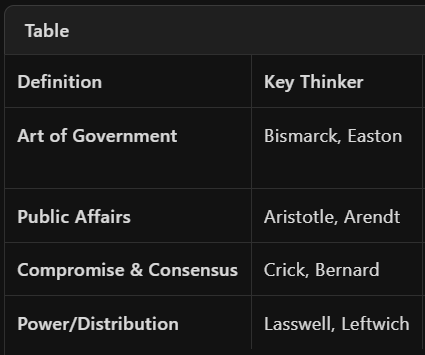
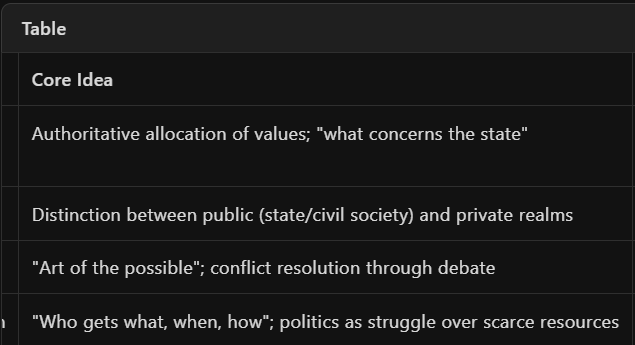
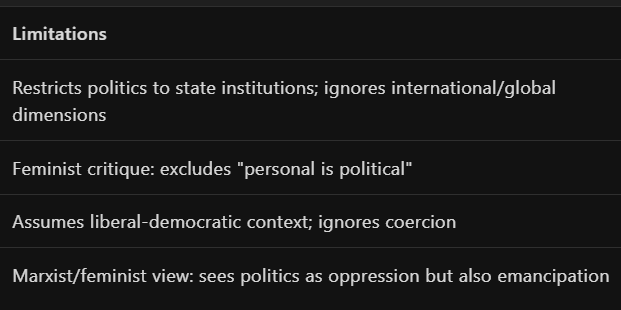
II. Approaches to Studying Politics
Philosophical Tradition: Normative questions (what should be); Plato, Aristotle
Empirical Tradition: Descriptive analysis; behavioralism (quantitative, observable behavior)
Rational-Choice Theory: Economic models of self-interested behavior; game theory (Prisoner's Dilemma)
New Institutionalism: Rules shape behavior; institutions matter
Critical Approaches: Feminism, post-structuralism, constructivism; question objectivity and status quo
III. Tools of Analysis
Concepts: General ideas (e.g., democracy, freedom)—often "essentially contested"
Models: Simplified representations (e.g., Easton's political system: inputs → gatekeepers → outputs → feedback)
Theories: Systematic explanations (e.g., pluralism, elitism, Marxism)
Paradigms: Ideological traditions (liberalism, conservatism, socialism)
IV. Politics in a Global Age
Traditional divide: Domestic (ordered, hierarchical) vs. International (anarchic)
Globalization creates spatial interdependence: overlapping spheres (global, regional, national, local)
Challenge to disciplinary boundaries between Political Science and International Relations
CHAPTER 2: POLITICAL IDEAS AND IDEOLOGIES
Learning Objectives
Define ideology and understand its contested meanings
Compare the three classical ideologies: liberalism, conservatism, socialism
Analyze internal tensions within each ideological tradition
Evaluate "new" ideologies and non-western perspectives
Key Concepts
Ideology: Coherent set of ideas providing basis for organized political action (worldview + vision of future + strategy for change)
Meta-ideology: Higher-order framework (liberalism often functions as this)
End of Ideology: Bell/Fukuyama thesis vs. ideological renewal argument
Detailed Content
I. Classical Ideological Traditions
A. Liberalism (Ideology of industrialized West)
Core Values: Individualism, freedom, reason, equality (of opportunity), toleration, consent, constitutionalism
Classical Liberalism: Minimal state, negative liberty, laissez-faire capitalism (Locke, Hayek)
Modern Liberalism: Positive liberty, welfare state, managed capitalism (Green, Hobhouse, Rawls)
Key Tension: Freedom vs. equality; market efficiency vs. social justice
B. Conservatism (Reaction to French Revolution)
Core Values: Tradition, pragmatism, human imperfection, organicism, hierarchy, authority, property
Paternalistic/One-Nation Conservatism: "Change to conserve"; noblesse oblige; social reform (Burke, Disraeli)
New Right: Neoliberalism (free market) + Neoconservatism (authority/tradition)
Key Tension: Pragmatic flexibility vs. doctrinal rigidness; market vs. social cohesion
C. Socialism (Reaction to industrial capitalism)
Core Values: Community, fraternity, social equality, need over merit, class politics, common ownership
Marxism: Historical materialism, class struggle, proletarian revolution, "withering away" of state
Social Democracy: Parliamentary road, welfare state, Keynesianism, "Third Way" revisionism (Bernstein, Blair)
Key Tension: Revolution vs. reform; state control vs. individual freedom
II. Other Ideological Traditions
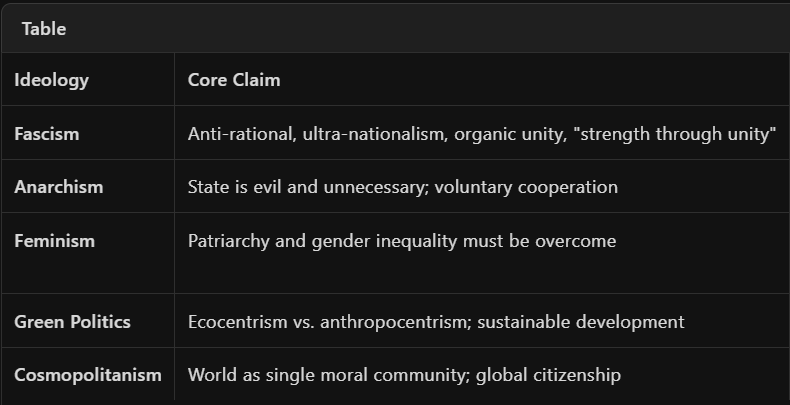
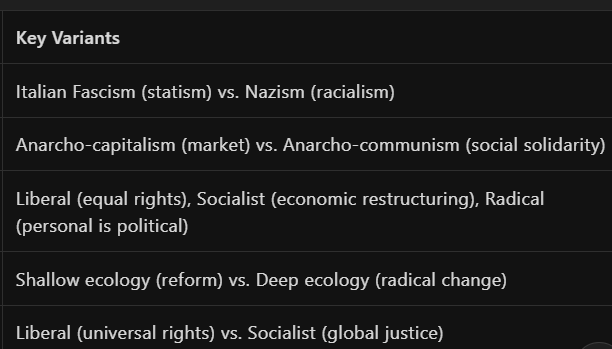
III. Non-Western Ideological Trends
Postcolonialism: Critique of western universalism; Bandung Conference (1955)
Religious Fundamentalism: Islamism, political Christianity; rejection of secular public/private divide
Asian Values: Confucian-influenced emphasis on harmony, duty, authority over individual rights
Beyond Dualism: Buddhist/Taoist influences on green politics; non-western epistemologies
CHAPTER 3: POLITICS AND THE STATE
Learning Objectives
Define the state and distinguish it from government/civil society
Evaluate rival theories of state power (pluralist, Marxist, New Right, feminist)
Compare different models of state responsibility (minimal to totalitarian)
Assess the impact of globalization on state power
Key Concepts
State: Political association exercising sovereign jurisdiction within defined territorial borders; monopoly of legitimate violence (Weber)
Sovereignty: Internal (supreme authority) and External (autonomy in international system)
Governance: Broader than government; coordination of social life through networks and partnerships
Detailed Content
I. Defining the State (Four Perspectives)
Idealist (Hegel): Ethical community; universal altruism
Functionalist: Maintenance of order and social stability
Organizational: Public institutions distinct from civil society (bureaucracy, military, courts)
International: Legal personality; Montevideo criteria (territory, population, government, capacity for relations)
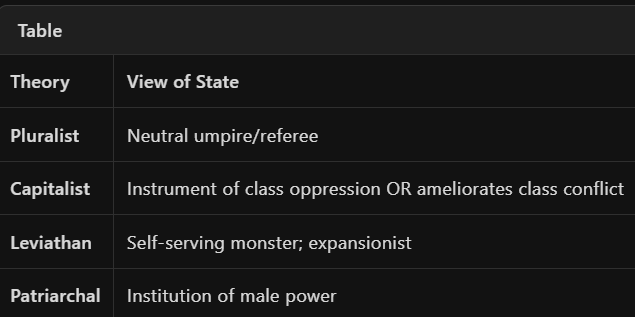
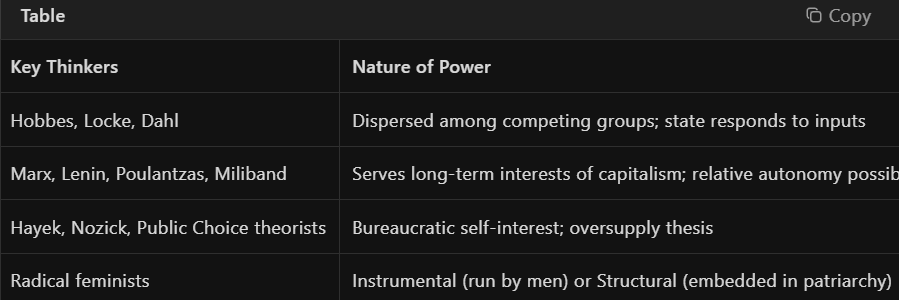
II. Rival Theories of the State
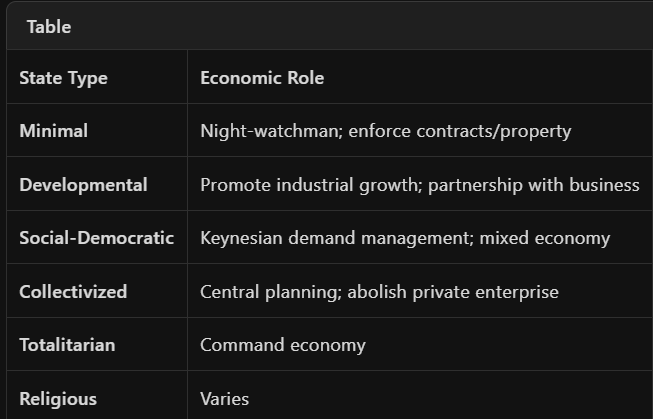
III. Roles of the State
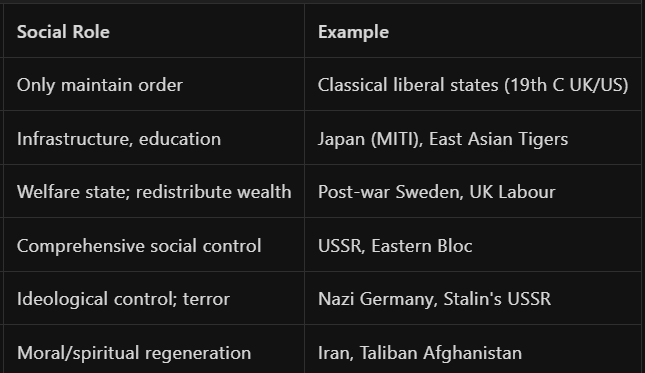
IV. Eclipse vs. Return of the State
Globalization Challenges:
Economic sovereignty eroded by supraterritoriality
Rise of TNCs, NGOs, global governance (UN, WTO, EU)
Shift from "government" to "governance"
Failed States: Collapse of post-colonial states (Liberia, Somalia); inability to maintain monopoly of violence
State Revival:
Security: War on terror, border control, surveillance
Economic: Competition states; state intervention in 2007-09 financial crisis
State-building: Post-conflict reconstruction (Liberia, Afghanistan)
SYNTHESIS: CONNECTING THE CHAPTERS
Key Themes Across Chapters 1-3
Power: From defining politics as power (Ch. 1), to ideological power struggles (Ch. 2), to state power theories (Ch. 3)
Public vs. Private: Changing boundaries of the political (feminism, globalization, state retreat)
Legitimacy: How ideologies justify state power; how states maintain authority
CHAPTER 3: POLITICS AND THE STATE
Overview
The state is central to political life—shaping everything from education to economic management, social welfare to external defense. This chapter examines the nature of state power, competing theories about whose interests it serves, the various roles states assume, and debates about whether the state is declining in the age of globalization.
Key Issues
Definition and features of the state
Rival theories of state power (pluralist, Marxist, New Right, feminist)
Contrasting state roles (minimal to totalitarian)
Whether globalization has caused the "eclipse" of the state
1. DEFINING THE STATE
Four Perspectives on the State:
Idealist View (Hegel): State as an ethical community representing "universal altruism" and the highest expression of human freedom
Functionalist View: State as the set of institutions that maintain social order and stability
Organizational View (Primary definition used in text): The apparatus of government—recognizably "public" institutions responsible for collective organization of communal life, funded at public expense
International View: State as the basic unit of world politics, defined by sovereignty and territorial boundaries
Five Key Features of the State:
Sovereignty: Absolute and unrestricted power; the "hard shell" that divides domestic from international politics (Weber: monopoly of legitimate violence)
Public Institutions: Distinct from private institutions of civil society
Legitimation: Decisions accepted as binding because made in the public interest
Domination: Authority backed by coercion; capacity to ensure laws are obeyed
Territorial Association: Jurisdiction geographically defined (contrast with transnational or non-territorial actors)
Historical Emergence:
Originated in 16th–17th century Europe
Peace of Westphalia (1648): Formalized modern statehood and territorial sovereignty
Charles Tilly: "War made the state, and the state made war"—states developed capacity to fight wars through taxation and administration
Marxist view: Emerged from transition feudalism → capitalism as tool of bourgeois class
2. RIVAL THEORIES OF THE STATE
A. The Pluralist State
State as neutral "umpire" or "referee" among competing societal interests
Rooted in social-contract theory (Hobbes, Locke): State arises from voluntary agreement to prevent "state of nature" (solitary, poor, nasty, brutish, short)
Neopluralism (Dahl, Lindblom): Acknowledges business enjoys "privileged position" and state can develop its own sectional interests (state elite pursuing bureaucratic interests)
B. The Capitalist State (Marxist)
State maintains class system either by:
Instrumentalism: Direct tool of ruling class (Miliband: state elite drawn from privileged ranks)
Structuralism: Economic structure constrains state autonomy; state must serve long-term capitalist interests even against specific capitalist wishes (Poulantzas)
Relative autonomy: State can mediate between classes but ultimately preserves capitalist system
Gramsci's Hegemony: Domination achieved through ideological/cultural control, not just coercion
C. The Leviathan State (New Right)
State as self-serving monster intent on expansion (Hobbes' imagery)
Public-choice theory: Bureaucrats act in self-interest to expand budgets and power (government oversupply thesis)
Demand-side pressures: Electoral competition encourages politicians to outbid each other with promises, leading to government overload
D. The Patriarchal State (Feminist)
State embodies patriarchy (systemic male domination)
Instrumentalist: State run by men for men; reflects public/private divide
Structuralist: State embedded in wider patriarchal system; welfare state creates "public dependence" replacing "private dependence" on husbands
3. THE ROLE OF THE STATE
Spectrum of State Intervention:
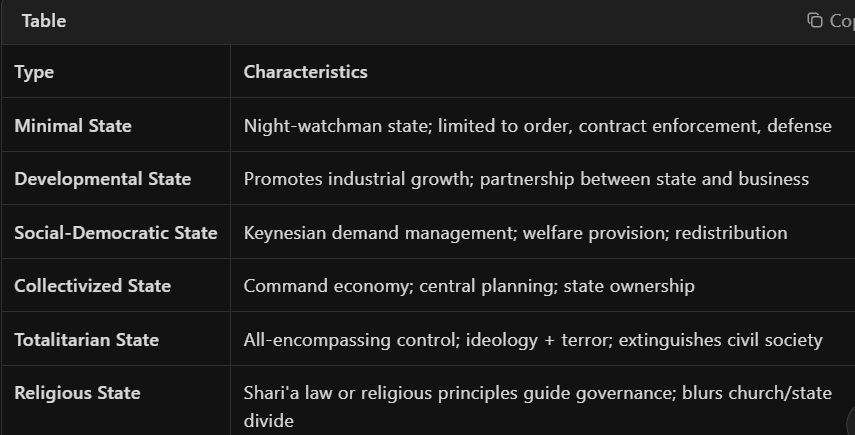
4. ECLIPSE OF THE STATE?
Arguments for Decline:
Globalization: Rise of supraterritoriality; borderless world undermines economic sovereignty
Governance turn: Shift from government to governance—networks, public-private partnerships, multilevel governance
Market state (Bobbitt): Prioritizes market opportunities over control
Non-state actors: TNCs, NGOs, global civil society operate beyond state control
Failed states: Unable to maintain monopoly of legitimate violence (Somalia, Liberia, DRC)
Arguments for Return/Transformation:
Security challenges (terrorism) require strong state responses
State necessary for legal framework markets require
State-building efforts in post-conflict zones emphasize state capacity
States created globalization and can reshape it
"Pooled sovereignty" (EU) may enhance rather than diminish state power
Chapter 3 Summary Points
The state is a sovereign, territorial association with public institutions that claim legitimation and exercise domination
Competing theories debate whether state is neutral (pluralist), class-based (Marxist), self-serving (New Right), or patriarchal (feminist)
States range from minimal (protective) to totalitarian (all-controlling)
Globalization challenges state sovereignty but hasn't rendered states irrelevant; transformed states persist as crucial actors