Ecology
biodiversity - variety of life in all of its forms
ecosystem diversity - variety of ecosystems found in an area/on earth
species diversity - number/relative abundance of species found in an ecosystem
genetic diversity - variety of genes/alleles present in a species
high genetic diversity → more likely to survive changes in environment
via natural selection
measured through ecological surveys of wide range of habitats
number of species fluctuated over time
there have been at least 5 mass extinction events
anthropogenic species extinction - loss of species due to human activities
humans are causing a 6th mass extinction
habitat destruction
climate change
pollution
overexploitation (overhunting)
invasive species
disease
Giant moas - large flightless birds that lived on new zealand
had few predators before humans
Maori people hunted them for food, clothing, and jewelry
overexploited/overhunted → extinct
caribbean monk seal
hunted to extinction for meat, clothing, blubber by humans
also damaged breeding sites
one of the biggest causes of biodiversity loss = destruction of habitats/ecosystems by ppl
mixed dupterocarp forest
some of the most biodiverse ecosystems on earth
loss from human activities
deforestation - hardwood timbers
agriculture - development of palm oil plantations
mining - excavation for mining coal, metals, and diamonds
climate change - result in floods + droughts
hunting - reduces biodiversity + disrupts ecological balance
mangrove ecosystem
loss from human activities
coastal infrastructure + tourism
agriculture - farms upstream release harmful chemicals into mangroves
fishing + aquaculture - overfishing removes links in food change + eutrophication
climate change - mangroves cannot tolerate more salt water from higher tides
biodiversity should consider richness + evenness
richness - number of different species
evennes - relative population numbers of each species
should have a wide variety of different species
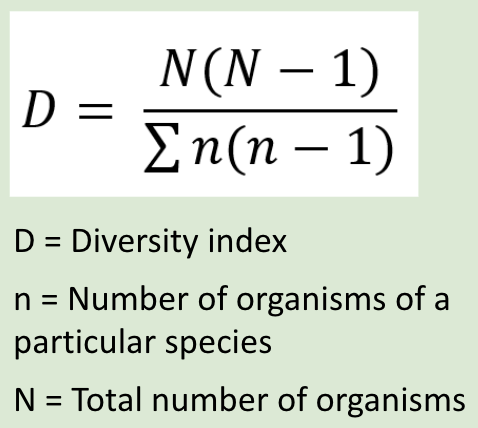
simpson’s reciprocal index - measure of biodiversity in an ecosystem
high index value → stable site w many different niches
index value may decrease in response to ecological disturbance
low index value → site w few potential niches where only few species dominate
benefits of citizen science
increases quantity of data
cost effective
increased public engagement in conservation
challenges
data quality
bias
over-exploitation of resources - unsustainable use of resources
disrupts food webs → decrease in biodiversity
poaching/irresponsible hunting
overfishing
logging
urbanization - movement of people to cities and towns
leads to loss of ecosystem biodiversity
deforestation
happens due to demand for wood + agricultural land
destroys ecosystems + biodiversity → climate change
agriculture
farm wastes, fertilizers, pesticides enter ecosystem → disrupt food webs + biodiversity
pollution - introduction of harmful substances into environment
invasive species - introduced species harm their non native ecosystem
brought by global transport
also pests + diseases are brought
species conservation
ex situ conservation - conservation outside of natural habitats
zoos, botanical gardens
ex. espanola giant tortoise
in danger of extinction via competition w goats + overhunting
tortoises entered captive breeding program
goats removed from island
tortoises reintroduced
seed banks - store seeds to preserve genetic variety
tissue banks - store plant tissues to propagate future plants
advantages
protection from predators
greater control of conditions → ensures that offspring survive after birth
IVF can increase offspring
disadvantages
captive populations have limited genetic diversity
organisms living outside natural habitat → may not have required survival strategies when reintroduced
does not prevent destruction of og habitat
in situ conservation - conservation inside of natural habitats
management of nature reserves
nature reserve - protected ecosystem managed for conervsation
endangered species often kept to protect from poachers
rewilding + reclamation of degraded ecosystems
aims to restore degraded ecosystems back to natural state
regenerate biodiversity
restoration of ecosystems
removal of invasive species
reintroduction of locally extinct species
legal protection against pollution/development
controlling access to ecosystem
controlling poaching
advantages
organisms not in captivity → survival strategies
other species in protected habitat also protected
biodiversity
disadvantages
endangered species need large areas for population survival
difficult to prevent poaching
genetic variety may already be damaged
Evolutionarily Distinct and Globally Endangered (EDGE) Program - identifies species to conserve
evolutionary distinctiveness - species are unique and has few/no close relaitves
global endangerment
based on IUCN red list
identifies threat level of extinction for a species
ecology - biology dealing w relationships btwn organisms + environment
organisms - any individual life form
have at least 1 cell
habitat - natural home/environment of an organism
must provide all resources an organism needs to survive
ex. coral reefs
descriptions of habitats
geographical location
latitude, longitude, climate
physical location - characteristics of the geographical area
landforms, water bodies, vegetation, microhabitats
type of ecosystem - broader ecological community
species interact w other species + abiotic environment
species - group of organisms capable of reproducing with each other to produce fertile offspring
population - one species in one location in one time
community - populations of different species living and interacting w each other in a habitat
interactions include
predator + prey
herbivory
competition for resources
mutualism
parasitism
ecosystem - location where a community of organisms interact w each other + abiotic environment
abiotic environment - nonliving environment
air, minerals in soil, light, climate
adaptations - any heritable traits that make an organism better able to survive + reproduce
Marram grass - adapted to little water (xerophytes)
leaves roll into a tube w stomata inside
air trapped inside → maintains high humidity outside stomata → reduce transpiration
sunken stomata w fine hairs
traps moist air outside stomata → reduces transpiration
thick waxy cuticles on leaves
reduces evaportion
long/deep roots
aid in search of water
extensive roots near surface
helps sand retain water
mangrove trees - adapted to waterlogged, anoxic soil + high salinity
prop roots descend from trunk
provide tree w stability
widespread shallow root system
provides additional support
aerial roots (pneumatophores)
low tide → gas exchange occurs through open passages → air transported to underground roots
salt filtration
plasma membranes of roots prevent salt from entering
Shelford’s Law of Tolerance
organisms have optimal survival rates for abiotic factors
an organism moves away from optimum conditions → decrease in survival rates
optimum range - max survival rates
zones of stress - reduced survival rates
zone of intolerance - organisms cannot survive
variables affecting the distribution of organisms
temperature
ph
available minerals + light
altitude
latitude
humidity
soil content
breeding sites
aeration of soil
climate
belt transects - investigate relationship btwn distribution of species w an abiotic factor
coral reefs - sessile animals w a mutualistic relationship w zooxanthellae
water clarity
need clear water
water depth
grows best at 50 m to allow light to penetrate zooxanthellae
temperature
16C - 34.5C
pH
8 - 8.3
salinity
23 - 42 ppt
biomes - naturally occurring communities of organisms occupying a major habitat
tropical forest
high rainfall + temperatures
temperate forest
hot summers + cold winters
moderate rainfall
grassland
low rainfall
hot desert
hot days + cold nights
very low rainfall
taiga
cold/snow winters + warm/humid summer
low precipitation (snow)
tundra
frozen a lot of the time
short summers
low precipitaiton
whittaker’s climograph - predicts terrestrial biome found in a location according to mean annual temperatures and mean annual precipitation
convergent evolution - independent evolution of similar features in different species
adaptations of desert plants
succulence - fleshy stems + leaves = water storage
reduced leaf surface
reduce transpiration
deep root systems
access groundwater
CAM Physiology - stomata close during day and open at night
thick waxy cuticle
reduces evaporation
saguaro cactus
thick waxy cuticles
spines
reduce surface area for transpiration
protection
water storage
widespread root system
adaptations of desert animals
nocturnal behavior
efficient water conservation
concentrated urine
efficient metabolism
low
camouflage
long loops of henle
Camels
water conservation
concentrated urine
fat storage
fat can be metabolized when sustenance scarce
large SA:V ratio
efficient heat loss
high temperature tolerance
long legs
above hot sand
long nasal passages
trap + reabsorb moisture from air
broad feet
walk over sand
adaptations of plants in tropical rainforests
buttress roots
provide stability + absorb nutrients
drip tips
allow water to run off
epiphytes
grow on trees
lianas - vines that grow on trees to reach light
mutualistic relationships
dipterocarp trees
tall
fast growth rate
buttress roots
large leaves
lots of fruit
seed dispersal
chemical defenses
adaptations of animals in tropical rainforests
arboreal adaptations
tails, grasping hands/feet, strong limbs
acute sesnses
camouflage
sumatran orangutans
long arms + grasping feet
opposable fingers and toes
color vision
see food + predators
camouflage
intelligence
strong jaws and teeth
ecological niche - role of an organism in an ecosystem
includes abiotic and biotic factors that affect
growth + survival
reproduction
mode of nutrition
interactions
obligate aerobes - cannot survive in presence of oxygen
anaerobic respiraton
facultative anaerobes - survive with or without oxyegn
aerobic or anaerobic
obligate aerobes - cannot survive in absence of oxygen
aerobic respiration
autotrophs - produce own food
heterotrophs - must take food from other organisms
holozoic nutrition - ingests + internally digests food
saprotrophs - external digestion via enzymes
ex. bacteria and fungi
mixotrophs - can be autotrophs and heterotrophs
ex. Euglena
obligate mixotrophs - need both to survive
facultative mixotrophs - can switch based on resources
archaea - metabolically diverse prokaryotes
phototrophs - use light to produce atp BUT no oxygen produced
chemolithotrophs - oxidize inorganic compounds to make ATP
organotrophs - oxidize organic compounds to make ATP
herbivores - have flat teeth + strong jaws
homo floresiensis
paranthropus robustus
omnivores - mixture of sharp teeth + flat molars
homo sapiens
plant adaptations against herbivores
physical structures (ex. thorns)
sharp trichomes w chemicals
tough/fibrous leaves
capsaicin
nicotine
adaptations of grazing mammals
flat molars
teeth grow forever → do not wear down
adaptations of insects
sharp mandibles w serrated edges
cut through cell walls
strong muscles in mandibles
piercing mouth pieces
stylets → insert into phloem → obtain nutrients
predator adaptations
physical
sharp claws/alons
powerful jaws/teeth
speed
camouflages
chemical
venom
behavioral
hunting in a pack
ambush tactics
prey adaptations
physical
armour/protective cover
swift
camouflage
mimicry
chemical
toxic/unpalatable chemicals
brightly colored
behavioral
travel in groups
swarms
alarm calls
nocrutnal/diurnal
plant adaptations for harvesting light
trees reaching canopy
lianas
epiphytes + strangler epiphytes
shade tolerant shrubs/herbs growing on forest floor
canopy trees
height/crown structure
broad leaves
liana vines
climbing mechanisms
rapid growth
flexible/thin stems
large broad leaves
epiphytes - plants growing on another plant
grow on canopy trees
broad flat leaves
flexible growth
strangler epiphytes - germinate in branches of canopy trees but send roots to floor
shade tolerant plants
branching
broad leaves
lots of chlorophyll
ecological niche - role of an organism in an ecosystem
fundamental niche - niche an organism COULD occupy without competition
realized niche - niche an organism occupies BECAUSE of competition
competitive exclusion - no two species occupy the same niche
one is better adapted → outcompetes → other species eliminated
ex. red and grey squirrels in the UK
population - one species in one location at one time
have to be reproductively isolated
reproductive isolation - a barrier stops individuals from reproduction
Sampling - estimate population size
not enough time to count
collecting data may damage habitat
counting is not feasible
quadrat sampling - estimates population of plants + sessile animals
random
representation
removes bias
generalization
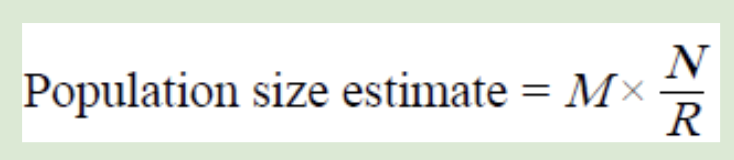
Capture-mark-release - estimates population of motile animals
random sample captured + counted (M)
captured individuals marked + released
second sample of population captured + counted (N)
number of recaptured mark is counted (R)
lincoln index formula
Carrying capacity - max population size of a species that cen supported long term in an environment
based on
availability of food + water
space
shelter
disease + predators
climate
factors affecting population growth
density independent - not based on population size (abiotic)
climate events + natural disasters
habitat destruction
seasonal changes
density dependent - based on population size (biotic)
competition
risk of predation
disease
4 factors affecting population growth
natality (birth)
mortality (death)
immigration (entering)
emigration (leaving)
change in population size = (natality + immigration) - (mortality + emigration)
exponential growth = environment with limited competition
sigmoid growth curve = environment with competition
exponential phase
transitional phase
plateu phase
intraspecific competition - competition btwn members of the same species
all have the same ecological niche
increases due to density dependent factors
territory for food + reproduction
mates
social dominance
intraspecific cooperation - benefits all members of a population
increases population’s access to resources + protection from predators
group hunting + foraging
defense against predators
parenting
community - populations of different species living/interacting w each other in an ecosystem
herbivory
predation
interspecific competition - different species compete for same resources
leads to competitive exclusion or species having different ecological niches
mutualism - close relationship btwn two different species (symbiosis)
both individuals benefit
parasitism - one species benefits, another is harmed
pathogenicity
examples of mutualism
root nodules in Fabaceae
nodules w nitrogen fixing bacteria
plants unable to synthesise nitrogen compounds
bacteria give nitrogen compounds to plants → plants give organic compounds + carbs to bacteria
mycorrhizae
roots of plant + fungus
orchids increase SA for absorption of water/materials
fungi enhances orchids ability to get nutrients
zooxanthellae and coral
zooxanthellae are photosynthetic
produce glucose for coal
remove wastes
produce oxygen
coral protects zooxanthellae + gives CO2
alien species - organisms introduced to an ecosystem
can become invasive if cause harm
replace endemic species via competitive exclusion
absence of predators + disease
faster reproduction
larger + more aggressive
outcompeting food + resources
positive assocation - two species are likely to be found together in an ecosystem
negative association - two species are not likely to be found together
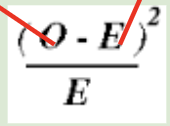
chi squared tests of association
null hypothesis - no significant association (P > 0.05)
alt hypothesis - significant association (P < 0.05)
Steps
construct table of observed frequencies for 2 species
construct table of expected values
calculate column + row totals
formula

calculate chi squared
determine degrees of freedom

determine if P > or < 0.05
if calculated < table → null hypothesis
if calculated > table → alt hypothesis
determine association
top down controls - pressures applied at higher trophic levels to control ecosystem dynamics
predator prevents prey overpopulation
bottom up controls - resources available to producers that affect their growth
allelopathy - release of chemicals by an organism that influences germination, growth, survival, or reproduction of another
black walnut trees produce juglone → inhibits growth of many plants
reduces competition
penicillium fungus secretes penicillin → stops bacteria growing
reduces competition
communities form ecosystems via interactions w abiotic environment
ecosystems = open systems where energy + matter and leave
earth = closed system
energy exchanged w surroundings outside planet
matter is not
most ecosystems depend on sun as principal source of energy
autotrophs use energy to photosynthesize
heterotrophs eat autortrophs
some ecosystems do not use sun
hydrothermal vent ecosystems
producers = chemoatuotrophic bacteria
deep sea ecosystems
producers = chemosynthetic bacteria
cave ecosystems
rely on organic matter from outisde cave
also chemoautrotophic bacteria
energy flows from producers → consumers
Food chains - shows feeding relationship btwn organisms in an ecosystem
arrow = energy + biomass transfer
always begin w producer
food webs - interlocking + interdependent food chains
decomposers - organisms that get energy from dead organisms
saprotrophs - heterotrophs that externally digest dead organisms
ex. fungi
detritivores - heterotrophs that internally digest dead organisms
ex. worms
consume faeces, dead parts of organisms, and dead organisms
autotrophs - producers who use external energy to make their own food from inorganic substances
photoautotrophs - use light
chemoautotrophs - oxidize inorganic compounds
iron oxidizing bacteria - oxidize ferrous ions to ferric ions
organisms release energy from food → use it for metabolism → provide energy for anabolic reactions → build macromolecules
heterotrophs - organisms use carbon compounds from other organisms to synthesize food
saprotrophs - externally digest dead organisms
detritivores - internally digest dead organisms
consumers - internally digest living organisms
digestion = hydrolysis reactions
carbon compounds assimilated → synthesize carbon compounds via condensation
trophic level - position an organism occupies in a feeding sequence
many species occupy different trophic levels
pyramid of energy - shows flow of energy through an ecosystem
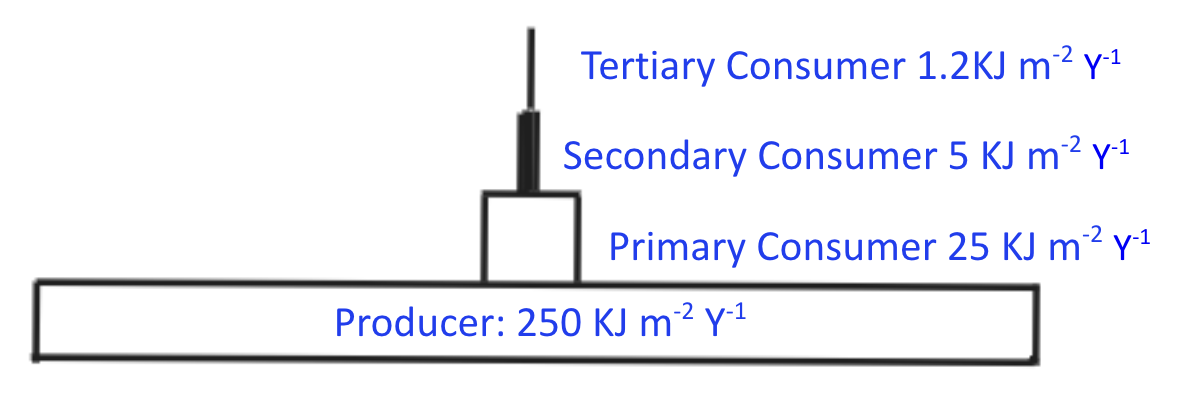
90% of energy is lost btwn trophic levels
organisms lose energy in forms of heat during respiration
organisms die before being eaten → energy not available to next level
some parts of organisms are not eaten
some parts are indigestible (ex. cellulose)
loss of energy restricts the number of trophic levels in ecosystems
each stage in food chain has less total biomass → less energy available to organisms at higher levels
source of energy for most food chains = sun
autotrophs get light energy → photosynthesis → carbon compounds
consumers eat autotorphs/other consumers
most (90%) of energy lost as heat btwn trophic levels
decomposers get energy from dead plants/organisms
productivity - rate of generation of biomass in an ecosystem
primary productivity - producers synthesizing compounds to create biomass
secondary productivity - heterotrophs feeding to increase biomass
always lower than primary productivity
productivity varies per biome
tropical rainforests get more rain + high temperature → plants grow fast
deserts have a lack of water → plants grow slowly
low primary productivity → reduces secondary productivity
loss of CO2 = loss of biomass
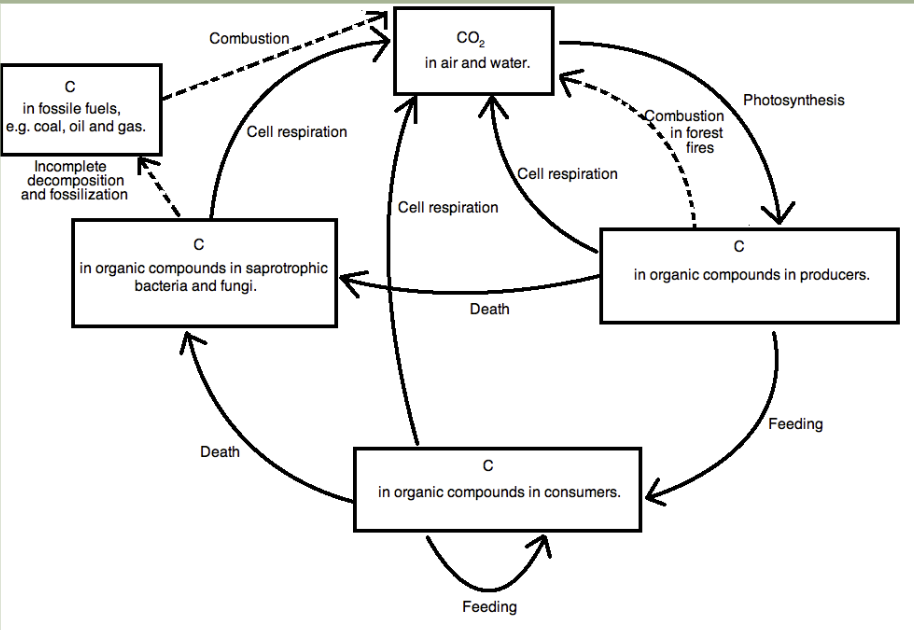
Carbon cycle
to air
combustion
fossil fuels
forest fire
cellular respiration
decomposers
consumers
producers
to producers
photosynthesis
to consumers
eating producers
feeding on each other
to bacteria/fungi
death of producers + consumers
to fossil fuels
incomplete decomposition + fossilization
carbon sinks - absorb co2 from atmosphere
ecosystems where photosynthesis exceeds respiration
net uptake of CO2
examples
fossil fuels (peat, coal, oil, natural gas) in distant past
formation of biomass (wood) currently
carbon sources - release co2 into atmosphere
ecosystems where respiration exceeds photosynthesis
net release of CO2
examples
combustion of biomass, peat, coal, oil, natural gas
human activities
combustion of fossil fuels
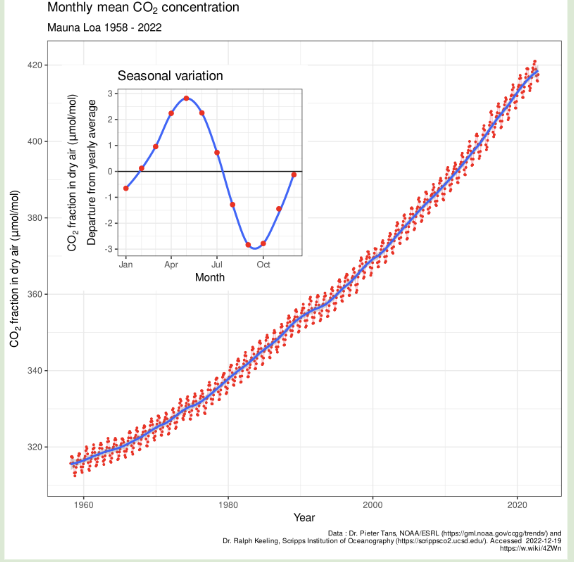
Keeling curve - shows change in earth’s atmospheric co2 concentrations
most landmass + plants in northern hemisphere
summer/winter in northern hemisphere → greater impact on keeling curve
photosynthesis peaks in summer → more CO2 removed from atmosphere
photosynthesis decreases in winter → more CO2 added to atmosphere
general increase in atmospheric CO2 since 1940s
human activity
heterotrophs require oxygen produced by autotrophs for aerobic respiration
autotrophs require CO2 produced by heterotrophs for carbon fixation
all chemical elements are cycled within ecosystems
decomposers release chemical elements from dead organisms back into ecosystems
loss of chemical elements → reduces productivity
many ecosystems are stable without human activity
tropical rainforsests - millions of years
desert ecosystems - 60 million years
requirements for stable ecosystems
supply of energy
recycling nutrients
genetic diversity
climatic variables within tolerance levels
tipping point - critical threshold that when crossed = large/irreversible changes in the climate system
ex. brazilian forests may be at tipping point for climate change
generate atmospheric water vapor via transpiration → cools atmosphere → impacts air flow + rainfall
rain forests = carbon sinks
20% of amazon rainforest been deforested
impact wind + rainfall → climate change
mesocosms - indoor environmental systems mimicking a natural environment under controlled conditions
allow to control/manipulate variables while investigating ecosystems
keystone species - species w a disproportionate effect on the structure of their community
ex. wolves in yellowstone
harvesting < replacement → harvesting plants/fish from ecosystem = sustainable
must have sufficient adult organisms to ensure enough offspring
commercial fishing usually not sustainable
sustainable fishing - harvesting fish where fish population does not decline over time
ex. alaskan cod
maximum sustainable yield - largest catch of fish that can be sustained without causing fish stocks to decrease
ex. silver top palms
remove leaves → harvest without killing plant
sustainable farming - agricultural production that meets current needs of food production + preserving natural environment
factors affecting sustainable farming
soil erosion
leaching nutrients
eutrophication - a body of water becomes enriched w nutrients and leads to algal growth
algal growth → increase biological oxygen demand
may become anoxic → animals die bc of low oxygen levels
prevents sunlight reaching plants in lake → plants die
nutrient levels decrease → algae dying
dead plants + algae accumulate → aerobic bacteria decompose
supply of fertilizers + other inputs
pollution bc of agrochemicals
carbon footprint
biomagnification - increase in concentration of a substance in tissues of organisms at successively higher levels in a food chain
ex. DDT
used to kill insects
does not readily break down in fat tissue
insects → fish → birds (ospreys)
causes shells to be very thin → shells break → offspring dead → osprey population decreases
ex. Minamata disease - neurological disease caused by biomagnification of methylmercury
mercucry released into manamata bay by chemical factory → bacteria turn it itno methylmercucry
plankton → fish → people
macroplastics - large visible debris
microplastics - produced by physical breakdown of macroplastics
evidence that consumption of plasitc → killed many Laysan albatrosses
sea turtles eat plastic bags → plastic becomes lodged in oseophagus → feeding problems
rewilding - aims to restore degraded ecosystems back to normal
reintroduction of keystone species
reestablishing connectivity of habitats through wildlife corridors
wildlife corridors - areas of habitat connecting wildlife populations separated by human activities/structures
allow
migration
expanding habitat range
increasing biodiversity
greater genetic variety
management of ecosystems to reduce human impact
Hinewai Reserve - goal to regenerate native vegetation + wildlife
ecological succession - process of change in an area of a period of time caused by complex interactions btwn organisms and the environment
primary succession - begins when an area of ground/bare rock with no existing soil is colonized
after volcanic eruptions/retreat of glaciers
ex. glacier bay national park
glacier retreats → bare rock
pioneer species colonize → pioneer dies → soil quality improves
pioneer species replaced by other communities → more soil improvement
woodland of alder trees present
replaced by a climax community → reduces pH → bad soil
climax community - ecological community where populations of organisms stay stable + exist in balance w each other/environment
final stage of succession + remains unchanged
secondary succession - started by a disturbance that reduces an already established ecosystem to a smaller community of species
abiotic factors involved
natural disturbances
retreating glacierss
forest fires
changes to soil composition
nutrient deposition
weathering
pollution
geolocial changes
soil erosion
biotic factors involved
pioneer species
modify environment → lets new species colonize
species competition
predation and prey cycle
keystone species
changes that occur during succession
size of plants
small → big
primary production
biomass increases over time
species diversity
increases
complex food webs
increases
nutrient cycling
soil builds up → more nutrients recycled
cyclical succession - community is changed by recurring events/changing interactions w species of plants/animals
ex. wildfires
plants have adaptations
lodgepole pines produce serotinous pine cones → release seeds after extreme heat
always secondary succession
arrested succession - natural progression of plant species is halted due to human activity or other factors
grazing livestock
eat vegetation that could grow more
reduces biodiversity
draining wetlands
less water → dryer soil
less biodiversity
anthropogenic climate change - climate change caused by humans
combustion of fossil fuels + wood → co2
farming cows, sheep, rice → methane
more co2 + methane → increase in global temp
greenhouse gases
climate change - long term shifts in temp + weather
positive feedback loops increase global warming
snow + ice
snow + ice reflect solar radiation
snow + ice melt → dark land/water exposed → absorb solar radiation as heat → more global temp
decomposition of permafrost
permafrost stores carbon
permafrost thaws → peat is decomposed → releases CO2 + methane → keeps heat
release of carbon dioxide from deep ocean
oceans = carbon sinks
temperatures increase → volume of CO2 that can dissolve in water deccreases + co2 released from oceans back to atmosphere
alterations in precipitation
more drought + dry condition → forest fires more liekly → release CO2
boreal forests = carbon sink
carbon stored underground
low temp → less decomposition
warm temperatures + decreased snowfall
more droughts → reduces primary productivity → volume of CO2 removed decreases
forest browning
drought → leaves turn brown
increases frequency + intesnity of wildfires
decreasing trend in area of arctic sea ice over time
landfast ice + sea ice melting
emperor penguins need sea ice to form breeding colonies
less sea ice → less emperor penguin colonies
sea ice melts before chicks can swim
walruses use ice floes for resting + feeding young
loss of ice floes → affect ability to hunt + feed young
walruses rest on beaches further from food
stampede of walruses → young walrsuses crushed to death
travel longer to get food → more difficult to feed young
nutrient upselling - cold nutrient rich water rises from bottom to surface of ocean
brings nitrate + phosphate to phytoplankton on surface
high primary productivity of phytoplankton → supports biodiversity
climate change
changes in wind patterns
changes frequency + extent of nutrient upwelling
alteration of ocean circulation patterns
alters frequency + extent
warm water prevents upwellings if there is no wind
no nutrient upwelling → primary productivity decreases → phytoplankton productivity decreases → decrease in biodiversity
species adapted to specific climates → climate change → range of species changes
move up to higher elevations
ex. birds in new guinea
birds move range to cooler/higher altitudes on mountains in new guinean montane forests
bird populations decreasing at lower altitudes
upslope range shift
birds move upslope → habitat is compressed
ex. north american trees
move northward to cooler climates
poleward range shift
contracts overall range of many north american tree species
coral reefs - one of the most biodiverse marine ecosystems
under threat
ocean acidification
more co2 coming into oceans → lower pH
co2 + water = carbonic acid
carbonic acid dissociates → H+ ions
H+ ions react w carbonate ions → hydrogen carbonate → reduces carbonate for corals to make their exoskeletons
coral bleaching bc of higher water temperatures
corals have mutualism w zooxanthellae
zooxanthellae give coral nutrients via photosynthesis
higher temperature → zooxanthellae dispelled → lose color (bleached)
danger of starvation
collpase of coral reef → extinction of many ocean species
carbon sequestration - process of capturing + storing atmospheric CO2
plants remove co2 during photosynthesis
carbon in biomass of plants as carbon compounds
plants die + decompose → carbon sequestered in soil
in peat wetlands → carbon stays sequestered in soil bc of acididity
carbon sink
more ways to sequester carbon
afforestation
establishing forests where there isnt tree cover
forest regeneration
regrowing a forest after a disturbance (reforestation)
restoration of peat wetlands
peat - forms when organic matter is not fully decomposed because of acidic or anaerobic conditions in watterlogged soil
phenology - study of cyclic + seasonal natural phenomena
flowering - plants produce flowers
budburst - emerging of new leaves
bud set - cessation of bud growth
migration
nesting
plants use changing temp/photoperiods to influence biological processes
photoperiod - length of time in a day an organism recieves light
interactions btwn species disrupted by climate change
global warming disrupts timing of biological events for temp but not photoperiod
ex. reindeer and arctic mouse eared chickweed
chickweed growth determined by increasing temp in late spring/early summer
migration of reindeer determined by photoperiod + move north in early spring
chickweed grows earlier → less chickweed available as food for migrating reindeer when they arrive
ex. great tit + caterpillar biomass
hatching of great tit offspring matches abundance of caterpillars in spring
caterpillar = important food source for birds + offspring
hatching = trigger for great tit egg laying
increasing temperature = trigger for growth/development of caterpillars
peak biomass of caterpillar comes earlier → offspring hatch after peak caterpillar biomass → shortage of food → number/mass of offspring produced by great tits decreased
spruce bark beetles eat spruce trees → infestation kills spruce trees
warmer temperatures → spruce bark beetles complete life cycle in 1 year instead of 2 → reproduce more frequently → increase in spruce bark beetle population → death of more spruce trees
plumage of owls
tawny owls → genetics
grey or brown
evolution
selection presures
decreasing snow cover bc of climate change
genetic variation
intraspecific competition
produce more offspring than environment supports → competition
favorable adaptation
brown more likely to survive mild winters
better camouflage
survive + reproduce
brown more likely to survive than grey
genetic inheritance
brown is favorable → more likely to be passed down
natural selection
frequency for brown increases over time