Thinking like an Economist
1. Economists Have Two Roles
Scientists: Try to explain how the world works.
Policy advisors: Try to improve the world.
2. Scientific Method in Economics
Economists use the scientific method to develop and test theories.
Observation: Collect and analyze data.
Develop a theory: Create an explanation based on observations.
More observation: Use additional data to test/evaluate the theory.
Economists generally cannot use laboratory experiments.
Instead, they pay close attention to natural experiments provided by history.
3. Assumptions & Models
Economists make assumptions to simplify a complicated world.
Models are simplified versions of reality.
Models:
Leave out details so important ideas are easier to see.
Are built using assumptions.
Help improve our understanding of the economy.
Can be revised when new information becomes available.
4. Circular-Flow Diagram
A visual model of the economy that shows how dollars flow through markets between households and firms.
Two Decision Makers
Households
Firms
Two Markets
Market for goods and services
Market for factors of production (inputs)
Households
Own and sell the factors of production.
Buy and consume goods and services.
Firms
Hire and use factors of production.
Produce and sell goods and services.
5. Markets for Factors of Production
Inputs/factors of production are bought and sold.
Sellers: Households
Buyers: Firms
Examples of factors of production include:
Labor
Capital
Land
Entrepreneurship
Think: Households → sell inputs → Firms
6. Markets for Goods & Services
Goods and services are bought and sold.
Sellers: Firms
Buyers: Households
Think: Firms → sell goods/services → Households
7. Production Possibilities Frontier (PPF)
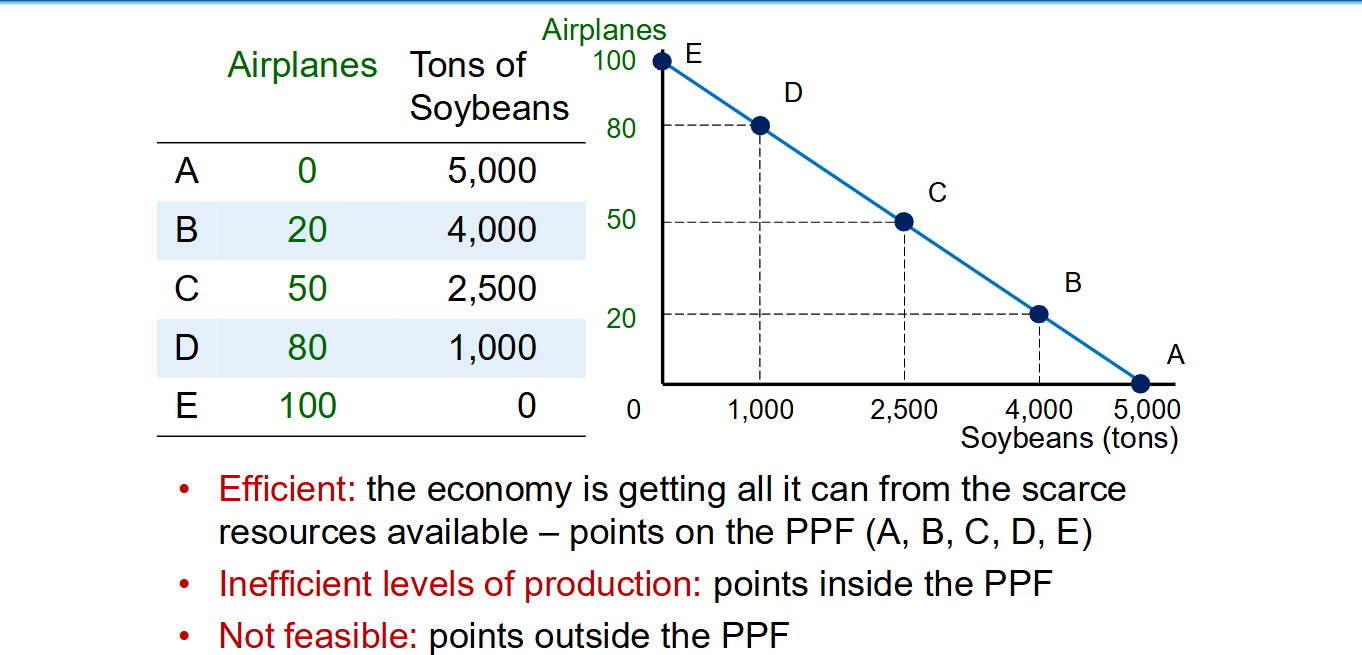
A PPF is a graph showing the various combinations of outputs that an economy can possibly produce.
The possibilities depend on:
Available factors of production
Available production technology
Key PPF Ideas
Points on the PPF = efficient/attainable combinations.
Points inside the PPF = attainable but inefficient.
Points outside the PPF = unattainable with current resources and technology.

________________________________________________________________________
Fields of Economics
Microeconomics: The study of how households and firms make decisions and interact in specific markets.
Macroeconomics: The study of economy-wide phenomena, including inflation, unemployment, and economic growth.
Positive vs. Normative Economics
Positive Statements (The "Scientist" Role):
Definition: Descriptive statements that attempt to explain the causes of economic events and describe the world as it is.
Verification: Can be confirmed or refuted by examining empirical evidence.
Example: "Minimum-wage laws cause unemployment."
Normative Statements (The "Policy Adviser" Role):
Definition: Prescriptive statements that attempt to dictate how the world should be.
Basis: Built on value judgments about what ought to be done to improve economic outcomes.
Example: "The government should raise the minimum wage."
SHOULD NEVER SAY THIS
Economic Agencies & Roles
Executive Branch Advisers
Council of Economic Advisers: Advises the president directly and writes the annual Economic Report of the President.
Office of Management and Budget (OMB): Helps formulate federal spending plans and regulatory policies.
Department of the Treasury: Helps design and implement tax policy.
Department of Labor: Analyzes data on workers/job seekers and formulates labor-market policies.
Department of Justice: Enforces the nation's antitrust laws to maintain market competition.
Legislative & Independent Agencies
Congressional Budget Office (CBO): Provides economic advice and budget analysis directly to Congress.
The Federal Reserve: An independent entity that sets the nation's monetary policy.
Presidential Decision Making
The president receives input from a wide circle, not just economists.
Advisory Groups: Economists, communication advisers, press advisers, legislative affairs advisers, and political advisers.
Final Choice: The president makes the ultimate decision, balancing all competing advice.
Why Economists Disagree
Despite broad agreement on many foundational propositions, economists often conflict on policy advice due to two main factors:
Differences in Scientific Judgments:
Different hunches regarding the validity of alternative positive theories.
Different judgments about the size of parameters that measure how economic variables relate to one another.
Differences in Values:
Differing political philosophies and normative views regarding what a specific policy should ultimately try to accomplish.