Normal Pediatrics
Newborn/neonate (Below 1 month)
Infant (Below 1 year)
Toddler (1-3 years old)
Preschooler (3-6 years old) or Early childhood
School age (6-12) or Middle childhood
Adolescent (12-18 years old) or Teenage
Growth and Development
Growth
Increase in size (height and weight)
Quantitative change, measurable data
Rapid in infancy period
Slow in school age
Increases in beginning of adolescence
Off in early adulthood
Weight
Is most important health indicators
“At birth, weight is more variable than height”
Newborn: 7-7.5 pounds (3.2 kg - 3.4 kg)
Note: Neonatal weight loss is normal below 1 lb
Doubles at 6 months
Triples at 12 months
Quadruples at 24 months
Height
Increases due to skeletal growth; elongation of Diaphysis; nutrient needed is Calcium; vitamin needed is Vitamin D
Calcitriol - active form of vitamin D by the kidneys
Newborn is 20 inches (Do not report if slightly different)
Doubles after 4 years
Triples after 12 years
Development
Advancement from lower to more advanced stage (skills and abilities)
Qualitative change, observable data
Developmental task - set of skills and competencies that children must accomplish to deal effectively with their environment
Growth and Development
Have predictable patterns, orderly, continuous, and progressive
Each human being experiences in an energy of time unique to every individual
Cephalocaudal (head-to-toe)
Proximodistal (near-to-far)
Maturation
Increase in competence in competence and adaptability (capabilities)
DDST (Denver Developmental Screening Test)
Used to assess developmental growth
Categories
Gross before Fine motor skills
Big movements before small movements
Language
Universal language of children?
Play
Crying (no crying means hearing loss)
Personal Development Theories
Sigmund Freud - Psychosexual
Erik Erikson - Psychosocial
Jean Piaget - Cognitive
Lawrence Kohlberg - Moral
Social
Play
major socializing agent
Encourages expression
Provides stimulation needed to learn
Types of play
Solitary - Infants; Alone
Parallel - Toddler; Independently but among other children
Cooperative/Associative - Preschooler; Together and engaged in similar activities
Competitive - School age; Competition
Reflexes
Rooting - Stroking cheek triggers sucking
Sucking - Stroking lower lip triggers sucking
Tonic neck - If the child’s neck faces the left, the left arm will extend and right arm will flex
Palmar - Closes fingers around an object in the palm
Plantar - Toes curl down when the sole of the foot is pressed (Tarsal area)
Pincer grasp - Holds an object using thumb and index finger (prone to aspiration)
Parachute - Extend the arms out when about to fall
Babinski - Stroking sole of the foot triggers fanning out of the toes. It shall disappear in toddler stage or 3 years old or it could be glioma (brain tumor)
Moro-startle reflex - Moro is movement or motion, startle is sound
Note: Most involuntary reflexes start to fade within 6 months in exchange for voluntary reflexes
Developmental milestones
1 month
Strong head lag (prone to cervical neck injury)
Hands predominantly closed because of strong (+) grasp reflex
Watches parents face intently as they talk
2 Months
Lifts head while in prone
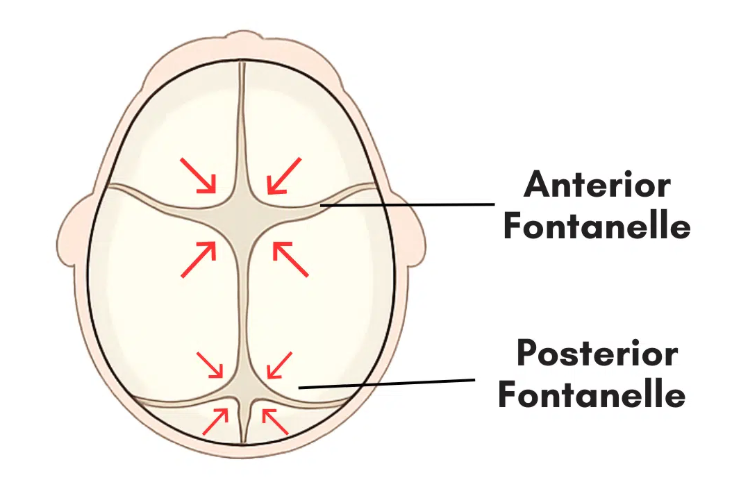
Closure of posterior fontanelle (triangular shape)
Fontanelles are open at birth to allow brain growth
Demonstrates social smile
3 months
Lifts head and shoulders while in prone
Slight head lag
Able to hold head more erect when sitting but still bobs forward
(-) grasp reflex
Can recognize familiar faces (mother) and objects (feeding bottle - mother’s milk)
4 months
Rolls back to the side
Balances head well in sitting position
(-) moro, (-) tonic neck, and (-) rooting reflex
Anticipates feeding when sees mother or bottle
5 months
Can turn over from abdomen to back “roll over”
Priority: safety
Do not let infant sleep in prone position to prevent SIDS
Sudden Infant Death Syndrome - can also be caused by cosleeping, soft beddings, pillows
Holds head erect and steady when sitting
Smiles at mirror image
6 months
Holds bottle
Extend the arms out to be picked up
Begins to imitate sounds
Onset of stranger anxiety
(-) Crying: sign of autism spectrum disorder
Eruption of the temporary teeth “milk teeth/deciduous teeth”
1st teeth: 2 lower central incisors (1st dental visit)
2nd teeth: 2 upper central incisors
3rd teeth: lateral incisors
Complete: 3 years
Total: 20
Replace: 6 years
Signs of teething:
Drooling
Gum rubbing
Increased finger sucking
Biting on head objects
Inflammation/pain of gums (give cold teething rings or dry crackers)
7 months
Sits, leaning forward on both sides
Transfers object from one hand to another
8 months
Sits steadily unsupported
Crawling
Onset of separation anxiety
Combines syllables “mama” and “papa”
Parachute reflex appear
9 months
Creeping
Pulls self to standing position
Stands holding on to furniture
Note: Infants who do not pull a standing position by 11 to 12 months of age should be further evaluation for possible Developmental Hip Dysplasia
Onset of pincer grasp
Priority: Prevent aspiration
10 months
Stand with support
Says “mama” and “dada” with meaning
Develops object permanence
11 months
Cruising
12 months
May attempt to stand alone momentarily
May attempt to take 1st step alone
Can say 3-5 words with meaning
15 months
Walks alone
18 months
Run and climb stairs
Closing of anterior fontanelle
Anterior is diamond shaped; posterior is triangular shaped
Anterior is wider than posterior
Anterior fontanelles close later then posterior fontanelles
Bulging of fontanelle is normal if child is crying
Fontanelles cannot close if there’s increased intracranial pressure
Fontanelle depression indicates dehydration

Anthropometric measurement (Newborn)
Head circumference: 33-35 cm (largest)
Chest circumference: 31-33 cm
Abdominal circumference: 31-33 cm
Jaundice
RBC breakdown is done by spleen
Main component of RBC is hemoglobin
Heme > unconjugated bilirubin (water insoluble)
Globin > ammonia
Liver converts unconjugated bilirubin to water soluble to be excreted in the GIT through defecation
Neonatal jaundice
is normal if it occurred 24 hours after birth, called physiologic jaundice. If color stated to change earlier than 24 hours after birth, it is abnormal and now called pathologic jaundice
Caused by liver immaturity > (-) conversion > hyperbilirubinemia
Management: Phototherapy
Remove clothes
Cover the eyes to prevent retina damage
Cover the genitalia
Basic needs of newborn
1. TO BE WARMED
To prevent hypothermia and heat loss
Newborns have poor thermoregulation
Caused by immature hypothalamus and less brown fat
These are previous board exam questions
Term | Definition |
|---|---|
Evaporation |
|
Convection |
|
Conduction |
|
Question | Answer |
Most basic way to prevent infection | Handwashing |
Most effective way to prevent infection | Vaccination |
2. TO BE PROTECTED
Vaccination
Vaccine | Site and indication |
BCG |
|
Hepa B |
|
Vitamin K |
|
Can we vaccinate a child with fever? Yes, but…
If greater than 38.5 and above (hyperpyrexia). Withhold
Can succeeding doses be given late? Yes
Can succeeding doses be given in advance? No
3. TO BE FED
To prevent hypoglycemia
Blood glucose should never be below 40 mg/dl
Uninterrupted breastfeeding (kahit kailan kailangan ng baby)
RA 7600 “Rooming-in and breastfeeding act of 1992”
Exclusive breastfeeding EO 51 “Philippine milk code of 1986” - Pure breast milk until 6th month
Breastmilk is low in sodium but high in colostrum which contains IgA (immunoglobulin protein for protection)
Food should not be mixed in the bottle and fed through a nipple with a large hole
Introduction of solid foods is allowed 6 months; Intervals at 4-7 days to identify allergies
Basic needs of Infant
Psychosexual development
Oral stage
Feeding, pacifier
Risk of aspiration, infection
Priority consideration: Washable toys to prevent infection
Psychosocial development
Trust vs. Mistrust
Consistent provision of basic needs
Avoid numerous individuals catering the needs of the infant
Cognitive development
Sensorimotor (learning through senses)
Solitary play (rattles and colorful toys)
Significant other: Mother
Fear: Stranger
Basic needs of Toddler
“The Great Imitators”
Psychosexual development: Anal stage
Toilet training (use potty seat)
Psychosocial development: Autonomy vs. Shame and Doubt
Normal “Negativism” = no, no, no (offer choices)
Discipline: Time out or face the wall
Normal temper tantrums
Promote safety: Give helmet and ignore the behavior
Do not pick them up during tantrums to prevent injury
Cognitive development: Preparational
“Egocentrism” or inability to see the point of view of others
Moral development: Preconventional / premoral
Parallel play like push and pull toys
Significant other: Parents
Fear: Separation
Basic needs of Preschooler
“Magical Thinkers”
Imaginary friends (normal)
Highest level of curiosity
Priority: Safety; Risk of poisoning
Ritualistic behavior
Psychosexual development: Phallic stage (loves opposite sex and hates same sex)
Psychosocial development: Initiative and Guilt (allow child to participate)
Cognitive development: Preoperational
“Conservation” or inability to conserve
Moral development: Preconventional
Cooperative play like role playing
Significant other: Playmates/siblings
Perception of death: Reversible
Fear: Body mutilation and darkness
Basic needs of Preschooler
Psychosexual development: Latent stage
Psychosocial development: Industry and inferiority
Support child’s activities
Recognize efforts and give compliments
Cognitive development: Concrete operational
Perceptual thinking: Judgements based on what they see
Conceptual thinking: Judgements based on reasoning
Moral development: Conventional
Competitive play
Significant other: Teacher
Perception of death: Irreversible
Fear: Death and School displacement
Basic needs of Adolescent
Menarche: Onset of menstruation
Thelarche: Onset of breast development
Adrenarche: Onset of sexual maturation (encourage proper hygiene)
Psychosexual development: Genital stage (Needs sex education)
Psychosocial development: Identity vs. Role confusion
Cognitive development: Formal operational
Moral development: Post-conventional (+) sense of morality
Focus: Body image
Significant other: Peers
Fear: Peer rejection
Cardiac Circulation
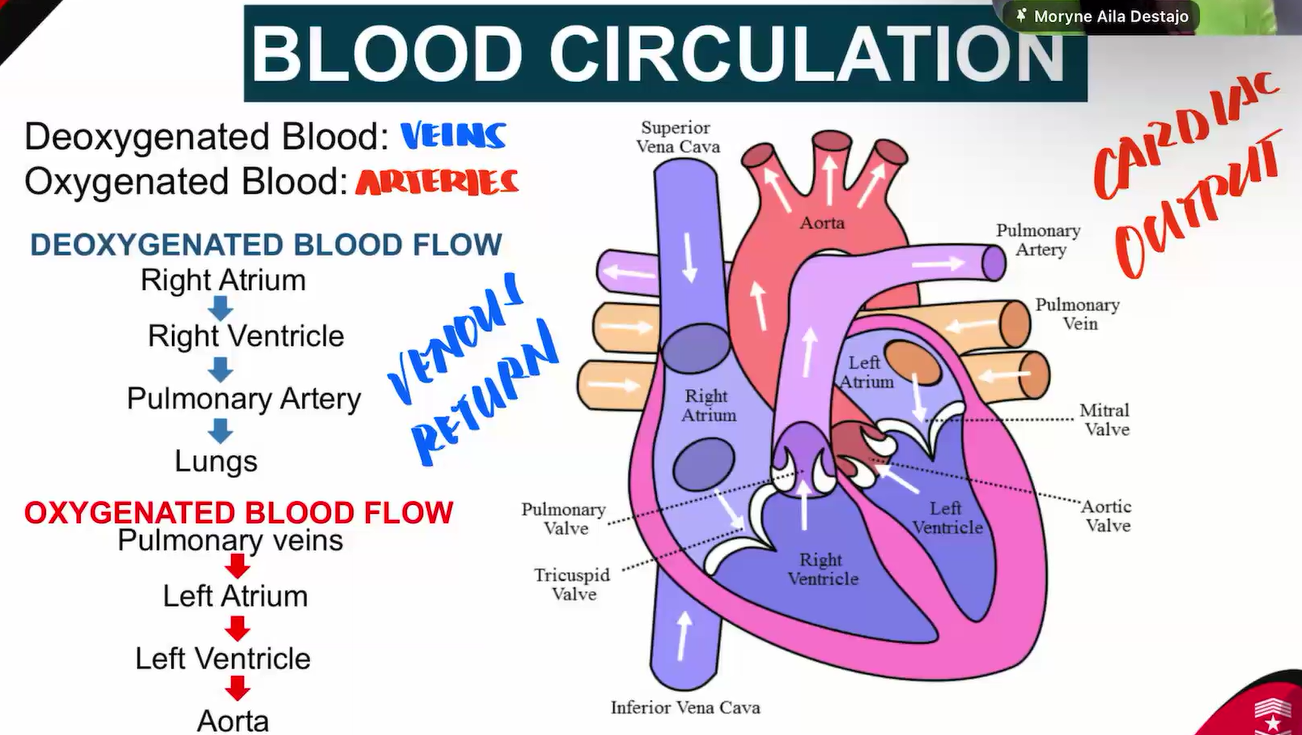
Oxygenated blood always have higher pressure
Fetal Circulation


Highest pressure is found in the right atrium which causes normal mixing of oxygenated and deoxygenated blood in the fetal heart

Fetal lungs is non-functional and fluid filled
Placenta serves as fetal lungs
IUFD - caused oxygen supply loss through compression of umbilical cord
Holes in the heart are normal inside the uterus
Most of them close at birth
No closure indicates heart defect