8.1-8.1 Ocean and Climate
8.1 Earth’s Heat Budget
heat budget — the incoming and outgoing heat on earth that must be balanced for constant conditions
incoming heat = outgoing heat
Solar energy
some goes into atmosphere, clouds, and earth surface
or absorbed by water vapor, clouds, and dust in atmosphere → turns into heat
energy absorbed by the earth goes back to atmosphere through conduction (direct contact), radiation (radiating heat in infrared radiation), and latent heat (largest pathway- through phase change, heat released or absorbed when water goes between S, L, Vapor state where heat travels along with water vapor into the atmosphere and returns back to the oceans when condenses)
Differential Heating
indirect sunlight on earth at the poles because the sunlight is more likely reflected than absorbed
poles also have higher albedo (how reflective its surface is) due to how light its surface is, ice snow and clouds in the poles increase albedo
Temperature Moderation
the poles emit more heat than received and the tropics receive more than they emit
but these extreme temperatures are regulated and prevented from going extreme through the transport of energy from tropics → poles
transfers are through ocean and atmosphere circulations
8.2 Winds and the Coriolis Effect
result of how different latitudes of earth rotate at different speeds, the equator must travel farther than the poles
Coriolis deflection in the North will always be right
Coriolis deflection in the South will always be left
Coriolis effect is stronger at the poles and weaker at the equator
3 Convection cells Per Hemisphere
Hadley cell- 0-30 degrees (rising air at equator and sinking air at 30)
Ferrel cell - 30-60 degrees (sinking air at 30 degrees and rising air at 60)
Polar Cell- 60-90 degrees (cold air sinking and rising at 60 degrees)
winds blow towards the equator at 0-30 degrees and 90-60 degrees, and towards the poles at 60-90 degrees
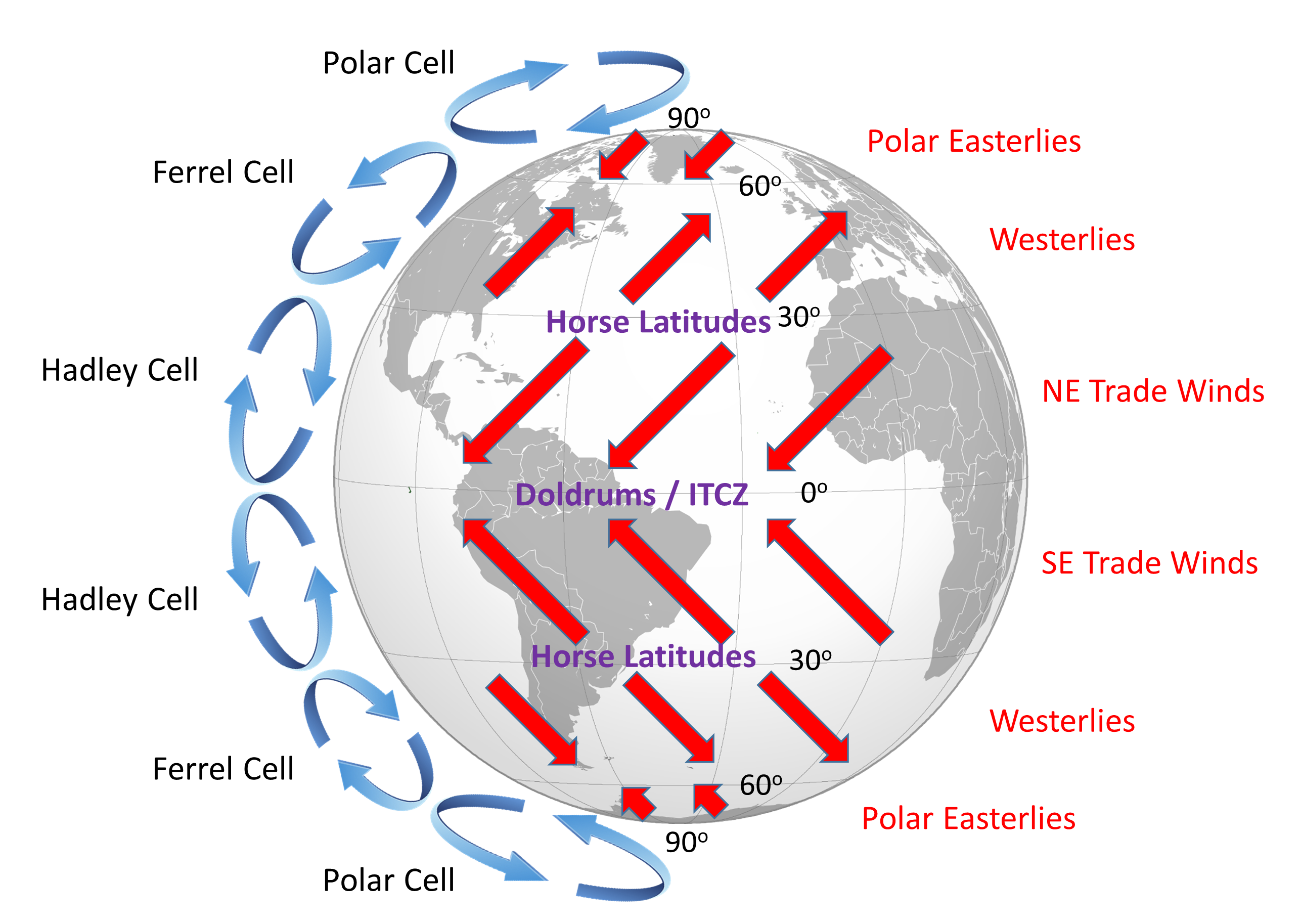
high/low pressure zones occur between wind bands
high pressure— where air is descending
low pressure— where air is rising
along the equator with rising air (LP) are doldrums or Intertropical Convergence Zone (ITCZ) where trade winds converge
at 30 degrees are descending air (HP) horse latitudes or subtropical highs
60 degrees are rising air (LP) called the polar front