Forensics
Week 1 - Morality, Social Control and Law
Historical background of Crime
During the Middle Ages crime was considered a conscious action against Gods will and the state.
Pre-modern justice systems based on religion and spirituality. Punishment was harsh and often focused on the physical (drive demons out - Vold et al 1998).
Laws mostly against the poor who were not part of the ruling aristocracy. In order to protect their wealth, the ruling astrcorcacy decreed most property crimes punsihable by death
Rise of modern society led to changes about criminal behaviour, characterised y the rise of secular rational thinking:
Humanist Ideas/Protestantism
Questioning the aristocracy
Scientific revolution (17c)
Philosophical enlightenment
Individual rationality/Free will
Criminal Law
Currently – criminals are those who violate the laws of the State, for certain acts to be considered a crime:
Actus Reus - Volunatary perpetration of crime
Mens Rea - Intention to comming the crime (premeditation)
Laws developed due to universal concerns with harmful behaviour - evolutionary origins (Ellis, 1987)
MALA in SE - Natural Law (rape, murder, assasult, theft) → Crime is that which interferes with our shared moral agency in the way we choose to live (Young, 1981)
MALA PROHIBITA - Human Law (traffic violations, illegal drug use, gambling, etc) → wrong only because a statute makes it so. Describes what is common and expected and can change
Social aspects to Crime
Obedience to Laws and Norms
Rule – power of authority
Role – legitimacy of authority
Value – guided by moral principles
Kohlberg’s stages of Moral Reasoning
Moral reasoning is based on avoiding punishment and obeying perceived authority figures. (Pre-convetional)
Moral reasoning is egocentric, with the person’s own needs being of greatest importance. Reasoning is based on the perceived balance of rewards and punishment. (Pre-convetional)
Moral reasoning is determined by other people’s needs, with personal relationships assuming importance. (Convetional)
Moral reasoning is based on maintaining society’s rules and laws in order to keep society in order. (Convetional)
Moral reasoning is underpinned by an understanding that society’s laws are a contract between the individual and society. However, under certain circumstances these laws can be broken. (Post-convetional)
Moral reasoning is determined by self-chosen ethical principles that are consistent over time and situations, and these may over-rule society’s laws if they come into conflict with each other. (Post-convetional)
There is no clear relationship between stage of development and offending behaviours (Jurkovic, 1980). Criminal behaviours can be justified at any level of moral development (Blackburn, 1993)
Stage 1 = if no punishment results
Stage 3 = if relationships are preserved
Stage 5/6 = protects human rights
Morality
What we know
Young people who have offended have lower moral maturity (Blasi, 1980)
Moral reasoning is lower but moral judgement is not (Emler & Winton, 1978)
No differences between young people who have offended and control group
Full range of stages in delinquent populations (Jurkovic, 1980)
Lower moral development – more prudent crimes (Thornton & Reid, 1982)
People who have offended have often reached at least stages 3/4 – so higher levels do not insulate against deviancy
Situational factors are important – e.g., people addicted to drugs have higher moral development (Jennings, Kilkenny, & Kohlberg, 1983)
Morality is a social skill that varies with context (Emler & Hogan, 1981)
Moral maturity of university students (Denton & Krebs, 1990)
Moral Maturity in Uni students
40 M and 40 F recruited at bars and parties
Moral Maturity assessed at bars/parties and again few days later at uni
Blood Alch assessed by rethalyser after each interview and level at bar/partyto create 2 groups (high and low alch)
All but 1 participant had drived home despite being over legal limit
The authors state: “This finding was surprising because subjects had just been interviewed about the values of life and law and the wrongfulness of impaired driving, had been given the results of a breathalyser test, and had been cautioned about the effects of driving whilst impaired.”
How participants rationalised their illegal and potentially dangerous behaviour → “I feel fine”, “It’s only a short drive home”, “I don’t want to pay for a taxi”, “The worst that can happen is they will take my license away”
Moral Agency and Moral Disengagement
Morality is self-sanctioning and may disengage to allow immoral behaviour
People view themselves as ethical and just. If they act differently, they invoked methods of morally disengaing, to justify behaviour
Social Learning + Moral cognition = Socio-cognitive theory of moral disengagment
Socio-cog theory of Moral disengagment → people experience moral conflicts when they come across valuale benefits requiring immoral behaviour
State sponsored Crime: War and Moral disengagement
Moral justification – e.g., threat to us, W.M.D.
Euphemistic language – e.g., collateral damage
Advantageous comparisons – we target only military bases, not indiscriminate like other nations
Diffusion of responsibility – ‘coalition of willing’
Distortion of consequences – freedom not suffering
Dehumanisation – evil regime by evil individual
Respectable citizens commit crimes: For example…
Jumping red lights
Not buying TV licences
Making false insurance claims
Paying cash in hand to avoid tax
Claiming benefits or subsidies not entitled to
Illegally downloading films, music, etc.
But why
Perceived injustices (misselling, hidden charges and over-priced premiums) lead to distrust, insecurity and cynicism towards legal rules
Distrust → people dont believe big busniness will stick to rules, Believe businesses and others will take advantage (cheat), Believe others will immorally increase risk for others
Fear and insecurity → People feel vulnerable: profit reigns – decrease of legitimacy, Fear of becoming a victim of others’ shady practices – e.g., car repairs, negation of insurance claims
Legal cynicism → People feel disengaged from legal norms, See others as disengaged from legal norms, Legal norms have no validity, Legal norms are useless in guiding behaviour in marketplace
What creates cynicism:
Socialisation:
parents – e.g. teaching how to interact with police
peers - e.g. observational learning
culture – e.g. movies or music
Experiences:
delinquency – getting away with it
poor response from authorities – unhelpful police
alienation from institutions - poor school commitment
observed justice – how police treats victims or offenders
Week 2 - Victim of Crime
Why people don’t report
Why vicitms don’t report crime:
Tried to report, but unable to contact the police
Private matter / dealt with matter themselves
Inconvenient to report
Reported to other authorities
No loss / damage
Common occurrence / just something that happens
Police could not do anything
Too trivial / not worth reporting
Police would not have been bothered / interested
Fear of reprisal
Partly own / family member / friend’s fault
Offender not responsibly for actions
Happened as part of job
Dislike or fear of police
Attempt at offence unsuccessful
Victim demographic:
Decreases with age
Varies by sexual orientation
Varies by disability status
Varies by the religion of the victim
NEW DATA: Increases if the victim’s gender identity is different from their sex registered at birth (i.e., trans or transgender)
Victimisation
Vicitmsation is not a single event, results in psychological, social and practical consequences. Shaped by responses of others and the justice system
Victimisation process (unfolds over time):
Before crime (assumptions about safety and control) → during crime (threat, dear, helplessness) → after the crime (meaning-making, recovery or distress)
Immediate psychological responses
Shock and Disbelief
Fear and Hypervigilance
Anger and Distress
Emotional numbness
Short term → sleep disturbance, anxiety, concertration difficulties
Long term → depression, PTSD symptoms, chnages in identity and trust
Role of social responses: Vicitm experience are shaped by family/friends, police repsonses, media portrayals, court responses. Supportive responses can aid recovery; negative responses can compound harm
Secondary vicitmation refers to being blamed or doubted, minisation of harm and insentive professional repsonses. Harm can come after reporting.
After a crime victims often ask why me, could i have prevented this called mean-making
Attribution theory → people seek causes for neg events like Interval v External, Stable v Unstable, Controllable v Uncontrollable (Heider, 1958)
Self-blame after vicitmisation (Janoff-Bulman, 1979) → self-blame is common after crime and takes 2 forms
Behavioural self-blame → (“I should have locked the door”)
Characterological self-blame → (“I’m careless / weak”)
Counterfactual thinking → mental process of imagining alternative outcomes to past events by considering what might have happened if something had been difference (Roese, 1997). Counterfactual thinking is often linked to self-blame, perceived control, and post-traumatic stress, and can influence how victims make sense of what happened and how they recover (Gilbar et al., 2010). Counterfactual thoughts can be:
Upward: imagining a better outcome (“If only I had locked the door, this wouldn’t have happened”)
Downward: Imagining a worse outcome (“It could have been much worse”)
Children and victimisation
Victimisation occurs during critical developmental periods
Crime has manvy types of victims:
Children may experience and may be victims even when not directly targeted:
Direct victimisation (i.e., physical abuse, sexual abuse, emotional abuse, neglect)
Indirect victimisation (e.g., domestic violence)
Repeated or chronic harm
Differ from adults in:
Cognitive development
Emotional regulation
Dependence on caregivers
Ability to seek help
Challenges getting children to report:
Know the abuser
Do not know who to turn to
Don’t know they were abused
Communication skills
Feel they did something wrong
Embarrassed
Effects of maltreatment in childhood
Death
Physical and mental disability
Mental health difficulties
Physical health difficulties
Emotional difficulties
Behavioural difficulties
Educational difficulties and failure
Impact on social and interpersonal functioning
Risk of further victimisation
Long-term effects in adulthood Hamilton-Giachritsis & Sleath (2018):
Borderline Personality Disorder
Depression
Post-traumatic Stress Disorder
Psychological Adjustment Problems
Suicidal Ideation and Behaviour
Traumatic Stress Symptoms
Intergenerational victimsation → transmission of harm across generations, leading to increased risk of victimisationa and offendimg. Cycles of abuse, neglect or violence. Risk is increased but not inevitable
If a child has a history of childhood abuse they either become maintainers or cycle breakers. If a child doesn’t a history of childhood abuse they either become intiatiors or controls
How cycles persist → social learning of behaviour, normalisation of violence, attachment disruptions, socioeconomic stress and limited access to support
Victimisation and later offending → some idividuals who are vicitmes as children may: experience revicitimisation, devleop maladaptive coping strategies or engage in offending behaviours
Implications for forensic psychology and Fear of Crime
Forensics psychologists may → Assess risk and vulnerability, Work with child and adult victims, Inform safeguarding decisions, Contribute to prevention strategies, Think about how victim experiences might inform your presentation assignment
Ripple effect of crime → spread of harm beyond the direct victim. Emo, psych, soc and practical impacts. Effects that can be immediate or long-term:
Indirect victimsation → Harmed through their connections to the victim (family, friends, co-worker, gen pop)
Vicarious victimisation → Harmed through exposure to oters trauma; withot direct or personal involvement (police, psychologists, lawyers, other practitioners, gen pop)
Wider societal impacts → Community level, increased fear and mistrust, social withdrawal, reduced use of public spaces, stigmatisation of areas or groups
General fear of crime:
Fear of crime has a significant impact on the lifestyles and quality of life of some individuals, with some restricting activities, such as avoiding certain areas, because of it
Fear of being harmed in some way is often more prevalent in the population than experience of an actual crime
Fear of crime is compounded by media effects and may lead to a heuristic bias in estimating the volume of crime.
The role of the Victims’ Commissioner is set down in the Domestic Violence, Crime and Victims Act 2004. The core principles are:
Independence of government and criminal justice agencies.
Inclusivity in representing all victims and witnesses, particularly the most vulnerable members of our community.
Transparency in all of our work, including in the issues the Commissioner raises with policy makers and our priorities for change.
Encouraging responsibility through work with all criminal justice and local agencies to ensure the voices of victims and witnesses are heard and that each organization takes responsibility for them.
Week 3 - Interrogations, Deception and False Confessions
Interrogations
Investigative interviewing - main purpose to elicit reliable, accurate and legally admissible info (Schollum, 2005)
~80% of all evidence gathered during crime investigation comes from interviewing, while physical evidence accounts for the remaining 20% (Yeschke, 2003)
Two-stage approach:
The interview – designed to allow suspects to admit to the crime (or not);
The interrogation – designed to persuade/pressurise suspects into admission.
Suspects make confessions or incriminating statements in around 60% of interrogations and in around 80% of guilty pleas (Baldwin, 1993).
Disticintion between accusatorial (US) and Info-gathering (UK) approahces. Accusatorial approach typically involves:
Power imbalance, where the interviewer is in control
The use of confirmatory questions
The use of psychological manipulation
Interrogation with the sole purpose of obtaining a confession breaks key principle of investigative policing – the presumption of innocence (UN General Assembly, 1966, Art. 14:2).
Reid technique → 9 step interrogative process with 3 main stages:
Custody and Isolation: suspect detained, isolated → creates anxiety and uncertainty, increases incentives to escape situation
Confrontation: suspect accused of crime & evidence (real or manufactured) is presented – suspect’s denials and objections refuted
Minimisation: interrogator sympathises with suspect to gain trust – morally justifies crime and provides alternatives which are easier to admit.
Deception
Theories of deception:
Emotional approach → Lying causes emotions that differ than those caused by telling the truth, which can lead to micro-expressions of these emotions. (Ekman, 2001). The stronger the emotion = the more “leakage”.
Cognitive load → Lying may be more mentally demanding than telling the truth. High cognitive load disrupts speech leading to long pauses & is associated with reduced body movement (Vrij, 2015; Vrij et al. 2017).
Self-presentation → Liars goal is to present as a truth-teller. The discrepancy between a liar’s reality and their presentation results in them being ambivalent or tense. Their statements might also be more vague.
Deception detection theories are influential but influence ≠ accuracy. Research typically low-stakes lab studies with student participants. With few exceptions, accuracy levels for human-detected deceptions falls between 45-60%. Paul Ekman’s emotion micro-expression approach
Influence:
Pioneered the scientific study of facial expressions and emotions.
Developed Facial Action Coding System and popularised idea of “leakage” of concealed emotion.
Strong impact on policing, security, and public understanding of deception.
Key criticisms
Emotional expressions are not uniquely tied to lying (e.g., guilt, anxiety also occur in truth-telling).
Limited empirical support that micro-expressions reliably indicate deception or that training significantly improves detection abilities.
High risk of confirmation bias when observers expect deception
Predictors of lying: DePaulo et al (‘03) meta-analysis examined 158 behaviours. Results indicated: reliable cues to deception were scarce, behaviours that are related to deception has small effect sizes. Weak predictors of deception include:
Liars appear more tense and nervous than truth tellers, reflected in dilated pupils and higher voice pitch.
Liars are rated as less cooperative than truth tellers and their faces are perceived as less pleasant.
Liars talk for a shorter time and include fewer details compared to truth tellers.
Liars’ stories are less plausible, less logically structured and more ambivalent.
Liars also sound more uncertain, and their communication is less direct, relevant and personal.
Truth tellers spontaneously correct themselves more often and admit not remembering more frequently
Statement validity analysis: SVA, 4 stage procedure (Kohnken, ‘04)
Thorough analysis of the case-file
A semi-structured interview where the person tells their story, which is recorded and transcribed.
Credibility is assessed using Criteria-Based Content Analysis (CBCA) - a list of 19 criteria, e.g., logical structure, descriptions of interactions and self- deprecation.
Finally, validity and interviewee motivations are considered.
Vrij’s (2005) review showed 73% accuracy rate, and the technique proved equally effective at detecting truthful and fabricated accounts.
Polygraph Testing → Measures autonomic arousal (cardiovascular, respiratory, electrodermal). Assumes lying produces detectable arousal. Limitation: arousal is not deception-specific.
Comparison/Control Question Test (CQT)
Relevant vs control vs neutral questions
High false positive rate
Guilty Knowledge Test (GKT)
Detects recognition of crime details
Stronger laboratory validity
Vulnerable to information contamination
Not admissible in UK courts due to evidential uncertainty; used in post-release monitoring contexts.
False Confessions
Power of confession
Settles case without lenghty trial
Stops expensive investigation
Removes doubt about guilt
Leo (2008) – not all police interviews aim for the truth, the goal is often a confession
Since 1989, 640 cases exonerated by DNA (with many more wanting testing – Innocence Project). Of these 161 (25%) falsely confessed to the crime → Average time served = 15 yrs, 17 false confession exoneree’s had been on death row. Thought to be a vast under-estimation
Research:
Field research – high external validity & guilt status often unverifiable
Lab research – low external validity & verifiable guilt status
Who falsely confesses → Leo and Drizin (2004)
93% males
Types of offences → murder (81%), Rape (8%), Arson (3%)
Most likely confessors → <25 (63%), <18 (32%), Learning Disability (22%)
How they were discovered → real offendor found (47%), new scientific evidence (46%)
Types of False confessions:
Voluntary → no pressure and willingly report to authorities claiming to have committed an offence. Why: Seek notoriety, Need for self punishment, Relieve guilt for other misdemeanours, Unable to distinguish fact from fiction, Aim to protect true offender
Coerced-compliant → Pressures of coercion during interview, gives in to pressure for personal gain (to go home, phone call, sleep). Suspect knows they didn’t commit crime BUT short term gains outweigh long term benefits of maintaining innocence, want above all to end interview and likely to retract soon as immediate stress goes
Coerced-internalised → Suspect gradually accepts version of events in which they are guilty. Distrust own memories: believe authorities have more info than they, so must be right. Retract only when again become convinced of own innocence - can result in innocents continuing to believe in their own guilt. Tend to be trusting of those in authority. Lack self-confidence & have high levels of suggestibility (Kassin, 2005)
External factors:
Being in custody → increases anxiety
Lacking sleep or alcohol and/or drugs → difficulty with attention & emotion regulation
Length of interrogation wears people down → reduces rational decisions
False evidence may be presented (U.S. only) → cognitive & emotional acceptance
If begin to accept accusation → 3X more likely to plead guilty because believe they have no chance of winning (NRE, 2015)
Internal factors:
Compliant –> eager to please, obedient to authority, dislike confrontation with others (Otgaar et al., 2021)
Suggestible –> gullible, naïve, easily influenced (Gudjonsson, 1999)
Vulnerable → young people, people with mental illness, people with learning/ intellectual disabilities (Redlich et al., 2010)
Legislation to reduce false confesstions → UK changes in police interviewing techniques via police and criminal evidence act (PACE).
P (plan and prepare), E (engange and explain), A (account and clarify), C (confirm and close), E (evaluate)
Legal rules about how interviews are conducted:
No oppression
Entitlement to legal advice
Recorded interview
Only interviewed in police station
No interference with evidence
Must be informed of the nature of offence
Content analysis of false confessions → False confessions often include detailed, crime-specific information, including sensory details and internal states that appear insider-based. Nearly half also involve supplementary materials such as sketches, crime scene maps, or physical reenactments.
Week 4 - Eye witness testimony memory on trial
Memories are very intimate aspect of who we are. The CJS relies on people’s memories, so eyewitnesses are crucial. BUT human imperfection means that such as reliance may lead to errors and injustices.
Different aspects of the processes involved in memeory including: categories of processes (encoding and retrieval) and types of memory (non) declarative, stm/ltm, episodic/semantic)
Memories are not recording and different variables affect each process; so memories and remembering are not perfect
Memory processes
Encoding: Involves the creation of memory following stimuli and events
Process of transforming sensory info into a format that the brain can use. This can de different modes: acoustic (Sound), visual and semantic
Allows us to access info about past events later on
Variables impact encoding
Stress can either hinder or improve encoding (Shields et al, 2017). Highly stressful events can lead to better recall, often related to encoding (Reisberg & Heuer, 2007). This may be adaptive.
Attention: you need to attend to the information to encode it. Salient events catch attention more
Exposure time: Recall is more accurate when exposure time for target to be remembered is longer
Storage: Involves the storing of memories
The process(es) involved in keeping info in memory
STM: very limited and stores memories for a short period
LTM: stores info and memories long term and has a higher capacity
Non-declarative → does not require conscious awarness of remembering (e.g. walking, swimming). Knowledge is mostly expressed by actions rather than consciously recalling an experience.
Declarative → involves consciously recalling explicit info about facts and events.
Episodic memory → recieves and sotres info about the temporal aspects of events and the temporal-spatial relationships of events. It allows to mentally relive an experience . Is important in eyewitness events and testimony.
Semantic memory → is imperative for the use of language and refers to one’s knowledge about facts, less affected by loss or transformation
Retrieval: involves accessing memories from storage
In interviews, how you ask questions can affect retrieval, like witnesses are more accurate when answering open-ended questions (Kebbell & Wagstaff, 1999).
Leading questions suggest what the answer should be (Loftus, Miller, & Burns, 1978; Loftus 2005; Sharman & Powell, 2012).
Some types of questions may have more detrimental effect on recall (Sharman & Powell, 2012), including questions with few response options that also contain specific details.
Factors that impact eyewitness testimony
Witnesses are expected to recall the who, what, where and when. Attemtos to recall the context in which a memory was originally encoded. Encoding specificity principle → ‘the greater the similarity between the certain features of an event at the time of encoding and the prompts available at the retrieval stage, the more efficient recall will be’
Semantic memory may involve some forensically relveant content, but not enough to support an investigation. The legal system requires details → episodic memory
Introducing misinformation can distort memories (misinfo effects, Loftus & Hoffman, 1989). One explanation is know as the updateable memory hypothesis, proposes that memories are sort of flexibile and can be overridden by new info (including misinfo). Making eyewitnesses vulnerable to the influence of new and potentially inaccurate or biased info
False memories → individuals can recall events that didn’t occur for various reasons
Loftus and Pickrell (1995) → were able to induce false memories about having been lost at a mall in participants. There are different potential explainations that may invovled effects of diff stages of memeory and its use
Hyman and Loftus (2002) → may occur due to errors in monitoring the source of a memory - when a false memory is imagined, similar memories are activated. As a result, individuals don’t recall the source of the false memory and percieve it as accurate.
Others propose that repeated exposure to suggestions or false information can increase chances of recalling a false memory (Zaragoza & Mitchell, 1996).
Crimes can be tramatising and may affect a victim and their memory. Results vary
The effect of trauma on memory depends on diff variables. Evidence that emotional memories are recalled with greater accuracy (Thompson, Morton, & Fraser, 1997).
This may be because they are remembered and rehearsed more frequently (Tinti, Schmidt, Testa, & Levine, 2014).
But trauma can decrease or improve recall, depending on different variables.
Children as eyewitnesses
Some doubt that children can be reliable witnesses. BUT, there’s evidence that children can, under the right conditions, provide relatively accurate info about events (Peterson 2012)
Even young children can encode and store significant amounts of details. BUT their difficulty lies in retrieving this info → their verbal reports are very brief and need further support to recall more details. Various methods and techniques have been facilitate retrieval and ascertain that they provide accurate and complete reports
Developmental differneces
Children may start accessing their episodic memory at 3 years (Bauer, 2007; Nelson & Fivush, 2004).
Children can recall events for a long time, from 20 months (Fivush, Gray, & Fromhoff, 1987; Hudson, 1990; Nelson, 1988).
Recall and recognition memory
Utilising differnet kinds of questions can help retrieve specific info from memory. The mamner questions are phrases can activate recall or recognition memory. Processes that enbale retireval from declarative memory:
Recall: searching one’s memory to retrieve information
Generally more accurate, important in forensic context as it can support children’s reports. In response to recall questions, children’s reports are brief
Types of question: free recall, open-ended prompts , e.g. ‘tell me what you remember about the time when…’, ‘tell me more about..’ or ‘and then what happened?’, or more focused recall questions, e.g. ‘Who said that’, ‘when did you see him/her’.
Such ‘wh’ questions also elicit scant responses
Recognition: making judgments about whether a person, an object, or a situation is familiar
Specific direct questions aout aspects the interviewer deems important (did you go to school yesterday.
Direct questions facilitate younger children’s recall to a greater extent than free recall questions, as children as young as 3 years may not be linguistically advanced to answer open-ended questions.
Direct prompts may lead to inaccuracies
Put pressure on the child to agree with the interviewers → errors or suggestibility
Time of interview → interviews that take place immediately after an event elicit more details than after long intervals: children (and adults) tend to forget as time passes
Forgetting: more errors of omission that errors of commission
Lamb et al. (2000) found that after delays of more than 1 month, children reported fewer new details about alleged abuse than children who were interviewed closer to the event.
Age and retrieval:
Children 5+ report more details than 3-4 year olders in free recall rather than direct recall (Butler et al ‘95)
4-year olds who were interviewed on repeated occasions about an event that had happened at 2.5-years, reported more information at 4 than when they were 2. 74% of the information at 4-years was new (Fivush & Hammond,1990).
2-3-year olds could recall memories which were first experienced when they were 21 months (Hudson, 1990).
Multiple interviews facilitate retrieval
Age and question types:
Y children may have limited communication skills due to immaturity in expressive language
Asking very y children direct questions helps report more episodic info
Direct questions → Inaccuracies increase, particularly when the questions require a yes/no answer
Improving eyewitness testimony: Structured (or standard) interview
Phased procedure recommended: Free recall – witness recalls what they saw;
Open questions – witness invited to recall information additional to that given in free recall – ‘describe the attacker’
Specific questions – focus on detail;
Closed questions – contain a list of alternatives.
Avoid using leading questions: If used, should be followed up with open questions
Information obtained can be:
Biased – examples
Witness estimations of suspect height 28cm greater when asked “How tall was the man?” compared to “How short was the man?”
When asked about items not in witnessed event, witness more likely to reply “yes” when asked “Did you see the..?” than when asked “Did you see a..?”
Children remember less, and follow misleading question more, with authoritative interviewers
Minimal
Ineffective communication,
Constant interruptions – every 7.5 secs on average (Geiselman & Raymond, 1987)
Excessive use of pre-determined questions
Inappropriate timing of questions
Poor memory performance.
Cogitive interview:
Designed to provide more accurate information from witnesses, developed in USA (Geiselman et al., 1984; Fisher & Geiselman, 1992)
Based on fundamental theories of Memory and cognition. Intended to facilitate recall by enhancing memory and communication; Can increase information by 25-50%.
Cognitive Interview. Central process = guided retrieval: Witness takes the lead – interviewer guides and assists.
Make witness feel at ease:
Build rapport – communicate empathy and personalise interview (use first names);
Reassure witness that any emotional reaction is normal and fine– reduces stress;
Getting witness to relax before interview may not be enough – may need to do this before every question.
Rapport increases accuracy
Resist challenging, even if witness is inconsistent: May make them defensive.
+ Geiselman et al (1985/6) → Up to 35% more correct information from witnesses in recall of simulated events witnessed days earlier, No increase in the number of errors obtained.
- CI not as clearly beneficial with child witnesses (Köhnken et al., 1999):
Increases the incidence of errors or confabulated details, some more positive research with older children
CI not as great a positive impact on recall if compared to structured interview.
If info not there, to keep asking for recall leads to false info even from adults.
Biases related to prejudice and bigotry
Eyewitness testimony is very compelling and influential in court.
There are biases that may impact memory in eyewitness testimony. At the group-level, what variables might impact memory?
Biased face memory can increase racially biased judgement even when participants think consciously about race (Strick, Stoeckart, & Dijksterhuis, 2015).
Cross-race effect (CRE; see Meissner & Brigham, 2001 for an example of a meta-analysis): individuals are better at recognising faces of people of their own race than those of other, less familiar races.
Eyewitness testimony is very important for the criminal justice system.
But human memory is fallible. Although there are ways to improve memory, communication, and testimony, accuracy and reliability remain problematic.
Week 6 - Working with Young People
Intro
How psychology is applied in the Youth Justice System (YJS)
Assessment of risk, need, and vulnerability
Formulation
Intervention design
Understanding trauma and adversity
Communication and relationship building
Safeguarding and exploitation awareness
Court reports and recommendations
Multi-agency working
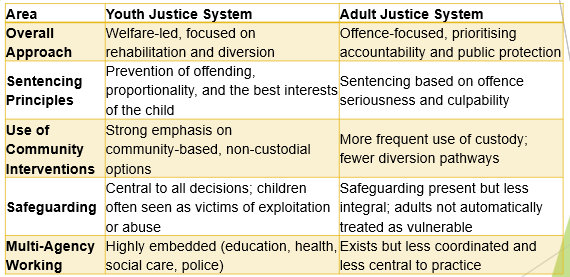
Why are YP treated differently from adults → reduced capacity, greater vulnerability, legal and ethical duties and evidence of better outcomes
Structure of YJS
Youth Justice Board (YJB) oversees the entire YJS in England and Wales
Sets national standards
Monitors performance
Allocates funding
Promotes evidence‑based approaches
Oversees the secure estate for children
Champions children’s rights and welfare
Youth Offending Teams/Youth Justice Service (YOT/YJS) → Local multi-disciplinary teams working with children who offend or at risk of offending. Bring together professionals from:
youth justice
social care
education
health and mental health
police
probation
substance misuse and speech‑language specialists (where funding available)
Courts, Youth Court (magistrates’ court for people aged 10 - 17)
Deal with most youth cases
Use specially trained magistrates or district judges who understand child development and youth justice practice
Prioritise welfare and rehabilitation
Can issue youth‑specific sentences, such as Referral Orders or Youth Rehabilitation Orders
Aim to reduce criminalisation by using diversion and proportionate responses
Crown-Courts (for serious offences)
Homicide (murder, attempted murder, manslaughter) must be sent to Crown Court.
Grave Crimes: Offences carrying a maximum sentence of 14 years or more for an adult (e.g., robbery, GBH) may be sent if a sentence longer than 2 years is likely.
Firearms & Dangerousness
Jointly Charged: When a child/young person is charged with an adult
Youth Court Limitations
While serious, many under-18s charged with grave crimes are still sentenced under Section 250 of the Sentencing Act 2020, which requires the court to consider their age and maturity.
Secure estate
Secure Children’s Homes → small, welfare-focused units run by local authorities. High staff to child ratio. Designed for children who are very vulnerable. Emphasis on therapeutic care. Used both justice and welfare placements
Secure Training centres → secure facilites, run by private or charties under contract. Ages between 12-17, focused on education, strucuted routines and behaviour managements. Lower staff to child rations than SCH, but higher than YOI. Intended to balance care and control
Young Offender Instituions → Large, prison like, lowest staff to child ratios. The most formal security-driven environment. Education and support are provided, but the setting is closer to an adult prison, used for older children and those convicted of more serious crimes. Higher risks around violence, self-harm and explotation due to size and regime
Roles in YJS
Case Managers / Youth Justice Practitioners
Day‑to‑day case management, ensuring National Standards are met.
Deliver assessments, plans, interventions and court work.
Come from varied professional backgrounds (social work, probation, youth work, criminology, etc.).
Psychologists (forensic, clinical, educational)
Support complex assessments (e.g., risk, formulation, trauma, neurodevelopmental needs).
Contribute to Pre‑Sentence Reports and dangerousness assessments.
Provide case formulation and clinical supervision to staff.
Speech and Language Therapists (SaLT)
Direct work with young people on communication needs.
Indirect support through consultation, screening tools and staff training.
Family Support Workers
Work alongside case managers to address family‑level needs and strengthen protective factors
Restorative Justice Practitioners
Victim‑focused work, restorative conferences, and reparation activity.
Education Training & Employment (ETE) Specialists
Support young people who are Not in Employment Education or Training (NEET) or at risk of disengagement (often focusing on 16+).
Liaise with schools, colleges, training providers and employers.
Substance Misuse Workers
Provide assessment and intervention around substance misuse and related risks.
Police Officers
Information sharing, joint risk management, and support with Out‑of‑Court Disposals.
Probation / YJB Pathways Roles
Support transitions into adult probation.
Oversee the Transition Programme for young people approaching adulthood.
Assessment in YJS
AssestPlus (strucutred assessment tool) → scaled approach, 4 main sections proportiante to young people risk and need
Core Record
Info Gathering
Explanation and Conclusions
Pathways and Planning
Screening for speech, language and commincation needs. Trauma and ACEs (Adverse Childhood Experiences). Risk of reoffending, safety and wellbeing, risk of harm. Importance of developmental stage, neurodiversity, mental health
Pre-Sentence Reports → assist the court to find most appropriate outcome. PSR info on:
the child’s background and circumstances (the court is obliged to consider their welfare in determining the sentencing outcome)
previous convictions
responses to previous penalties imposed by the court
aggravating and mitigating factors
public protection concerns
concerns about the safety and well-being of the child.
positive factors, including information about any agencies involved with the child and how they can support the child’s safety and well-being and public protection
The report should conclude with an explanation of the options available and a clear single sentencing proposal for the court to consider.
Dangerousness assement → court may request this if a child is convicted for a specified offence and the court considers there is a significant risk of serious harm to publid or the commission or further offences (Serious harm = ‘death or serious personal injury whether physical or psychological’)
Must set out how that the offence is a specified offence and not undertaken just because a YJS practitioners had assessed as a risk of serious harm. Supported by clinical/psychological staff available. Thes assessment of dangerousness should consider all available info, including:
the past behaviour of the child
the offences they were convicted of
their nature and circumstances including any concern about the child being a victim of exploitation
It should also take into account any previous patterns of behaviour (relevant to the offence type) and any known behaviour which did not proceed to charge such as incidents in school, which may have been a cause for concern. No recommendation must be made either way about the dangerousness of the child. A comprehensive and appropriate intervention plan to increase safety and public protection must be outlined.
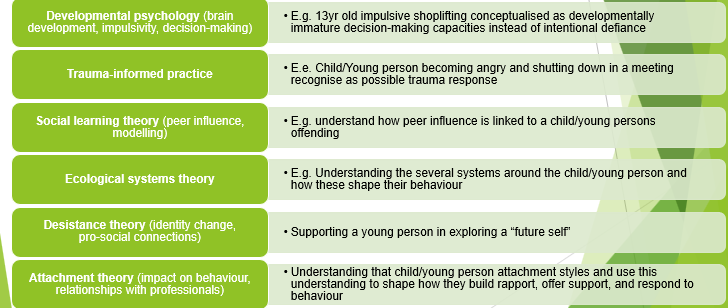
Psychological Models and Theories Used in YJ
Interventions and Programmes for YP
Restorative justice
Writing a letter of apology to the victim
Participating in a restorative meeting or conference with the victim
Engaging in victim–offender mediation
Reparation activity chosen by victim (but there is also non-RJ reparation i.e. completed hours of reparation activity mandated by the court)
Cognitive‑behavioural interventions
Mentoring and positive role modelling
Family‑based interventions:
Multi-systemic Therapy (MST)
Functional Family Therapy
Education and vocational support
Emotional regulation and problem‑solving programmes
Community‑based diversion schemes
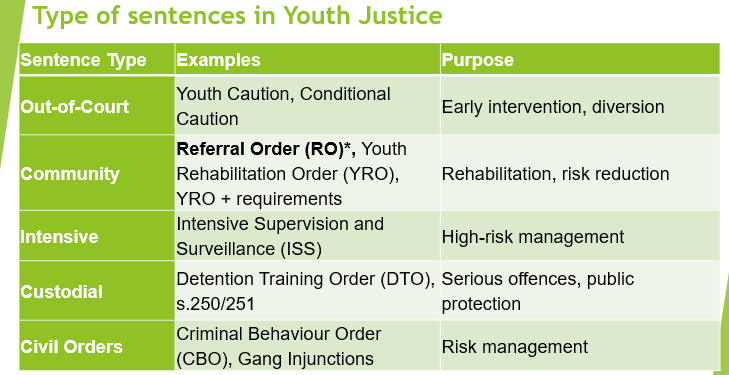
Key youth justice sentence - restorative, involving a Youth Offender Panel made up of trained community volunteers.
RO focus on:
repairing harm
taking responsibility
involving victims
agreeing a contract for change
What this looks like in practice: The young person attends a panel meeting with volunteers and a YJS worker (parents usually attend also). They discuss the offence, its impact, and what needs to change. A contract is created, which may include:
reparation to the victim or community
work on offending behaviour
education or training goals
positive activities
Week 7 - Imprisonment
What are prisons for?
Retribution: deliver punishment. Can be important to make public and victims feel there is justice.
Utilitarian: reduce recidivism, chances offender will do it again.
Humanitarian: offenders are typically victims of circumstance and need rehabilitation.
Imprisonment:
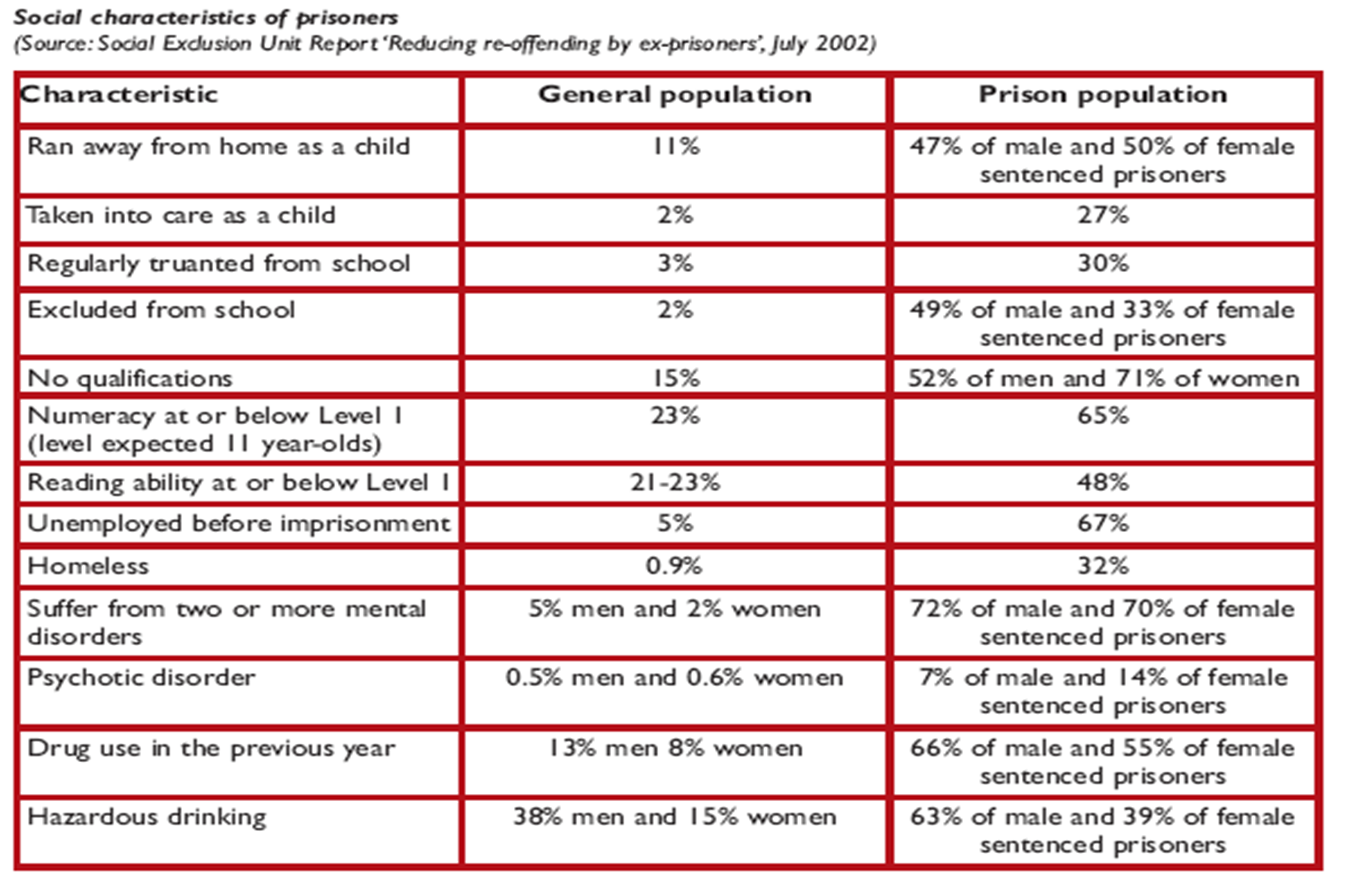
Prisoners are a population at risk: risk of violence and suicide
Prison can make things worse, if not done correctly: Prisoners can learn maladaptive behaviours. Become more criminally oriented. May contribute to an increase in recidivism, without dealing with underlying causes of criminality
Cost money and resources
Above all, we live in a democracy and state must follow rules:
Punished for a crime you actually committed
No excessive punishment
Maintain rights even if you are in jail
Health and safety of prisoners should be a priority
Prison population, England and Wales, June 2018 (83,163)
Male = 79361, Females = 3829
Development of penal policy → 80’s Harsher tougher sentencing (retribution), 90’s riots (Strangeways, 45 days, 1 dead prisoner, 47 prisoners injured, 147 prison officers)
Imprisonment can be an expensive way of 'making bad people worse' (Home Office, 1990)
Woolf Report → Custody, Care and Justice 1991
Prisoners Cited:
Unsanitary Conditions
No Redress For Injustices
Negative Regimes
Lack Of Respect
Destruction Of Family Ties
Increased delegation of responsibility to Governors of prisons
A contract for each prisoner
National system of accredited standards
No establishment should hold more prisoners than its certified normal level (CNA) of accommodation.
Access to sanitation for all inmates not later than February 1996
Prospects for prisoners to maintain links with families and community through more visits and home leaves.
Currently:
Overcrowding still exists
Some prisoners still slop out
Still no consistent regime
Prisons can’t fulfil rehabilitative role successfully
Increases re-offending?
Empirical evidence: Imprisonment and recidivism
Lloyd et al (1994): 4 types of sanctions
Community service
Probation
Probation with additional requirements
Imprisonment
Found:
No difference between reconviction across types of sentence
Concluded: different sentences don’t have different effects on reoffending
Types of imprisonment
Boot camps: Mackenzie & Souryal (1995)
Short terms of incarceration in a strict military environment
Daily schedule of hard labour, drill, ceremony and physical training
Strong hope that tough punishment will deter future criminal involvement
Burton et al (1993)
Boot camp prisoners: more positive prosocial attitudes
But: MacKenzie & Souryal (1994): selection effect boot camp prisoners not the same as other prisoners: non-violent crimes and less serious criminal histories
Mackenzie et al (1995)
In U.S.A. no impact of boot camps on recidivism.
One State there was an increase in recidivism but mixed results from 3 others.
Why → But: problems with measures of reoffending
Also any success could be due to level of supervision post release – not to boot camp regime.
Concluded:
Most successful boot camps: had treatment programmes.
Recidivism higher for camps that emphasised physical activity and military discipline without any therapeutic programming.
Physical exercise, military atmosphere and hard labour won’t change offenders behaviour if the criminogenic needs are not addressed (Mackenzie et al 1995)
What doesn’t work
McKenzie (2000) review of rehabilitation:
Increased control and surveillance in the community.
Boot camps using old-style military models.
Programmes emphasising specific deterrence (shock probation and Scared straight).
Meta-analysis:
Lipsey (1995): ‘Despite their popularity, the available studies indicate that they actually result in delinquency increases rather than decreases.’ (p. 74).
Social Exclusion Unit (2002): Re-offending by ex-prisoners costs us £11 billion per year.
What effect does prison have?
Environment:
Gallo & Ruggiero (1991):
Prisons are ‘factories for the manufacture of psycho-social handicaps’.
Two most common forms of behaviour = aggression and depression.
Prisoners live in a state of constant anxiety or disengaged in a form of psychological absenteeism encouraged by the availability of drugs.
Imprisonment may itself be criminogenic (Cid (2009).
Deprivation:
Sykes (1958) – pains of prison leads to ‘profound hurt’ → 5 specific ‘pains’
Loss of liberty: confinement, removal from family, friends
Goods and services: choice amenities, material possessions
Frustration of sexual desire: prisoners figuratively castrated
Autonomy: regime routine, work, trivial restrictions e.g. letters
Personal security: enforced association with unpredictable prisoners causing fear anxiety and having to fight for the safety of possessions
Psychologically:
Bukstel & Kilman (1980) → reviewed 90 experimental studies: found:
Methodological flaws
Crowding, phase of sentence and peer groups impact on personal functioning
Deterioration results from poor adaptation to surroundings
Benign, passive and dependent personalities often adjust well
Indeterminant sentencing leads to adjustment problems
Issues in Prisons
Prison Gangs → Group of prisoners with a leader whose negative behavior adversely impacts on the prison that holds them” (Fong & Buentello 1991).
Camp & Camp (1985) → 1st gang in Washington State in 1950. By 1957 gangs were in California: in 1962 appeared in Illinois. By 1983 33 of 49 US prisons reported presence. 2% of prison population involved. By 1992 10% adult males, 3% females and 17% young offenders involved (Knox 1994)
Aims and impact:
Acquisition of finance through trades & power through violence (Stevens 1997)
Where gangs are active: large amounts of drugs, assaults, extortion and non-gang transfer requests (Rush, Stone & Wycoff 1998).
Prison gangs control drug trade in North Carolina prisons (Stevens 1997).
Undermine order & control in the prison (Camp & Camp 1985; Fong & Buentello 1991). For example, 1987 - Texas prison authorities lost control of prison due to gang activity (Porter 1988).
Prison gangs can control street gang activity (Sikes 1997): Can order punishment (beatings, murders). Though this can develop into intra-gang conflict in some cases.
Characteristics of gang members
Reluctant to accept prison mandate or be involved in any non-criminal activity (Camp & Camp 1985).
Serve longer sentences and have more convictions (Sheldon 1991).
Are younger than their non-gang counterparts (Ralph, Hunter, Marquart, Curchier & Meriianos 1996).
1st study (Wood & Adler 2001) included 180 prison staff across all categories of prison: staff perceived high levels of prisoner group involvement in activities associated with prison gangs. Perceived levels of events predicted staff concern over losing control and order in prison.
Found: most common group activities
Drugs
Groups formed along racial lines
Transfer request
Groups assaulting other prisoners
Group formed along regional lines
Contraband phone cards
Verbal domination by groups
Groups making threats to staff
Physical domination by groups
Requests for protective custody
2nd study: prisoners’ perspective, 2 main aims:
Examine prisoners’ reports of own and others’ gang-related events to see if order and control undermined.
Identify prisoners most involved in gang-related activity and some of the psychological characteristics associated with involvement in gang-related activity.
Psychological factors:
Prisonation:
Definition → the taking on, in greater or lesser degree, the folkways, mores, customs, and general culture of the penitentiary (Clemmer 1940, p. 270).
Facilitated by association with prisoners who possess leadership qualities and are integrated into prison subculture.
Prisonaisation prisoners are reluctant to become involved with legitimate activities in prison.
Social support:
Definition → the perceived or actual instrumental and/or expressive provisions supplied by the community, social networks, and confiding partners (Lin 1986, p. 18).
Thoits (1995): perceived emotional social support ‘buffers’ against life’s stressors.
Interestingly, Giving of social support also conducive to psychological well being (e.g. Coles 1993).
Methods:
Cross section - 360 prisoners in English prisons
Involvement assessed using quantitive and qualitative methodology based on variables associated with gang existence (e.g.Fong & Buentello 1991)
E.g. → Group violence, Group trades in contraband, Group protection of members, Adherence to ‘group rules’
Measures: perceived social support received from and to family and significant others in prison using adapted SOS A & B (Power, Champion & Aris 1988). Calculate dissatisfaction with SS IN & OUT.
Measures of prisonization taken using Organizational Structure and Prisonization Scale (OSPS) (Thomas and Zingraff1974).
Results:
Gang activity & order and control
Perceived gang events successfully predicted perceptions of reduced order in prison.
Perceived gang events successfully predicted perceptions of reduced staff control in prison.
Prediciting prionsers’ personal involvement: Important predictors
Age: younger more involved
Gender: males more involved
Number of sentences: more served = more involved
Prisonized attitudes
Dissatisfaction with soc supp to others in prison: more satisfied with support to others = more involved
Theories of prison gang development
Importation Theory: Street gang members imported into prison and regroup. For many gang members’ entry into prison is a ‘homecoming’ (Jacobs, 1974). Just part of the life of a gang member. Once in prison, pre-existing attitudes and behaviours continue (Irwin & Cressey 1964).
Indigenous theory (Buentello, Fong & Vogel 1991): gangs develop as a result of the system
Stage 1:
prisoner imprisoned. Must learn to deal with everyday threat of violence (Duffee, 1989). To cope with loneliness and isolation prisoner goes through process of prisonization (Clemmer 1940) adopts prisoner code of conduct
Stage 2: prisoner mixes with similar others: race, religion, region of origin (Camp & Camp 1985) or previous incarceration (Stevens 1997).
Stage 3: group becomes self protective – is recognised by others. It has no structure; no clear membership; no criminal activity.
Stage 4: group becomes predatory – recognises its potential for power; rules may be devised; weak members expelled; begins criminal activity.
Stage 5: group strengthens; becomes organised; evolves into prison gang.
Why gang membership might appeal
Offset some of the deprivation imprisonment imposes (sykes 1958)
Liberty
Goods and services
Autonomy
Personal security: Prisoners fear intimidation and assault above all aspects of prison life (Adler 1994)
Week 8 - Biases in Criminal Justice system
Cogntive bias in CJS
Cognitive bias: deviation from accurate or rational cognitive processes. WE tend to recognise bias in others, but do not see it in ourself (bias blind spot)
Confirmation bias: the tendecy to search for, interpret or remember information that supports existing beliefs preconceptions,