Unit 6
Types of Alkyl Halides
Alkyl halides, also known as haloalkanes, are organic compounds that contain a halogen atom (fluorine, chlorine, bromine, or iodine) bonded to an alkyl group. The type of alkyl halide is determined by the number and position of halogen atoms attached to the alkyl group.
Primary Alkyl Halides
Primary alkyl halides have one halogen atom bonded to a carbon atom that is directly attached to only one other carbon atom. The general formula for primary alkyl halides is R-CH2X, where R represents an alkyl group and X represents a halogen atom.
Secondary Alkyl Halides
Secondary alkyl halides have one halogen atom bonded to a carbon atom that is directly attached to two other carbon atoms. The general formula for secondary alkyl halides is R2-CHX, where R represents an alkyl group and X represents a halogen atom.
Tertiary Alkyl Halides
Tertiary alkyl halides have one halogen atom bonded to a carbon atom that is directly attached to three other carbon atoms. The general formula for tertiary alkyl halides is R3-CX, where R represents an alkyl group and X represents a halogen atom.
Vinyl Halides
Vinyl halides have a halogen atom bonded to a carbon atom that is part of a double bond with another carbon atom. The general formula for vinyl halides is R-CH=CHX, where R represents an alkyl group and X represents a halogen atom.
Aryl Halides
Aryl halides, also known as haloarenes, have a halogen atom bonded to a carbon atom in an aromatic ring. The general formula for aryl halides is Ar-X, where Ar represents an aromatic ring and X represents a halogen atom.
These different types of alkyl halides have varying reactivity and chemical properties, which make them useful in various organic synthesis reactions and industrial applications.
Geminal dihalide
Two halides on the same carbon
Vicinal dihalide
Two halides on adjacent carbons
Substitution reactions involve replacing a leaving group with a nucleophile. There are two important substitution reactions: Substitution Nucleophilic unimolecular (SN1) and Substitution Nucleophilic Bimolecular (SN2).
The SN1 reaction involves the formation of a carbocation from an alkyl halide followed by the subsequent attack of a nucleophile generating the product.
The SN1 reaction relies on the formation of a carbocation. It stands to reason that any reactant that can readily form a carbocation is a good candidate for an SN1 reaction. Indeed, tertiary halides undergo SN1 reactions very easily.
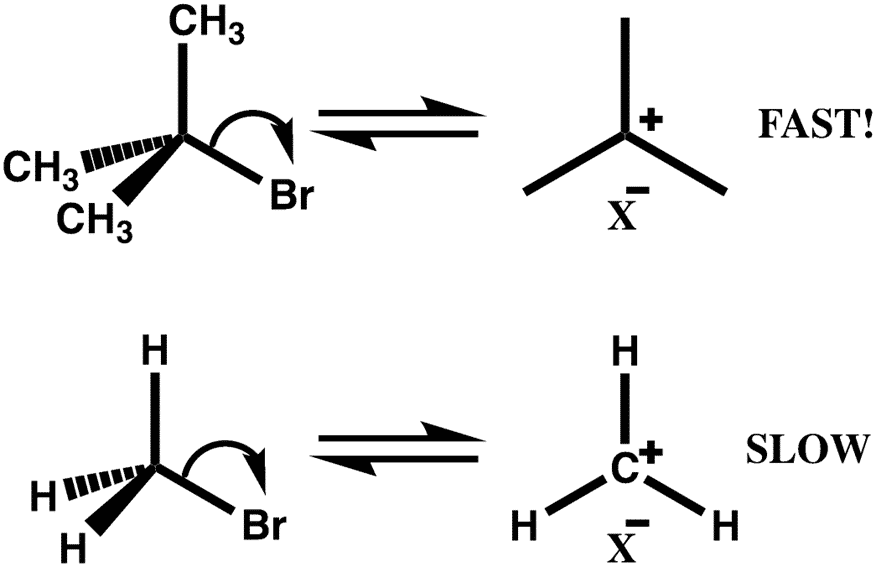 SN1 require a polar protic solvent. SN2 reactions require a polar aprotic solvent.
It is often the case in an SN1 that the solvent is also the nucleophile.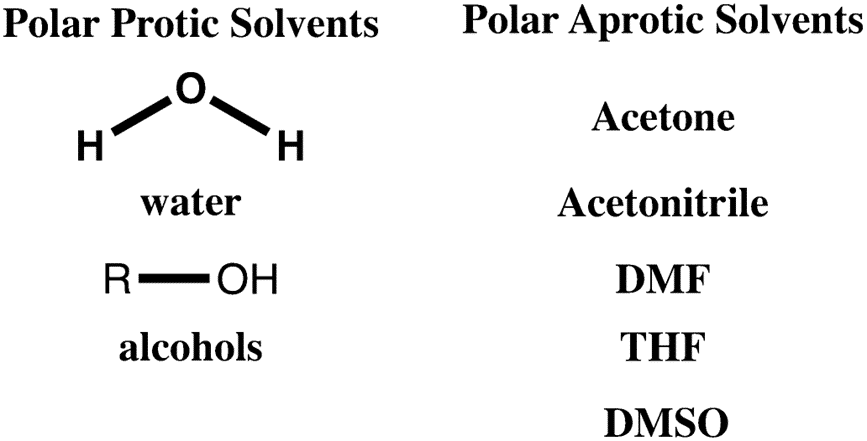 All carbocations are trigonal planer. Perpendicular to the three sp2 orbitals is an empty, p orbital. Due to this trigonal planar geometry, the nucleophile can approach the carbocation from either side of the carbocation. The stereochemical outcome of this is racemization.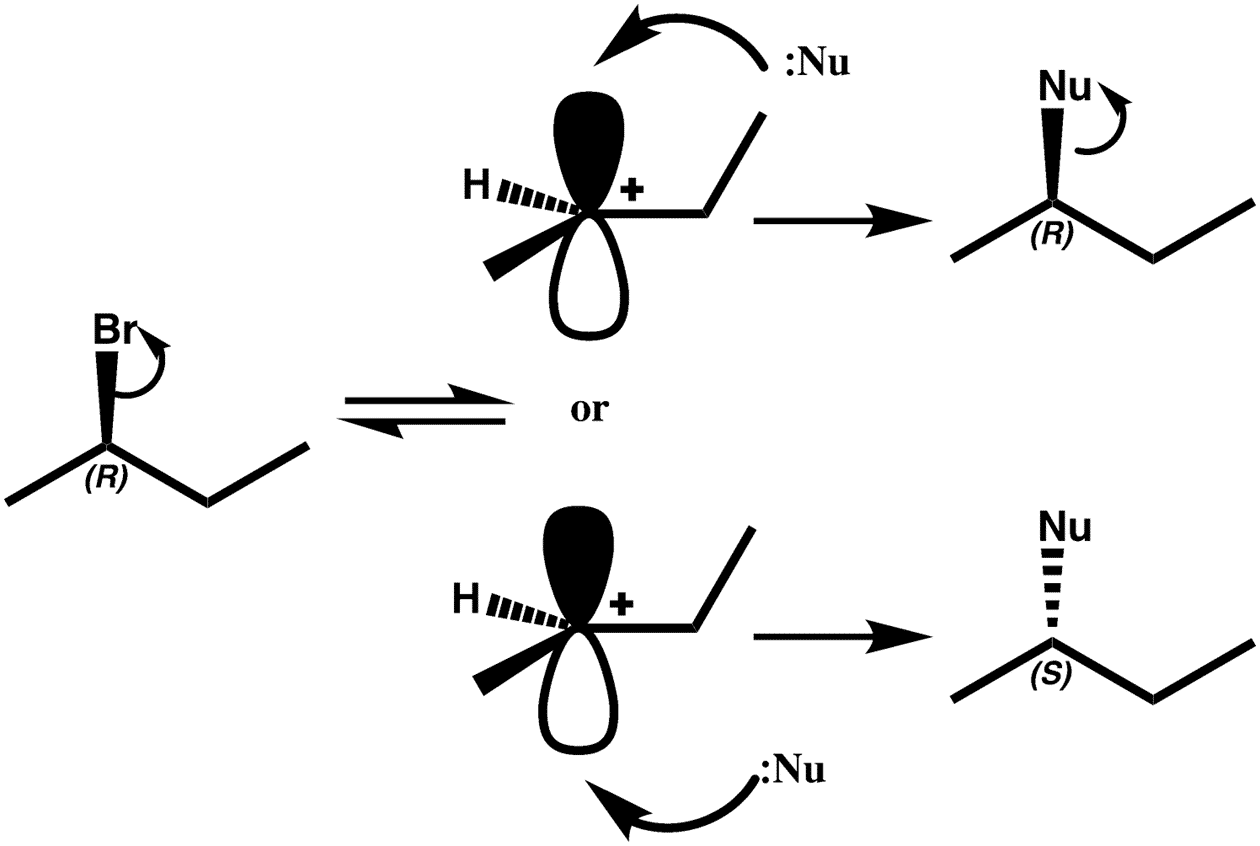
The SN2 mechanism involves the simultaneous attack of a nucleophile onto an electrophilic carbon and a leaving group departing. 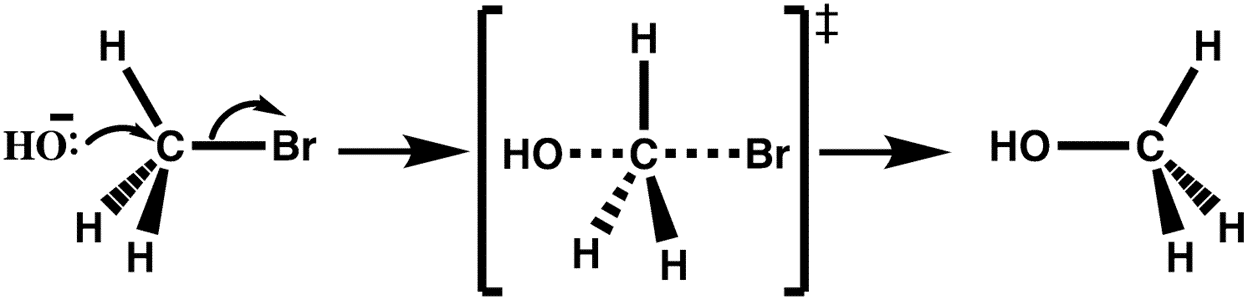 SN2 reactions require that the nucleophile collides with the electrophilic carbon from the side opposite the leaving group. This is known as “back side attack”.
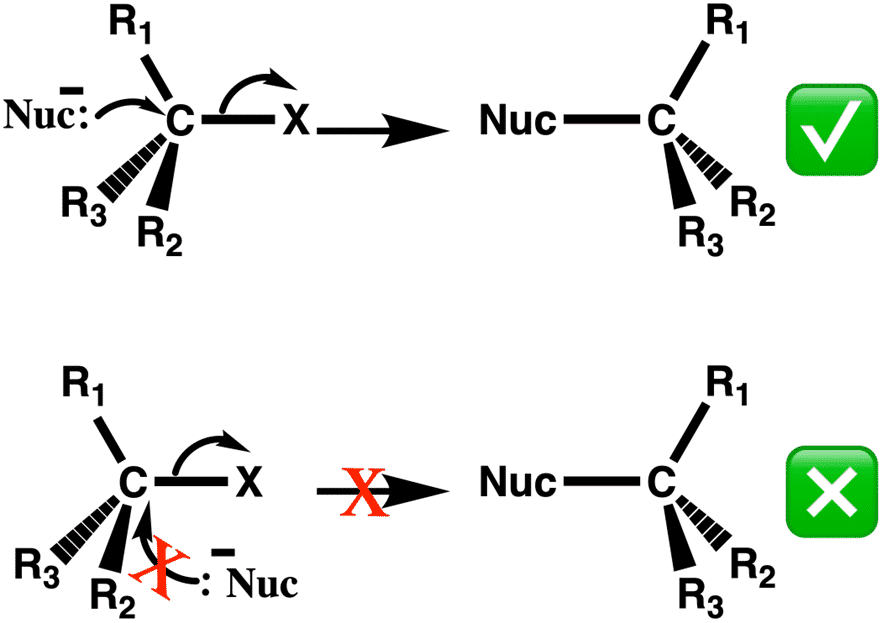 SN2 reactions rely on back side attack of the nucleophile onto the electrophile. This means that anything that prevents back side attack will slow or stop this reaction. Therefore, the rate of an SN2 reaction is fast with methyl and primary halides, slower for secondary halides. Tertiary halides never undergo SN2 reactions. A good nucleophile for an SN2 reaction is nonbulky with a polarizable anion. Nonbulky refers to the R group attached to your nucleophilic atom. Polarizable anions are “large” with a low relative electronegativity. A polarizable anion does not hold the electrons as tightly and is more amenable to donating its electrons in an SN2 reaction.
  A chiral electrophile will undergo an inversion of stereochemistry due to the required back side attack of the nucleophile to the electrophilic carbon. This phenomenon is called Walden Inversion.
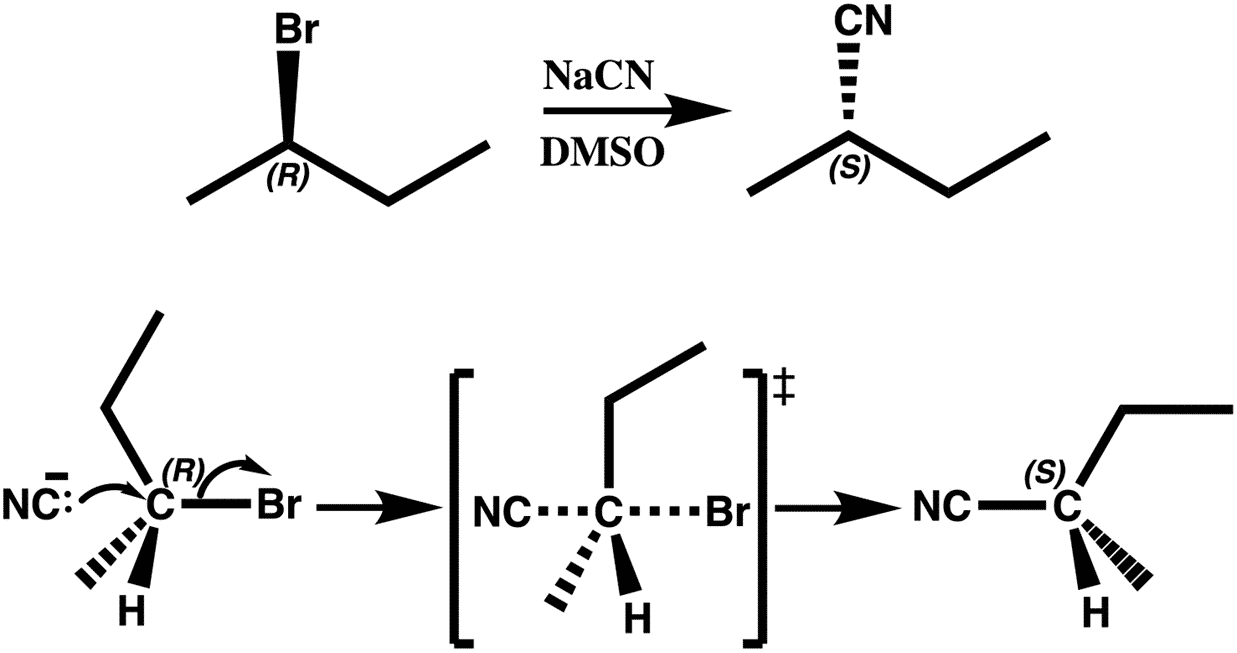 Here are some things to look for when deciding if a reaction is using an SN1 or SN2 mechanism.
A bulky alkyl halide usually undergoes an SN1 mechanism. Tertiary halides never undergo an SN2 mechanism.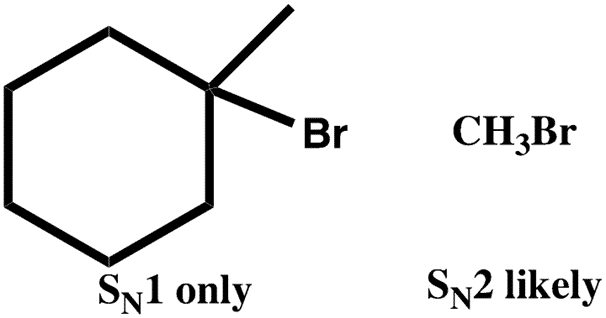 If the solvent is polar protic, this is a good indicator that the mechanism is SN1. If the solvent is polar aprotic, this is a good indicator that the mechanism is SN2.
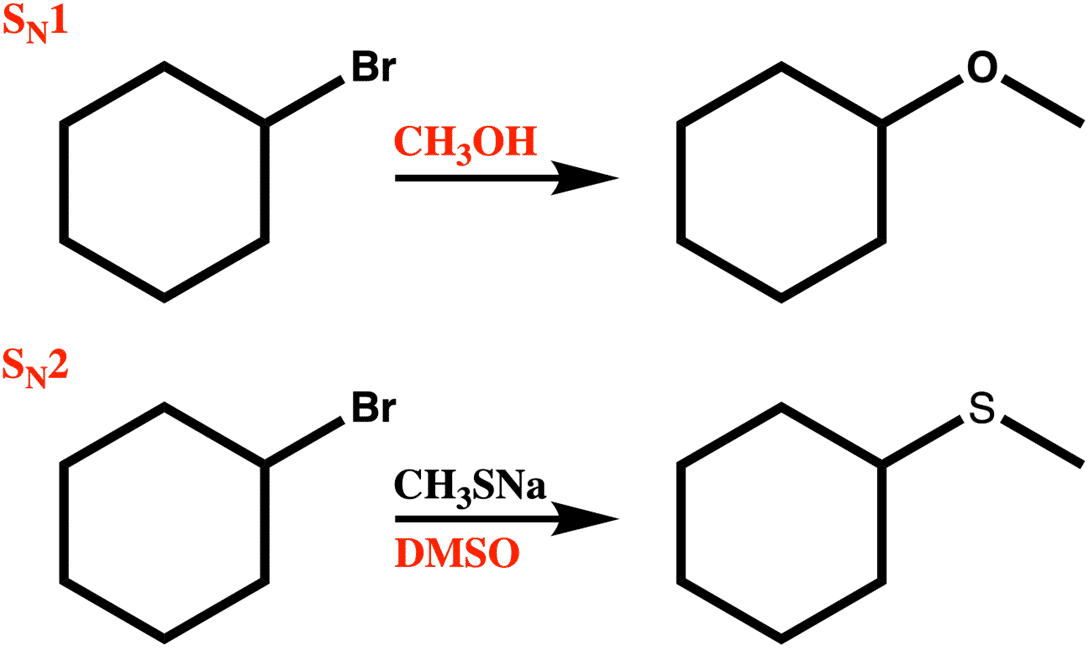 Reactions that have a good nucleophile are likely undergoing an SN2 mechanism. Reactions undergoing an SN1 mechanism typically have only the solvent as the nucleophile.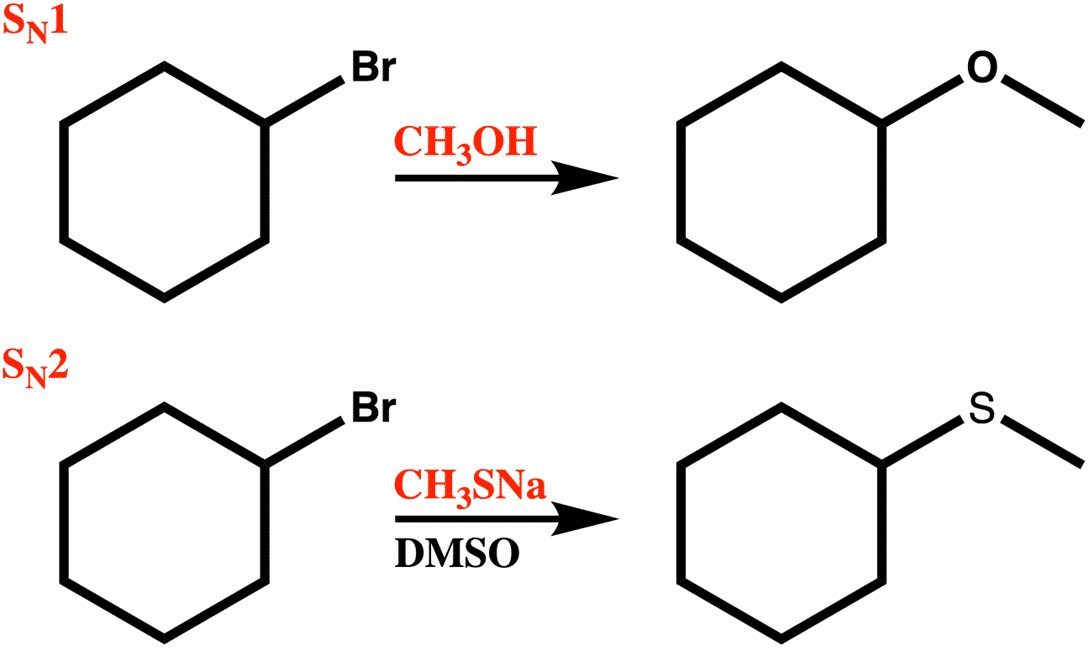
Elimination reactions involve the formation of a double bond (often a C=C) and the elimination of a molecule of HX. There are two important elimination reactions: Unimolecular Elimination (E1) and Bimolecular Elimination (E2).
The E1 reaction relies on the formation of a carbocation. It stands to reason that any reactant that can readily form a carbocation is a good candidate for an E1 reaction. Indeed, tertiary halides undergo E1 (and SN1) reactions very easily.
E1 require a polar protic solvent.
It is often the case in an E1 that the required base is the solvent.
Zaitsev’s rule states that the alkene with the most substituted double bond will predominate in an elimination reaction.
E2
The E2 mechanism involves the simultaneous deprotonation of a proton from an atom adjacent to a carbon bearing a halogen.
E2 reactions are often performed in a polar protic and a strong base. Even though a polar protic solvent would suggest an E1/SN1 mechanism, the addition of a strong base forces the reactants to undergo an E2 mechanism.
E2 reactions require that the departing hydrogen and the leaving group are in an anti-coplaner arrangement.
Depending on the alkyl halide, there is potential for either the Zaitsev (most substituted alkene) product and the Hofmann (least substituted alkene) product.
If a small base is employed in a reaction, the Zaitsev product will predominate. If a bulky base is employed, the Hofmann product will predominate.
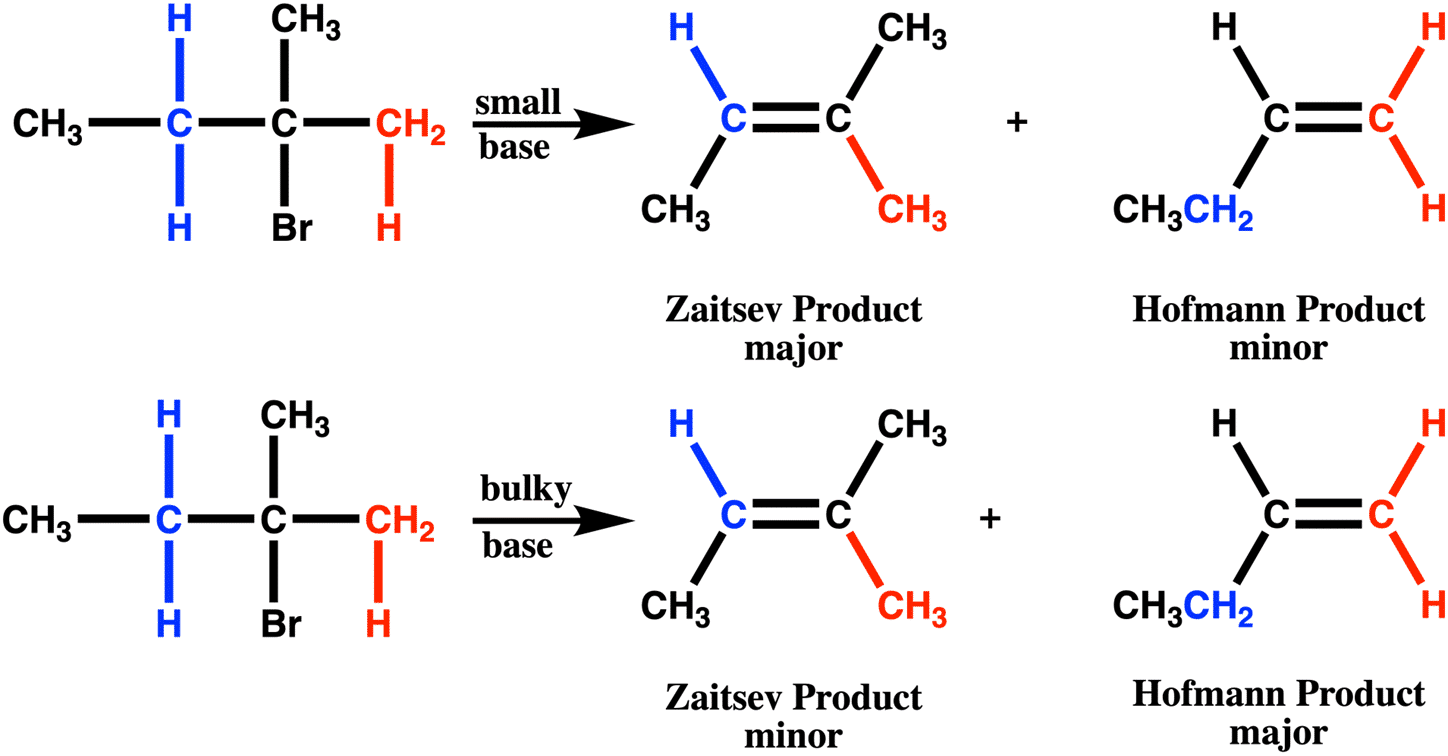
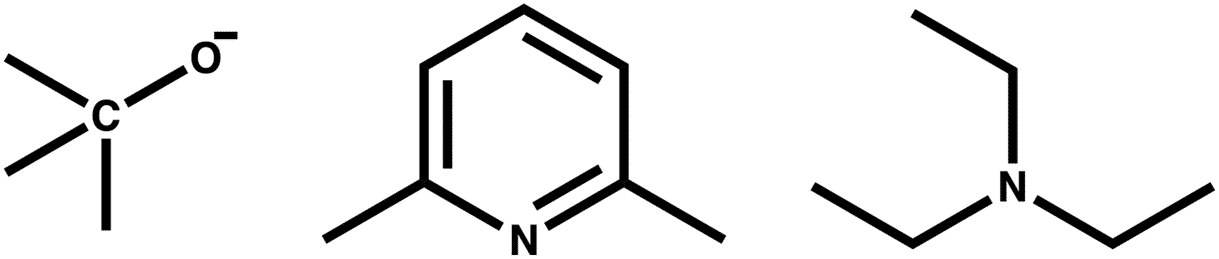
Some examples of bulky bases that are often used in E2 type reactions.