Fluids
Properties of matter:
Solid
Fixed shape and volume
Particles locked in rigid structure
Almost no compressibility
Little space between particles
Almost no ability to flow
Liquid
Assumes the shape of the container it occupies
Particles can move/slide past each other
Not easily compressed
Little space between particles
Moderate ability to flow
Gas
Assumes the shape and volume of the container it occupies
Particles move past each other and bump into the sides of the container
Compressible
A lot of space between particles
Flows easily
understanding that both liquids and gasses are fluids
The ice cube has a certain mass and shape, and neither of these quantities depends on the size or shape of the glass.If the ice melts, the water flows to take the shape of its container and forms a definite, flat, upper surface.If you boiled the water, the resulting gas (water vapor) would flow and expand to fill the room but would not have any definite surface. oth liquids and gases are fluids, which are materials that flow and have no definite shape of their own.
Fluids
Fluids are the substances that flow easily because of increased intermolecular spaces and do not have fixed shape. Liquids and gases are considered as fluids.
Density
is the measurement of how tightly a material is packed together. It is defined as the mass per unit volume Density Symbol: D or ρ Density
Formula: ρ = m/V,
where ρ is the density, m is the mass of the object and V is the volume of the object
Pressure
is The force applied perpendicular to the surface of an object per unit area over which that force is distributed
The basic formula for pressure is P=F/A (Force per unit area)
Buoyancy
the ability or tendency of something to float in water or other fluid.
Ex. A boat or a ship floating in the water and the floating of cork in water
how are pressure and force related to each other
(P) is the perpendicular component of a force on a surface divided by the area of the surface.
Pressure is a scalar quantity.
In the SI system, the unit of pressure is the pascal (Pa), which is 1 N/m^2
Since pressure is force exerted over a surface, anything that exerts pressure is capable of producing change and doing work.
An ideal gas is a gas whose particles take up no space and have no intermolecular attractive forces.
The pressure exerted by a gas can be understood by applying the kinetic-molecular theory of gases, which explains the properties of an ideal gas.
According to this theory, the particles in a gas are in random motion at high speed and undergoing elastic collisions with each other.
When a gas particle hits a container’s surface, it rebounds, which changes its momentum. The impulses exerted by many of these collisions result in gas pressure on the surface.
Pressure = force over area
Example answer
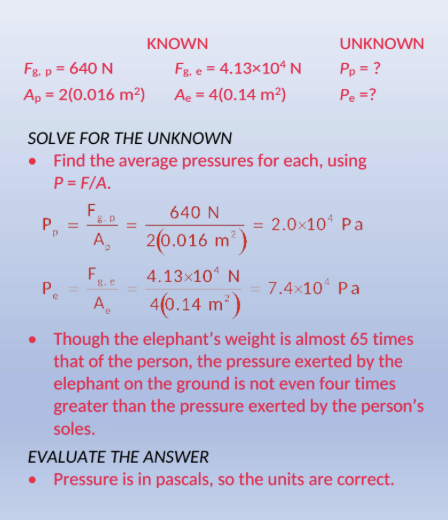
Problem
How does the average pressure of an elephant standing on the ground compare to that exerted by a person standing on the ground? The person weighs 640 N. Each shoe has an area of about 0.016 m^2 in contact with the floor. The elephant weighs 4.13×10^4 N and has four feet, each with an area of about 0.14 m^2 in contact with the ground.