Main electricity
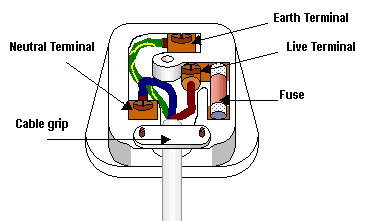
Live: Brown: This supplies the AC current, its voltage is 230V. (alternating current)
Neutral: Blue: This completes the circuit.
Earth: Green/yellow: This is connected to a metal casing of an appliance. Appliances without metal casing do not need it.
 AC current
The current supplied in UK plugs is Alternating current. This means it continuously keeps changing direction and magnitude 50x a second.
DC current
The current flows in one direction only.
Fuse
Contains a thin wire with a low melting point that melts if the current becomes too large, disconnecting the device.
Protects wires and devices from overheating/fire.
Earth wire
If a device with a metal casing becomes faulty, the casing can be live. A person could get a shock.
Earth wire is connected to the casing, a large current will surge through to the ground, this large current melts the fuse on the live wire, disconnecting the device.
Double insulation
The device has a non-conducting case (plastic), so this device does not need an earth wire.
Energy transferred = Power*time
P=VI
P = Electrical power [W] watts
V = Voltage [V] volts
I = Current [A] amps
A device requiring larger power requires a large current and will need thicker (lower resistance) wires to prevent the wires from overheating.
Electrical energy
E=Pt=VIt
E = electrical energy (transferred) [J] joules
P = Power [W] watts
t = time [s] seconds
V = Voltage [V] volts
I = Current [A] amps
Dangers
Damaged insulation
Contact with the wire due to gaps in the insulation can cause an electrical shock or pose a fire hazard by creating a short circuit
Overheating of cables
High currents passing through thin wire conductors can cause the wires to heat up very high temperature which can melt the insulation and cause a fire.
Damp conditions
Water can conduct a current so wet electrical devices can cause an electrical shock.