Lifespan Perspective
Defintion (#f7aeae)
Important (#edcae9)
Extra (#fffe9d)
Why study life-span development:
Importance of studying life-span development.
Prepares one to take responsibility of the children.
Gives insight to one’s life.
Provides knowledge about what one’s life would be like as they age.
Development:
Patterns of change that begin at conception and continues through the life span.
Involves growth and decline brought on by aging and dying.
Lifespan perspective:
Involves growth, maintenance and regulation.
Constructed through biological, sociocultural and individual factors working together.
Introduction to life-span development:
Developmental psychology/Lifespan development is the scientific study of ways in which people change, as well as stay the same, from conception to death.
Topics include physical and other psychophysiological processes, cognition, language, and psychosocial development, including the impact of family and peers.
Research has recognised that adulthood is a dynamic period of life marked by continued cognitive, social, and psychological development.
As developmental psychology expands, studies are dealing with the question of whether development occurs through the gradual accumulation of knowledge or through shifts from one stage of thinking to another, or if children are born with innate knowledge or figure things out through experience, and whether development is driven by the social context or something inside each child.
Causes for humans to develop:
Maturation:
Developmental changes in the body or behaviour that result from the aging process rather than from learning, injury, illness, or some other life experience.
Human maturational biological programme helps us to progress from crawling to running, uttering first meaning words, reach sexual maturity and many more.
Maturation also responsible for psychological changes such as increase in concentration, problem solving and recognize emotions.
Learning:
The process through which our experiences produce relatively permanent changes in our feelings, thoughts, and behaviours.
Many of our abilities/habits don’t simply unfold as part of maturation; we learn to feel, think, and behave in new ways from our observations of and interactions with parents, teachers, and other important people in our lives, as well as from events that we experience.
Chronological overview of human development:
The age ranges listed here are approximate and may not apply to any particular individual.
Period of Life | Approx Age Range |
Prenatal | Conception to birth |
Infancy | Birth - 18 months |
Toddlerhood | 18 months - 3 years |
Preschool | 3 - 5 years |
Middle childhood | 5 - 12 years (Until onset of puberty) |
Adolescence | 12 or so - 20 years |
Young adulthood | 20 or so - 40 |
Middle adulthood | 40 - 65 years |
Late Adulthood | 65 years or older |
Characteristics of the lifespan perspective:
Lifelong:
Early adulthood is not the endpoint of development; rather, no age period dominates development.
Development is life-long, and change is apparent across the lifespan.
No single age period is more crucial, characterizes, or dominates human development.
Multidirectional:
We show gains in some areas of development, while showing losses in other areas.
Throughout life, some dimensions or components of a dimension expand and others shrink.
Multidimensional:
We change across 3 general dimensions; physical, cognitive, and socioemotional.
Whatever your age, your body, your mind, your emotions, and your relationships are changing and affecting each other.
Plasticity:
Capacity for change in response to positive or negative life experiences.
Researchers have found that the cognitive skills of older adults can be improved through training and developing better strategies.
Multidisciplinary:
Human development is such a vast topic of study that it requires the theories, research methods, and knowledge base of many academic disciplines.
Contextual:
All development occurs within a context, or setting like families, schools, peer groups, churches, cities, neighbourhoods, university laboratories, countries.
Type of contextual influences:
Normative age-graded influence:
Age-grade: A specific age group, such as toddler, adolescent, or senior.
Humans in a specific age-grade share particular experiences and developmental changes.
Non-normative life influence:
Unusual occurrences that have a major impact on the individual’s life.
These events do not happen to all people, and when they do occur they can influence people in different ways.
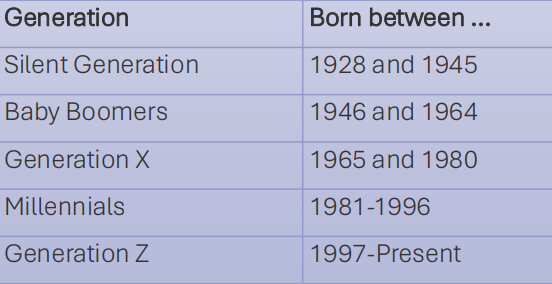
Normative history-graded influence:
The time period in which you are born.
Cohort: A group of people who are born at roughly the same period in a particular society.
These people travel through life often experiencing similar circumstances.
Contemporary concern:
Health & wellbeing:
Health professionals recognize the power of lifestyle changes and psychological states in health and well-being; so, issues on health and wellbeing in this subject are integrated in our discussions.
Clinical psychologists are among the health professionals who help people improve their well-being.
Parenting & education:
Analysis on childcare, the effects of divorce, parenting styles, child maltreatment, intergenerational relationships, early childhood education, relationships between childhood poverty and education, bilingual education, new educational efforts to improve lifelong learning, and many other issues related to parenting and education.
Sociocultural contexts and diversity:
Culture: The behaviour patterns, beliefs, and all other products of a group that are passed on from generation to generation.
Cross-cultural studies: Comparison of one culture with one or more other cultures.
Ethnicity: A characteristic based on cultural heritage, nationality characteristics, race, religion, and language.
Socioeconomic status (SES): Refers to the grouping of people with similar occupational, educational, and economic characteristics.
Gender: The characteristics of people as males or females.
Nature of Development:
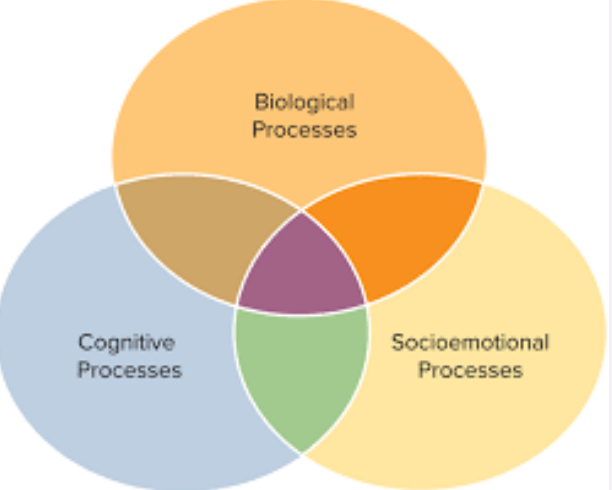
The pattern of change is complex because it is the product of biological, cognitive, and socioemotional processes.
Connecting biological, cognitive and socioemotional processes.
Biological, cognitive, and socioemotional processes are inextricably intertwined.
Developmental cognitive neuroscience: Explores links between development, cognitive processes, and the brain.
Developmental social neuroscience: Examines connections between socioemotional processes, development, and the brain.
The process:
Biological:
Produce changes in an individual’s physical nature.
Ex: Genes inherited from parent, brain development, height/weight gains, changes in motor skills, nutrition, exercise, the hormonal changes of puberty, and cardiovascular decline.
Cogntive:
Changes in the individual’s thought, intelligence, and language.
Ex: Putting together a two-word sentence, memorizing a poem, imagining what it would be like to be a movie star, and solving a crossword puzzle all involve cognitive processes.
Socioemotional:
Changes in the individual’s relationships with other people, changes in emotions, and changes in personality.
Ex: An infant’s smile in response to a parent’s touch, a toddler’s aggressive attack on a playmate, a school-age child’s development of assertiveness all reflect the role of socioemotional process.
Processes and periods of development:
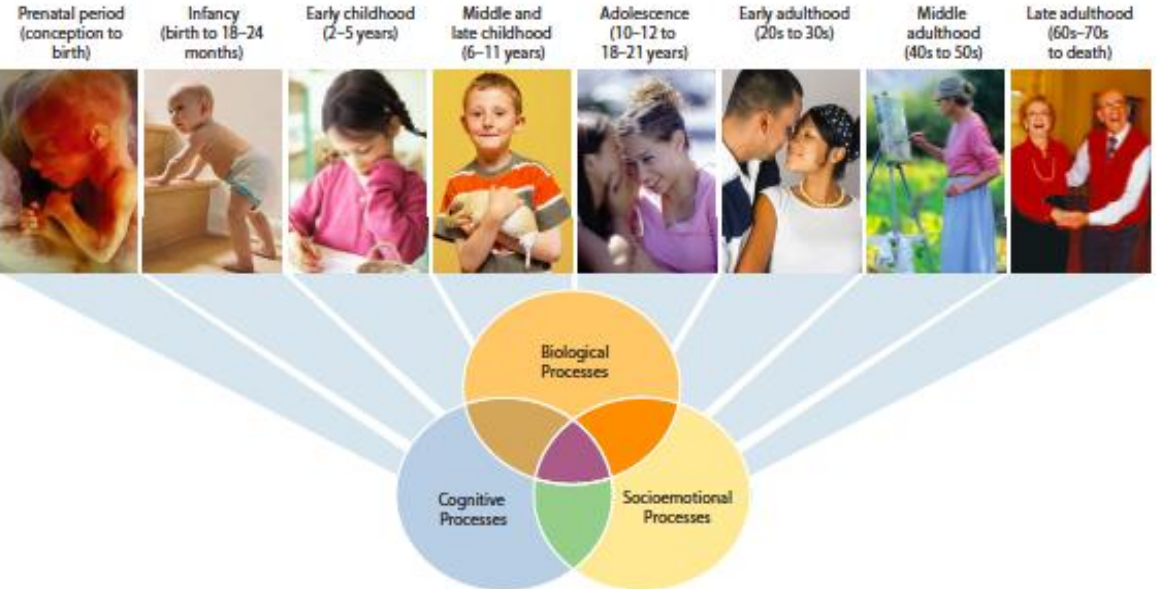
A developmental period refers to a time frame in a person’s life that is characterized by certain features.
Prenatal period:
Time of conception of birth.
The mother’s lifestyle affects the baby and how the environment affects the baby inside the womb.
Infancy:
Period of extreme dependance on adults.
Able to examine the attachment style of infants and the parents.
Language and communication is vital during this stage.
Early childhood:
Period of end of infancy, preschoolers.
The child goes to playschools, mingle and expand their circle beyond their family.
They become more self-sufficient and can take care of themselves at a basic level.
Middle & late childhood:
Begin to increase their fundamental skills like reading, writing, maths and applying maths. They become more curious.
Adolescence:
Rapid physical changes.
Development of sexual characteristics.
Early adulthood:
Time to establish personal growth & independence.
Develop and solidify romantic relationships.
Middle adulthood:
Expanding their social and personal involvements.
Managing responibilities and changes in their body. (Menopause)
Emptiness syndrome. When children leave the house.
Late adulthood:
Period for reviewing their life, things slow down and adjusts to life when retired.
Periods of development:
Life-span developmentalists who focus on adult development and aging typically describe life-span in terms of 4 “ages”.
First age: Childhood and adolescence.
Second age: Prime adulthood, 20s through 50s.
Third age: Approximately 60 to 79 years of age.
Fourth age: Approximately 80 years and older.
Individuals in the third age are healthier and can lead more active, productive lives than their predecessors in earlier generations.
Conception of ages:
Chronological age: The number of years that have elapsed since birth.
Biological age: Person’s age in terms of biological health and determining biological age involves knowing the functional capacities of a person’s vital organs.
Psychological age: Individual’s adaptive capacities compared with those of the same chronological age. Older adults who continue to learn, positive personality traits, control their emotions and think clearly are engaging in more adaptive behaviours.
Social age: Refers to social roles and expectations related to a person’s age.
Developmental issues:
Nature-Nurture issues: The extent to which development is influenced by nature and by nurture.
Nature: An organism’s biological inheritance.
An evolutionary and genetic foundation produces commonalities in growth and development.
They argue that heredity plays the most important role in bringing about that feature.
Nurture: Environmental experiences.
Emphasize the importance of nurture, or environmental experiences.
They argue that one's environment is most significant in shaping the way we are.
Stability vs change:
Stability-change issue involves the degree to which early traits and characteristics persist through life or change.
Many developmentalists who emphasize stability in development argue that stability is the result of heredity and possibly early experiences in life.
Developmentalists who emphasize change take the more optimistic view that later experiences can produce change, just like plasticity in development.
The roles of early and later experience are an aspect of the stability-change issue that has long been hotly debated.
Continuity vs discontinuity:
Focuses on the degree to which development involves either gradual, cumulative change (continuity) or distinct stages (discontinuity).
Continuity: Puberty might seem abrupt, but it is a gradual process that occurs over several years.
Discontinuity: At some point a child moves from not being able to think abstractly about the world to being able to.
Research in Lifespan Development:
Developmental is continous research.
Methods in data collections:
Observations:
Laboratory: Controlled setting in which many of the complex factors of the real world are removed.
Naturalistic observation: Studies that involve observing behavior in real-world settings.
Survey & inerviews:
Can be used to study a wide range of topics from religious beliefs to sexual habits to attitudes about gun control to beliefs about how to improve schools.
1 problem with surveys and interviews is the tendency of participants to answer questions in a way that they think is socially acceptable or desirable rather than to say what they truly think or feel.
Standardised tests:
Tests with uniform procedures for administration and scoring.
Case study:
Usually performed by mental health professionals when, for either practical or ethical reasons, the unique aspects of an individual’s life cannot be duplicated and tested in other individuals.
Physiological measures:
To study development at different points in the life span.
Increasingly being used is neuroimaging, especially functional magnetic resonance imaging.
Research design:
Descriptive research:
Designed to observe and record behaviour.
Descriptive research cannot prove what causes some phenomena, but it can reveal important information about people’s behaviour
Correlational research:
Describe the strength of the relationship between 2 or more events/characteristics.
Correlation coefficient: Number based on statistical analysis that is used to describe the degree of association between 2 variables. Ranges from -1.00 to +1.00.
Experimental research:
Experiment: 1 or more of the factors are manipulated while all other factors are held constant.
Independent and dependent variables, experimental and control groups.
Time span of research:
Cross-sectional approach: Individuals of different ages are compared at one time.
Longitudinal approach: Same individuals are studied over a period of time, usually several years or more.
Cohort effects: Due to a person’s time of birth, era, or generation, rather than the person’s actual age.
Conducting Ethical Research:
Informed consent.
Confidentiality.
Debriefing
Deception.
Minimising bias:
Gender bias:
Gender bias also has had a less obvious effect within the field of life-span development.
Ex: It’s not unusual for conclusions to be drawn about females’ attitudes and behaviours from research conducted with males as the only participants.
Cultural bias:
The realization that research on life-span development needs to include more people from diverse ethnic groups has also been building.
Given that individuals from diverse ethnic groups were excluded from research on lifespan development for so long, we might conclude that people’s real lives are perhaps more varied than research data have indicated in the past.
Ethnic gloss: Using an ethnic label such as African American in a superficial way that portrays an ethnic group as being more homogeneous than it really is.
Ex: A researcher might describe a research sample like this: “The participants were 60 Latinos.”