Reading Notes - CH. 3: Basic Principles of Heredity
3.1 - Gregor Mendel Discovered the Basic Principles of Heredity
Mendel’s Success
Made use of Pisum sativum (pea plant) as subject of study
advantages for genetic investigation: easy to cultivate, grow relatively rapidly, produce large amount of progeny
Numerous varieties of peas also crucial to Mendel’s success because of their various traits & that they were genetically pure
Focus on two differentiated forms
ex. white vs. gray seed coats, round vs. wrinkled seeds, & inflated vs. constricted pods
Formulated hypotheses based on initial observations before conducting additional crosses to test his hypotheses
Genetic terminology
Gene: an inherited factor (encoded in the DNA) that helps determine a characteristic
Allele: One of two or more alternative forms of a gene
Locus: A specific place on a chromosome occupied by an allele
Genotype: A set of alleles possessed by an individual organism
Homozygote: An individual organism possessing two of the same alleles at a locus
Heterozygote: An individual organism possessing two different alleles at a locus
Characteristic/character: An attribute or feature possessed by an organism
Phenotype/trait: The appearance or manifestation of a characteristic
can refer to any type of characteristic—physical, physiological, biochemical, or behavioral
ex. general feature (i.e., eye color) = characteristic; manifestations of feature = trait/phenotype (i.e., brown/blue eyes)
A given phenotype arises from a genotype that develops within a particular environment
Only alleles of the genotype are inherited; phenotypes are not transmitted to the next generation
In Mendel’s crosses, seed shape was determined by a gene that exists as two different alleles: one allele encodes round seeds & the other encodes wrinkled seeds, found on loci

3.2 - Monohybrid Crosses Reveal the Principle of Segregation and the Concept of Dominance
Mendel used 34 varieties of peas, verifying each variety was pure-breeding (homozygous for traits he selected for study); he crossed different pea plants b removing the anthers from flowers to prevent self-fertilization and dusted the stigma with pollen from a different pea plant
The pollen fertilized ova, developing into seeds, which grew into plants
The P generation crossed a homozygous round seed with homozygous wrinkled seeds to yield the F1 generation, where all the seeds were round
Mendel allowed these seeds to self-fertilize
resulting in the final generation: ¾ of F2 seeds were round and ¼ were wrinkled
Conclusion: The traits of the parent plant do not blend, although F1 plants display the phenotype of one parent, both traits are passed to F2 progeny in a 3:1 ratio
Monohybrid crosses: Crosses between two individuals that differ in a single characteristic
Specifically, a cross between individuals that are homozygous for different alleles at the same locus (AA x aa); also refers to a cross between two individuals that are heterozygous for two alleles at a single locus (Aa x Aa)
Mendel studied monohybrid crosses in the above mentioned experiments—P generation (Parental), F1 (first filial generation), and conducted reciprocal crosses—pair of crosses in which the phenotypes of the male and female parents are reversed (ex. a tall male crossed with short female. in the other cross, a short male is crossed with a tall female)
what monohybrid crosses reveal:
Each plant must possess two genetic factors encoding a characteristic
Because F1 plants display the phenotype of only one parent, they must inherit factors from both parents because they transmit both parental phenotypes to the F2 gen
two alleles in each plant separate when gametes are formed, and oe allele goes into each gamete
When two gametes (one from each parent) fuse to produce a zygote the alleles from the parents unite to produce the genotype of the offspring
F1 plants inherited R allele from the round-seeded pea plant and half received the r allele for wrinkled seeds
The concept of dominance was the third conclusion Mendel derived from his monohybrid crosses
Mendel’s fourth conclusion was that the two alleles of an individual plant separate with equal probability into the gametes
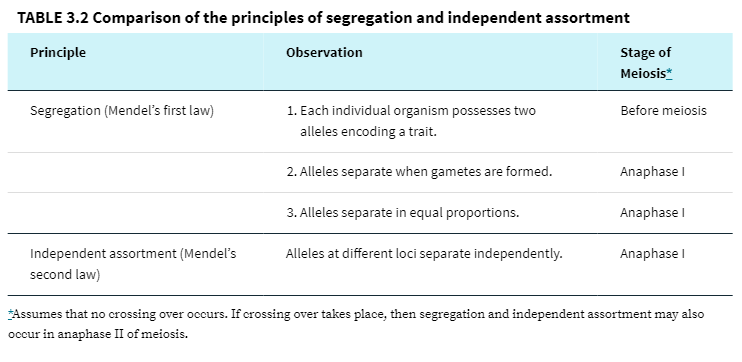
Mendel’s First Law: the principle of segregation: each individual diploid organism possesses two alleles at a locus and that these two alleles separate when gametes are formed, one allele going into each gamete
concept of dominance: when two different alleles are present in a genotype, only on of them—the dominant allele—is observed in the phenotype
The molecular nature of alleles
Represent specific genetic sequences
Locus, in pea plants, determine round/wrinkled shape on pea chromosome 5 that encodes a protein called starch-branching enzyme
Predicting the Outcomes of Genetic Crosses
The Punnett Square
Backcross — cross between an F1 individual and either of the parental genotypes
determines the outcome of a genetic cross via grid form, listing the gametes produced by one parent along the upper edge and listing the gametes produced by the other parent down the left side
3.3 - Dihybrid Crosses Reveal the Principle of Independent Assortment
dihybrid cross: Cross between two individuals that differ in two characteristics
Specifically, a cross between two individuals that are homozygous for different alleles at two loci (AA BB x aa bb)
Also refers to a cross between two individuals that are both heterozygous at two loci (Aa Bb x Aa Bb)
Principle of Independent assortment: genes encoding different characteristics (genes at different loci) separate independently; applies to genes located only on different chromosomes or to genes far apart on the same chromosome