Chapter 4 (ECON 1001)
Equilibrium: a term used to suggest that demand and supply are equal
The point at which there is no tendency for change. A market is in equilibrium when the quantity supplied equals the quantity demanded
→ Buyers and sellers will change things until they balance out
Equilibrium price: when the demand and supply (the market) are in equilibrium
Equilibrium quantity: The quantity demanded and supplied in equilibrium
→ Better to charge almost the same price for a product as competitors
→ The market decided equilibrium price
→ When there are shortages, prices will increase to decrease the number of people buying coffee to get it back into equilibrium
Equilibrium depends on the interdependence principle
Planned economies: Centralized decisions are made about what is produced, how, by whom, and who gets what
Market economies: Each individual makes their own production and consumption decisions, buying and selling in markets
Markets: A setting beginning together potential buyers and sellers
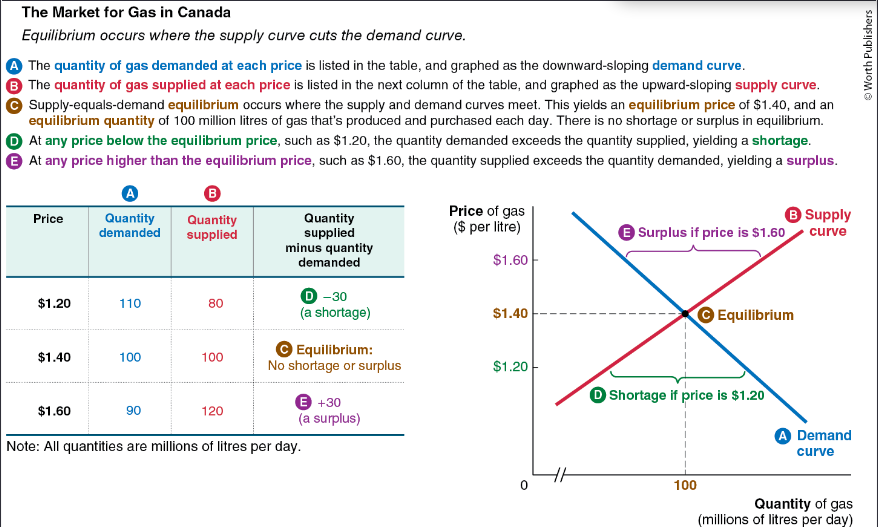 Shortage: When the quantity demanded exceeds the quantity supplied
Surplus: When the quantity supplied exceeds the quantity demanded
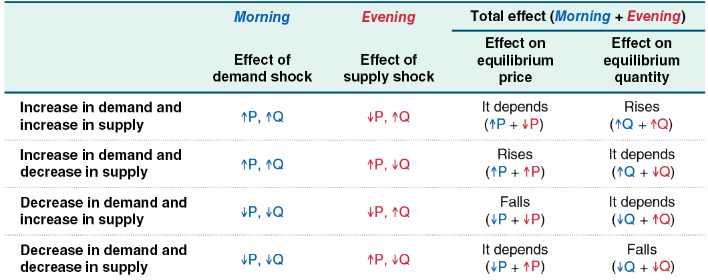
When there’s an increase in demand:
Causes demand curve to shift right
Leads to a new supply-equals-demand equilibrium
Leading to an increase in the price
Leading to an increase in quantity
When there’s a decrease in demand:
Causes demand curve to shift to the left
Leads to a new supply-equals-demand equilibrium
Leading the dreasing prices
Leading to decreasing quantity
When there’s an increase in supply:
Causes supply curve to shift to the right
Leading to a new supply-equals-demand equilibrium
Leading to a decrease in price
Leading to an increase in quantity
When there’s a decrease in supply:
Causes supply curve to shift to the left
Leading to a new supply-equals-demand equilibrium
Leading to an increase in price
Leading to a decrease in quantity
BIG demand shift & SMALL supply shift:
Decrease in both supply and demand curves, both curves shift left
Prices end up falling
Decrease in the quantity
SMALL demand shift & BIG supply shift:
Decrease in both supply and demand curves, both curves shift left
Prices end up rising
Decrease in quantity