Forgetting
Definition (#f7aeae)
Important (#edcae9)
Extra (#fffe9d)
Learning objectives:
Define forgetting.
How can fading be measured.
What causes fading.
How can understanding of it can be put to practical uses?
Memory Metaphors:
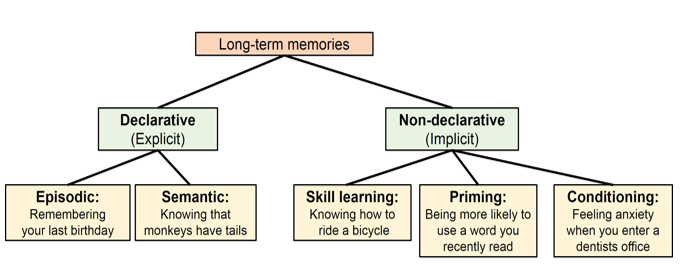
Knowledge Taxonomy:
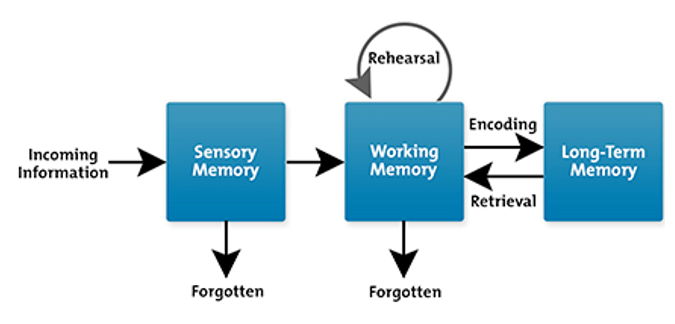
Atkinson & Shiffrin’s Theory of Memory:
Forgetting:
Encoding Failure:
Never encoded.
Information never entered into long term memory.
Retrieval Failure:
Forgotten information.
Forgetting: Deterioration in performance of learned behavior following a retention interval.
Retention Interval: Period during which learning does not occur.
Measuring Forgetting:
Free recall: How much can be remembered.
Prompted or cue recall
Relearning/Saving method: The more retained, the lesser the relearning time.
Recognition: MCQ.
Delayed matching to sample: Checking again after a while.
Extinction method: Quicker extinction refers to forgetting.
Gradient degradation
Sources of Forgetting:
Ebbinghaus (1885):
Strong relationship between length of retention interval and forgetting.
Forgetting increases with the passage of time.
John McGeoch (1932):
Learning occurs with time, but it’s certain behavior, experience not time that change behavior.
Forgetting occurs in time, but time is not the cause.
Factors:
Degree of learning.
Prior learning.
Subsequent learning.
Change in context.
Degree of Learning:
The better something is learnt, the slowly it’s forgotten.
Ebbinghaus (1885) – retention is better with rehearsing 64 times instead of 8 time.
William Krueger (1929) – performed how powerful overlearning can be.
Transferring information from STM to LTM:
Encoding: Acquiring information and transforming it into memory.
Control Process: Strategy that determines how information is processed.
Rehearsal: Repeating verbal information to keep it active in STM or transfer it to LTM.
Coding: Semantic elaboration of information to make it easier to remember.
Imaging: Creating visual images to make materials easier to learn.
Process:
Verbal Rehearsal & Learning:
Engages in rote learning, learning by repetition.
Useful for abstract materials.
Elaborative Rehearsal:
Thinking about the meaning, transfers into LTM.
Levels of processing:
Shallow Processing: Little attention to meaning.
Deep Processing: Close attention to meaning.
Factors Aiding Encoding:
Imagery:
For imagery based mnemonics to work, the images created need to be integrated.
Generation Effect:
The robust finding that information will be better remembered if it is generated rather than simply read.
Memory is better for self-generating content using free recall.
Organizing to be Remembered Information:
Having a mental framework of a comprehension aided memory encoding and retrieval.
Testing:
Which results in stronger memory?
Re-reading the material
Being tested on the material
The testing group performed better.
Creating Connections/Remembering Cues:
Engaging in conscious memory strategies.
Mnemonics
Mood congruent effect
Mood dependent memory
Self Reference Effect:
Tendency for people to encode information differently depending on the level on which the self is implicated in the information.
Prior Learning:
Forgetting occurs rapidly when learning unrelated words or terms.
More meaningful material is easier to remember.
Prior learning can interfere with recall.
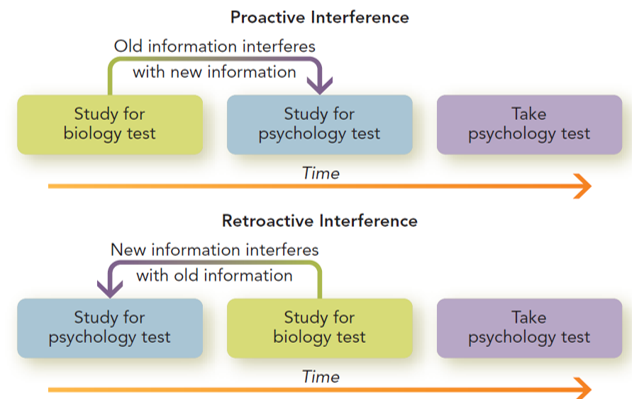
Proactive Interference: Material learned earlier disrupts retrieval of materials learned later.
Subsequent Learning:
We forget because we keep learning.
Retroactive learning: Material learned later disrupts.
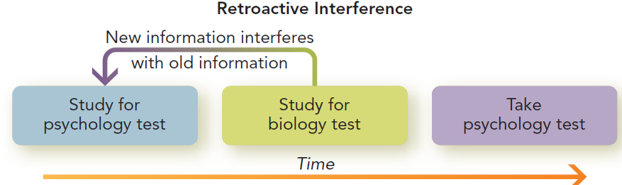
Difference between proactive and retroactive learning:
Changes in Context:
Context: Stimuli present during learning that’s not directly relevant to what’s learnt.
Cue dependent forgetting: When a stimuli that’s present during learning is absent, performance can suffer.
Application:
Overlearn
Practice with feedback
Test yourself
Use mnemonics
Use context cues
Take a problem solving approach