Lecture 3: Biological Polymers Study Guide
Overview of Biological Macromolecules
Classifications of Life's Molecules: All living organisms are composed of four primary classes of large biological molecules:
Carbohydrates
Lipids
Proteins
Nucleic acids
Hierarchical Organization: Within cells, small organic building blocks are joined together to form larger units:
Sugars function as building blocks for Polysaccharides.
Fatty acids function as building blocks for Lipids/membranes.
Amino acids function as building blocks for Proteins.
Nucleotides function as building blocks for Nucleic acids.
Carbohydrates: Sugars and Polysaccharides
General Definition: Carbohydrates include both sugars and the polymers of sugars.
Polysaccharides : carbohyrate macromolecules , polymers somposed of many sugar building blocks
Long chains of monosaccharides —> linked through dehydration synthesis
Energy Storage
Plants use starch
Starch: Used by plants; consists of monomers of -glucose. Includes Amylose (unbranched) and Amylopectin (somewhat branched). Starch granules are roughly to in size.
Animals use glycogen
Glycogen: Used by animals (stored in liver and muscle cells); highly branched polymer of -glucose.
Structural Support
Plants use cellulose
Cellulose: A major component of plant cell walls. It is a polymer of -glucose. Unlike starch, the -linkages make it straight and unbranched, allowing -bonds between parallel strands to form strong microfibrils.
Arthropods and fungi use chitin
Chitin: Used by arthropods to build exoskeletons and by fungi for cell walls.
Monosaccharides (Simple Sugars): these are the simplest carbohydrates.
Molecular Formulas are usually multiple of CH2
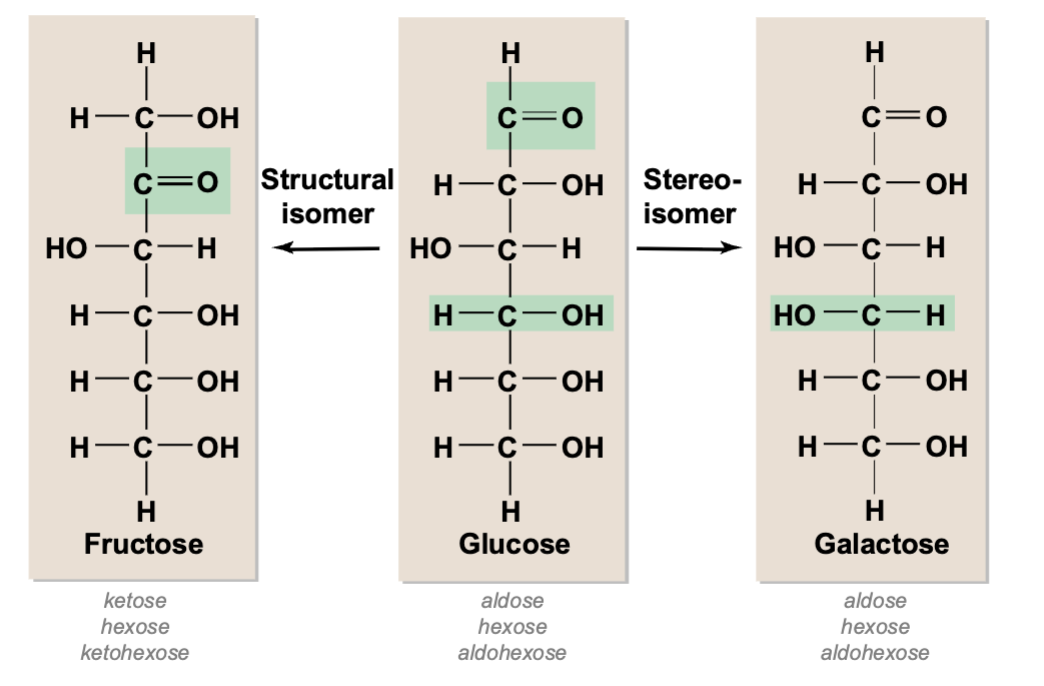
Glucose (C6H12O6)
Classified by :
Location of the cabronyl group (aldose or ketose)
The number of carbons in the carbon skeleton (pentose or hexose)
Serves as a major fuel for cells and as raw material for building molecules
Disaccharides : 2 monosaccharides linked together by dehydration synthesis
Used for sugar transport or energy storage
Ex. Sucrose, Lactose, Maltose
Condensation Reaction : two molecules become covalently linked with the loss of a water molecule (dehydration)
The covalent bond formed is called a glycosidic linkage.
Hydrolysis : the reverse reaction, in which water is added
Common Examples:
Sucrose: Constructed from Glucose + Fructose; used for sugar transport in plants.
Maltose: Constructed from Glucose + Glucose.
Lactose: Sugar found in milk.

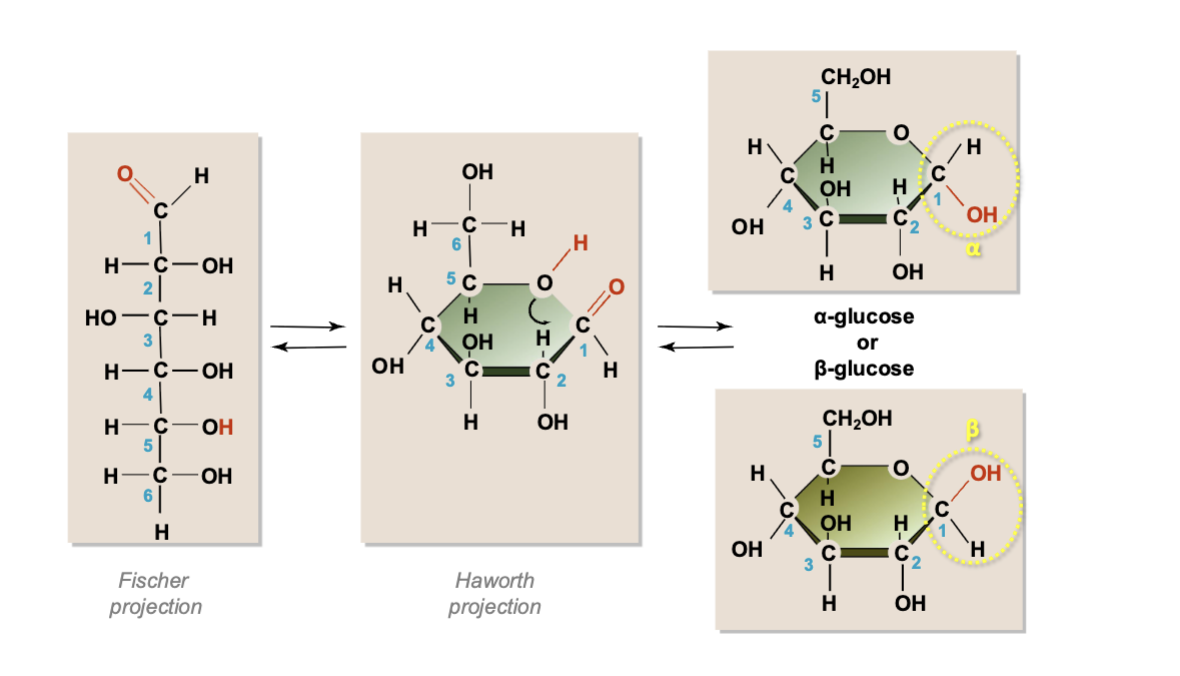
Isomeric Forms of Glucose: Glucose can exist in a linear Fischer projection or a ring-shaped Haworth projection.
n aqueous solutions, glucose molecules form rings.
-glucose vs. -glucose: These isomers differ in the orientation of the hydroxyl group on Carbon 1.
Lipids: Hydrophobic Molecules, the only class of large biological molecules that do not include true polymers
Unifying feature of lipids is having a little or no affinity of water
Hydrophobic because they consist mostly of hydrocarbons, which form nonpolar covalent bonds
The most biologically important lipids are fats, phospholipids, and steroids
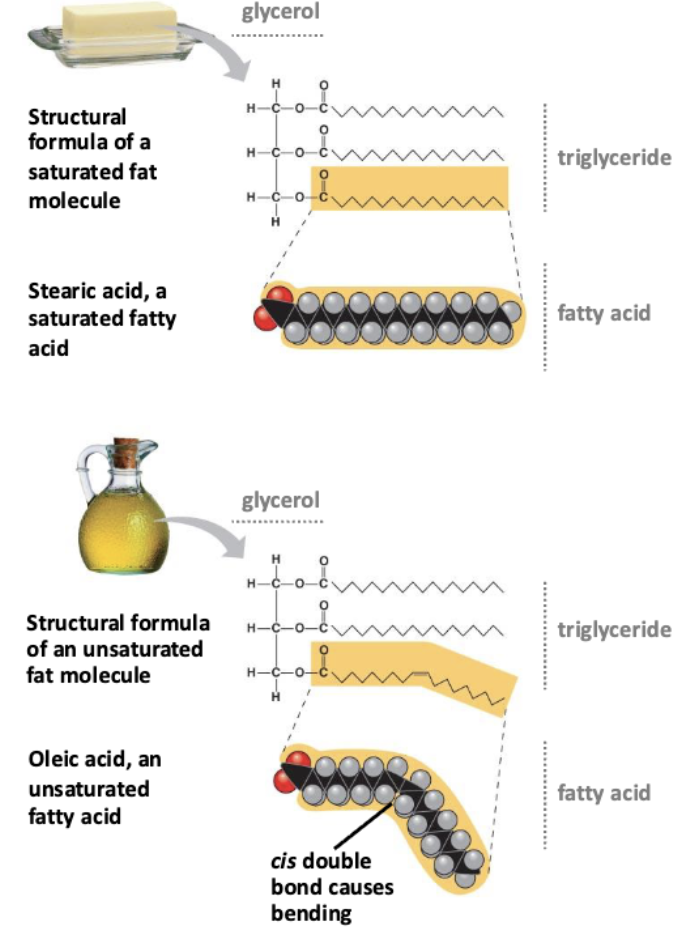
Fats (Triacylglycerols): Constructed from one glycerol molecule (a three-carbon alcohol with a hydroxyl group on each carbon) and three fatty acids (long carbon skeletons with a carboxyl group at one end).
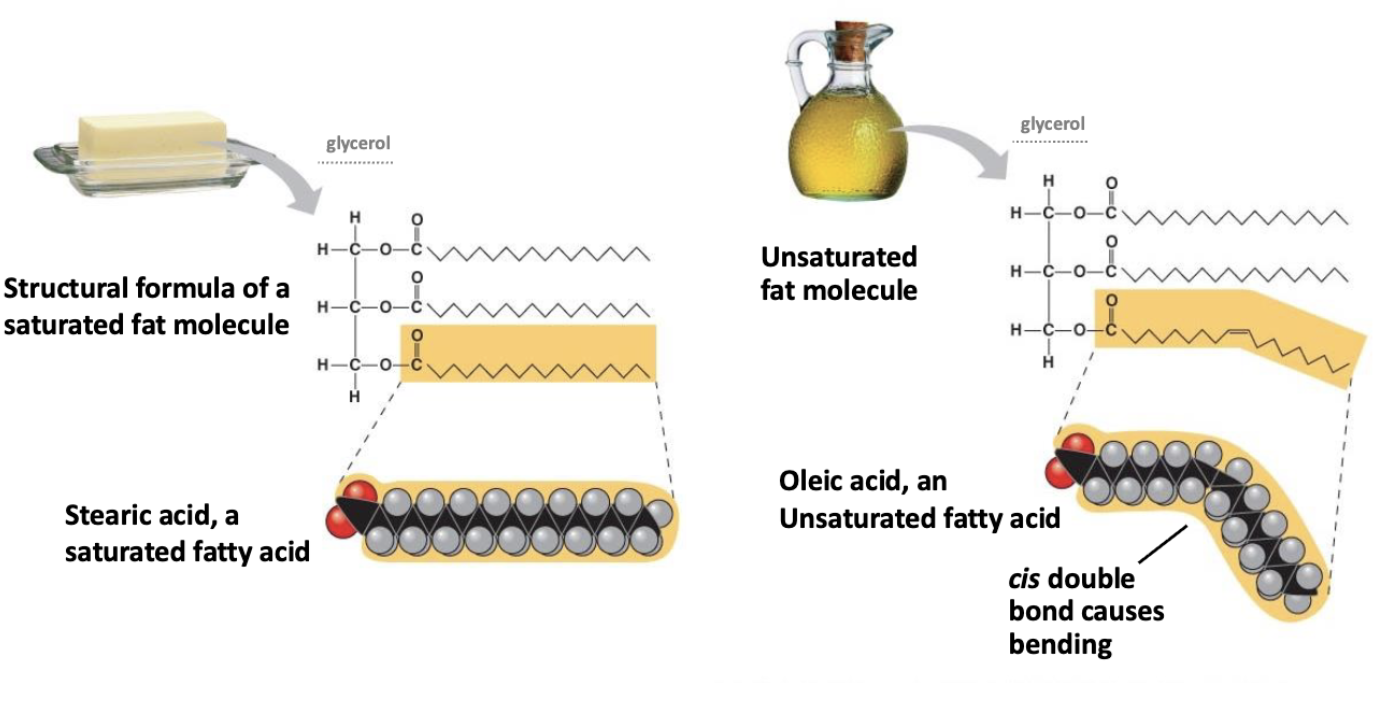
Saturated Fats: Have the maximum number of hydrogen atoms possible and no double bonds. They are typically solid at room temperature (e.g., animal fats like stearic acid).
Unsaturated Fats: Have one or more double bonds, resulting in "kinks" in the hydrocarbon chain. They are typically liquid at room temperature (e.g., vegetable oils like oleic acid).
Cis double bond: Causes bending in the fatty acid tail.
Hydrogenation and Trans Fats: Hydrogenated vegetable oils are synthetically converted to saturated fats by adding hydrogen to allow solidification at lower temperatures. his process produces trans double bonds. Trans fats contribute to coronary heart disease.
US FDA regulation: Food manufacturers were ordered to stop adding trans fats to foods by 2021.
Primary function is long-term energy storage.
Phospholipids: wo fatty acids and a phosphate group attached to glycerol.
Structure: Amphipathic, containing a hydrophilic head (phosphate group and attachments) and Hydrophobic tails (fatty acids).
Cellular Role: They are essential components of all cell membranes, forming a bilayer structure.

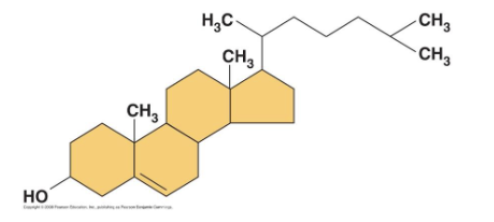
Steroids: Characterized by a carbon skeleton consisting of four fused rings.
Cholesterol: An essential steroid in animal cell membranes; however, high blood levels may contribute to cardiovascular disease.
Proteins: Structure and Diversity of Function
Overview: Proteins account for more than of the dry mass of most cells.
Protein fucntions include catalyzing biochemical reactions, structural support, storage, transport, cellular communications, movement, and defense against foreign substances
Key Functions:
1. Enzymatic: Selective acceleration of chemical reactions (e.g., digestive enzymes catalyzing hydrolysis).
2. Defensive: Protection against disease (e.g., antibodies inactivating viruses and bacteria).
3. Storage: Storage of amino acids (e.g., casein in milk, ovalbumin in egg whites, seed proteins in plants).
4. Transport: Transport of substances (e.g., hemoglobin transporting oxygen, or membrane transport proteins).
5. Hormonal: Coordination of organismal activities (e.g., insulin regulating blood sugar levels).
6. Receptor: Response of cell to chemical stimuli (e.g., nerve cell receptors for signaling molecules).
7. Contractile and Motor: Movement (e.g., actin and myosin in muscle contraction; motor proteins in cilia and flagella).
8. Structural: Support (e.g., keratin in hair/skin, silk in webs, collagen and elastin in animal connective tissues).
Polypeptides: Polymers built from a set of 20 amino acids.
A protein consists of one or more polypeptides twisted into a unique shape.
Amino Acid Anatomy: Consists of an carbon bonded to an amino group, a carboxyl group, a hydrogen atom, and a variable R group (side chain).
Physical Properties: Side chains determine if an amino acid is nonpolar (hydrophobic), polar (hydrophilic), acidic (negative charge), or basic (positive charge).
Chirality and Mirror Life: Amino acids exhibit chirality (L and D isomers). Naturally occurring amino acids are generally the L-form (e.g., L-tryptophan).
Biosecurity Risks: Discussion exists regarding the risks of "mirror life" (synthetic life using D-amino acids). Concerns include the potential for mirror bacteria to act as invasive species that predators cannot consume, potentially causing infections across ecosystems.
The 20 Organic Amino Acids:
Nonpolar: Glycine (Gly, G), Alanine (Ala, A), Valine (Val, V), Leucine (Leu, L), Isoleucine (Ile, I), Methionine (Met, M), Phenylalanine (Phe, F), Tryptophan (Trp, W), Proline (Pro, P).
Polar: Serine (Ser, S), Threonine (Thr, T), Cysteine (Cys, C), Tyrosine (Tyr, Y), Asparagine (Asn, N), Glutamine (Gln, Q).
Acidic: Aspartic acid (Asp, D), Glutamic acid (Glu, E).
Basic: Lysine (Lys, K), Arginine (Arg, R), Histidine (His, H).
Protein Synthesis: Amino acids are linked by peptide bonds formed via dehydration synthesis between the carboxyl group of one and the amino group of another.
A polypeptide has a repeated sequence called the backbone, with an Amino end (N-terminus) and a Carboxyl end (C-terminus).
Four Levels of Protein Structure:
1. Primary: The unique linear sequence of amino acids.
2. Secondary: Coils and folds in the polypeptide chain resulting from hydrogen bonds between backbone constituents (e.g., helix and pleated sheet).
3. Tertiary: The overall three-dimensional shape determined by interactions among various side chains (R groups).
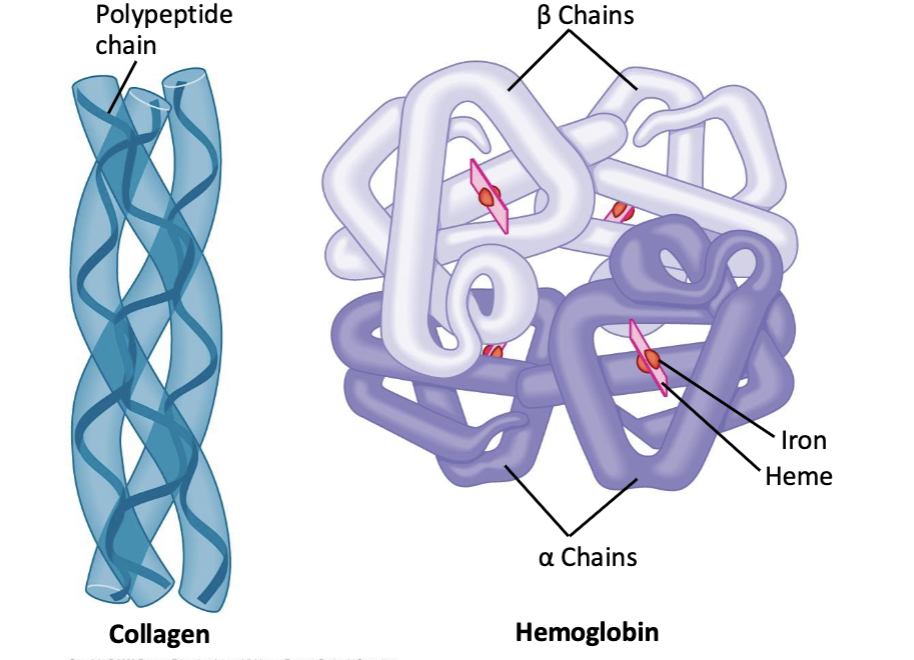
4. Quaternary: Results when two or more polypeptide chains form one macromolecule (e.g., Collagen made of 3 polypeptides, Hemoglobin made of 4 polypeptides containing Iron Heme groups).
Structural Determination:
Experimental: X-ray crystallography and electron microscopy.
Prediction/Modeling: DALI and AlphaFold.
Nucleic Acids: Information Storage and Transmission
Definition: Nucleic acids are polymers called polynucleotides made of monomers called nucleotides.
Types:
1. Deoxyribonucleic acid (DNA): Provides directions for its own replication and directs mRNA synthesis.
2. Ribonucleic acid (RNA): Controls protein synthesis.
Gene : the amino acid sequence of a polypeptide is programmed by a unit of inheritance
Stored as DNA, a nucleic acid
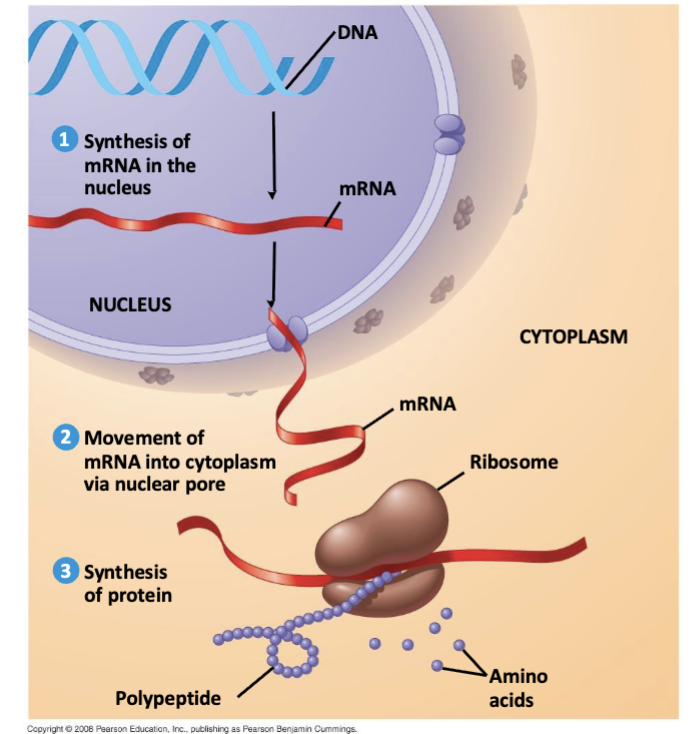
The Central Dogma of Molecular Biology
Polynucleotides : nucleic acids are polymers
each polynucleotide is made of monomers
each nucleotide consists of a nitrogenous base, a pentose sugar (Ribose or Deoxyribose), and a phosphate group(attached to the 5’ carbon)
Nucleoside : the portion of a nucleotide without the phosphate group
nitrogenous base + sugar
Nucleotide : nucleoside + phosphate group
Nucleotide Structure: * Nitrogenous Base: * Pyrimidines (single ring): Cytosine (C), Thymine (T - in DNA), Uracil (U - in RNA). * Purines (two rings): Adenine (A), Guanine (G). * Pentose Sugar: Deoxyribose (DNA) or Ribose (RNA). * Phosphate Group: Attached to the 5' carbon.
Phosphodiester Linkages: Nucleotides join via condensation reactions, connecting the sugar of one nucleotide to the phosphate of the next.
DNA Double Helix: Two polynucleotide strands spiraling around an imaginary axis.
Antiparallel: The two sugar-phosphate backbones run in opposite directions ( vs. ).
Base Pairing: Strands are held together by hydrogen bonds between bases: Adenine (A) pairs with Thymine (T), and Guanine (G) pairs with Cytosine (C).
base pairs are joined by hydrogen bonding
Evolutionary Context: DNA sequences are hereditary. Closely related species share more similar DNA/protein sequences, making molecular biology a "tape measure" of evolution.
Summary Table of Biological Molecules
Type | Monomer | Polymer | Linkage Type |
|---|---|---|---|
Carbohydrates | Monosaccharides | Polysaccharides | Glycosidic linkages |
Lipids | Fatty acids/Glycerol | Triacylglycerols | Ester linkages |
Proteins | Amino acids | Polypeptides | Peptide bonds |
Nucleic acids | Nucleotides | Polynucleotides | Phosphodiester linkages |
NOW ABLE TO ANSWER THESE :
1. List and describe the four major classes of biological macromolecules
2. Describe the formation of a glycosidic linkage and distinguish between monosaccharides, disaccharides, and polysaccharides
3. Distinguish between saturated and unsaturated fats and between cis and trans fat molecules
4. Describe the four levels of protein structure
5. Distinguish between the following pairs: pyrimidine and purine, nucleotide and nucleoside, ribose and deoxyribose, the 5’ end and 3’ end of a nucleotide