Dengue
Definitions
Bleeding diathesis - an abnormal propensity toward bleeding
Hematocrit - volume percentage of red blood cells in blood
Pleural cavity - fluid filled space surrounding lungs
Dengue Fever
Acute febrile diseases
Tropics and Africa
Geographical spread similar to Malaria but Dengue is found in urban areas
Dengue Hemorrhagic Fever
Bleeding diathesis (tendency) or disseminated intravascular coagulation caused by increased vascular permeability
Dengue Shock Syndrome - 20-30% of DHF cases
History
In 1944, Albert Sabin successfully isolated the virus and found that it belongs to the Flaviviridae virus family
Classification
Group: IV
Family: Flaviviridae
Genus: Flavivirus
WNV, Tich encephalitis, Yellow Fever, Zika
Enveloped, isoahedral nucleocapsid
E protein
Has 3 domains with folds based largely on Beta-sheets
Domain 2
Elongated, finger-like structure
Hydrophobic sequence that is conserved among all flaviviruses
Genes of Dengue
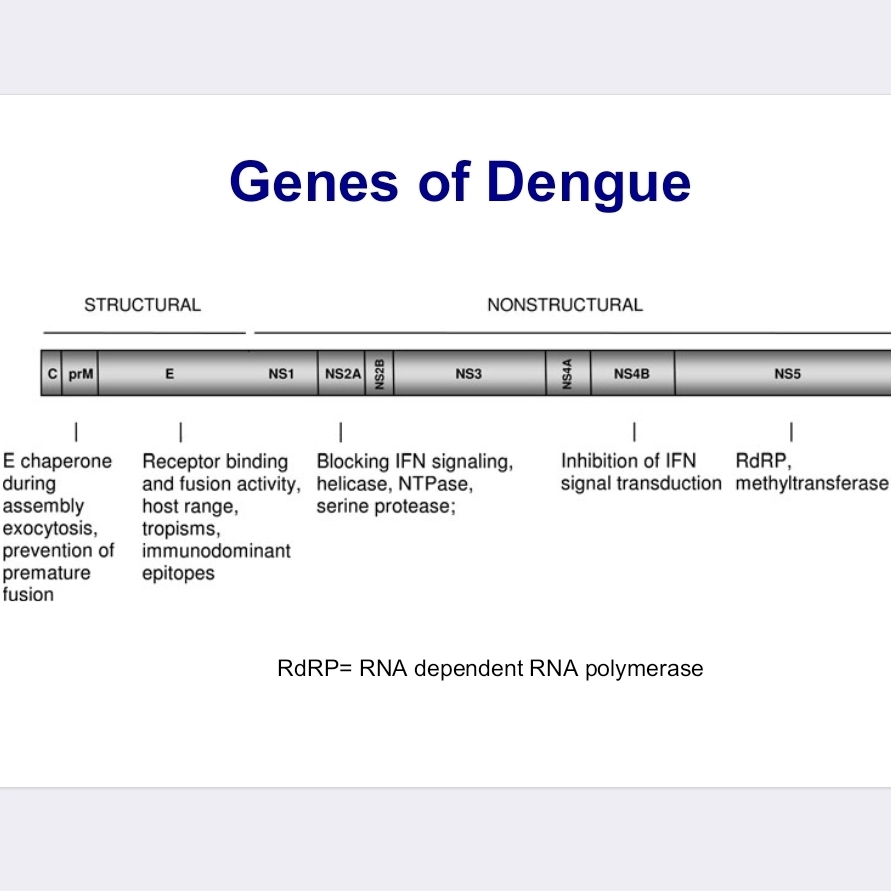
Structural
C & prM - E chaperone during assembly exocytosis, prevention of premature fusion
E - receptor binding and fusion activity, host range, tropisms, immunodominant epitopes
Nonstructural
NS1 and NS2A - blocking IFN signaling, helicase, NTPase, and serine protease
NS4B - inhibition of IFN signal transduction
NS5 - RdRP, methyltransferase
RdRP - RNA dependent RNA polymerase
Dengue Replication
Dengue binds o some receptor protein (DC-SIGN, DC-SIGN-R (Dendritic Cell-Specific ICAM3-Grabbing Nonintegrin-Related Protein), and CLEC5A), E protein plays a role
In cell, pH drops, conformational change of E protein, becomes hydrophobic, and viral membrane fuses with host membrane
Serotypes
Same Morphology and Genome size
Genetic Variation within serotypes
Different antigens
Life-time immunity and short term cross-immunity
All can cause severe and fatal disease
Hyperendemicity (constant presence at high levels) may occur
Dengue is 4 main viruses
4 Serotypes
DEN-1
DEN-2
DEN-3
DEN-4
DEN-1 found in Pacific Islands
Historically, DEN-2 is the prevalent serotype found in Southeast Asia
Recently found in Jamaica
DEN-3 found in the Caribbean
But now all 4 strains are found almost everywhere
Transmission
Arbovirus - arthropod-borne virus
Human and primate host transmission
Vector: Aedes aegypti
Infected female mosquito
10-day extrinsic incubation period (virus passes from intestinal tract to salivary glands)
Lays eggs and produces larvae in “artificial containers”
Pathogenesis
After bite, virus infects immature dendritic cells
Migration to lymph nodes
Incubation period of 3-6 days to viremia
Symptoms
High, prolonged fever
Severe headache
Painful eyes
Nausea
Vomiting
Symptoms-DHF
4 Criteria Defined by WHO
Fever, or recent history of acute fever
Haemorrhagic manifestations
Low platelet count
< 100,000/mm
Indications of plasma leakage
Elevated hematocrit
Low albumin
Pleural (space around lungs) or other effusions
Viral Risk Factors for DHF
Higher risk for DHF in secondary infections
Higher risk in hyperendemic transmission
DEN-2 → DEN-3 → DEN-4 → DEN-1
Diagnosis
X-ray - reveals pleural effusion
Blood test - to look at hematocrit level
Tourniquet test - to determine patient’s haemorrhagic tendency
Serology test
PCR
Treatment
Supportive therapy such as rest and fluid intake
Aching symptoms - acetaminophen
Platelet transfusion
Prevention
Vector control
Vaccine development
Tetravalent vaccine - protection against all 4 serotypes
Chimeric vaccine - uses a yellow fever vaccine