Com 200 week 2 - media and mediums
Communication models and media
A model is a selective representation in verbal or diagrammatic form of some aspect of the dynamic process of mass communication
They provide us w/ a visual representation of the different aspects of a communication situation.
It’s often challenging to determine where a conversation begins and ends
Models of communication come in, to simplify the process of understanding communication
Some are more detailed than others.
Monological - one way
Transmission model
An information source, produces a message
A transmitter or encoder, encodes the message into signal
Receiver or decoder, decodes or reconstructs the message from the signal
A destination where the message arrives
“Noise is anything that is added to the signal between its transmission and reception that is not intended by the source.”
Noise from mic rubbing, background noise, a late student walking in (disruption)
Two-step flow model
Most people form their opinions under the influence of opinion leaders, who in turn are influenced by the mass media.
The flow of info and influence from the mass media to their audiences involves: from the meia to certain individuals amd from them to public
Dialogical models - two ways
Interactional model
A two way process in which participants alternate positions as sender and receiver and generate meaning by sending and receiving feedback within physical and psychological contexts
Transactional model
Someone can be sender and receiver at the same time.
Mutual.
A process in which communicators generate social realities within social, relational, and cultural contexts
Cultural models - multiple ways/contexts
Harrold Innis - Communication as space and time
Mechanized communication (space biased) is displacing the oral tradition (time biased)
A flourishing civilization should have balance between both space and time biased forms of communication.
James Carey - Communication as culture
Togertherness (commune - communication)
It is not merely the transmission of info. It has a ritualistic function
Ritual (cultural model) - communication is the construction of a shared space and meanings within which people coexist and share their experiences.
Communication is the transmission of signals in space for controlling distance or people
Highlights, information, persuasion, change
Communication as transmission and ritual
In a ritual understanding, communication is linked w/ participation, community, and fellowship. It isnt about extending messages in space, but to the maintenance of a society in time. The study of communication is also a symbolic process where reality is produced, maintained, repaired, and transformed.
Non-western model
Collective communication model - involves one or more senders and one or more receivers. Interdependence, mutual, and collective.
Emphasis:
Collective rather than individual
Mutual rather than self centered
Interdependence rather than independence
Relationship rather than process
Fluid rather than mechanical
Every person interprets the message they receive based on their relationship with the other person, and their unique understanding of the semantics and connotations of the exact words being used.
Medium/Media
In physics and telecommunication:
“Medium” refers to a substance or material that can propagate waves or energy. A medium can be any phase of matter: solid, liquid, gas, plasma
In fine arts:
“Media” encompasses material conduits of creative expressions like music, arts, literature, or painting, sculptures, architectures
In communication:
Refers to a single medium or multiple mediums (hence, media or mass media) that carry info to its target audience or users.
Print/printing: is a process for mass reproducing text and images using a master form or template
Mass media: includes the diverse arrays of media that reach a large audience via mass communication
Broadcast media: transmit info electronically via media such as film, radio, recorded music, or TV
Digital media: comprises both internet and mobile mass communication
Social media: are interactive technologies that facilitate that creation and sharing of information, ideas, interest and other forms of expression through virtual communities and networks
Synthetic media: is a broad term for media that is artificially created or modified using technology, especially AI.
While non-synthetic media is created in the physical environment by human, synthetic media is generated in the digital world by AI algorithms
Chatbot: a computer program designed to simulate conversation with human users, especially over the internet.
Medium: the stuff between communicators.
Carrier: physical media (like an envelope). Focus is on the material vehicle that bears the message.
Conduit: the message moves in the medium (like a cable). Channels the message as it flows from one place to another. Conduits provide the infrastructure for message transmission
When the message appears from the cable (conduit) to your screen (carriers) it changes from one medium to another.
Both communications and the media propagate the values and schemas of a culture through the repeated interaction and exchange enabled by the communications process.
Circuit of culture:
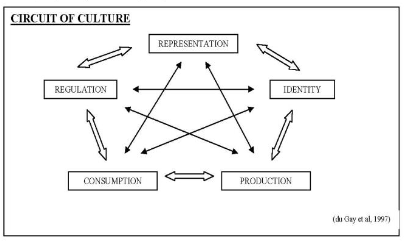
Demonstrates how communications and media work together to spread a culture’s values and ways of thinking. This occurs through the repeated interactions and exchanges that take place when people communicate with each other. Media plays a key role in this process.
Medium (is the message)
Marshall Mcluhan’s theory
Form affects content
The form and content are dependent. The form or manner of
presentation fundamentally affects the content.
A dominant medium affects our society
Medium plays a role not by the content delivered over the medium, but by the characteristics of the medium itself.
“It is the medium that shapes and controls the scale and form of human association and action.”
“It is only too typical that the ‘content’ of any medium blinds us to the characteristics of the medium.” (Understanding Media, 1964)
Our sensory participation with medium shapes our thinking.
It influences what we think and how we make sense (high participation – cool media; low participation – hot media)
Hot vs. cool media
Hot media - needs less sensory participation
Cold media - demands more active sensory participation
Continuum - Contextual rather than binary opposites Cool media is cool in
comparison to hot. Participation may vary.
Sensory ratios: different media alter the “ratio” of our senses, emphasizing some hile diminishing others.
Mcluhan views media as extensions of human senses - the wheel is an extension of the foot, book an extension of the eye.
Media as a service environment refers to how media technologies create ecosystems that shape human experience and behavior in largely invisible ways
“Media aren’t just “channels,” they are environments that encourage certain types of interaction and discourage others. From lecture.