amh2020 summer b unit 3
COLD WAR
- Competing for global INFLUENCE
- Competing for national SUPERIORITY
I. the suburbs, conformity, and cold war culture
- Conformity defines US domestic policy during this time
- During this early cold war period it seemed essential that everyone conform to certain political and social standards
- What was the perceived danger of people not conforming?
- People may think you are a communist
- Cannot prove that US is best country on earth, if you're not conforming to mainstream social standards how can US superiority be proved
- It was encourage politically, socially, and culturally to conform
- Culture of conformity during the cold war was heavily rooted in suburbs
The house un-american activities committee (HUAC), 1945
- Regardless of political affiliation it was extremely important to be anti-communist
- Both parties were invested in rooting out communism at home
- Identify people in the country who had communist sympathies
- Their job is to identify people who are “un-american”
- Anyone can be accused of being a secret communist or socialist, HUAC takes it very seriously, you may then be called to testify in front of HUAC, if you are testifying in front of this committee you will be asked about political affiliations and personal questions, you are under oath so you cannot lie, if you don't cooperate you will be held in jail for contempt
- People thought Hollywood was using subliminal messages to indoctrinate people into socialism and communism
- Actors, directors, screenwriters were investigated
- Example of federal government using their power and authority to control people who do not conform
McCarthyism and the second red scare
- A red scare is a period of paranoia and hysteria regarding communism within the united states
- The cold war is ramping up ATT
- Joseph mccarthy used this fear of communism to generate a lot of political power for himself
- Was a senator from wisco, he really wanted to make a name for himself
- In 1952 it was his first year in the senate, he gets on TV for a press conference and at the press conference he says “i have the names of 205 known communists working in the state department in my briefcase”
- He got his own investigative committee in congress as a result of this statement
- That is one of the most powerful positions ATT
- Uses this to attack political rivals
- Known for berating people who were testifying
- Accusation of being a communist ATT would ruin your life: fired from your job, evicted from your home, family would stop talking to you
- 1952-1954: his allegations got more and more outlandish
- At one point joseph mccarthy accused secretary of state (the guy who made the marshall plan) of being a secret communist
- When he accused the army of harboring communist officers people started to hate him and he got shut down
- He was addicted to amphetamines and he was an alcoholic
- Emphasizes the real fear about people who do not conform
- They have to be targeted/found out
C. the consumer republic of the suburbs
- Americas culture during the beginning of the cold war is most associated with the suburbs
- What is a suburb?
- It's not urban, but it isn't rural
- predominately a residential area, tends to be middle class and ATT the people were typically white
- Kept racially homogenous (purposefully only whites)
- Suburb is just outside of a major urban areas, people from the suburbs have to commute to work (in the cities)
- Suburbs take off post a WW2
- Why would more and more people be moving to suburbs after ww2?
- Commuter culture (cars make it easier to commute)
- Economic prosperity (production is back on track, more people have entered the middle class)
- Baby boom (after ww2 there is an increase in average family size, height of baby boom 1956) (families need more space, rather than being cramped in a city apartment they move to the suburbs)
- “White flight” (a lot of white middle class families left cities bc the cities became more racially and ethnically diverse)(a lot of white middle class families no longer want to live there)(schools are now integrated)
- “The consumer republic of the suburbs” a particular culture around consumption
- During this early period of the cold war, consumption took on political meaning
- If you are purchasing american goods, it highlights production
- It's the complete opposite of communism (capitalism)
- Our purchasing is anticommunism in action
- It proves our economy is doing so much better than the soviet economy
- During this early period of the cold war, consumption took on political meaning
D. television, the home, and the cold war
- One of the most important appliances you can purchase and put in your home is a television set
- First available in the late 1940s
- Not until 1950s that tv takes off
- Television is filled with programming that promotes consumption
- ADs
- TV is another medium for advertisements
- TV is also portraying the typical american family/home a certain way
- Aligns with the culture of the suburbs
- The american family is mom dad and two kids living in the suburbs
E. the kitchen debate, 1959
- Quote from nixon photo in camera roll
- Relations between us and ussr thawed out a bit, so the us start communicating slightly
- In 1959, they host a joint exhibition: one part is in NYC (show off all their most modern stuff), other part is in moscow (show off their most modern stuff)
- Both countries are still competing
- Ussr brought space technology
- US brought a model (working) of a suburban home
- Nixon was the VP at the time tours ussr leader, ussr leader is mad that the people of his country are witnessing the suburban home
- Two men start arguing in the kitchen of a suburban home
- The model of the suburban home represents that we are the best country on earth, best society, most comfortable standard of living, the idea of making prosperity for all achievable
II. the early civil rights movement
- It was important for the US to stress they were a democracy that valued equality and freedom
- Certain groups of people felt like the needed to question the equality and freedom
- Double v campaign is an example of this during ww2
- In cold war, there is a lot of activism fighting against discrimination in jim crow south
Fight against segregated education
- Schooling (public) was segregated
- Education is liberation
- If you don't have adequate education you can move up in society
- Segregated education was designed to keep blacks in second class
- Brown v. Board of Education 1954
- The case was trying to prove that segregated education was inherently unequal
- NAACP was using brown case to try to overturn plessy v. ferguson (separate but equal)
- The supreme court ruled (unanimously) segregated education is inherently unequal
- Schools must be integrated with “all deliberate speed”
- “Massive resistance”
- Photo of quote
- Schools in the jim crow south were not willingly integrated
- Brown decision is a great legal victory but takes a long time to be enforced
- Southern whites vow to resist integration
- Central high school Little Rock, AR, 1957
- This example has a lot of lessons we can learn about segregated edu.
- Integration often was a voluntary position
- 9 students volunteered
- Test the supreme court ruling to see if it would be enforced, the children were the test subjects
- The little rock 9 are blocked from entering the school by angry mobs of people
- The kids keep trying to attend the school
- Little rock becomes very tense
- The gov. Of arkansas called in the national guard to prevent the students from entering the school
- At that point, president eisenhower gets involved, there is a constitutional battle now
- The president said those national guards men work for him now and they now must protect the student who are integrating
- This example shows us that integration will not happen without force from the federal government
Boycotts and non-violent direct action
- Other activists are going to try to dismantle jim crow in south
- Seg: public spaces, transportation
- The Murder of Emmett Till, 1955
- Modern civil rights movement (basically george floyd ATT)
- 14 y/o boy, summering in MS visiting family, he and his cousin visit a convenient store owned by the bryant family, at the store a confrontation/conversation happens between Carolyn B. and emmett, cousin said that he just had an attitude, carolyn says emmett was sexually harassing her, carolyn goes to her husband and tells him her story, her husband (roy) and his friends kidnaps emmett and beat him to death also mutilate his body then throw it in the tallahatchie river
- When ET body is recovered, his mother insisted having an open casket funeral even though his body was mutilated beyond recognition
- So the people can see what they did to him
- Roy bryant and his accomplices are found not guilty, he bragged about committing the crime after being acquitted
- The Montgomery, AL Bus Boycott 1955-56
- After the murder of ET, waves of protests through the south
- Summer of 1955 a young woman decides that she doesn’t want to give up her seat on a segregated public bus, the bus driver called the police and she was arrested
- Massive protest sparks throughout montgomery
- Claudette colvin
- 15 year old girl, first person in montgomery arrested for violating segregation policy in AL
- NAACP used this as the basis of a boycott against city busses
- The NAACP doesn't want to use the face of Claudette Colvin for the face of the boycott so her story got lost in history, face of the boycott then becomes Rosa Parks
- Blacks start boycotting the busses, the boycott finally ends in 56 when the supreme court intervenes, SC says montgomery’s segregation law for busses is unconstitutional
- MLK
- The Tallahassee Bus Boycotts, 1956-57
- Black residents of Tally decided they were going to boycott the busses
- Two black FAMU students were arrest for not giving up their seats
- Various orgs. Plan a massive boycott in response of it
- Leadership of the boycott fell to religious leader, reverend C.K. Steele
- When that ruling was decided in Montgomery residents of Tally decided to test it in tally, they tested the ruling in tally
- Crisis in tally: tension in town, Gov ATT (LeRoy Collins) to avoid integrating ceases all bus services 1/1/1957
- Due to political pressure busses resume six days later but full integration will not be seen until summer of 1957
- Sit in Movement, 1960
- Different type of protest
- Non-violent direct action
- [direct action]= involvement, more (meant) disruptive
- [non-violent]= not causing harm, if violence is used against you you cannot defend yourself
- 4 students in greensboro NC decide spur of the moment that they would integrate at a segregated lunch counter, they do not get served, they sit all day,
- Day two, 8 of them now, wait all day to get served
- Day three, even more people
- Day four, two hundred black people waiting to get served
- Day four, they get served
- That type of protest spreads throughout the south over 2 months
- The student nonviolent coordinating committee (SNCC)
- Created in response to all the sit ins in the south
- Their job is to train other young people how to do their own sit ins
The swing toward conservatism, 1968-80
- If historians had to describe the 1970s in one word: malaise
- Malaise: is a combination of anxiety and depression
- Why do people feel this way?
- The feeling of malaise provided a good foundation for conservatism
- Conservatism was a rising political movement
- Conservatism captured the malaise and blamed it on the liberal politics
- Conservatives build a large political movement in the late 1970s
- Elect Reagan
- Crisis of confidence stems from liberal policies (conservative views)
The end of the vietnam war
- Malaise (part of it) stems from the way the vietnam war ends
- It doesn't end in a US victory
- A negotiated removal from the war
- For many people it did not inspire hope or confidence
Nixon’s vietnam: 1969-73
- Republican
- The vietnam war fell on to him when he was inaugurated
- Emerging anti war movement
- By 1969 many americans want the US to leave the war
- Nixon’s plan to leave the war is “vietnamization”
- The US will gradually reduce troop levels
- The other part of this plan is to force S vietnam to fight this war themselves
- In addition to vietnamization, there were ongoing peace negotiations
- Headed up by his secretary of state
- Henry kissinger
- Henry kissinger was most responsible for peace negotiations about the vietnam war (not always negotiate in a forthright manner)
- Was trying to diplomatically resolve the conflict, but also escalating bombing campaigns (particularly in the neutral nation of cambodia)
- Cambodia is the neighbor of S vietnam, kissinger authorized covert bombing campaigns
- The supply trail from n to s vietnam dipped into cambodia, the bombing was authorized bc of this
- Was a big scandal
- Was trying to diplomatically resolve the conflict, but also escalating bombing campaigns (particularly in the neutral nation of cambodia)
- On one hand there is an effort to get the US out of the war, while at the same time covert practices are causing an uproar in asia
The paris peace accords, 1973
- In these, the US leaves the vietnam war
- Has negotiated its way out
The fall of Saigon, 1975
- The NVA (N vietnam army) made a last HUGE offensive in S vietnam
- They (N vietnam) are able to take control of Saigon (S vietnam capital)
- N vietnam has now won the war w the fall of saigon, Communism won
- The US watched as all of its efforts in vietnam resulted in nothing
- Really concerning bc (context) this was the middle of the cold war
- NVA crept closer and closer to the US embassy
- US personal had to be airlifted from the embassy before the NVA took over the embassy
- Also had to get out the S Vietnam officials bc they would be killed
- The way the war ended after so many US soldiers died and resources used, left americans feeling hopeless
II. Political and social crises: liberalism vs. conservatism
- Worry and hopelessness about the future leads people to subscribe to the increasing political divide (the extremes of the left and right)
- Disagreement about the size and role of the federal government
- Conservatism (definition): [1970s] also referred to as neoconservatism, small and weak federal government, they oppose regulation of the economy and social safety net from the federal government, any issues of discrimination/social justice is not the job of the federal government (FG shouldn't have to federally legislate social justice), advocates for traditional morality (sex, gender, religion)
- Not a new movement, similar to the views of the anti-federalists (like thomas jefferson)
- Liberalism: believes the federal government should be large and active, regulating the economy and providing a social safety net, advocating for social justice (addressing discrimination)
The watergate scandal, 1973
- June 17, 1972: five men are arrested at the watergate building
- At the watergate there is a hotel, offices, and residential spaces (office, and residential spaces are for rent), the democratic party has its official headquarters at the watergate
- These five men were attempting to break into the democratic offices
- When they are arrested they were carrying a bunch of illegal surveillance equipment that they were going to put into the democratic HQ offices
- It barely made the newspaper when it initially happened
- Two reporters at the Washington Post decide to investigate
- They thought it was suspicious and had political motivation
- They found that two of the arrested men were employed by Nixon’s re-election campaign
- They eventually find explicit connections of people from Nixon’s white house to the people that broke into watergate
- Followed paper trails (checks, money)
- In 1973, congress begins their own watergate investigation
- The congressional investigation was unable to prove that nixon ordered the break in
- Suspicion but no proof
- The investigation did prove that nixon ordered a cover-up of the nixon administration with the break in
- The congressional investigation was unable to prove that nixon ordered the break in
- In June of 1974, the House of representatives are considering filing articles of impeachment against Nixon, it was certain that Nixon would have been impeached
- He resigned in august of 1974, before they could officially impeach him
- Nixon’s Resignation, 1974
- Gerald Ford, Nixon’s VP, was inaugurated as president when Nixon stepped down
- His first action as president was to fully pardon Nixon, Nixon will now never see any criminal charges for his involvement in watergate
- Americans who identify as liberal viewed watergate and Nixon’s federal pardon as the highest form of government corruption
- Conservatives, republicans, view this as a political hitjob against a republican president
- Evidence is fabricated and its untrue, just slander against Nixon bc he was republican
- This contributed to the increasing political divide and malaise the american public was experiencing
The fight over the equal rights amendment (AErA), 1972-1974
- Second wave feminism
- Women's liberation, complete equality politically and socially for both sexes
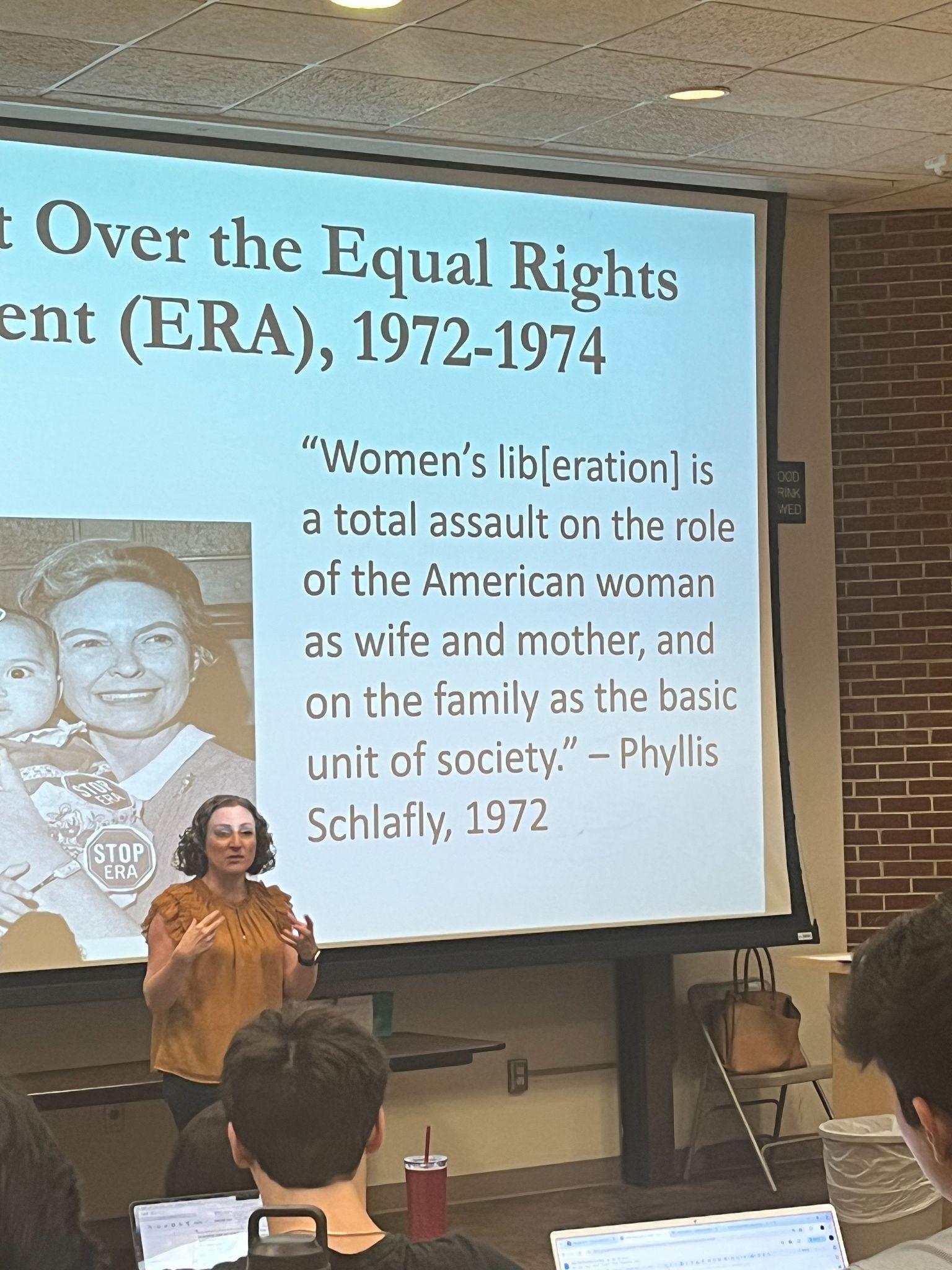
- The quotation is appealing to traditional idea about the proper role of women as wives, mothers, and homemakers/keepers
- The ERA would have mandated equality
- In 1972 the amendment passed congress (the first hurdle to actually be amended to the constitution) now it has to go to the states for ratification (2/3s of the states must ratify it for it to be valid)
- 1974, the ERA was four states short of being ratified
- There was an emergence to stop the ERA, conservative activist Phyllis Schlafly led this movement
- Built a movement of other conservative women against the ERA
- She instead believed american women were the most privileged class of people who ever lived
- They were privileged because of their status as wives and mothers
- Was successful
- ERA was never ratified
Roe V. Wade, 1973
- Cements abortion as one of the major divisive issues between political parties
- SC ruled that american women have the right of abortion in the first trimester
- Ruling rested on the right to privacy
- Liberals tended to support the right to abortion
- Conservatives viewed this as a moral issue and did not support this ruling
Antia bryant and the “save our children” campaign, miami, 1977
- Gay liberation movement
- Protections against discrimination based on sexual orientation
- In response to that movement, cities pass ordinances (“laws”) that protect LGBT americans from employment and housing discrimination
- Miami was the first to do this
- In response to the ordinance in miami, anita bryant led a charge against the gay rights ordinance “save our children” campaign
- Opposed the ordinance based on traditional morality, much of it was inspired by biblical morals
- She wanted to raise her children based on biblical morality
- Gay rights ordinance was repealed do to the pressure of the “save our children” campaign
III. the economic crisis of the 1970s
- Another economic crisis, not as bad as the depression, short term and long term issues at play
Short term causes:
- The oil embargo and energy crisis
- Oil producing nations instituted an embargo against USA
- OPEC (organization of petroleum exporting countries)
- embargo= a trading ban
- This leads to a massive oil/gas shortage
- Leads to an energy crisis
- Not enough fuel in US for what it needs to function
- Gas prices increase (by a lot)
- This is how you get federal speed on highway 55 mph limit
- Auto industry slump
- One of the most important industries and culture in US
- A major part of the economy takes a dive
- Contributes to unemployment
- People are not buying as many american made cars which scales back production = more unemployment
- Foreign vehicles tended to be more fuel efficient
- Rising inflation
- The price of everyday goods goes up
- Companies are spending more on shipping their products bc the gas was more expensive, so the price of the gas was incorporated into the price of goods
- Federal deficit
- Fed gov. Goes more and more into debt
- In the mid 1970s there was one very expensive thing that had been driving up the federal money, VIETNAM WAR
- As a result of the johnson administration there are more social safety net type programs, eats into the federal budget
- Foreign competition
- American companies are facing more foreign competition
- Seen in cars, electronics,
- Tend to be cheaper and better quality
Combination of all of it leads to stagflation
- What is stagflation?
- Inflation combined with a stagnated economy (due to unemployment, sluggish economy, not growing economy)
- Usually really high inflation occurs when consumerism is through the roof
- What we see here is high inflation with stagnant/decreased consumerism
B. the long term cause
- deindustrialization
- Certain parts of the US are experiencing deindustrialization
- This affects the major industrial regions
- NE and MW
- By the 70s these two regions are experiencing deindustrialization
- Manufacturing jobs are moving out of the northeast and midwest
- It's not like the jobs disappear, the jobs are moving elsewhere
- Partially the jobs are going to the sunbelt
- SE and SW
- Lower ⅓ of the country
- Carolinas to lower cali
- Other part is Outsourcing
- Going overseas to asia or to latin america
- Partially the jobs are going to the sunbelt
- Why would American manufacturers move to these other areas? Why the sunbelt?
- Cheaper labor
- No/fewer union benefits
- Access to natural resources
- Lack of labor regulation
- Weak labor unions
- Better climate
- Proximity and location
- More land/cheaper land
- Lower taxes
- The rust belt
- NE and MW = rust belt
- Significant economic decline
- Abandoned factories will rust, symbols of the decaying economy
- Cities have to start pivoting their economies
- Example: binghamton, NY
- 1940s-60s → “the valley of opportunity”
- IBM
- General electric
- Lockheed martin
- BAE systems
- 1970s-80s → gradual shift to service economy
- Other types of services pick up the slack that the industries left when the exited the economy
- Service economy= driven by trades and services not the production of goods
- Industries leave
- IBM leaves and starts larger locations to places like silicon valley, CA; NC
- Leaves a hole in the center of binghamton’s economy
- healthcare: lourdes and UHS
- Education: SUNY binghamton (state university of NY) (NY gave binghamton uni millions of $)
- Other lower paying service jobs
- Very large spectrum
- One end is high wages: drs, uni administrators
- Middle: nurses
- Lower: majority of people
- Very large spectrum
- Industries leave
- These economies are less stable than a production economy
The triumph of the conservatism, the end of the cold war,and the rise of the new world order, 1980-1992
- Seen with election of reagan
- The republican party built a large coalition of voters, responsible for the election of the first modern conservative president: Reagan
The conservative republican coalition:
- Coalition Refers to a diverse collection of voters
- May not agree on everything but enough commonality between them that creates a large voting block
- Republican party starts appealing more and more to the group of conservative voters
- Conservatives have been increasingly alienated by liberal politics of the 1960s
- So they band together under the republican party to elect reagan
- Four major groups under this coalition
Sunbelt conservatives
- Taxes
- Want to see a reduction in their federal taxes
- Federal intervention
- Tend to be suspicious and critical of the federal government and think federal interference is an abuse of power
- Civil rights in the south
- Tend to resent the federal intervention in the region as a result of the civil rights movement
- Land use in the west
- Federal gov. Has a lot of regulations on land development in the west
- Conservation efforts and federal forests, national parks
- This limits how land in the west gets developed
- They feel its way too much gov control
- Sunbelt is carolinas to lower half of cali
Suburban conservative
- Taxes
- Especially for suburban voters property taxes
- They don't want to pay the high property taxes
- The tax revolt movement, in CA, to cap property taxes
- “Law and order” in cities
- Suburban voters viewed cities as the root of the nations problems
- Crime infested, decaying, grimy places that need to be cleaned
- Demand a tough on crime law and order stance when it comes to crimes in cities
- Suburban voters viewed cities as the root of the nations problems
Evangelical christians and the moral majority
- How christianity influenced policies and politics
- By the mid 20th century, christians became the religious majority which gives them a lot of political influence
- Issues christians care about become more and more involved in republican politics to bring in christians to the party
- Moral issues
- Sexuality
- Gender roles
- Abortion
- Religion and schools
- The moral majority’s purpose is to shape republican policy more and more around these moral (christian) issues
- A political action group
- Founded by preacher Jerry Falwell
- Every year the MM creates an agenda of issues they care about and what policies they want to see put into effect, then they tell politicians that if they adopt this agenda as their own that they will get millions of evangelical voters to vote for them
Establishment republicans
- Taxes
- They want to see a reduction in their federal tax rate
- Free market (laissez-faire) capitalism
- Dismantling of financial regulations
- These people are the ones running the republican party and have been since the 19th century
- Upper class, wealthy, elites
- Upper tax brackets
- Financially driven
- These people are like the industrialists
- They don't care about the moral issues but understand that they need a broad agenda to bring voters into the party
- Jimmy Carter served 1977-1981
- When he runs for re-election in 1980 he is in for a challenge bc stagflation is at its worst during his administration
- Reagan is appealing because the people were tired of the terrible parts of the 1970s which are associated w carter's presidency
II. reaganomics
- He will attempt to use policy to (appease) make the conservative republican voters (the republican coalition that elected) happy
- Reagan has a couple different goals w his economic policy
- 1. Cut taxes
- Primary goals
- Income and corporate
- 2. Balance the federal budget
- Stop the fed gov to go into too much debt
- 1. Cut taxes
- These two goals somewhat contradict itself
- Gov generates revenue through taxes
Supply side economics/ trickle down economics
- The theory is that if you cut taxes for the top earners, those top earners will re invest their tax savings into their businesses
- That will lead to business growth which leads to job and wage growth
- So the wealth at the top “trickles down”
The economic recovery tax act of 1981
- “We are going to put an end to the notion that the American taxpayer exists to fund the federal government.”-- ronald reagan 1981
- Playing to the conservative issue of taxation
- That appeals to the establishment republicans and sunbelt conservatives (not the recipient of tax cut but the rhetoric appeals to them) and suburban conservatives (they may not be the recipient of the tax cut but the rhetoric appeals to them)
- In this act the corp taxes by 150 bil over 5 years (huge reduction)
- Tax cut practice to institute trickle down economics
- Massive tax cut for top earners
- Reagan cuts taxes
- But it increases the budget and exacerbates the federal deficit
- A quarter of the federal budget under reagan was allocated to the military budget $1.2 trillion over 5 years beginning in 1981
- Unable to balance budget
- Now in 1983 reagan has to raise taxes again to compensate for the exponential increase in federal deficit
- He calls it a tax adjustment not increase
III. social issues during the reagan administration
The HIV/AIDs epidemic
- In the early 1980s doctors seem to see more and more patients with HIV
- Virus that affects the immune system
- Transmitted through sex or blood
- There are no known treatments at that time
- HIV develops overtime into AIDS
- Acquired immune deficiency syndrome
- An AIDS diagnosis ATT was a death sentence
- Rapid deterioration from opportunistic infections
- Hundreds of thousands of americans will die from AIDS in the US
- Most prevalent among gay men
- AIDS becomes associated with the gay community
- Because of the association of AIDS w gay men Reagan's administration was hesitant to intervene
- Doctors and researchers wanted more funding
- Reagan’s administration sees this as a moral issue not a public health issue
- Lack of response is influence by the rhetoric of the moral majority, to appease them
- ACT UP: AIDS coalition to unleash power
- An activist group that used protest to push for more funding for AIDS research
- They use similar tactics as 60s protests
- Disruptive, visible protests
- Non violent
- Die- ins
- Keith haring was a part of act up and an activist/member
- silence=death
- Prominent HIV/AIDS patients
- Pushes public acceptance bc they are not the typical AIDS diagnosis
- Ryan White: contracted HIV from a blood transfusion as a baby
- He was expelled from school for having AIDS
- He used that to spark a public discussion
- Died at the age of 18 bc of AIDS complication
- Magic johnson: the biggest sports star in the world at the time
- Not gay
- Had contracted HIV through sexual contact (with a woman)
- Moves the public discussion forward
- Rock hudson: famous movie star ATT
- Ryan White: contracted HIV from a blood transfusion as a baby
- Pushes public acceptance bc they are not the typical AIDS diagnosis
Crack cocaine and the war on drugs
- Predominately in urban america
- Drug traffickers cooked down powder cocaine that is in rock form that can be smoked instead of snorted
- Condensed and cheaper
- Not as pure
- Most affects cities
- Illicit drug trafficking leads to crime
- Violent crime
- Similar to the violence we saw during prohibition
- A lot of politicians respond to the outbreak of crack usage toughly, tough on crime approach
- Escalation of the federal government war on drugs
- Nixon was the first president to usher in a response
- War on drugs:
- 1. Foreign activities (DEA)
- Tracking down drug traffickers
- Finding where the drugs are produced
- 2. Cracking down on drug use within the US
- Domestic drug trafficking as well
- 1. Foreign activities (DEA)
A lot more funding is given to local police departments
To crack down on the solicitation of drugs and the usage of drugs
We see a lot of states passing increasingly strict drug possession laws
- All of this is reagan's attempt to appease the suburban voters
- Suburban conservatives and all others
- Nancy Reagan creates her own campaign
- JUST SAY NO campaign
- To encourage teenagers to avoid peer pressure and just say no
- JUST SAY NO campaign
IV. foreign policy and the cold war
- Reagan takes a more aggressive approach to the cold war
- Compared to jimmy carter
- REAGAN (R):
- Increasing amount of nuclear weapons
- Stopping the spread of communism
- Specifically in Latin America
CARTER (D):
Diplomacy
Weapons reduction
The iran-contra scandal
- By the 80s iran was a major enemy of US
- Bc they took americans hostage in the late 70s\
- Reagan had an aggressive approach ab dealing w them
- In the nation of Nicaragua
- Socialist government; run by the sandinistas
- Also a paramilitary group that is fighting the sandinistas
- They are the contras (anti-socialists)
- Reagan wants to support organizations like the contras but:
- The contra’s are no good people
- They use a lot of violence
- Specifically sexual violence
- Human rights violations
- The Contra’s funding comes from drug trafficking
- Reagan understands the larger context of the cold war
- And he wants to continue supporting the Contra’s but congress won't let him give them any more money
- People within reagan's administration find a loophole
- Find a way to fund the contras without directly giving them money
- The way to do that is to sell weapons to the nation of Iran
- Iran was an enemy against the US ATT
- Reagan's administration takes the proceeds of the weapon sales and give it to the contra’s
- When this leaks, there is a congressional investigation
- One member of reagan's admin, oliver north, takes the fall for the scandal
Mikhail Gorbachev and the end of the cold war
- Mikhail Gorbachev is the leader of the soviet union ATT
- He was a different type of leader for the soviet union
- More transparent in the inner workings of the soviet government
- He offers economic reforms
- He loses some of the strict communist policies on the economy
- The combination of their leadership styles kind of brings about the end of the cold war
- Reagan had an increased nuclear arsenal and an aggressive stance of the cold war
- The fact that the weapon production was increased, it forced the soviet union to do the same
- It was all about competition
- The soviets had to match the billions of $ that the US wawa investing into weapons production
- Caused soviet union economy to tank
- Gorbachev had to put through more economic reforms, it poked holes into the foundation of communist control in US
- Communism now seems like it can be overcome in the soviet union at this time
- In 1989 the berlin wall falls, communism in europe begins to fall apart
- By 1991 communism and the nation of the soviet union falls apart
- Becomes russia
- 1991 the cold war is over
- With the end of the cold war, the world has changed
- What will the nature of the world be like?
- The fact that the weapon production was increased, it forced the soviet union to do the same
Liberalism and its challenges, 1960-1973
- Political ideology
- 1960s “the decade of liberalism”
- New deal changed def of liberalism in the US
- Prior to new deal it was similar to laissez faire
- What is it post new deal?
- Fed. gov. Regulates the economy + creates social safety net
- Fed gov should be large and active
- Social justice
- Associated with democrats
The civil rights movement of the 1960s
- A lot of momentum going into the 60s
- The birmingham campaign 1963
- This campaign is planned by MLK jr
- Activists are going to try to integrate as many public spaces as possible
- Birmingham police respond very violently
- JFK is forced to intervene
- Calls for a national civil rights bill
- March on Washington 1963
- Show popular support for the national civil rights bill that's being planned
- Also about making sure employment discrimination is addressed in that bill
- Over 250,000 people
- The civil rights act 1964
- LBJ signed civil rights act into law
- He relied heavily on the memory of JFK
- Old school politician
- The “johnson treatment”
- He used his size and presence to intimidate people
- Freedom summer 1964
- Movement starts to shift again, movement starts to focus on voting rights
- Protection of voting rights
- Campaign was to register black voters in mississippi
- Why weren't they voting?
- Literacy taxes
- Poll taxes
- Threat of violence
- Freedom summer murders (3 men)
- Voting year
- Selma and the national voting rights act, 1965
- In response to crisis of selma
- March from selma to montgomery received violent response
- In response the national voting rights bill was signed into law by LBJ in 65
Vietnam War Escalates
Early US intervention in Vietnam
- Cold war was still going on in the 60s
- The domino theory
- Influences how the US approached Asia in the cold war
- All of the nations of asia are stacked like dominos, if one other nation in asia falls to communism, the entire continent will become communist
- Support for anti-communist south vietnam
- Partitioning, 1954, N and S vietnam
- N is controlled by a communist regime
- So US is invested in keeping S as anti communist
- US maintains anti communist S
- Provide military advisors
- Nothing is published yet
- Cash is given to S
- Cia is taking out any sort of destabilizing personalities
- Partitioning, 1954, N and S vietnam
- North Vietnam: the north vietnamese army (NVA) and the Viet Cong (VC)
- War of reunification
- Their goal is to reunify vietnam into one vietnam but communist
- NVA
- Traditional army
- Uniforms, are identifiable as soldiers
- Traditional tactics
- Invade S Viet from the north
- VC
- Not traditional
- No uniforms
- A guerrilla fighting force
- Their job is infiltrate S viet and stage the war from within
- Unconventional warfare
- Sabotage, boobytraps
- Job is to blend in
B. The gulf of tonkin crisis (1964)
- LBJ wants to be known as his domestic policies
- His name for the dp is “the great society” it expands the social safety net (liberalism)
- He gets known for escalating US involvement in vietnam
- He is trying to get elected for president in 1964
- He needed to prove he was anti communist, bc his election was in the middle of the cold war
- Two reports of US ships being fired at in the gulf of tonkin
- Maddox and turner joy
- Reported that the N viet fired (allegedly)
- Even though the intelligence he received was somewhat unsure, he went to congress and asked for increase involvement in vietnam (not a declaration of war)
- The first official us forces arrive on the ground in 1965
- Immediately apparent that the war was more complicated than anticipated
- Complicated and messy
- More obvious the longer the troops are there
- Rooting out the VC is extremely difficult
C. “search and destroy”
- Guerilla fighting force you never directly engage with the enemy
- A lot of ambush, sabotage, raids
- US army wasn't used to this type of war
- The policy was to search for VC and destroy villages who were infiltrated villages
- Civilians are often caught in the middle
- The VC most likely used violence to take over the villages
- A lot of the search and destroy missions were televised
- Live on TV
D. vocal anti war movement
- Tends to be young people
- Young men do not want to be drafted
- Specifically college aged men
- A lot of civil rights leaders and religious leaders speaking out against the war
- All of this protest leads to anxiety within the country up until the 70s