AP World History - Unit 5: Revolutions (copy)
The Enlightenment
- 17th and 18th centuries - humankind in relation to government
- Divine Right: church allied with strong monarchs, monarchs believed they were ordained by God to rule - people had moral/religious obligation too obey
- Question of ultimate authority
- Mandate of Heaven in China - had to rule justly to be appreciated in heaven
- Social contract: governments not formed by divine decree, but to meet social and economic needs
- Philosophers of the age:
- Thomas Hobbes (1588-1679): government should preserve peace/stability - all powerful rule who ruled heavy-handed
- John Locke (1632-1704): men are all born equal, mankind is good and rational - primary role of government was to secure and guarantee natural rights and revolting is justified if not
- Jean-Jacques Rousseau (1712-1778): all men are equal, society organized according to general will of people - government is protection by community and both being free
- Voltaire (1694-1778): espoused idea of religious toleration
- Montesquieu (1689-1775): separation of powers among branches of government
- David Hume (1711-1776): lack of empirical evidence casts doubt on religion
- Adam Smith (1723-1790): an “invisible hand” will regulate economy if it is left alone
- Mary Wollstonecraft (1759-1797): women should have political rights, including voting and holding office
- Immanuel Kant (1724-1804): knowledge exists beyond what is deduced from use of only observation or only reason
- Cesare Beccaria (1738-1794): criminals retain some rights and state should not practice cruel punishment
- Enlightened monarchs: utilized ideas of tolerance, justice, improving quality of life
- Neoclassical Period: middle of 18th century - imitated style of ancient Greek/Roman architecture
Enlightenment Revolutions in the Americas and Europe
American Revolution
- British defeated France over American territory - French and Indian War/Seven Years’ War - pushed France to northern territory
- Americans revolting against British rulership
- British passed laws on behalf of Crown for the American colonizers (George Grenville, Charles Townshend)
- Revenue Act (1764), Stamp Act (1765), Tea Act (1773) intended to raise funds for British government
- Colonizers opposed these laws and began battling British troops shortly after - Boston Tea Party (1773): colonists dumping imported tea in harbour to protest Tea Act
- Thomas Paine: wrote Common Sense, encouraging colonizers to form a better government than the monarchy - 6 months later the Declaration of Independence was signed
- France joined forces with Americans in 1777 and defeated the British in 1781 and the American democracy was created
French Revolution
- France was running out of money from monarch spending, wars, and droughts - Louis XVI proposed raising taxes to the Estates-General (governing body infrequently called by the kings)
- First Estate: clergy
- Second Estate: noble families
- Third Estate: everyone else
- Representatives from each estate
- Third Estate was facing being shut out of new constitution - formed National Assembly in 1789 out of protest and peasants stormed the Bastille shortly after
- Declaration of the Rights of Man - adopted by National Assembly in 1789 and caused big changes in French government structure
- Established a constitutional monarchy at first, but new constitution development led to the Convention being the new ruling body - France become a republic (led by Jacobins who later beheaded the king)
- Convention threw out constitution again and created Committee of Public Safety: enforcer of revolution and murdered any anti-revolution people
- led by Maximilien Robespierre
- French beheaded Robespierre in 1795 and established another new constitution with the Directory as the government
- Built up military, with Napoleon Bonaparte as one of the generals
- Napoleon overthrew the Directory in 1799 - Napoleonic Codes (1804) recognized equality of men, dissolved the Holy Roman Empire with French military and fought other countries who eventually met to overthrow him (Prince von Metternich, Alexander I of Russia, Duke of Wellington)
- Defeated him at Waterloo in 1813 and met at Congress of Vienna to discuss what to do with France
- Congress of Vienna:
- Balance of power should be maintained among powers of Europe
- Tried to erase French Revolution
Haiti:
- France enslaved many Haitians, who eventually revolted successfully, led by Pierre Toussaint L’Ouverture
- Jacques Dessalines, a former slave, became governor-general in 1804
South America
- Napoleon invaded Spain and appointed his brother Joseph Bonaparte to the throne -
- Colonists ejected French governor and appointed own leader in Venezuela, Simón Bolívar, who eventually helped them declare independence from Spain in 1811
- Established a national congress, but was also opposed by Spanish royalists, who declared a civil war
- Bolívar won freedom for Gran Colombia (Columbia, Ecuador, Venezuela)
- José de San Martin: took command of Argentinian, Chilean, Peruvian armies, and defeated many Spanish forces to also declare independence from Spain
Brazil
- John VI of Portugal fled to Brazil when Napoleon invaded Portugal -
- His son Pedro became the emperor of Brazil and declared it independent with a constitution
- His son Pedro II took over and abolished slavery
Mexico
- priest Miguel Hidalgo led a revolt against Spanish rule in 1810, who was later killed by them
- Jose Morelos picked up where he left off
- Independence achieved in 1821 - Treaty of Cordoba: Spain recognizing their 300-year-old control of Latin America was ending
- Neocolonialism: independent nations still controlled by economic and political interests
- Riches accumulated often stayed within wealthy landowning class
- Mexican Revolution: protest of neocolonialism - rejection of Porfirio Diaz’s dictatorship to protest impoverished conditions
Other resistance movements:
- Peru
- Tupac Amaru II led a revolt against Spanish occupiers and inspired further resistance movements
- West Africa
- Samory Toure led resistance against French colonizers and inspired further resistance
- US
- Sioux resisted the US government invading their land, but were shot at during their protests
- Sudan
- Muhammad Ahdam led Mahadists in a revolt against colonial rule of Egypt but was stopped by the British
- Slavery still existed in independent nations as well as class inequalities
- Catholic Church still dominated
Comparison of Independence Movements
| AmericanColonies 1764-1787 | France 1789-1799 | Haiti1799-1804 | Latin America1810-1820s | |
|---|---|---|---|---|
| Causes | Unfair taxationWar debt | Unfair taxationWar debt | French EnlightenmentSocial and racial inequalities | Social inequalitiesRemoval of peninsulares |
| Key Events | Boston Tea PartyContinental CongressDeclaration of IndependenceConstitution and Bill of Rights | Tennis Court OathNational AssemblyDeclaration of Rights of ManStorming Bastille Reign of Terror5 Man Directory | Civil warSlave revoltInvasion of Napoleon | Peasant revoltsCreole revoltsGran Colombia |
| Major Players | George IIIThomas PaineThomas JeffersonGeorge Washington | Louis XVIThree EstatesJacobin PartyRobespierre | BoukmanGens de CouleurToussaint L’OvertureNapoleon Bonaparte | Miguel HidalgoSimón BolívarJosé de San MartinEmperor Pedro I |
| Impacts | IndependenceFederal Democracy spreads - France, Haiti, Mexico | Rise of NapoleonCongress of ViennaConstitutional monarchy | IndependenceDestruction of economyAntislavery movements | IndependenceContinued inequalitiesFederal democracy (Mexico)Creole republicsConstitutional monarchy (Brazil) |
Industry and Imperialism
- Industrial revolution in Britain can not be separated from Imperialism
- Industrial countries gained power quickly to exploit colony resources
- Industrial Revolution: began in Britain in 19th century - spread through Europe, Japan, US
- Agricultural output increased significantly again - more people moved to cities
- Enclosure: public lands that were shared for farming became enclosed by fences
- New farming technologies
- Urbanization was natural - London grew to over 6 million people
- Domestic system (most work being done on farms or at home or at small shops) preceded
- New advancements that changed production:
- Flying shuttle: sped up waving process
- Spinning jenny: spinning vast amounts of thread
- Cotton gin: invented by Eli Whitney - processed massive amounts of cotton quickly
- Steam engine - Thomas Newcomer, James Watt
- Steamship - Robert Fulton
- Steam-powered Locomotive - George Stephenson
- Telegraph: communication with great distances in seconds
- Telephone - Alexander Graham Bell
- Lightbulb
- Internal Combustion Engine for cars
- Radio
- Also major developments in medicine and science, theory of natural selection (Charles Darwin)
- Rapid creation of products was done in factories
- Interchangeable parts: machines could be replaces or fixed quickly
- Assembly line: each worker had one small part in production - man became the machine
- Workers were overworked, underpaid, and working in unsafe conditions - child labour was common
- Despairing conditions
- Formation of new social classes - aristocrats were those rich from industrial success, middle class of skilled professionals, huge working class
- Adam Smith: success achieved through private ownership and free market system (capitalism) - governments removed from regulation = laissez-faire capitalism
- Start of stock market and other financial instruments
- Karl Marx: The Communist Manifesto - working class take over means of production and all resources would be equally - Marxism was foundation for socialism and communism
- Luddites: workers who destroyed equipment in middle of night to protest working conditions
- Marxism mixed with capitalist thought to create partly socialist systems in many places
- Major split among intellectuals and policymakers in regards to response to inhumane factory conditions
- Factory Act of 1883: limited hours of each workday, restricted children from working, factory owners had to make conditions safer
- Labour Unions: vehicles for employees to bargain for better conditions
- Living conditions improved - middle class became larger, public education increased, social mobility became more common
- Slave trade abolished in 1807 in Britain
- Women became more limited to their traditional roles
Nationalist Movements and Other Developments
- Nationalism was strong after Napoleonic era
- France, Spain, Portugal, Britain, Russia had unified
- Italy and Germany, which were city-states took longer to unify and alter balance of European power
- Italy: Count Camillo Cavour named prime minister of Sardinia by Victor Emmanuel II who pushed for nationalism - after Giuseppe Garibaldi, another nationalist overthrew other Italian kingdoms, a lot of Italy was unified in 1861
- Germany: Prussia, which controlled a lot of present-day Germany, under the rule of William I who appointed Otto von Bismarck as prime minister, defeated Austria and engaged in the Franco-Prussian War to create the new German Empire
- New emperor William II forced Bismarck to resign and built a huge military force
- Other Nationalist Movements:
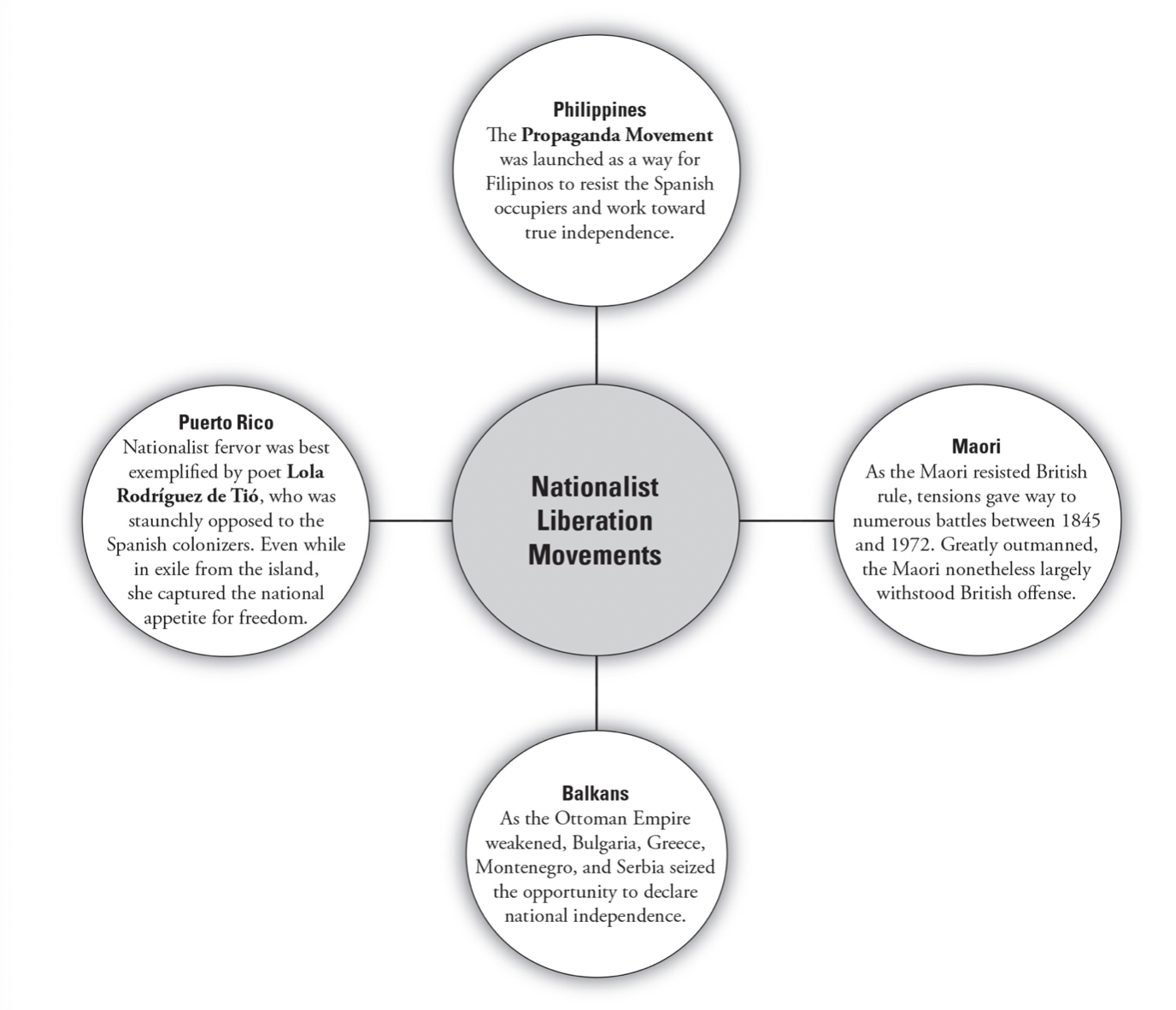
- Russia:
- Romanov czars had absolute power in 19th century
- Alexander II began reforms - Emancipation Edict: abolished serfdom but had little effect
- Small middle class began to emerge which led to an intellectual political group The People’s Will assassinating Alexander II
- In response, Alexander III started Russification: all had to learn the Russian language and convert to Russian Orthodoxy
- Ottoman Empire: was at danger of collapse so Britain and France worked to maintain it to prevent Russia from gaining control over Mediterranean
The Growth of Nationalism
- Desire of people of common cultural heritage to form independent nation-state/empires that protects their cultural identity
- Had major influence and effects all over the world