Scientific Thinking
Define Science
- what does science ^^encompass^^: observations, descriptions, experiments, and explanations of natural phenomena
- ==science== is an important pathway in the discovery and better understanding of the world we live
- ==pseudoscience==: scientific-sounding claims that are not supported by trustworthy, methodical scientfic studies
- “four out of five dentists”
- ==anecdotal observations==: based on only one or a few observations, people conclude that there is or is not a link between two things
- superstitions
- bad science leads to dangerous behavior
- ex: do vaccines cause autism ?
limits of science
- the scientific method is above all, empirical
- value judgements and subjective info falls outside the realm of science
- doesnt do general moral statements nor gives insight to ethical problems
- technology is not science, it is the application of research
- ex: should we edit genes?
Define Biology
- what is ==biology==: the study of living things
- important ^^questions in bio^^:
- what are the chemical and physical basis for life?
- how do organisms use genetic info to build themselves and reproduce
- what are the diverse forms that life on earth takes and how did it arise
- how to organisms interact with each other and their environment
Describe scientific thinking
- what are some examples of %%scientific literacy%% in the modern world:
- how reliable is DNA fingerprint evidence
- why do allergies strike children from clean homes more than child from dirty homes
- why do new agricultural pests appear more quickly than new pesticides
- what is ==biological literacy== : the ability to use the process of scientific inquiry to think creativty about real world issues that have a biological component, communicate those thoughts to others, integrate these ideas into your decision making
- scientific thinking is an empirical ^^process^^ that involves making : observation, hypothesis, prediction, experiment, conclusion
- ex: phone not charging
- ^^rarely linear^^
- what is scientific thinking ^^based on^^: experience and oberservations that are rational, testable, and repeatable
- self-correcting
scientific method:
- when making an ^^observation^^, it mustn’t have: an apparent matter or cause and effect relationship
- correlation does not equal causation
- what is a ==hypothesis==: a proposed explanation for an observed phenomenon
- what is a useful ^^hypothesis^^: must clearly establish an alternative explanation for a pheneomenon and generate testable and falsifiable predictions
- ex: echinacea reduces the duration and severity of the symptoms of the common cold
- ==null hypothesis==: a negative statement proposing that no relationship exists between two factors
- valid but easier to disprove
- ex:echinacea has no effect on the duration or severity of the symptoms of the common cold
- ==alternative hypothesis==: impossible to prove that a hypothesis is absolutely and permanently true
- what is the goal of your ^^predictions^^: to propose a situation that will give a particular outcome if your hypothesis is supported but a differrent outcome if it is not
- involves ^^“if…then”^^ statements
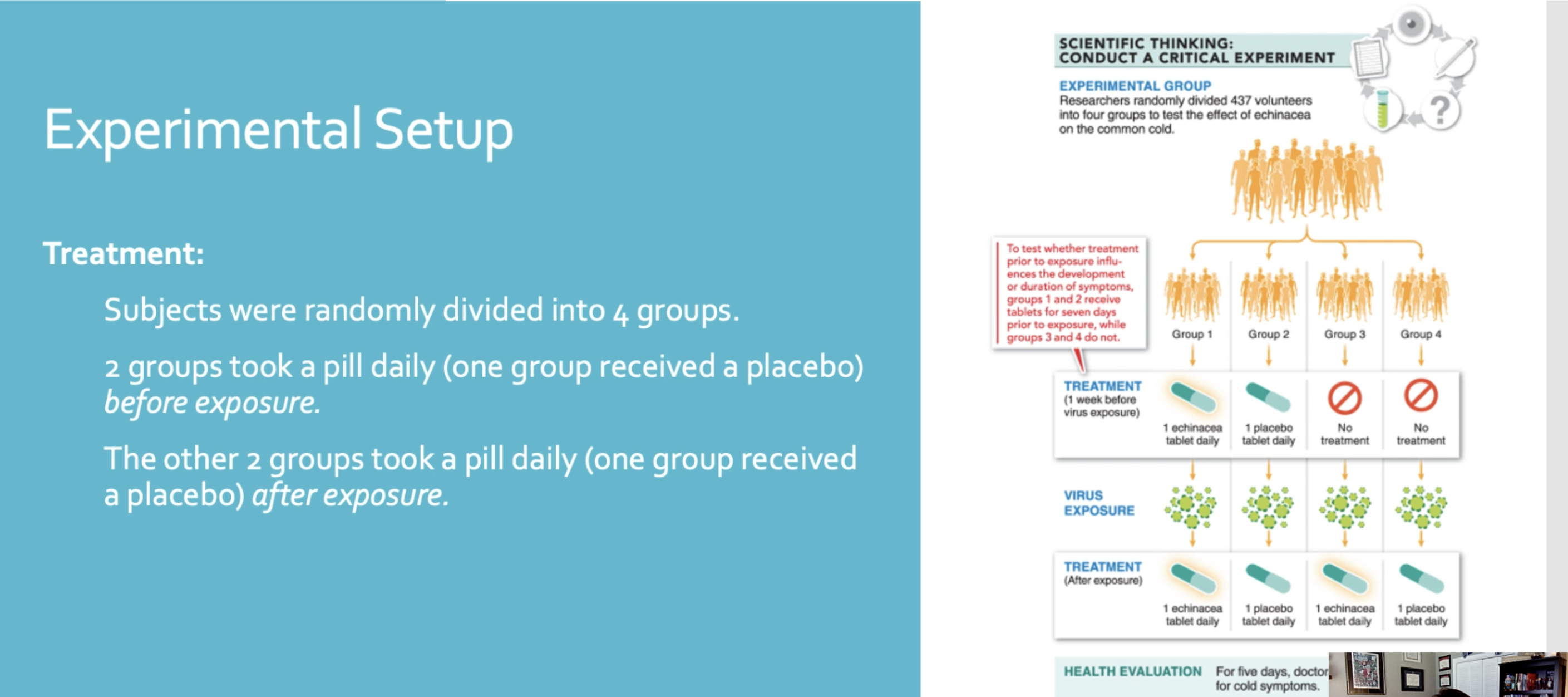
- example of prediction: %%if%% echinasea reduces the likelihood of catching the common cold and the duration of the symptoms of a cold, %%then%% indivudals who take echinasea will have a %%lower%% likelihood of catching a cold and a %%shorter%% duration of cold symptoms
- %%if%% echinasea reduces the likelihood of catching the common cold and the duration of the symptoms of a cold, %%then%% individuals who dont take echinasea will have a %%higher%% likelihood of catching a cold and a %%longer%% duration of teh cold symptoms
- what is a ==critical experiment== : one that makes it possible to decisively determine whether one hypothesis supported by evidence over all alternative hypothesis
- \
- the last step of the scientific method is: to draw ==conclusions== and make revisions to your hypothesis if needed
- look for patterns and relationships in evidence
- determine if findings and conclusions support hypothesis
- if the result isnt what you expected, it doesnt mean its a wrong answer, it just means you need to revise your hypothesis and conduct further experimenets based on new observations
Describe key aspects of a well-designed experiment
- ==theories==: exceptionally well supported hypothesis, repeatedly tested, unlikely to be altered by any new evidence, broader in scope than hypothesis
- ex: evolution, gravity
key terms
- ==treatmeants==: any experimental condition applied to individuals(does not have to be animal)
- ==experimental group==: a group of individuals who are exposed to treatment
- ex: group exposed to epinichea
- ==control group==: group of individuals who are treated identically to the experimental group with one exception-they are not exposed to the treatment
- ==variables==: characteristics of an experiment that are subject to change
- variables can be ^^independent^^ and ^^dependent^^
- dependent variable ^^depends^^ on independent variable
- ==control variables==: minimizing any differences between control group and experimental group other than the treatment itself ; the things you consciously kept the same
- ex: plants with same sunlight and water and soil
- ==placebo effect==: this is the phenomenon in which people respond favorably to any treatment
- what highlights the need for a comparison of treatment effects with an appropriate control group : the placebo effect
designing experiments
- ==blind experimental design==: the experimental subjects do not know which treatment(if any) they are receiving
- ==double blind experimental design==: neither the experimental subjects nor the experimenter knows which treatment the subjects are receiving
- which design is the ^^best^^: double blind experimental design (no bias)
- ==randomized experimental design==: the experimental subjects do not know which treatment (if any) they are receiving because it is randomized
- ==replication==: process of repeating a study
- increases our confidence in results
- helps isolate variables responsible for outcomes
- experiments that can be repeated again and again are an effective defense against biases
- ^^biases:^^ can influence our behavior, including our collection and intepretation of data. with careful controls, it is possible to reduce the impact of biases
visual displays
- ^^visual displays^^ help us understand phenomena
- title
- y-axis: dependent variable
- ==dependent variable==: created by the process being observed and whose value cannot be controlled
- x-axis: independent variable
- ==independent variable==: some measurable entity that is available at the start of a processs and whose value can be changed as required
- data points
- how can a ^^graph^^ be ^^misleading^^:
- ambiquity in labeling or scales
- incomplete info on how data was collected
- biases or hidden assumptions
- unknown/unreliable data sources
- insufficient/inappropriate context for data presentation
statistics
- ==statistics==: a set of analytical and mathematical tools designed to help researchers gain understanding from the data they gather
- can help us make decisions
- drawing conclusions based on ^^limited^^ observations is risky
- \
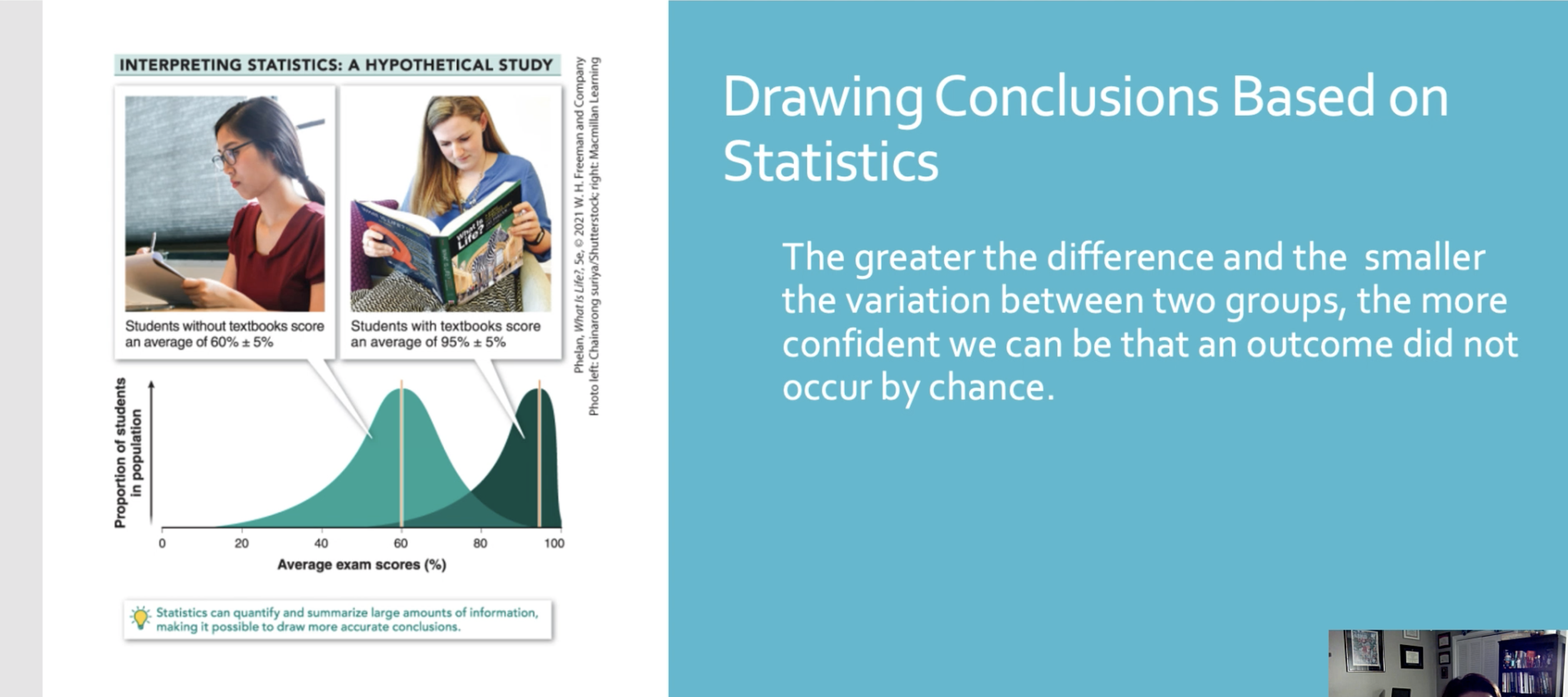
- statistics can also help us ^^identify relationships^^ (or lack thereof) between variables
- ==positive correlation==: when one variable increases, so does the other
- ==statistical analyses== help us organize and summarize observations and experimental evidence
- dont help us draw conclusions
- \
Describe how scientific thinking can be used to help make better decisions
- ^^evidence^^ gained from well-controlled studies designed in accordance with ^^good scientific thinking^^ can illuminate when we should ^^change^^ our minds
- we make choices everyday based on assumptions about out world; it is essential to ^^question^^ these ^^choices^^ and the veracity of our ^^assumptions^^
Describe the major themes in biology
- ==biology== is the study of life
- ^^characteristics of all living things^^: organism of one or more cells, uses energy to perform work, responds to external stimuli and environment, homeostasis , capable of growth and developing and repoduction, capable of evolving and adapting over time
- what are the ^^five central themes^^ in biology: evolution;structure and function; information flow, exchange, and storage ; pathways and transformation of energy and matter; systems