Biosci L3 - Respiration
Glucose: Structure, Source, and Role
structure - Glucose (C6H12O6) is a simple sugar and their MAIN FUNCTION is to provide primary energy source for CELLS.
It is often depicted as a hexose sugar with the functional groups HO- and H-, e.g., CH₂OH and multiple hydroxyl groups.
Molecular formula: C6H12O6
some sources for glucose is central to cellular metabolism and can be derived from:
Carbohydrates in the diet (bread, rice, fruits) and converted from starches and other sugars
Lipid stores in the liver (glucose produced by gluconeogenesis)
Key context: glucose is the starting point for cellular respiration to generate ATP; also involved in glycolysis, the Krebs cycle, and the electron transport chain.
Blood Glucose Dynamics and Homeostasis
After a meal, blood glucose levels rise and then return toward baseline through regulatory mechanisms (homeostasis).
Regulatory mechanisms involve…
Regulation involves insulin release from pancreatic beta-cells:
Insulin lowers blood glucose by promoting uptake into muscle and liver (glycogen synthesis and storage).
Glucose Absorption and Transport into Blood
In the gut, glucose absorption occurs via:
Active transport from the gut lumen into the epithelial cells through a transporter.
Glucose exit from epithelial cells into the bloodstream via the GLUT2 transporter.
Diet composition affects absorption rate:
Fiber-rich meals slow absorption and produce a different time course of blood glucose rise compared with low-fiber meals.
This variation is due to the presence of soluble fibers that can form gels and slow the digestion of carbohydrates, leading to a more gradual release of glucose into the bloodstream.
Insulin-regulated uptake and GLUT transporters play critical roles in cellular glucose entry.
GLUT Transporters and Glucose Uptake
Glucose transporters (GLUTs) mediate uptake into cells:
GLUT1: insulin-independent; high affinity (low Km); used by red blood cells and brain; includes brain and placenta in some contexts.
GLUT2: insulin-independent; low affinity (high Km); liver, pancreas, and other tissues.
GLUT3: insulin-independent; high affinity; mainly in neurons/brain.
GLUT4: insulin-dependent; found in skeletal muscle and adipose tissue; translocates to the plasma membrane in response to insulin.
GLUT5: primarily a fructose transporter in the small intestine and other tissues.
Key concept: different GLUTs have different regulatory controls (insulin-dependent vs insulin-independent) and different affinities (Km values) which influence glucose handling in tissues.
Insulin-Independent vs Insulin-Dependent Cells
Insulin-independent glucose uptake cells include brain and liver (GLUT1/GLUT2/GLUT3).
Insulin-dependent uptake is prominent in skeletal muscle and adipose tissue via GLUT4 translocation triggered by insulin.
The question of “why” certain tissues use different transporters relates to organ function and metabolic demands (e.g., brain requires steady glucose supply independent of insulin; liver can rapidly take up or release glucose signaled by hormonal state).
Overall Cellular Respiration: Purpose and Equation
Purpose: Convert glucose into ATP to power cellular processes.
Location: Mitochondria (most ATP generation occurs here, via the Krebs cycle and ETC).
Overall respiration equation (a balanced summary):
C6H12O6 + O6 = 6CO2 + 6H2O + 32-38 ATP
Typical ATP yield per glucose: ~32–38 ATP (depending on shuttle mechanisms and cell type).
Stages of Cellular Respiration
Three main stages:
Glycolysis (occurs in cytoplasm; anaerobic option available)
Krebs Cycle (Citric Acid Cycle)
Electron Transport Chain (ETC) and Oxidative Phosphorylation
Glycolysis (Anaerobic Pathway)
Glycolysis is the process that breaks down one glucose molecule into two molecules of pyruvate, producing a net gain of 2 ATP molecules under anaerobic conditions
Location: Cytoplasm; does not require oxygen.
Key reaction (simplified):
gluecose = 2 Pyruvate + 2 Waters + 2 Hydrodren ions.
Additionally, glycolysis generates NADH which can be used later (in aerobic conditions) to feed the ETC.
If oxygen is scarce, pyruvate is reduced to lactate to regenerate NAD⁺ for glycolysis to continue.
Aerobic Respiration: Krebs Cycle and Electron Transport Chain (ETC)
we are only branching off to the two formation (alcohol and fermentation)
and then talking about the aerobic respiration.
Oxygen is required for the complete oxidation of glucose.
Pyruvate from glycolysis is converted to acetyl-CoA a central molecule in metabolism that transports a two-carbon acetyl group for energy production and enters the Krebs Cycle.
Electron carriers NADH and FADH₂ produced in glycolysis and the Krebs Cycle feed electrons into the ETC, driving ATP synthesis through oxidative phosphorylation.
Overall aerobic sequence per glucose: approximately 32–38 ATP (depending on shuttle mechanisms and NADH yield).
Net reaction for the aerobic portion (simplified):
C₆H₁₂O₆ + 6 O₂ → 6 CO₂ + 6 H₂O + 32–38 ATP.Key point: Efficiency is high in aerobic respiration compared to anaerobic fermentation.
Fermentation: Anaerobic Pathways
Occurs when oxygen is limited or absent.
Glycolysis yields 2 ATP per glucose; pyruvate is converted to lactate (in animals) or to ethanol and CO₂ (in yeast and some bacteria).
Lactic acid fermentation (animals, including exercising muscle):
Pyruvate is reduced to lactate; regenerates NAD⁺ to sustain glycolysis when oxygen is scarce.
Lactate accumulation can contribute to muscle fatigue during intense exercise; liver can convert lactate back to pyruvate for gluconeogenesis.
Example: 1 glucose → 2 pyruvate → 2 lactate + 2 ATP (net) in anaerobic glycolysis.
Alcohol fermentation (yeast and some bacteria):
Pyruvate is converted to acetaldehyde (releases CO₂), which is then reduced to ethanol, regenerating NAD⁺ for glycolysis to continue.
Net: glycolysis continues in the absence of oxygen; fermentation products are ethanol and CO₂.
Comparative Snapshot: Aerobic vs. Anaerobic Respiration
Oxygen requirement: Aerobic = Yes; Anaerobic = No
End products:
Aerobic: Pyruvate → Acetyl-CoA → CO₂ + H₂O; ~32–38 ATP per glucose
Anaerobic: Pyruvate → Lactate (animals) or Ethanol + CO₂ (yeast); 2 ATP per glucose
ATP yield: Aerobic ~32–38 ATP per glucose;
Anaerobic ~2 ATP per glucose
Location of ATP production:
Aerobic: Mitochondria (Krebs Cycle + ETC)
Anaerobic: Cytoplasm (Glycolysis) with fermentation regenerating NAD⁺
Primary purpose:
Aerobic: Maximize energy (ATP) production per glucose
Anaerobic: Maintain ATP supply quickly when oxygen is limited
ATP: Structure, Hydrolysis, and Cellular Roles
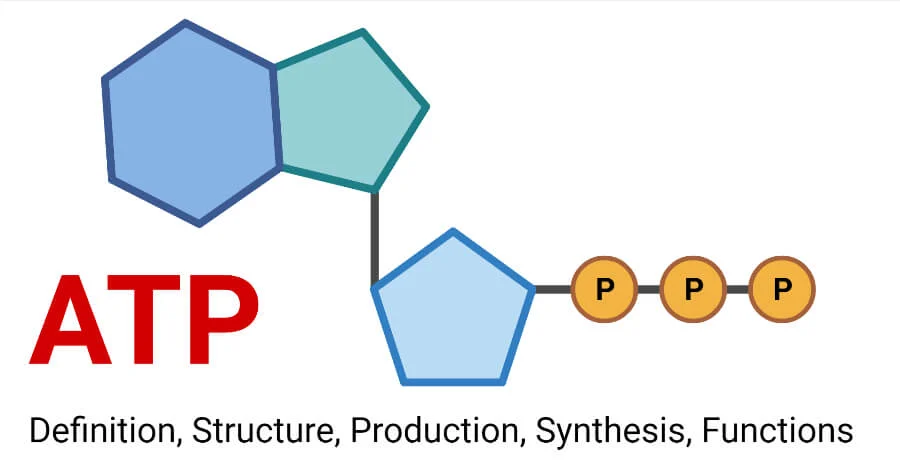
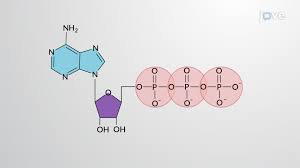
Structure: Adenine + Ribose + 3 Phosphate groups
Chemical structure (text):
One adenine base, one ribose sugar, and three phosphate groups arranged as a chain (alpha, beta, gamma phosphates)
ATP hydrolysis (energy release):
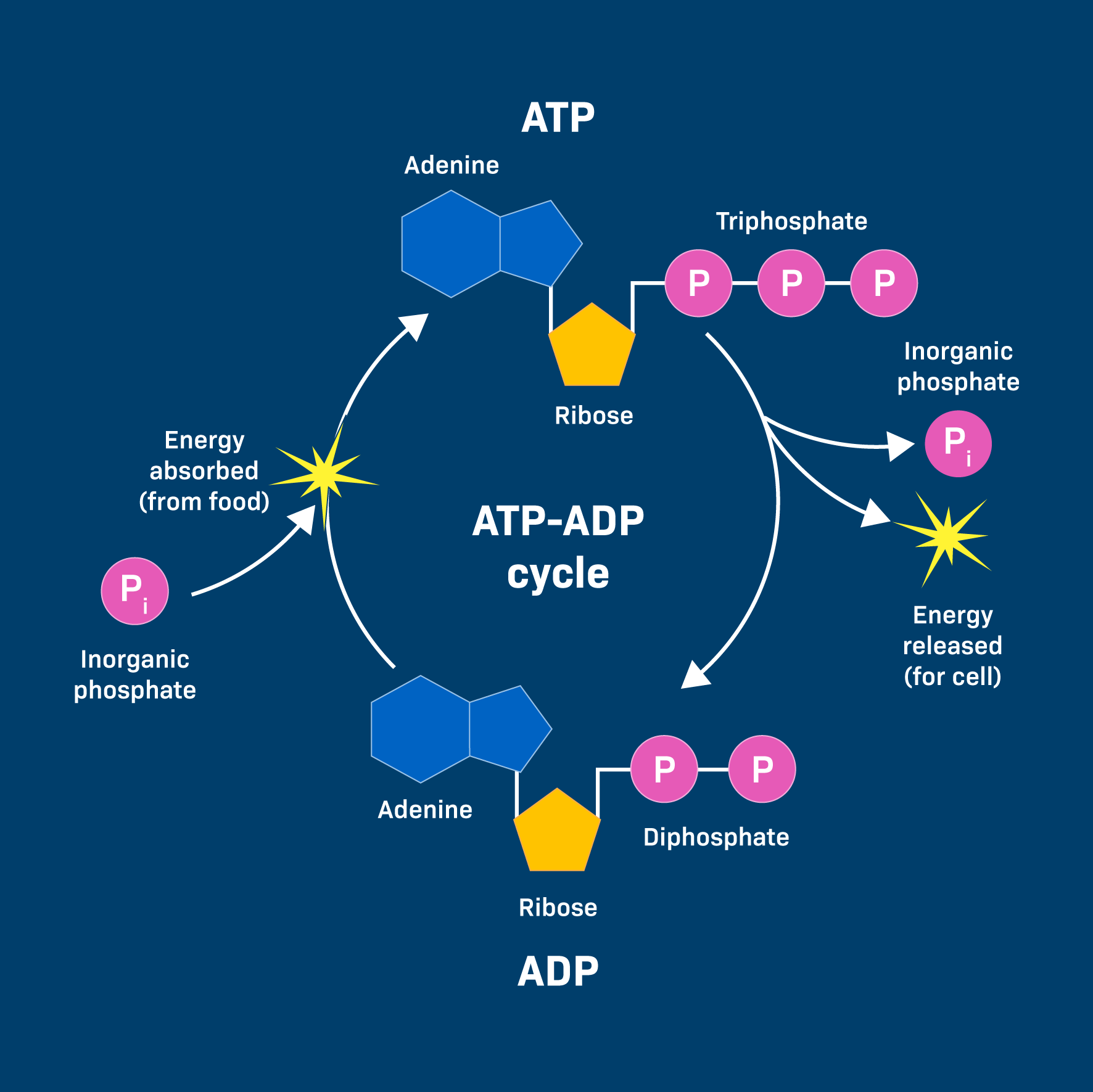
Reaction: ATP is broken down into adenosine diphosphate (ADP) and an inorganic phosphate (Pi), releasing energy that can be used for cellular processes.
a high-energy chemical bond formed between two phosphate bonds provide energy for cellular work. like muscle contractions
ATP Recyciling
ATP recycling: Catabolic ATP → ADP + Pᵢ + energy out; Anabolic ADP + Pᵢ + energy in → ATP.
Roles of ATP in cells (examples):
Active transport (e.g., nerve impulse transmission via ion pumps such as Na⁺/K⁺-ATPase)
Muscle contraction (drives myosin head movement in muscle fibers)
DNA/RNA synthesis and protein synthesis
General cellular work and enzyme catalysis
Cells with High ATP Demand
Tissues/cell types that require large amounts of ATP include:
Cardiac muscle cells
Skeletal muscle cells
Neurons
Sperm cells
Kidneys
Liver
Rationale: These cells perform energetically demanding tasks such as rapid signaling, sustained contraction, active transport, and metabolism.
Quick Review Questions
Quick Quiz prompts (from the slides):
1) What are the reactants of cellular respiration? (Glucose and oxygen)
2) What does ATP stand for? (Adenosine Triphosphate)
3) What happens to glucose after it enters the cell? (It undergoes glycolysis to form pyruvate, which can enter aerobic respiration or fermentation depending on oxygen availability.)
learning objective
looking into microscope
Fungi
fungi- these bacteria thrive better in damp dark environments eg like a cave, which then they produce spores the humans inhale leading to potential ammonia
how we can prevent them - by ventilation, removing those spores making it dry and kills the spores and sunlight (UV) which opens the spores and breaks it
^question relating to what microbe is most likely to give us respiratory issues.
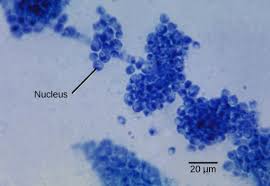
Bacteria
bacteria role in nature are decomposers, meaning they are good at breaking down proteins. via taking nitrogen out of proteins back into the soil
we have taken that process and modify it, which has become a bacteria that consumes oil and leaves co2 and h2o as a byproduct
most STi and sexual transmitted diseases are due from bacteria
bacteria also creates plague by infecting hosts and causing widespread illness, showcasing their dual role as both beneficial agents in ecosystems and harmful pathogens in human health.
Protsis
algae
-is a component of planktion
a problem we can have with them is in a lake or pond and we have alot of farm surrounded, then you got alot of nutrients which the algae will grow very rapidly which kills everything in the pond that creates a algae layer on the toop therefore sunlight cannot go in.
Connections to Foundational Principles
Energy transformation: Glucose is chemically stored energy that is converted into ATP energy, usable by enzymes and cellular machinery.
Regulation and transport: Hormonal control (insulin) modulates glucose uptake; transporter proteins (GLUTs) determine tissue-specific uptake rates and regulation.
Metabolic flexibility: Cells can switch between aerobic respiration and anaerobic fermentation depending on oxygen availability, balancing speed and efficiency of ATP production.
Interdisciplinary relevance: Pathogens (bacteria, protists, fungi) interact with energy cycles (decomposition, bioremediation, disease) and can influence ecosystems and human health.