1b: Theoretical Models
Overview of Theoretical Models
Models used in psychology to understand mental illnesses and behaviors.
interacting levels of risk and resilience
Key approaches:
Biological
genetics, trauma, biochemical, brain
Psychological
thoughts, feelings, attitudes, learning, memory coping skills
Sociocultural
culture, relationship, social support, environment
Biopsychosocial Model
Definition: A model that integrates biological, psychological, and social factors.
Components:
Biological Factors: Genetics, brain structure, biochemistry.
Psychological Factors: Thoughts, feelings, attitudes, learning, memory, coping skills.
Social Factors: Culture, relationships, social support, environment.
Implications: Interacting levels of risk and resilience can provide a more comprehensive understanding of mental health.
Biological Models
General Concepts
Definition: Mental illnesses are viewed as real, diagnosable, and treatable brain disorders as noted by Hyman in 1998.
Developed roughly 150 years ago with the rise of psychiatry.
Focuses on biological processes that affect the brain or nervous system, leading to abnormal behavior.
Limitations: Emphasizes biological mechanisms but lacks depth in addressing heterogeneity and contextual factors.
Genetics - Key Topics in Biological Models
Molecular Genetics: Study of the molecular structure of DNA and its cellular activities.
Behavioral Genetics: Examines how genes influence behavior transmission. hoe does genetic differences lead to behavioural differences
Polygenetic Traits: Observable traits (phenotypes) influenced by multiple genes.
Epigenetics: How behavior and environment can alter the way genes function.
Brain Injury and Cognition
Acquired Brain Injuries (ABI): Result from sudden trauma leading to brain damage.
Traumatic Brain Injury (TBI): Results from a blow or jolt to the head, causing disrupted brain function such as:
Decreased consciousness
Memory loss
Neurological deficits
Alterations to mental state
Localised Injuries: Includes hematomes, contusions, intracerebral and subarachnoid hemorrhages.
Diffuse Injuries: Includes diffuse injuries and diffuse axonal injuries, as well as ischemia.
Neurotransmitters and Hormones
Neurotransmitters: Chemicals released in the central and peripheral nervous systems that transmit information across synapses.
Hormones: Released by endocrine glands, influence activity at the synapse via the bloodstream.
Psychopharmacology: Study of how therapeutic medications treat mental illness and affect behavior.
Brain Structure and Function
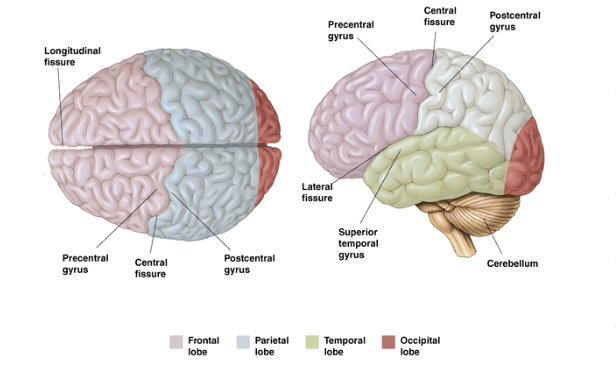
Regions of the Brain:
Frontal Lobe: Decision making, problem solving, emotional expression, concentration, judgment.
Parietal Lobe: Attention, sensory processing, body orientation.
Temporal Lobe: Auditory processing, language, emotional processing, short-term memory.
Occipital Lobe: Sight, image processing, recognition.
Changes in these areas are linked to specific cognitive, emotional, and behavioral profiles.
Treatment Modalities(方式)
Types of Treatments:
Psychosurgery
neurosurgical treatment of severe, treatment-resistant mental disorders
Electroconvulsive Therapy (ECT)
highly effective, safe psychiatric treatment for severe mental illnesses
Deep Brain Stimulation
neurostimulator-based treatment for movement disorders
Transcranial Direct-Current Stimulation (tDCS)
non-invasive portable neurostimulation technique
direct electrical currents applied via scalp electrodes to modulate brain activity
Psychotropic Medications 精神药物 (e.g., anxiolytics, antidepressants, mood stabilizers, antipsychotics)
Strengths:
Continuous evolution and efficacy of psychopharmacology.
Focus on symptom reduction as a treatment goal.
Limitations:
Unclear relationships between beliefs, values, and biology.
Lack of clarity on causation (nature vs. nurture).
Potential side-effects, relapses, and issues with long-term medication use.
Non-specific effects of biological interventions across various neural systems.
Psychological Models
Overview
These models became prominent alongside the development of psychiatry over 150 years ago, focusing on psychological processes behind abnormal behavior.
Factors in Psychological Models:
Interpretation of experiences
Beliefs and motivations
Conscious and unconscious processes
Learning history
Psychoanalytic Models
Sigmund Freud's Contributions:
Key concepts include unconscious processes, psychosexual development, and defense mechanisms.
Treatments involve free association and dream analysis as well as counter/transference reflections.
Emphasizes childhood experiences impacting later development.
Limited empirical testability has led to new models emerging.
Psychodynamic Models
Focus on dynamic internal forces and unconscious influences.
retains unonscious processes while increasing clinical measurability
Key Theories: Includes ego psychology, object relations theory, interpersonal therapy, and attachment theory.
Behavioral Models
Abnormal behavior viewed as the result of observable and identifiable environmental stimuli.
Techniques involve reinforcement and punishment.
Methods of Learning:
Classical Conditioning (Pavlov & Watson): Associating unconditioned stimuli with conditioned responses.
Definitions:
Unconditioned Response (UR)
Conditioned Response (CR)
Unconditioned Stimulus (US)
Conditioned Stimulus (CS)
Operant Conditioning (Skinner): Behavior modification through reinforcement and punishment (positive and negative).
shaped by consequence and reinforcement
Observational Learning: Learning by watching others, such as in Bandura's Bobo Doll study.
social behaviour learning
can occur in absence of reinforcers
Cognitive Models
Proposed by Albert Ellis and Aaron Beck, these models focus on dysfunctional cognitive processes leading to abnormal behaviors and emotions.
abnormal behaviours and emotions caused by dysfunctional cognitive processes
multiple levels of cognitive processes
Rational Emotive Behavioral Therapy (REBT):
Proposed the ABC model (Activation-Beliefs-Consequences) to demonstrate the role of interpretations in emotional responses.
interpretations drive emotional responses
Identified themes of negative thinking and cognitive distortions prevalent in various disorders.
ABC Model, explains how thoughts create emotional and behavioural outcomes:
activating event
something happens to you or in the environment around you
beliefs
you have a belief or interpretation regarding the activating event
consequences
your belief has consequences that include feelings and behaviours
disputations of beliefs
chalenge your beliefs to create new consequences
effective new beliefs
adoption and implementation of new adaptive beliefs
Cognitive-Behavioral Models
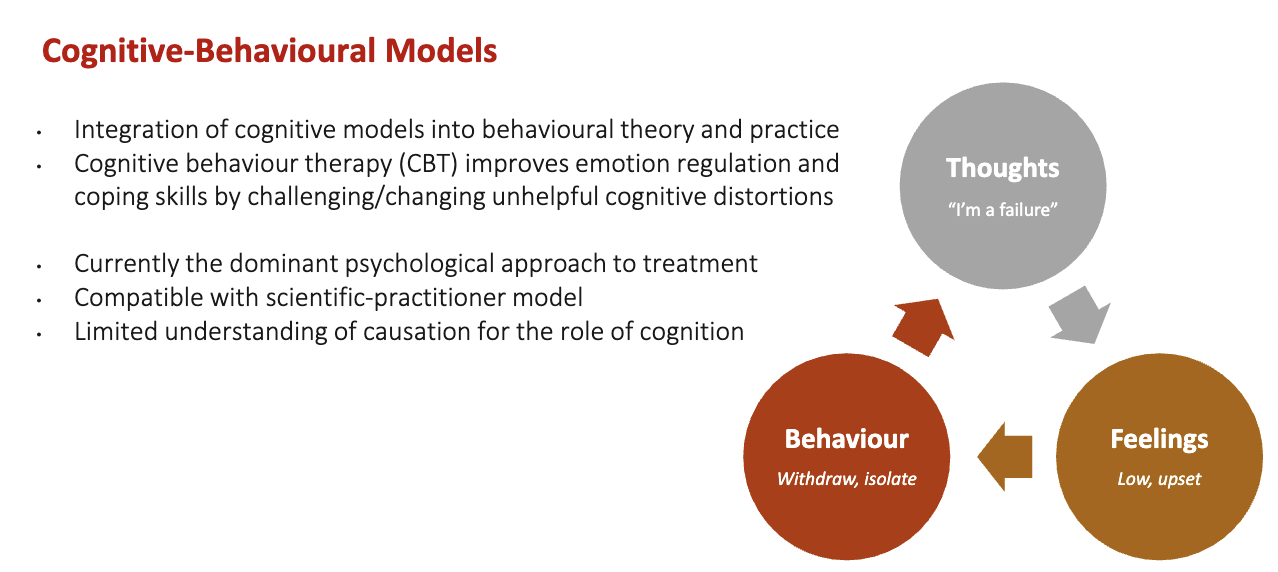
Integration of cognitive models with behavioral practices.
Focus on improving emotion regulation and coping skills through Cognitive Behavioral Therapy (CBT).
Dominant approach to psychological treatment today, with compatibility to the scientific-practitioner model.
Sociocultural Models
General Overview
Established approximately 150 years ago alongside psychiatric development, focusing on social structures and cultural norms that influence psychological experiences.
Examines the interaction of behaviors, thoughts, and feelings in real or perceived social contexts.
examines how people’s behaviours, thoughts and feelings based on real or imagined interactions with society
Key Points:
Social structures and environmental stressors significantly affect psychological wellbeing.
Explores individual suffering from a broader social perspective.
Influential Factors
Consideration of living conditions, social norms, family dynamics, education, work environment, age, and culture.
Theories of Behavior and Intention
Theory of Reasoned Action (TRA)
Founded by Martin Fishbein and Icek Ajzen in the 1960s; further developed into the Theory of Planned Behavior (TPB) in the 1980s.
Key Components:
Attitude towards the behavior
Behavioral beliefs and evaluations of outcomes
Subjective norms and normative beliefs
Motivation to comply
Perceived behavioral control and perceived power
Theory of planned behaviour (TPB)
performing a behaviour is also influenced by hacing the necessary resources and capability to peform the behaviour
extended TRA to form TPB
Attribution Theory
Examines how people perceive and attribute their own and others' behaviors.
Discusses errors in attribution, such as:
Fundamental Attribution Error - focusing on internal over external factors.
Confirmation Bias - interpreting information to fit existing beliefs.
Self-Serving Bias - attributing successes to oneself but failures to external factors.
Illusory Superiority - overestimating one's abilities compared to others.
Diathesis-Stress Model
Explains mental illness risk through interaction between predisposition and stress levels.
Illustration:
Low stress with a predisposition: Disorder not manifested.
High stress with predisposition: Disorder manifested.
Emphasizes probabilistic risk rather than deterministic causation in developing mental illnesses.