Lecture 16: The Philippine Commonwealth
The Philippine Commonwealth: A Nation in Transition (1935–1946)
The Commonwealth of the Philippines was a transitional government established as part of the Philippines' path to full independence from the United States. It was a significant period of political institution-building, economic planning, social reform, and preparation for self-governance—all against the backdrop of a looming global conflict.
Struggle for Independence and the Birth of the Commonwealth
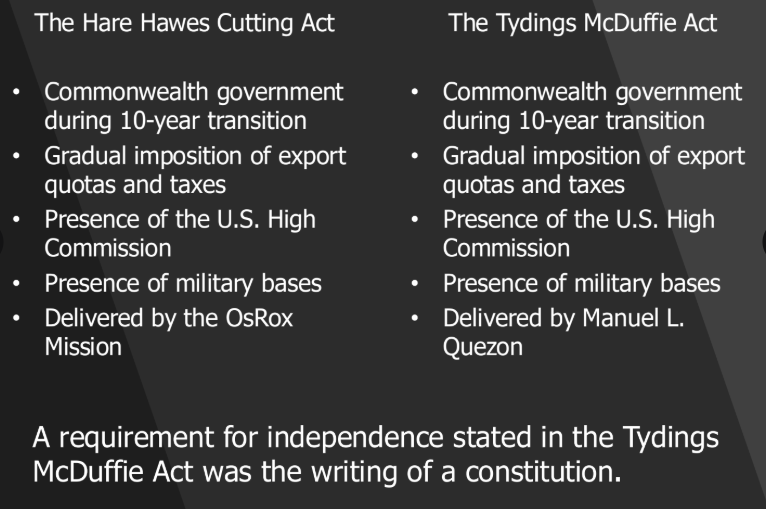
In the early 20th century, Filipino leaders lobbied for independence from the United States. These efforts resulted in several legislative milestones. The first major attempt was the Hare-Hawes-Cutting Act of 1932, which offered a 10-year transitional period before granting full independence. However, this act was rejected by Philippine Senate President Manuel L. Quezon and his allies, mainly due to provisions allowing the U.S. to retain military bases and influence trade.
Quezon countered with his own diplomatic effort, resulting in the Tydings-McDuffie Act of 1934, which mirrored many of the same provisions but was politically more acceptable. This act officially established the Commonwealth of the Philippines, set to last for ten years before the Philippines would be granted independence.
The 1935 Constitution and Government Structure
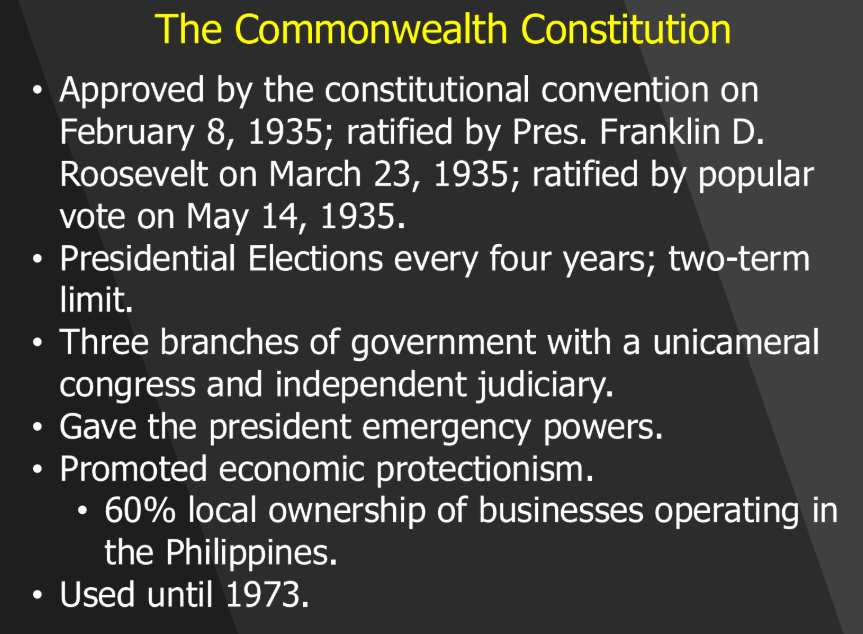
One of the requirements of the Tydings-McDuffie Act was the drafting of a Philippine constitution. A constitutional convention led to the 1935 Constitution
Manuel L. Quezon: First President of the Commonwealth
In the 1935 presidential elections, Manuel L. Quezon won a decisive victory, defeating historical figures like Emilio Aguinaldo and Gregorio Aglipay, securing about 68% of the vote. Sergio Osmeña became Vice President. The inauguration took place at the Legislative Building (now the National Museum of Fine Arts) on November 15, 1935.
Economic Challenges and State Intervention
The Challenge
Backward industrialization due to reliance on American imports
The Philippine economy at the time was heavily reliant on the United States. Imports dominated, ranging from cotton and steel to automobiles and wheat flour.
The Solution
To reduce dependence and stimulate development, Quezon's administration formed the National Economic Council under Commonwealth Act No. 2, tasked with formulating a national economic development plan for the government.
The National Development Company (NDC) became the investment arm of the state, setting up enterprises in sugar, coconut, abaca, and tobacco processing, among others.
Other Government Projects and NDC Subsidiaries
Insular Sugar Refining Company
Malabon Sugar Company
National Abaca and Other Fibers Corp.
National Coconut Corp.
National Tobacco Corp.
Agrarian Unrest and Social Justice
Much of the Filipino population were tenant farmers living in poverty. With inadequate public education and a rapidly growing population, social unrest intensified. Quezon responded with a Social Justice Program, aimed at improving the plight of farmers and workers. One major initiative was the creation of the National Land Settlement Administration in 1939, which organized the migration of landless farmers to less populated areas like Mindanao.
However, Quezon made it clear that the government could not confiscate private land without just compensation, as prohibited by the constitution. He emphasized that “kasama are partners, not slaves,” signaling a shift in attitudes toward tenant-landlord relations.
Urban Problems and the Creation of Quezon City
To address issues in Manila such as overcrowding, poor sanitation, and traffic congestion, Quezon spearheaded the creation of Quezon City, which was envisioned as a modern and well-planned capital city. This move was part of broader efforts to decongest the colonial capital and establish a new center for national governance.
Consolidation of Power and Political Maneuvering
In 1940, Quezon sought to amend the constitution to restore the Senate, which had been removed in the 1935 framework. He wanted to ensure that the Senate would be elected nationwide, rather than by regions, thereby reducing localism and retaining central control. These amendments strengthened his influence over both the legislature and executive agencies.
The Threat of War and National Defense
As tensions in the Pacific grew, the biggest challenge facing the Commonwealth was the imminent threat of Japanese invasion. In response, the National Defense Act (Commonwealth Act No. 1) was passed. It created the Philippine Army, Air Corps, and the Offshore Patrol. Quezon recruited General Douglas MacArthur, former U.S. Army Chief of Staff, to serve as his military adviser, setting up headquarters at the Manila Hotel.
In August 1941, the U.S. began deploying military forces to the Philippines. But following the surprise Japanese attack on Pearl Harbor on December 7, 1941, Japanese forces quickly bombed Clark Airfield in the Philippines. American and Filipino forces retreated to Bataan and Corregidor, and Quezon and Osmeña fled to the U.S., establishing a government-in-exile.
Government in Exile and Quezon’s Death
While in exile in the U.S., Quezon continued to serve as president, advocating for Filipino interests and supporting the Allied war effort. He died of tuberculosis in Saranac Lake, New York, in 1944. His remains now rest at the Quezon Memorial Circle in Quezon City. After Quezon’s death, Sergio Osmeña became president and later returned with MacArthur's liberation forces on October 20, 1944, as the Philippines was freed from Japanese occupation.
Cultural Identity and National Language
In 1937, Quezon also addressed cultural unification through Executive Order No. 134, proclaiming Tagalog as the basis for the national language. However, this did not change the fact that English remained the primary language of instruction in schools.
Legacy of the Commonwealth
The Commonwealth period laid the institutional and ideological groundwork for the Republic of the Philippines, which was formally established on July 4, 1946. Despite the challenges of colonial legacy, social inequality, and war, the Commonwealth government marked a crucial stage in the nation’s journey toward full independence and self-determination.