Photosynthesis
Concepts:
Chemical Equation:
6H2O + 6CO2 (light → energy) C6H12O6 + 6CO2
Location of Photosynthesis
Mesophyll Cells in the Chloroplast
Structure of a Chloroplast
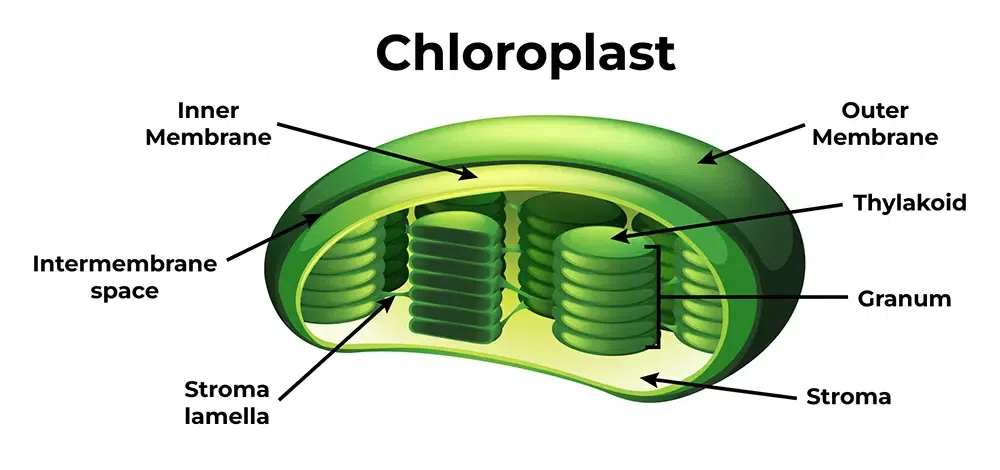
Double Membrane Envelope:
Outer Membrane - Covers the entire chloroplast. The barrier between the chloroplast and the cell
Inner Membrane - inside the outer membrane.
Intermembrane Space - the space in between them
Inside
Stroma - the aqueous environment within the inner membrane. Enzymes that catalyze the Calvin Cycle are here. The Calvin Cycle happens here.
Thylakoid - the discs in the chloroplast. Contains Chlorophyll + other pigmentsGranum - stacked thylakoids
Stroma Lamella - connects the granum
Thylakoid Membranes
Pigments: Absorb photons from sunlight energy to use for the LIGHT DEPENDENT RXNS
Light reactions happen here
Thylakoid Lumen: Similar to the STROMA but inside the thylakoid
Light Energy + bits of the Photosystems
Light gets absorbed by the pigments within the thylakoid. These pigments absorb different wavelengths.
When they absorb light, the ELECTRONS within the chloroplasts from the MAGNESIUM 2+ in the middle of the structure either
Get Excited but then return to their ground state and energy is lost as thermal energy
Transfers the electrons to the neighbouring pigment molecule
Transfers the electrons to the PRIMARY ELECTRON ACCEPTOR
Chlorophyll A gets oxidized as it loses its electrons to the Primary Electron Acceptor.
Primary Electron Acceptor gets reduced as it accepts Chlorophyll a’s electrons
Pigments do NOT absorb all wavelengths. The ones that are not absorbed either pass through the pigment or are reflected
Red and Blue wavelengths are absorbed the most by chlorophyll as it is the most common pigment and it reflects green, making plants appear green. During fall chlorophyll is reduced and other colours are reflected instead (yellow, orange)
Chlorophyll a STRONGLY absorbs red and blue lights but not green or yellow lights which get reflected instead. Anything not absorbed by Chlorophyll A that is red/blue gets absorbed by Chlorophyll B???
Pathways of Photosynthesis
Photosystem II / PSII / PS680
Contains P680 molecules that CONTAIN CHLOROPHYLL A.
Photon → Antenna Complex → sends the photon to P680 which gets it excited and goes from ground state into high energy
When P680 is excited, it gives it’s 2 electrons to the Primary Electron Acceptor. It turns it into P680+ and becomes very electronegative (the most in biology)
Because of it’s electronegativity, it can split up H2O. Through the Water Complex Enzyme, the electronegative pull from P680+ splits H2O → 2H+ and ½ O2 and transfers its 2 electrons through P680+ which neutralizes it → P680 again and it sends the electrons to the Primary Electron Acceptor
In this process P680 is OXIDIZED (Loses Electrons) and the P.E.A is REDUCED (gains electrons)
PQ
An Electron Transporter
Transports Electrons and H+ ions
Gets Electrons from P.E.A and transfers them to Cytochrome COmplex
Gets H+ from Stroma (REDUCED) and transfers them to the Lumen (OXIDIZED)
Photosystem 1 / PSI / P700
Re-energizes the electrons that went through PSII → PQ → Cyt. Comp. → PC → PSI
Synthesis of ATP & Reduction of NADP to NADPH
PQ carries H+ from STROMA to LUMEN = proton gradient. H+ high in lumen lower in stroma
H+ in LUMEN diffuse through ATP Synthase = ATP and transports them to the stroma
(2) H+ in the STROMA combined with NADP + using the electron transported to enzyme NADP reductase, NADP → NADPH
NADP + 2H+ (through NADP reductase and electron sent to it) → NADPH + H+
Cyclic ET
PSI is not dependent on PSII anymore
PSI absorbs a photon → passes through the pigments to PS700 → PS700 gets reduced when it gets the electron and gets excited → gets oxidized when sends it to the P.E.A and PEA gets reduced → PEA sends it to Fd → Fd sends e- to PQ which also receives H+ → PQ sends it to Cytochrome Complex and releases H+ → Cytochrome Complex sends it back to PSI and cycle repeats
NADPH is not produced but more ATP is produced (the H+ released by PQ gets diffused in ATP synthase)
Calvin Cycle
Carbon Fixation
3 CO2 molecules enter the cycle
3CO2 + RuBP (using enzyme Rubisco) → 6 3PGA
CO2 (C) + RuBP (P-C-C-C-C-C-P) → 2 GPA (C-C-C-P)
Reduction
The 6 3PGA (through ATP → ATP + Pi) → 6BiPGA (gains an extra phosphate from the Pi)
PGA (C-C-C-P) + Pi → BiPGA (P-C-C-C-P)
The 6 BiPGA → 6 G3P through (6NADPH getting reduced to 6NADP+, losing e- and H+)
BiPGA (P-C-C-C-P) → G3P(C-C-C-P)
1 of the G3P molecules will be used to make sugar (2 is needed to make glucose)
Regeneration
The 5 other G3P turns into 3 RuBP (using 3 Pi from ATP → ADP + Pi)
5 G3P (C-C-C-P) → 3RuBP(P-C-C-C-C-C-P)
2 G3P are needed to make 1 Glucose; Calvin cycle needs to occur twice to make 1 glucose; requires double the molecules needed,
1 Cycle: 3CO2, 6 + 3 ATP, 3NADPH
2 Cycles: 6CO2 12 + 6 ATP, 6 NADPH
C4 Plants
CO2 enters the Mesophyll cells and immediately gets fixed into a 4-carbon molecule
Comparing C3/C4/CAM
C3: normal one
Occurs in the mesophyll cells
CO2 → directly to the Calvin Cycle to be fixed into a CO3 molecule
C4: alters the location of photosynthesis
Occurs in the mesophyll cells and the bundle sheath cells
CO2 → mesophyll cells, get fixed into a 4-carbon molecule (oxaloacetate) → bundle sheath cells to protect it from the O2 accumulating → Calvin Cycle
CAM: alters the time of photosynthesis
Stomata opens during the day to let CO2 in
Terms:
Stomata: small openings within a plant cell which takes in CO2 and releases O2
Photolysis: the process of breaking down a compound into smaller pieces through light
Photophosphorylation: the process of using light energy to convert ADP into ATP for plant
Light Dependent Rxns
Primary Electron Acceptor - A molecule that is capable of accepting electrons and becoming reduced in photosynthesis.
Reaction Centre - a bunch of proteins and pigments. Contains the Primary Electron Acceptor and Chlorophyll A
Photosystem II (PS680): a collection of pigment proteins that includes P680 Chlorophyll a molecules and absorbs light the best at a wavelength of 680nm
Photosystem I (PS700): a collection of pigment proteins including P700 Chlorophyll a molecules and absorb light the best at a wavelength of 700nm.
Antenna Complex - Transfers light to the chlorophyll a molecule in the photosystem
PQ - an electron carrier (Primary Electron Acceptor → Cytochrome Complex)
Calvin Cycle
Rubisco - an enzyme that is responsible for the fixation of CO2 in the Calvin Cycle. Acts as a catalyst to reduce CO2.
RuBP - Rubisco BiPhosphate (P-C-C-C-C-C-P) 5 carbon molecule
PGA - Phosphoglycerate (C-C-C-P) 3 carbon molecule
CO2 fixation - turning CO2 (an inorganic carbon molecule) → ORGANIC molecules
Other
Photorespiration - The catalysis of O2 instead of CO2 by Rubisco into RuBP which slows the Calvin cycle, consumes ATP, and releases Carbon
C4 - 4 carbon compound
Plasmodesmata
Mesophyll Cells - DO NOT contain Rubisco (around the sheath cells)
Bundle Sheath Cells - Contain Rubisco (around the veins)
Transpiration - loss of water vapour from plants
incandescent - emitting light as a result of being heated.
fluorescent - emitting light normally from like photons