India
HINDUISM
Religion of India
Hinduism is both a religion and a way of life.
- Determines a person’s way of life
Beliefs:
(a) In Hinduism there is a belief in many gods (polytheism).
(b) Reincarnation: this is the belief in the rebirth of the soul into another form until it reaches perfection known as Nirvana.
a. Could be reincarnated into an animal
(c) Karma: this is a belief that the “deeds” of each human being determines his/her future state.
a. How a person lived their life determines if they are reincarned into something higher or lower
(d) Dharma: this is a belief that states that an individual has a duty and obligation, within his/her family, caste, or social group.
(e) Caste: this refers to the four main social groups of Hinduism.
(1) Brahmins…………………………………priests. (this one i have to remember)
(2) Kshatriya…………………………………warriors.
(3) Vaishyas………………………………….merchants and artisans.
(4) Shudra…………………………………….servants.
If a person lives a good life, they move up castes and eventually reach Nirvana
If someone from the upper class wanted to marry someone from the lower class, they would be disfigured
There are people who are considered outside the caste system and they are the Harijans, also known as the Untouchables (that is where we get the term outcaste. Old tales of Hinduism are found in the Vedas and the epic poem, Mahabharata.
Hindus have two main beliefs that are very important in shaping their attitude toward life. The first is reincarnation; the belief that after a person dies his or her soul is born again in another body. This body may be that of another human being, an animal, or even an insect. Souls begin in the lower animals, and if life is lived in the proper way, the soul is reborn in more advanced being. So it goes all the way up to the top caste. People usually have no memories of what their previous lives have been, but they must accept their present birth as part of a series of lives.
Because of their belief in reincarnation, Hindus have a great respect for all living things. Animals, birds, and even insects are fed and protected as they are all believed to have souls. A main idea of Hinduism is that “All life is one; all life is sacred”.
The second belief is caste. Hindus belong for their whole lives to the caste into which they are born. These castes may determine what the members eat, what they may do for a living, whom they may marry, and the way they may associate with members of other castes. Because of the caste rules, it is said that Hinduism is not just a religion but a way of life.
Good Hindus try to live according to the rules of their castes. If they keep all the rules and generally live honest devout lives, their souls will be rewarded by happy lives or by graduating to perfection or to a higher caste in the next life. If Hindus do not live good lives their souls may be reborn into lower caste bodies or even into the bodies of animals.
Caste is determined by hereditary. Children belong to the caste of their parents. The religious ideas behind caste are more complicated than simple hereditary. Many Hindus, especially those of the higher castes believe that through reincarnation people can be born into higher castes and that members of the higher castes are those whose souls are becoming more nearly perfect. When souls reach perfection, they become part of the universal soul (Nirvana).
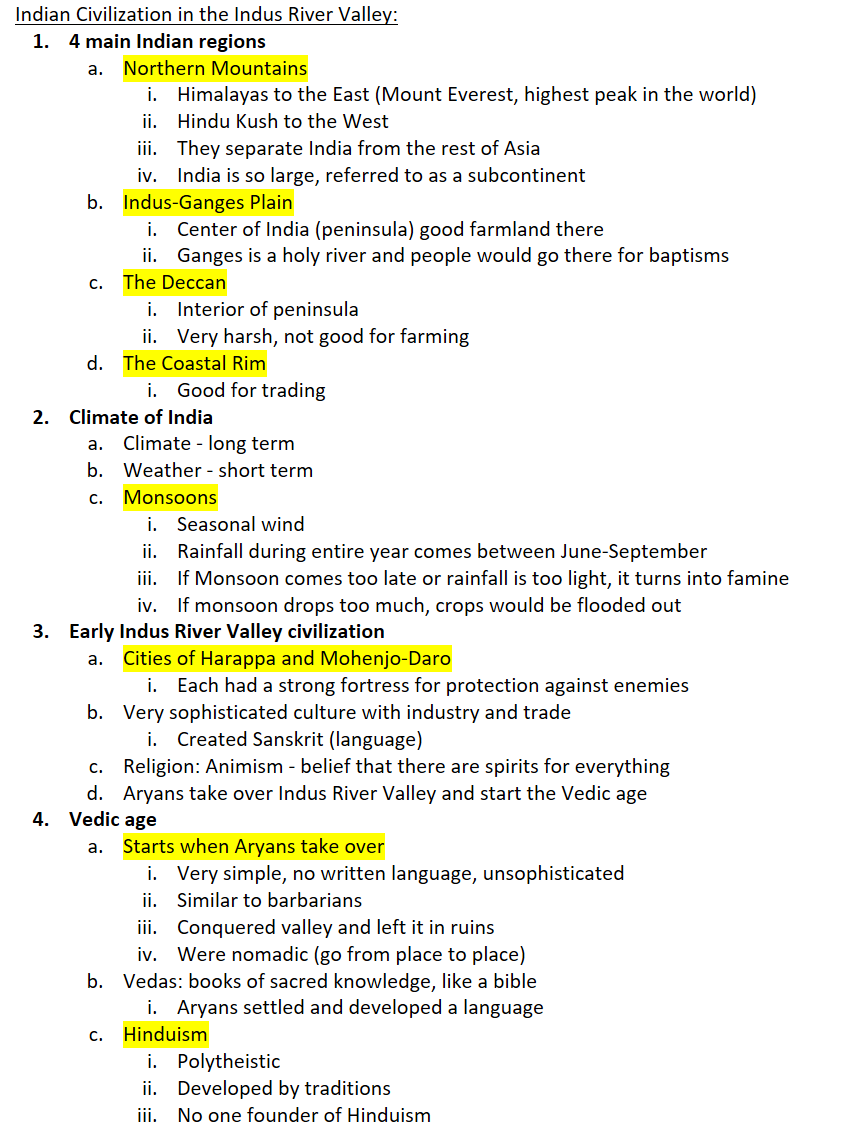
Indian Civilization in the Indus River Valley:
4 main Indian regions
Northern Mountains
Himalayas to the East (Mount Everest, highest peak in the world)
Hindu Kush to the West
They separate India from the rest of Asia
India is so large, referred to as a subcontinent
Indus-Ganges Plain
Center of India (peninsula) good farmland there
Ganges is a holy river and people would go there for baptisms
The Deccan
Interior of peninsula
Very harsh, not good for farming
The Coastal Rim
Good for trading
Climate of India
Climate - long term
Weather - short term
Monsoons
Seasonal wind
Rainfall during entire year comes between June-September
If Monsoon comes too late or rainfall is too light, it turns into famine
If monsoon drops too much, crops would be flooded out
Early Indus River Valley civilization
Cities of Harappa and Mohenjo-Daro
Each had a strong fortress for protection against enemies
Very sophisticated culture with industry and trade
Created Sanskrit (language)
Religion: Animism - belief that there are spirits for everything
Aryans take over Indus River Valley and start the Vedic age
Vedic age
Starts when Aryans take over
Very simple, no written language, unsophisticated
Similar to barbarians
Conquered valley and left it in ruins
Were nomadic (go from place to place)
Vedas: books of sacred knowledge, like a bible
Aryans settled and developed a language
Hinduism
Polytheistic
Developed by traditions
No one founder of Hinduism