NCEA Level 1 English Assessment Guide and Text Study Notes (Standards 91925 & 91927)
Overview of NCEA Level 1 English Standards (91925 & 91927)

- Organization: New Zealand Association for the Teaching of English / Te Pouhere Whakaako o Te Reo Pakeha o Aotearoa (NZATE).
- Academic Level: NCEA Level 1 English (2025 Assessment Frameworks).
- Core Standards Covered:
- Standard 91925: Demonstrate understanding of specific aspects of studied text (5 Credits).
- Standard 91927: Demonstrate understanding of significant aspects of unfamiliar texts (5 Credits).
- Assessment Design & Recommended Timing:
- Standard 91925 requires candidates to answer ONE essay question with detailed supporting evidence from a studied written, visual, or oral text.
- Standard 91927 requires candidates to complete THREE questions based on provided resource texts (Text A: Prose Fiction, Text B: Poetry, Text C: Non-Fiction Prose). Recommended time is approximately 40 minutes per question.
Standard 91925: Demonstrate Understanding of Specific Aspects of Studied Text
- Standard Objective: Evaluate how specific aspects of studied texts work independently and together to convey meaning, positioning the reader or audience and connecting to broader societal contexts.
- Assessment Criteria Matrix:
- Achievement: Demonstrating understanding involves describing specific aspects of a text, describing how those aspects create engagement with or give viewpoints of a text prompted by the question, and including relevant supporting details from the text.
- Achievement with Merit: Demonstrating convincing understanding involves explaining how aspects work together to create engagement with or viewpoints of a text prompted by the question, supported by relevant text details.
- Achievement with Excellence: Demonstrating perceptive understanding involves discussing how aspects of a text have been used to create engagement with or viewpoints of a text to establish meaning. This requires awareness of the creator's purpose or wider contexts outside the text (such as human experience, society, and the wider world), supported by relevant text details.
- Notes on Question Interpretation:
- The question stem "How…" requires candidates to outline the specific ways aspects are deliberately used.
- Each question incorporates at least two aspects to guide candidates toward convincing or perceptive analysis ("between the lines" and "beyond the lines").
- Convincing or perceptive performance demands an understanding of creator intention/purpose and the creator-audience relationship (how the audience is positioned).
- Grade Scale and Cut Scores:
- Total Mark Scale: 0 to 8 points.
- Not Achieved (N): 0−2 points.
- Achieved (A): 3−4 points.
- Achieved with Merit (M): 5−6 points.
- Achieved with Excellence (E): 7−8 points.
- Detailed Grade Descriptor Breakdown:
- N0: No response; no relevant evidence.
- N1: Attempts to state an idea that is relevant to the question.
- N2: Attempts to state a relevant idea and shows awareness of the specified aspect(s) in the text.
- A3: Fulfills the intent of the assessment criteria for Achievement, though some parts may be partial or weak.
- A4: Securely fulfills the intent of the assessment criteria for Achievement.
- M5: Fulfills the intent of the assessment criteria for Achievement with Merit, though some parts may be partial or weak.
- M6: Securely fulfills the intent of the assessment criteria for Achievement with Merit.
- E7: Fulfills the intent of the assessment criteria for Achievement with Excellence, though some parts may be partial or weak.
- E8: Securely fulfills the intent of the assessment criteria for Achievement with Excellence.
- Question Choices for Standard 91925:
- Question 1: How does the ending of the text help to show one or more ideas about the world you live in?
- Question 2: How does the creator use one or more events to communicate important aspects of character(s)?
- Question 3: How does the creator use techniques to help you to engage with the text? (Techniques could include vocabulary, style, imagery, symbolism, narrative, technical features, point-of-view, or structure).
- Question 4: How does the creator use setting(s) to highlight important ideas in a text?
- Question 5: How does the creator use characters to help you understand the text as a whole?
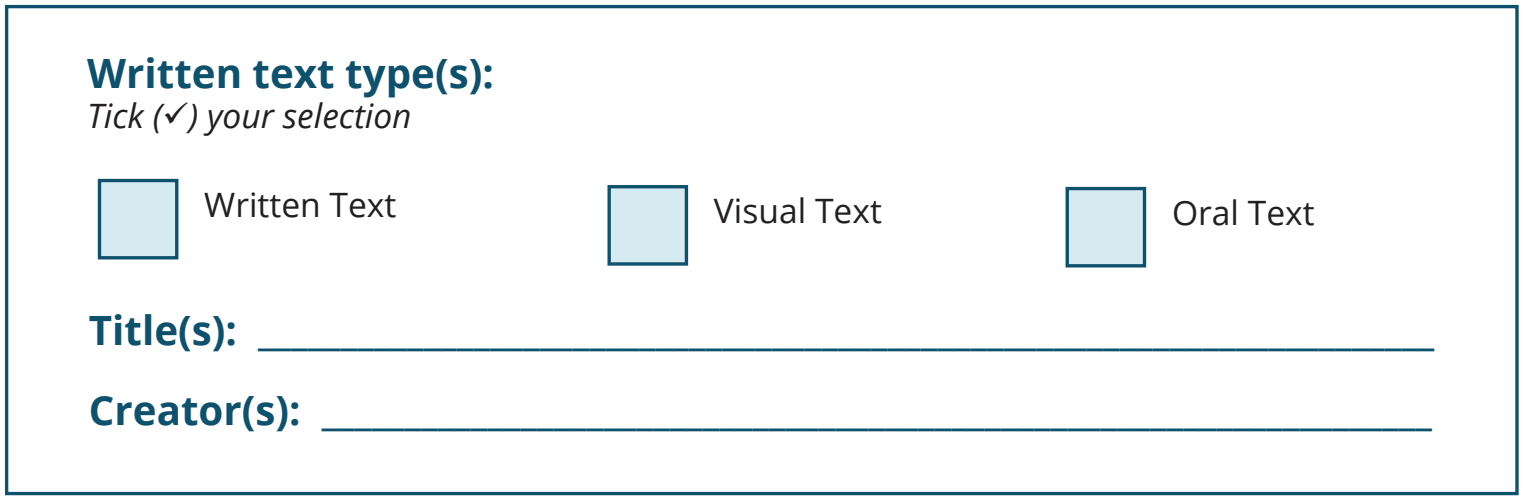
- Form Selection Requirements: Candidates must select and tick one text category and state title and creator details:
Standard 91925 Exemplar Analysis & Text Case Studies
- Achievement Level Exemplar Case Study:
- Text Details: Film V for Vendetta (2005), directed by James McTeigue.
- Selected Question: How does the creator use ideas and characters to help you engage with the text?
- Analysis & Evidence:
- Discusses V as an interesting character driven by the core idea that individuals must fight for what is right.
- Analyzes the tension between V's core philosophy and his violent methods (blowing up buildings, threatening violence), which risks intimidating the public rather than inspiring them.
- Quotes V directly: "That he believes the government will turn into an oppressive, fascist state and that his goal is to not overthrow but to take it down from its roots."
- Recognizes V's courage in standing up against systemic oppression, acknowledging that most people fear taking such risks.
- Achievement with Merit Level Exemplar Case Study:
- Text Details: Film The Breakfast Club (1985), directed by John Hughes.
- Selected Question: How does the creator use characters to help you understand an important idea in our world?
- Analysis & Evidence:
- Explores the central idea that teenagers face universal obstacles and insecurities that dictate their actions.
- Contrasts Claire, the high-status 'princess' stereotype in detention for skipping class, with Bender, the rebellious 'bad boy' who uses defiance ("eat my shorts") to express frustration.
- Explains how their interaction during weekend detention breaks down social barriers, uncovering shared experiences of toxic home environments.
- Highlights the key symbol: Claire giving her diamond earring to Bender. This act symbolizes affection, devotion, and recognition, signaling to Bender that he is worthy of respect despite his father's abuse.
- Integrates character relationships and symbolism to show that external social roles mask internal commonalities.
- Connects text to real-world experience: joining kapa haka, overcoming personal discomfort, and forming friendships across diverse social and cultural groups.
- Achievement with Excellence Level Exemplar Case Study:
- Text Details: Film Pleasantville (1998), directed by Gary Ross.
- Selected Question: How does the setting of a text help shape your understanding of a character or individual?
- Analysis & Evidence:
- Examines two contrasting settings: a typical, highly hierarchical American high school in the 1990s versus the artificially 'perfect' 1950s TV town of Pleasantville.
- Analyzes film techniques in the opening scene: a close-up on David talking to an attractive 'cool' girl ("Look. I know you don't think I should be telling you this, but…") followed by a wide shot from behind revealing he is alone and imagining the dialogue. This illustrates how 1990s social conditioning enforces isolation and fear of social rejection.
- Draws explicit comparisons to The Breakfast Club, noting how structural settings force individuals from rigid social tiers (jock, nerd, rebel) to find common ground.
- Unpacks David's hidden obsession with the 1950s Pleasantville sitcom as a coping mechanism for his timid 1990s reality.
- Connects the pressure of rigid social hierarchies to contemporary society, referencing initiatives like Kids Health that encourage emotional awareness and individuality to dismantle harmful stereotypes.
- Traces David's psychological transformation: as cracks appear in Pleasantville's artificial perfection, David shifts from passive compliance to an assertive leader fighting for equality and social justice.
Standard 91927: Demonstrate Understanding of Significant Aspects of Unfamiliar Texts
- Standard Objective: Analyze unfamiliar written texts across prose fiction, poetry, and non-fiction prose by evaluating significant textual aspects, language features, structural choices, and thematic applications.
- Definition of Significant Aspects (Explanatory Note 2):
- Purposes and Audiences: Intended effect, perspective, and target audience positioning.
- Ideas: Character, theme, narrative stance, and setting.
- Language Features: Figurative language (simile, metaphor, personification), syntax, vocabulary, parallel phrasing, and symbolism.
- Structures: Narrative organization, part-to-whole relationships, stanzaic progression, and lineation.
- Text Conventions: Grammar, punctuation, spelling, and register.
- Assessment Criteria Matrix:
- Achievement: Identifying or describing aspect(s) of the text relevant to the question; explaining how one or more significant aspects create meaning or effect; including specific and relevant details from the text.
- Achievement with Merit: Explaining how TWO or more significant aspects work together to create meaning or effect; including specific and relevant details from the text.
- Achievement with Excellence: Explaining how significant aspects have been deliberately used to create meanings or effects in order to communicate ideas relating to the writer's purpose and wider contexts beyond the text (such as human experience, society, and the wider world); including specific and relevant details.
- Grade Scale and Cut Scores:
- Total Marks: Three items assessed holistically out of 8 points each (3×8=24 points maximum).
- Not Achieved (N): 0−6 points.
- Achieved (A): 7−12 points.
- Achieved with Merit (M): 13−18 points.
- Achieved with Excellence (E): 19−24 points.
- Individual Question Item Breakdown: Same N1−E8 scale applied per text item (N1,N2,A3,A4,M5,M6,E7,E8).
Standard 91927 Resource Booklet Texts
Text A: Prose Fiction — Excerpt from The Bone Tiki
- Citation: Hair, David. (2009). The Bone Tiki. Auckland, New Zealand: Harper Collins.
- Narrative Context: Mat travels south in Tama Douglas' deep green Mercedes toward his Nanny Wai-Aroha's tangi. Tama deals with gang members and criminals for a living and is not easily intimidated, implying that Puarata is dangerous. Mat reflects on his single prior meeting with Nanny Wai-Aroha.
- Key Characters & Relationships:
- Mat (Matiu): Main protagonist journeying to claim the bone tiki.
- Nanny Wai-Aroha: Mat's distant relative, previously locked away in an institution for years, unacknowledged by the family except by Hinemoa.
- Aunty Hinemoa (Hine): Mat's great-aunt (dad's mother's sister) and Wai-Aroha's best friend.
- Tama Douglas: Mat's driver/companion.
- Puarata: A threatening figure involved in undisclosed plans regarding the tiki.
- Text Passages & Specific Details:
- Physical Description of Wai-Aroha: "a frail little woman with wide-staring eyes and scarred wrists." She had a sudden, pixie-like smile, and a strange, "tinkling laugh," appearing mentally frozen at age fourteen despite her aging body.
- The Sketching Incident: Mat was bored, sketching patterns on pad paper, frustrated because the concepts in his mind would not translate onto paper. Wai-Aroha observed him and remarked that he had talent that needed an outlet. She took a pencil, added minor modifications, and revealed an intertwined koru and Celtic knot—a design Mat currently keeps on his bedroom wall.
- Wai-Aroha's Key Direct Quote: “When you find what you are good at, you find why you are alive.”
- The Bone Tiki: As Mat prepared to leave, Wai-Aroha hugged him with arms "thin as gnarled twigs." She presented a bone-carved hei-tiki (a man-shaped pendant). Though physically ugly, she held it like a holy relic.
- Wai-Aroha's Direct Quote on Legacy: “When I die, Matiu, you should have this tiki. Maybe you’ll know what to do with it. Because I don’t.”
- Departure: Wai-Aroha broke down in tears into Hine's arms, sobbing like a child, before Hine drove her away. Mat never saw her again.
Text B: Poetry — View from the summit of an Island named after an Extinct Bird
- Citation: Valentine, Māhina T. (2024). View from the summit of an Island named after an Extinct Bird. In D. Eggleton, V. Rapatahana & M. Taito (Eds.), Katūīvei: Contemporary Pasifika Poetry from Aotearoa New Zealand. Massey University Press.
- Glossed Term: Kāhu — a large, tawny bird of prey.
- Complete Text Structure & Lineation:
text
A circus of beauty
streaks across sunset
luminous wings
cresting the curve
of Sugarloaf two kāhu are calling
calling as they helix
high
into Sky
they intertwine like fibres of a long fishing line
like the invisible
umbilical that binds us to everything:
Life!
slips unhindered
from my lips
& air
flowing in freely
they say
the heart is a muscle
to strengthen
with oxygen
a gift
and a promise
- Citation: Avia, Tusiata. (2023). Dancing in the Footsteps of Our Ancestors. Adapted from e-tangata.co.nz.
- Glossed Terms:
- puletasi: Traditional dress for Samoan women.
- taupou: A hostess selected by the high chief in the village, charged with entertaining visitors.
- tupuaga: Ancestors.
- Text Passages & Specific Details:
- The Performance: The writer watches her teenage daughter's Pasifika fiafia (celebration) night. Girls perform barefoot in puletasi, dancing "Heartbreakingly beautifully," embodying the movements of grandmothers, great-grandmothers, taupou, and ancestral lineages.
- Cultural Inheritance: Although the girls do not know their ancestors' names, they share physical traits: "the same shaped feet, the same tilt of eye, the same slope of forehead." They carry "this DNA buried deep in their bones," creating a connection that stretches back across the Pacific Ocean.
- The Intergenerational Divide: In contrast to their daughters, the mothers do not dance, sing, orate, or speak Pacific languages. The writer describes this loss: "Our mouths are closed, our hands are still, and our bodies are stiff, but our shame — oh, our shame — is wider than the blue Pacific Ocean."
- Historical Suppression vs. Modern Reconnection: The older generation grew up in Aotearoa without cultural validation. The younger generation reclaims heritage using modern tools like Polyfest, TikTok, and mobile phones (used "like vaka"). They serve as guides ("They follow each other like stars"), learning and transitioning between traditional dances: Samoan taualuga, Tongan tau’olunga, and Cook Island ‘ura.
Standard 91927 Text Analysis & Language Features Guide
Text A Analysis: The Bone Tiki
- Primary Question: How does the writer explain Nanny Wai-Aroha's impact on him?
- Core Themes: The development of personal identity, the role of artistic expression, mentorship, and cultural heritage.
- Identified Language Features & Examples:
- Simile:
- "he had talent that just needed to find a way to come out - like a stream blocked by a fallen tree."
- "her arms thin as gnarled twigs."
- "sobbed like a child."
- Symbolism: The bone-carved hei-tiki symbolizes cultural legacy, spiritual responsibility, and the ancestral link Wai-Aroha passes to Mat.
- Direct Speech:
- “When you find what you are good at, you find why you are alive”
- “When I die, Matiu, you should have this tiki. Maybe you’ll know what to do with it. Because I don’t.”
- Contrast / Juxtaposition: The contrast between Wai-Aroha's physical frailty ("frail little woman with wide-staring eyes and scarred wrists") and the profound wisdom she imparts.
- Adjectives: Precision descriptors such as "Tinkling laugh" and "Wide-staring eyes and scarred wrists."
Text B Analysis: View from the summit of an Island…
- Primary Question: How does the writer develop the connection between humans and the natural world?
- Core Themes: Interconnectedness, environmental reciprocity, nature as a source of vitality, and human responsibility toward the ecosystem.
- Identified Language Features & Examples:
- Simile:
- "like the invisible umbilical that binds us to everything"
- "they intertwine like fibres of a long fishing line"
- Metaphor:
- "A circus of beauty"
- "A gift and a promise"
- Heart as a muscle strengthened by oxygen
- Alliteration: "Circus of Beauty", "Cresting on the Curve", "calling"
- Personification: "Life slips, unhindered from my lips"
- Repetition: The word "Calling" echoed across line breaks
- Free Verse: The lack of a fixed rhyme scheme reflects the organic movement of nature.
- Line Breaks and Spacing: Visual arrangements mirror avian flight patterns and natural breathing rhythms.
- Primary Question: How does the writer help us to understand the relationship between different generations in Pasifika communities?
- Core Themes: Intergenerational trauma, cultural reclamation, digital tools as modern navigation, and ancestral presence.
- Identified Language Features & Examples:
- Contrast: Contrasts the mothers' silenced generation with the daughters' active cultural revival ("Our girls might dance in the footsteps of their female ancestors, but they don’t dance like their mothers").
- Simile:
- "using their mobile phones like vaka"
- "They follow each other like stars."
- Metaphor: "They dance with this DNA buried deep in their bones."
- Pasifika Language Integration: Authentic cultural terms including puletasi, taualuga, tau’olunga, ‘ura, and tupuaga.
- Personification: "our shame — is wider than the blue Pacific Ocean"
- Short Sentences: "These girls don’t know their names.", "Heartbreakingly beautifully"
- Repetition: "dance beautifully. Heartbreakingly beautifully.", "but our shame — oh, our shame"
- Parallel Phrasing: "Our mouths are closed. Our hands are still and our bodies are stiff. But our shame, oh our shame"
Standard 91927 Model Responses Across Assessment Levels
Exemplars for Question One (The Bone Tiki)
- Achievement Level Response:
> The writer explains Nanny Wai-Aroha’s impact on him by showing how she recognizes his artistic talent and helps him unlock it, using the example of “stream blocked by a fallen tree” to describe his potential.
- Achievement with Merit Level Response:
> The writer uses simile, describing Mat’s talent as a “like a stream blocked by a fallen tree,” to illustrate Wai-Aroha’s guidance in helping him unlock his artistic potential. Additionally, symbolism is evident in the bone-carved tiki, which Wai-Aroha calls “holy” and promises to Mat, representing the cultural legacy and responsibility she entrusts to him. These features highlight Wai-Aroha’s profound influence on Mat’s identity and cultural connection.
- Achievement with Excellence Level Response:
> The writer uses simile, describing Mat’s talent as like a “stream blocked by a fallen tree,” to illustrate how Wai-Aroha helps him unlock his artistic potential, symbolizing the broader theme of self-discovery and the importance of mentorship in personal growth. The symbolism of the bone-carved tiki represents the passing down of cultural heritage and responsibility. This connects to the author’s purpose of exploring how personal identity is shaped by both individual creativity and the legacy of one’s cultural roots, encouraging readers to reflect on their own connections to heritage and the influence of mentors.
Exemplars for Question Two (View from the summit…)
- Achievement Level Response:
> The poet shows the connection between humans and nature through simile. The simile “like the invisible umbilical that binds us to everything” explicitly states the connection, suggesting that just as a baby is connected to its mother, humans are inherently connected to the natural world.
- Achievement with Merit Level Response:
> The poet develops the connection between humans and the natural world through metaphor and simile. The “invisible umbilical” represents the deep, unbreakable link between humans and nature, suggesting that life and nature are intertwined. The image of the “long fishing line” further emphasizes this interconnectedness, implying a delicate yet strong relationship.
- Achievement with Excellence Level Response:
> The poet uses metaphor and free verse to explore the reciprocity between humans and the natural world. The “invisible umbilical” symbolises the power between humanity and nature, suggesting that life itself is interconnected. The poem’s conclusion, with the metaphor of the heart as a muscle strengthened by oxygen, reinforces this dependence. The free verse structure, with its flowing line breaks and varied spacing, mirrors the natural rhythms of breathing and movement, reinforcing the harmony between humans and the environment. The oxygen, provided by the natural world, becomes a symbol of life itself, highlighting the essential role nature plays in human existence and suggesting a reciprocal relationship where both are sustained.
- Achievement Level Response:
> The writer develops ideas about how the younger generation dances like their ancestors, carrying on traditions even without knowing their names or languages. Metaphors, like “DNA buried deep in their bones,” show that culture is passed down.
- Achievement with Merit Level Response:
> The writer develops the relationship between different generations by using contrast and metaphors . The older generation feels disconnected, shown through phrases like “our mouths are closed, our hands are still,” emphasising their shame at their loss of tradition. In contrast, the younger generation proudly reclaims their heritage through dance, modern tools like social media, and teaching each other through metaphors, such as “DNA buried deep in their bones.”
- Achievement with Excellence Level Response:
> The writer uses contrast and simile to explore generational connections in Pasifika communities, emphasising how the younger generation reclaims what the older generation lost. The extended metaphor of the young people being like navigators helps to develop this idea “They use each other as guides. They follow each other like stars. They follow each other criss-crossing the Pacific, using their mobile phones like vaka, The older generation’s “shame” reflects the impact of history on Pasifika pride, while the younger generation’s dance symbolizes resilience and pride and re navigating their cultural connections.