T2W4 - Memory and Number
Recognition
Prenatal infants recognise familiar auditory stimuli (DeCasper, 1994)
Neonates habituate to repeated shapes and discriminate new ones (Slater et al., 1983)
Morgan & Hayne (2006) à How does encoding and retention develop
Tested 1 & 4 year olds’ visual recognition
They manipulated the length of familiarisation – speed of encoding: 5s; 10s; 30s
And the length of delay – retention: 0; 24hr; 1 week
Results
1-year-olds recognised it immediately with 10 seconds of familiarisation. They retained it for over 24 hours with 30 seconds of familiarisation
4-year-olds recognised it immediately and every 24 hours with 5 seconds of familiarisation. They retained it for over a week with 10 seconds of familiarisation.
Conclusion:
Children’s speed of encoding for recognition increases with age. Children’s retention for recognition increases with age. Increasing familiarisation prolongs retention - a greater level of encoding
Recall - this is harder to test - requires a response that shows evidence of retrieval, not just recognition
One measure for testing recall is deferred imitation (see week 2 lecture)
Repeating an action after a delay is evidence for memory of the action and the ability to recall it
Herbert et al. (2006) - How does retention for recall develop?
Tested 6 vs 9-month-olds - deferred imitation
Experimenter demonstrates an action
Children’s ability to imitate that action is assessed
Immediately vs after a 24 hr delay
Compared to a control group.
Results:
6 month old children recall the actoon immediately, but not after 24 hours
9 month old children recall the action immediately and after 24 hours
Conclusions:
Ability to recall an action increases with age
Ability to retain an action for recall increases with age
Herbert (2011) → How is retention for recall supported by retrieval cues?
Tested 12 vs 15 month old children - deferred imitation
Experimenter demonstrates an action three times
Removed a mitted from the puppet
Shakes the mitten (a hidden bell rings)
Replaces the mitten (puts it back on)
Experimenter demonstrates an action three times with (conditions):
Empty narration (oh look at this! wow)
Action narration (look - a puppet! shake!)
With no verbal cues (baseline) - different action, just shakes puppet
Childrens ability to imitate the action is assessed after 10 mins.
A new puppet is used to test flexibility of memory
Results
Infants recalled the action (produced more imitations than baseline)
Infants who heard action narration cues produced more imitations than those who heard empty narration
Conclusions
Infants are capable of more flexible memory representation by 1 year
Verbal cues enhance infants memory of an event
Childhood Amnesia
Development of a sense of self
Children must recognise self as individual in order to store information and memories about themselves (“this happened to me”) → autobiographical memories
Language acquisition hypothesis (jack et al., 2012)
Early memories are not encoded in language (or, linguistically).
There is a shift from nonverbal to verbal which prevents access to early memories
The shift to verbal encoding allows retrieval of memories.
Simcock and Hayne (2002)
tested 2, 3 and 3.5 year olds.
Children participated in an event - ‘magic shrinking machine’.
Memory was assessed later:
6 months or 1 year
Machine not present
Verbal memory
Asked to describe what happened
Non-verbal memory
Recognise pictures
Perform actions with machine
Results:
Non-verbal memory
Children did recognise photos of items and perform the correct actions
Verbal memory
Children’s verbal reports only used words that had been part of their vocabulary at the first event
Children’s verbal recall was not as good as their current language skills
Dahl et al (2015) replicated Simcock and Hayne (2002)
Tested 2 and 3 year olds
Children participated in an event - “Magic Shrinking Machine’
Memory was assessed later:
6 months
machine (+ foil present)
Verbal memory
Asked to describe what had happened
(When the foil machine was present, 80% used newly acquired words, not the words that they had available to them when the memories were encoded)
Non-verbal memory
Recognise pictures
Perform actions with machine
How do these results account for childhood amnesia?
Prior to language acquisition, children encode memories in a nonverbal way
Children can translate nonverbal memory represenattions into language with appropriate contextual support
Researches are now asking if these early memories are latent, or lost completely.
Hippocampus has some capacity to encode experiences from around 1 year of age (yates et al., 2025)
Post encoding processes are responsible for childhood amnesia?
Interactions with the environment
Caregiver reminiscing in second year associate with verbal memory improvement
Knowledge Development
Knowledge supports memory
May support encoding of new information
Recognise information more easily
Retain memory capacity for encoding
More information = more connections
•Schneider & Bjorklund (1992) tested 7- and 9-year-olds’ recall memory for football items or unrelated items
•Children who were football experts recalled more football items than non-experts
•
•There was no difference for unrelated items. (not better memory in general)
Knowledge development - scripts
Familiar events have a script - a generalised event representation:
Scripts: A series of slots and causal links between the slots
E.g. what normally happens at a restaurant, school, doctors appointment
Scripts provide top-down structure for events
Fill in the gaps rather than remember everything - free’s up cognitive space and power for other things
Make assumptions that events fit the script
With age and experience, children scripts become more detailed
increased knowledge and language supports memory development
Memory strategies - mnemonics
These are ‘simple tricks’ that people use in order to boost their memory and enhance encoding
Not used spontaneously by young children before the ages of 8-10
use of strategies become more sophisticated with age
Meta Memory
Procedural meta memory - awareness of how memory works
5 year olds know long lists are harder and require more effort than short lists (well man, collins, and glieberman, 1981)
Declarative meta memory (memory monitoring) - knowledge about the appropriate use of mnemonics
Memory and meta memory are related but the direction is unclear.
Children’s ability to act as eyewitnesses
Quantity and quality of recall increase with age:
Developing memory processes
Knowledge and language development (scripts)
Ability to use explicit memory enhancing strategies
Susceptible to suggestion and false memory:
Cognitive factors → susceptible to stereotype, biased encoding
Social pressures → responding to adults/for reward or threat
Repeated questioning can create false memory
Suggestibility
Leichtmann and Ceci (1995)
Preschool children witnessed a neutral event and were interviewed about it 5 times
Measured effects of stereotypes and suggestive questions on their reports of false memories
Results:
False memories increased with interference but decreased with age
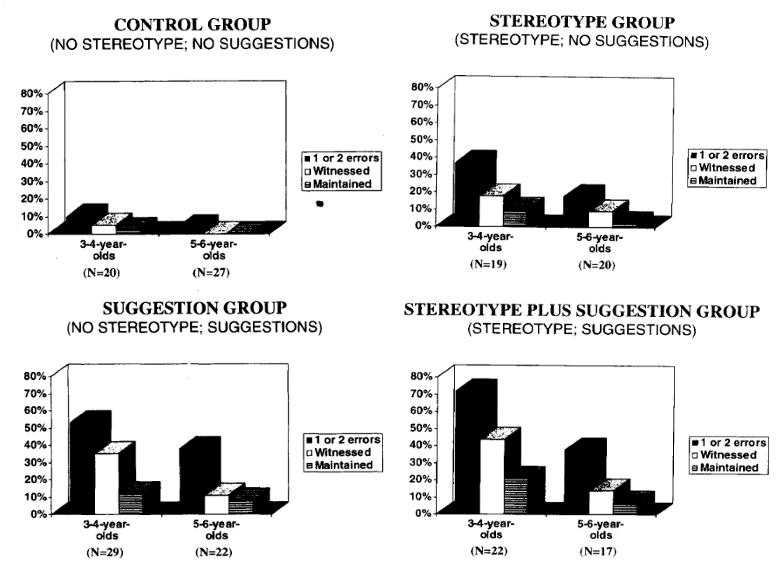
Highlights the importance of understanding how and when children’s memory storage and retrieval abilities develop.
False Mmeories 🚩🚩🚩
Broaders and Goldin-Meadow (2010)
Tested 5-7 year olds recall memory using interviews
occuring vs non-occuring
Specific vs open-ended questions
Speech alone vs speech + gesture
A musician visited the children in their clasroom, and they were interviewd about this event 2 weeks later.
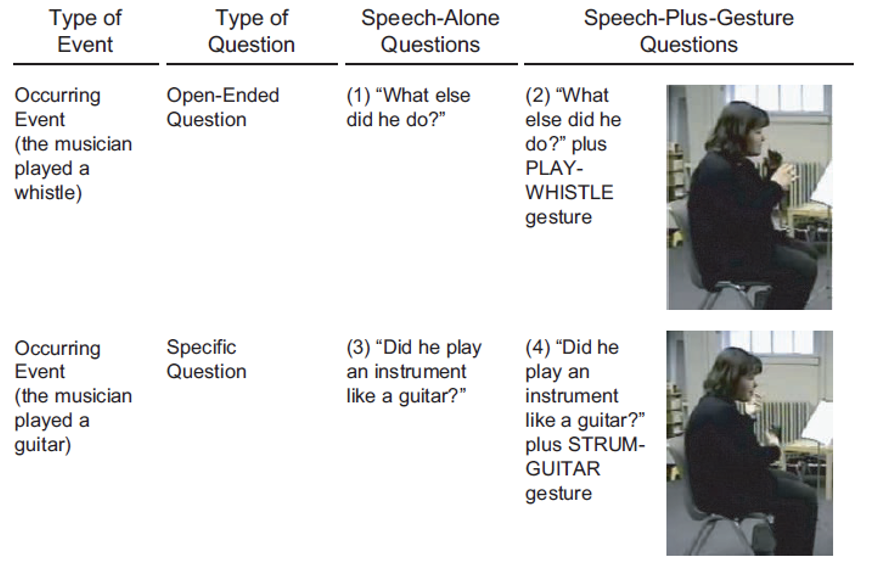
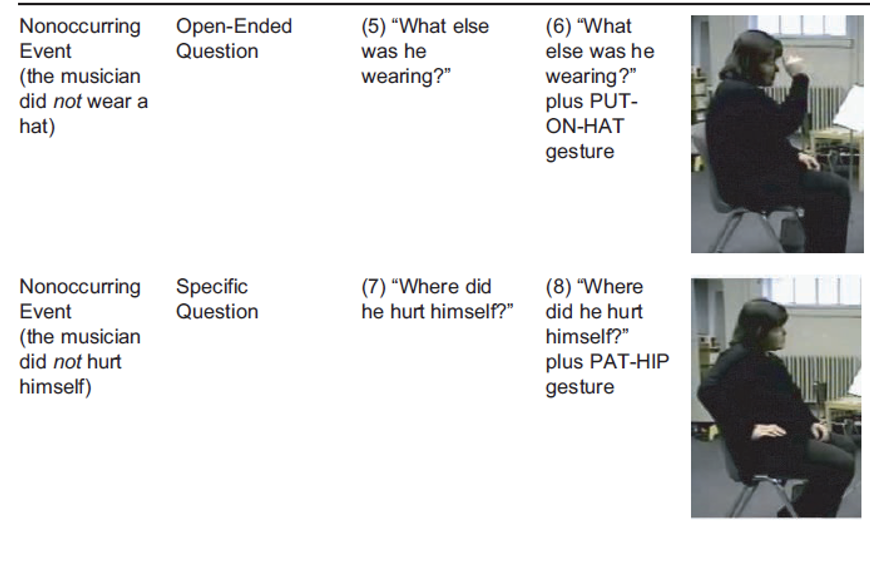
Children incorporated information into their verbal reports that was conveyed uniquely in an interviewers gestures, even when that information was misleading
These findings underscore the need to attend to gestures produced in investigative interviews, particularly interviews conducted with children
They also underscore the need to video record, rather than audio record (or simply transcribe speech), in order to capture suggestive gestures produced by the interviewer.
Symbols and System
Number systems are cultural tools that represent quantities e.g:
Recursive systems
Roman: I, II, III, IV, V, VI, VII, VIII, IX, X, XI, XII… XX… L … C, CI…
Hindu-Arabic: 1,2,3,4,5,6 etc…
Finite systems:
Oksapmin - a non-recursive, finite system: numbers are represented by body locations
Number Relations
Quantity: A property of magnitude - How many
Cardinality
Being represented by a cardinal number
Any set of items with a particular number is equal in quantity to any other set with the same number
Ordinality
Numbers come in a serial order of magnitude
Transitive inferences are possible
Perceiving number
Starky and cooper (1980): can 4 month olds perceive number?
Method
Habituation procedure + looking time and measure
Small number vs large number
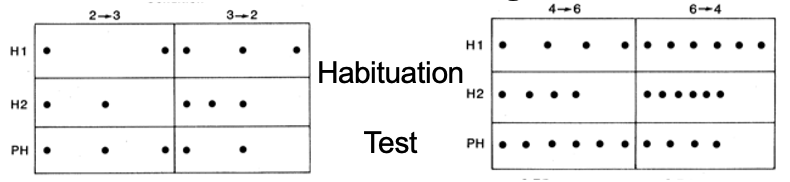
Reults
Infants dis-habituated (looked longer) on smaller number trials
Cardinality → the two sets of dots are not equal in quantity
Conclusions:
Infants discriminate difference between small quantities
Infants are born with the ability to understand number
Adding and Subtractin
Wynn (1992): tested 5-month olds knowledge of mathematical operations: addition and subtraction
Method: violation of expectation study
e.g. a toy was placed behind a screen then another added to it
Compared looking time when screen lowered
For possible outcomes (2 toys behind the screen)
or impossible outcomes (1 toy behind the screen)
Results:
Infants were surprised (looked longer at) by impossible outcome
Conclusions:
Infants understand mathematical operations
infants have innate number structures
Alternative explanations: Wynn’s (1992) results could be based on change detection
Impossible outcome is the same as starting point - 1 toy and infants’ surprise could be related to expecting a change
Mixed success in replication of these results
Limited to small numbers: < 3
Children do not show understanding of 2+2=4 until 3-5 years
perception results limited to small numbers too.
Is number knowledge innate?
Alternative explanations: Infants results could be based on perceptual features
Number needs to separated from continuous dimensions of sets: area, contours etc.
Infants may perceive difference between continuous quantity not precise number relations
Xu and Spelke (2000): tested 6 month old infants’ discrimination of large number
Method:
Habituation procedure - sheets with dots
8 dots, 12 dots or 16 dots
Test
Discrimination of a change in number
8 Dots → 16 dots
8 dots → 12 dots
Longer looking to new number.
Results:
Infants discriminated large differences - 8vs16, NOT 8 vs 12
Infants’ perceptions is based on approximate representations not exact number
Perceptual processes may account for the effects
Approximate estimation - perceiving difference between large sets
Subitising - small numebr of discrimination without counting
How do we count?
Abstract counting vs object counting
Abstract counting → reciting number sequences
Object counting → determining a quantity
2.5 year old counting 1-10 in 10 languages
Is that abstract or object counting?
What does this tell us about number knowledge?
Gelman’s counting principles
How to count principles;
One-to-one: count each item in a set once and only once.
Stable order: produce the number words in the same set order (ordinality)
Last number: the last number counted represents the value of the set
Other principles:
Order irrelevance: the order in which items are counted makes no differences
Abstraction: the number in the set is independent of the qualities of the members.
Gelman’s counting principles:
Gelman and Gallistel (1978):
Do children observe counting principles?
Nativist approach → children are born with counting principles
2-5 year olds counted sets of 2-19 items, tested:
Counting sequence
one-to-one correspondence
last-number significance
Children were accurate with small sets
Understand counting principles
Children made errors with larger sets
Attributed to performance errors 🚩🚩?
Children recognise counting erros made by a puppet 🚩🚩🚩
Children recognise unusual but correct procedures
Carey’s Individuation hypothesis (2004)
Children gradually developn number understanding through combination of innate knowledge and experience
one learning mechanism is: Parallel individuation. Infants recognise and represent small numbers exactly.
Children first recognise ‘one’ → ‘one knower’.
Then recognise ‘one’ vs ‘two’ → ‘two knower’ etc.
Children gradually develop number understanding through combination of innate knowledge and experience
Enriched parallel individuation: children learn larger numbers, bootstrapping from counting.
Learning the count list teaches them that quantities extend beyond ‘three’ and helps children discriminate larger numbers
Comparing sets
Number words imply relationship between sets
Cardinality: any set of items with a particular number is equal in quantity to any other set with the same number
According to Piaget, understanding cardinality key to understanding number
Greco (1962): Conservation tasl
Test 4-8 olds on three tasks:
Classic conservation
Classic conservation + counting 1 set
Classic conservation + counting both sets
Are the sets equal?
easier to understand version of lecture:
So this lecture covers two big topics — memory development and number development — and both are really about the same underlying question: how much do children know, and when do they know it? Let's start with memory.
The lecture opens by looking at recognition memory, which is basically the ability to identify something you've encountered before. Remarkably, even before babies are born, they already show signs of recognising familiar sounds — there's research from DeCasper (1994) suggesting prenatal recognition of auditory stimuli, which is pretty wild to think about. Newborns can also habituate to repeated shapes and notice when something new appears. A study by Morgan and Hayne (2006) looked more closely at how both the speed of encoding (how quickly you take in information) and retention (how long you hold onto it) develop with age. They tested one-year-olds and four-year-olds by showing them something for different amounts of time — 5, 10, or 30 seconds — and then tested whether they remembered it immediately, after 24 hours, or after a week. The results showed that one-year-olds could recognise something immediately if they'd seen it for 10 seconds, and could hold onto it for over 24 hours if they'd had 30 seconds of exposure. Four-year-olds only needed 5 seconds to recognise it immediately and after 24 hours, and with 10 seconds of exposure they could remember it for over a week. The takeaway is clear: as children get older, they encode information faster and retain it for longer, and the more time they spend with something, the better they remember it.
Recall is a step harder than recognition — it's not just spotting something familiar, it's actively pulling something from memory without it being right in front of you. One way researchers test recall in babies is through deferred imitation — watching whether a baby can copy an action they saw some time ago, which is evidence that they both remembered and retrieved it. Herbert et al. (2006) tested this in 6 and 9-month-olds by having an experimenter demonstrate an action, and then testing whether babies could copy it immediately or after a 24-hour delay. Six-month-olds could copy it straight away but not after 24 hours. Nine-month-olds could do both. Again, this shows that both recall ability and the ability to hold onto a memory for longer get better as babies get older.
A follow-up study by Herbert (2011) added another interesting layer — the role of verbal cues in memory. This experiment involved a puppet with a mitten, and the experimenter demonstrated removing the mitten, shaking it (so a hidden bell rang), and putting it back — doing this three times. Some babies heard narration that described the actions ("look — a puppet! shake!"), some heard empty narration ("oh wow, look at this!"), and some had no verbal cues at all. When tested 10 minutes later with a new puppet, babies who had heard the action narration remembered more of the sequence. This tells us two important things — firstly, that by around 12 months, babies are developing more flexible memory (they can transfer what they learned to a new object), and secondly, that words and verbal cues genuinely help lock memories in. Language and memory are already working together in the first year of life.
Now, you might have noticed that most people can't remember anything from before around age 3 or 4. This is called childhood amnesia, and it's a genuinely fascinating phenomenon. The leading explanation is the language acquisition hypothesis — the idea that very early memories are stored in a non-verbal way, and once children develop language and start encoding memories verbally, those pre-verbal memories become inaccessible. It's essentially a translation problem: the early memories are in a format that the older, language-using brain can't read. Simcock and Hayne (2002) tested this beautifully by having 2, 3, and 3.5-year-olds experience a fun event involving a "magic shrinking machine." When children were asked about it 6 months or a year later, their non-verbal memory was actually pretty good — they could recognise photos and perform the right actions. But when they tried to describe it verbally, they only used words that had been in their vocabulary at the time of the original event, not words they'd learned since. So their language development hadn't "upgraded" the memory — it was frozen in the vocabulary they had when it was formed. A follow-up study by Dahl et al. (2015) replicated this, but found something interesting — when the machine was physically present again as a cue, 80% of children started using newly acquired words. So context can help. This raises the question of whether early memories are truly lost, or whether they're just very hard to access without the right cues. Recent research suggests the hippocampus (the brain structure most associated with memory) does start encoding experiences from around age 1, and that what happens after memories are formed — things like how caregivers talk to children about past events — plays a big role in whether those memories survive. Parents who engage in reminiscing ("remember when we went to the park?") actually seem to help children develop better verbal memory.
Closely linked to memory is knowledge development. The more you already know about something, the easier it is to remember new information about it. Think about it — if you know nothing about football, watching a match is just a confusing blur. But if you're a football expert, everything fits into a framework you already have. Schneider and Bjorklund (1992) demonstrated this with children — football experts recalled more football-related items than non-experts, but there was no difference between the groups for unrelated items. So it's not that experts have better memory in general — it's that their existing knowledge helps them make sense of and hold onto new information in that specific domain. This links to the concept of scripts — mental frameworks for familiar events. When you go to a restaurant, you don't have to consciously remember every step of what happens; you have a script for it (sit down, get a menu, order, eat, pay). Scripts free up mental resources because you don't have to encode every detail — you just fill in the gaps. As children get older and have more experiences, their scripts become more detailed and nuanced.
Another aspect of memory development is the use of mnemonics — little tricks for remembering things, like grouping items into categories, repeating them, or creating associations. Young children don't tend to use these strategies spontaneously before around age 8 to 10, but with age they become increasingly sophisticated in how they approach memorisation. Linked to this is metamemory — knowing how your own memory works. Even 5-year-olds have some grasp of this: they know, for example, that a long list is harder to remember than a short one. Declarative metamemory is a step further — knowing when and how to use specific strategies — and this also develops over time. Interestingly, having good metamemory and having good memory are related, but researchers haven't fully settled on which one drives the other.
All of this has real-world implications for children as eyewitnesses. Memory clearly improves with age, and older children give more and better-quality recall. But children — especially younger ones — are also quite susceptible to suggestion. They can be influenced by stereotypes, by how questions are worded, by social pressure to please adults, and by being asked the same question repeatedly. Leichtmann and Ceci (1995) showed that when preschool children were interviewed about a neutral event five times with suggestive questions, false memories increased with each round of questioning — though this was worse for younger children. Another important study by Broaders and Goldin-Meadow (2010) found something particularly striking: when interviewers used gestures that implied things that hadn't actually happened, children incorporated that misinformation into their verbal reports — even when the gesture contradicted what was said out loud. This has serious implications for how investigative interviews with children are conducted. It highlights why interviews should be video-recorded (not just audio-recorded or transcribed), because the gestures of the interviewer matter just as much as their words.
Now onto the second half of the lecture — number development. The lecture starts by pointing out that number systems are cultural tools. Different cultures have developed different ways of representing quantities. Some systems are recursive and can go on infinitely (like our Hindu-Arabic system: 1, 2, 3, 4… you can always add one more). Others are finite — like the Oksapmin system, where numbers are represented by pointing to different body locations, and the system stops when you run out of body parts.
When thinking about number, there are two key concepts to understand. Cardinality means that any group of, say, four things is equal in size to any other group of four things — the number tells you the total quantity. Ordinality means that numbers come in a fixed order — 3 is always more than 2, and less than 4 — and you can make logical inferences from this (if A > B and B > C, then A > C).
So do babies understand number? Starkey and Cooper (1980) tested 4-month-olds using a habituation procedure — showing them sets of dots until they got bored, then showing them a different number of dots. Babies looked longer at the new number, suggesting they noticed the change in quantity. This indicates that even very young infants can distinguish between small quantities, which led researchers to suggest that some basic number sense might be innate.
Wynn (1992) pushed this further with a violation of expectation study on 5-month-olds, testing whether babies understood basic addition and subtraction. A toy was placed behind a screen, then another was added — and when the screen was lowered, the baby either saw the correct result (two toys) or an impossible result (one toy). Babies stared longer at the impossible outcome, suggesting they expected two toys. This is a striking finding — it implies babies understand that 1 + 1 = 2. However, there are good reasons to be cautious. One alternative explanation is change detection — the impossible outcome (one toy) looks the same as the starting point (one toy), so babies might just be surprised that nothing changed, rather than doing actual arithmetic. Replication of these results has also been mixed. Additionally, both the perception and arithmetic results seem to be limited to small numbers (fewer than 3 or 4). Children don't reliably show understanding that 2 + 2 = 4 until they're between 3 and 5 years old.
There's also a broader question about whether what babies are actually perceiving is number specifically, or just general perceptual features like the total area or density of a set of objects. Xu and Spelke (2000) tested whether 6-month-olds could discriminate large numbers. They found that babies could tell the difference between 8 and 16 dots (a 2:1 ratio), but couldn't distinguish 8 from 12 (a 3:2 ratio). This suggests that babies' numerical perception is approximate rather than exact — they're not counting, they're estimating, and they need a big enough difference to notice it. This is sometimes called the Approximate Number System. For small numbers (up to about 3 or 4), babies may use a different process called subitising — instantly perceiving a small quantity without counting — rather than genuinely understanding number in the way we do.
The lecture then makes a nice distinction between abstract counting (just reciting numbers in order — "one, two, three, four…") and object counting (actually using numbers to figure out how many things there are). A child who can rattle off numbers in ten languages is impressive, but that doesn't necessarily mean they understand what those numbers mean. Gelman and Gallistel (1978) proposed five principles that underlie genuine counting. The one-to-one principle says you count each item once and only once. The stable order principle says you always say the numbers in the same order. The last number principle says the final number you say represents the total size of the set. The order irrelevance principle says it doesn't matter which item you start counting from — you'll end up with the same total. And the abstraction principle says you can count anything — toys, sounds, ideas — the counting rules apply regardless of what you're counting. Gelman found that children as young as 2 to 5 years could follow these principles accurately when counting small sets, though they made more errors with larger ones. Crucially, children also recognised when a puppet was counting incorrectly, and even recognised when a puppet was counting in an unusual but technically correct way — suggesting they understood the principles at some level, not just the procedure.
Carey's individuation hypothesis (2004) offers a neat account of how number understanding builds up gradually. The idea is that children start by being able to represent small numbers exactly — they recognise "one" as distinct from "more than one," then "two" as distinct from "one" and "more than two," and so on. This process, called parallel individuation, happens one number at a time. From there, children bootstrap their understanding — using the count list they've learned to extend their grasp to larger and larger numbers. It's a combination of innate capacity and experience, with each piece building on the last.
Finally, the lecture touches on the role of understanding cardinality in comparing sets — something Piaget thought was crucial to understanding number. Piaget argued that truly understanding number requires understanding that two groups with the same count are equal in quantity, regardless of how they look. A classic conservation task (Greco, 1962) tested this by asking children aged 4 to 8 whether two sets were equal, under different conditions — just looking at them, counting one set, or counting both sets. Whether counting helps children make the right judgement about equality gets at a deeper question about whether children understand what counting is actually for, and whether they can connect their counting ability to their broader understanding of quantity.
So to pull it all together — both memory and number understanding develop significantly across early childhood, and in both cases there's a fascinating tension between what seems to be present from very early on (even in infancy) and the slower development of the ability to apply and act on that knowledge in real situations. Sound familiar? It's the same pattern we saw with object permanence — early knowledge, but a long road to full competence.