Cell Communication & Differentiation
Key Terms
Endocrine - Through the bloodstream to distant cells or organs
Paracrine - Diffuses through nearby tissue to nearby cells
Autocrine - Acts locally on the same cell.
Growth factors - Proteins that stimulate cells to grow, divide, survive & differentiate. They bind to receptors on the cell surface and trigger signalling pathways
Death signals - Chemical signals that instruct a cell to undergo programmed cell death
Cell-cell contact - Direct communication between neighbouring cells through physical contact using specialised proteins on their surfaces
Cell - extracellular matric contact - occurs when cells attach to the extracellular matrix (ECM), the network of proteins (such as collagen and fibronectin) surrounding cells.
Ligands - Signalling molecules - a molecule or ion that attaches to another atom or biological molecule through a specific interaction or bond.
Second Messenger - Mall molecule inside the cell that carriers the message onward.
Kinases - Attach to phosphate groups to a target proteins
Phosphorylation - Target protein changes the protein structure leading to a change in activity.
Phosphatases - Class of enzymes that reverse phosphorylation by removing the phosphate groups
Cell Communication
Why is it needed
Cells need to be interconnected and function in a coordinated manner to ensure proper functioning of tissues and organs
Key concepts
molecular recognition
Molecular switches
Signal amplification
Types of stimuli
Growth factors
Death signals
Dell-cell contact
Cell - extracellular matric contact
Hormones
Light (Photons)
Odorants
Touch
Oxygen levels
pH
Magnetic fields
Growth factors - Proteins that stimulate cells to grow, divide, survive & differentiate. They bind to receptors on the cell surface and trigger signalling pathways
Death signals - Chemical signals that instruct a cell to undergo programmed cell death
Cell-cell contact - Direct communication between neighbouring cells through physical contact using specialised proteins on their surfaces
Cell - extracellular matric contact - occurs when cells attach to the extracellular matrix (ECM), the network of proteins (such as collagen and fibronectin) surrounding cells.
Types of Direct Cell-Cell Signalling
Signalling by secreted molecules
Endocrine - Through the bloodstream to distant cells or organs
Paracrine - Diffuses through nearby tissue to nearby cells
Autocrine - Acts locally on the same cell.
Most cell communication involves the activation of specific receptor proteins via Ligands
Located in the plasma membrane.
Upon reception of a signal, the receptor is activated and transmits the signal into the cell
via a series of switches/relay molecules, called signal transduction, leading to a cellular response.

Reception of Signals
Most cell communication involves the activation of specific receptor proteins.
these are located in the cell membrane
receptors act as sensors that receive environmental cues and initiate a response within the cell.
Signal → receptor → intracellular signaling → cellular response
Types of receptors
lipophilic ligand → nuclear receptor
Matric - associated ligand
cell-matric adhesion receptor
cell adhesion molecule
nuclear receptor
Soluble ligand receptors
transporter
ion channel
G-protein coupled receptor
Enzyme-linked receptor
Receptor activation
Second Messenger - Mall molecule inside the cell that carriers the message onward.
Kinase - Adds phosphate
Phosphatase - Removes phosphate
Adding/removing phosphate can act like changing a protein's activity switch.
This change in the receptor acts as a signal for other enzymes to be recited to the receptor, allowing the signal to be relayed to other enzyme which amplifies the signal and pass it further into the cell
Receptor | Goes through second messenger? | Goes through kinases/phosphatases? | Main outcome |
|---|---|---|---|
GPCR | Usually ✅ | Usually ✅ | Many types of cellular responses |
Enzyme-linked receptor | Sometimes | Usually ✅ | Growth, metabolism, gene expression, etc. |
Ion channel | Usually ❌ | Not necessarily | Rapid ion/electrical changes |
Cell-matrix adhesion receptor | Sometimes | Often ✅ | Cytoskeleton, adhesion, survival |
Cell adhesion molecule | Sometimes | Often ✅ | Cell-cell communication/organization |
Nuclear receptor | ❌ | ❌ usually | Direct changes in gene expression |
Signal transduction
Cells have different receptor molecules as they don’t know what signals they may encounter.
- Signal amplification vis second messengers allows a weak signal to be amplified so that the cell can respond rapidly.
Examples of second messengers:
Cyclic AMP
Cyclic GMP
Inositol trisphosphate
Diacylglycerol
Calcium
Example Pathway - (Epinephrine signalling pathway)
Epinephrine binds to GPCR causing it to change shape.
G protein is activated which in turn activates adenylyl cyclase
adenylyl cyclase is activated and converts ATP to cAMP
cAMP is produced
Protein kinase A is activated which activates phosphorylase kinase
Phosphorylase kinase activates glycogen phosphorylase
glycogen phosphorylase breaks down glycogen
stored carbohydrate is mobilised so the cell can use it to help provide energy
Epinephrine → GPCR → G protein → adenylyl cyclase → ATP → cAMP → PKA → phosphorylase kinase → glycogen phosphorylase → glycogen breakdown → glucose-1-phosphate

Responding to signals
Kinases - Attach to phosphate groups to a target proteins
Phosphorylation - Target protein changes the protein structure leading to a change in activity.
Phosphatases - Class of enzymes that reverse phosphorylation by removing the phosphate groups
Post - Translational modification
Example - Protein phosphorylation
Addition of negative charged from the phosphate group to a protein can have significant effects on protein structure, leading to a conformational change
This typically occurs on - Serine, Threonine or tyrosine amino acids
Cellular Response - Insulin
when the insulin receptor binds insulin
the activated receptor phosphorylates the IRS-1 protein
IRS-1 can lead to recruitment of GRB2
activating the RAS pathway
IRS-1 activates PI 3 - kinase which catalysis the addition of a phosphate group to the membrane lipid PIP2
Converting PIP2 to PIP3
PTEN can convert PIP3 back to PIP2
PIP3 binds a protein kinase called AKt, which is activated by other protein kinases
AKt catalysis phosphorylation of key proteins, leading to an increase in glycogen synthase activity and recruitment of the glucose transporter
GLUT4 to the membrane
Dealing with multiple signals

Cell Differentiation
Each cell of the body ( expect from some exceptions) contain the same instructions as all the other cells.
Examples of specialised cells:
Bone ( osteoclasts and osteoblasts)
Venom Glands, duct and venom secreting cells
Eyes (light sensing cells, nerves, blood vessels, muscles, cornea)
chemical sensing cells (pit organ)
Epithelial cells ( lining of the mouth, scales)
muscle, nerves, blood vessels
Stem Cells
How do they develop
Mitosis produces 2 identical daughter cells
Differentiation - turning an undifferentiated , generalist cell (a stem cell ) into a differentiated, specialised cell.
Stem cells are capable of producing many types of differentiated cells
cell division is asymmetric - producing 2 different daughter cells
All stem cells are capable of self-renewal, but some are able to produce a wider range of cell types than others.
Types of Stem Cells
Totipotent - capable of producing any type of cell
Pluripotent - capable of producing any cell within a major lineage
Multi-potent - capable of producing a restricted set of related cells
Structure
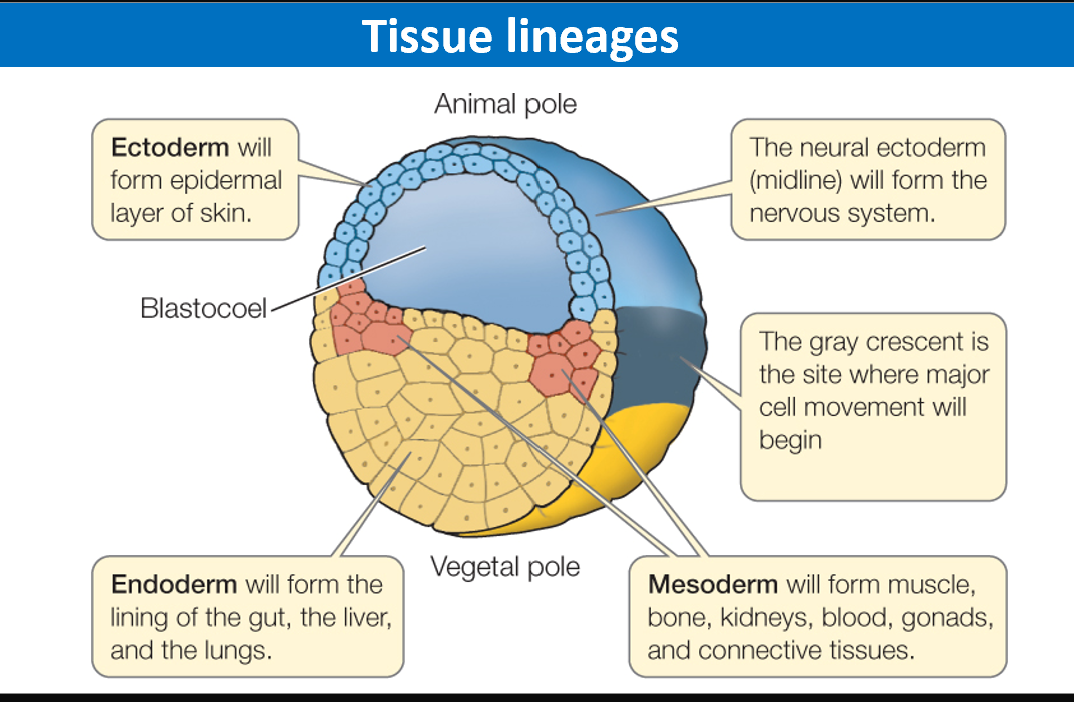
Ectoderm - associated with outer surface nervous system
Brain and spinal cord
Nervous system
Skin (epidermis)
Hair and nails
Eyes and parts of the sensory organs
Mesoderm - Support, movement and transport structures
Heart and blood vessels#
Bones
Muscles
Connective tissue
Kidneys
Reproductive organs
Blood
Endoderm - linings of internal organs
Lungs and respiratory tract lining
Digestive tract lining
Liver
Pancreas
Thyroid (mainly the follicular cells)
Parts of the urinary and reproductive systems
Stem cells receive instructions in the form of differentiation signals, telling them what type of differentiated cell to produce.
These signals are received via cell surface receptors that transmit the signal into the cell, leading to changes in gene expression.
Stem cells have multiple different receptors and when one or more receptors are activated, it starts the process of differentiation.
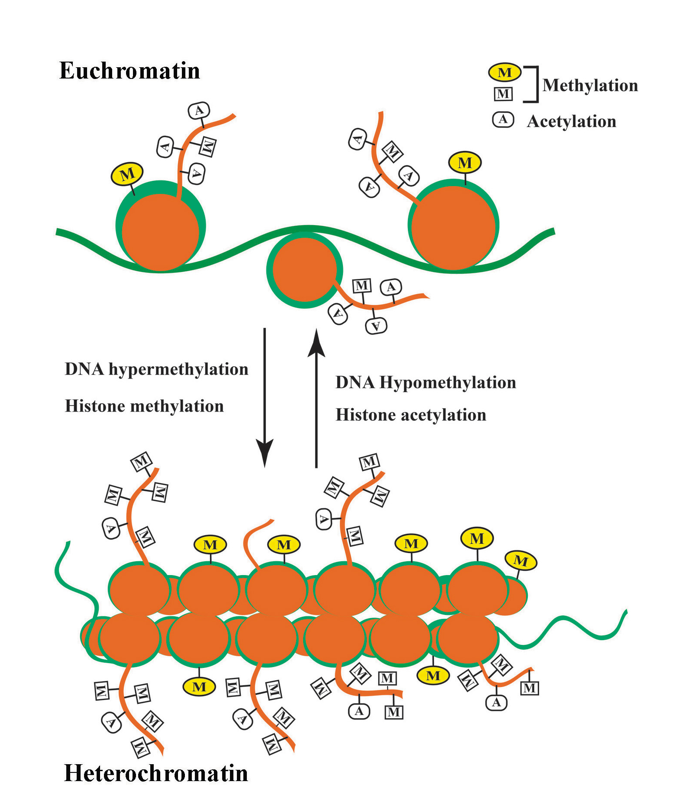
Whether a specific gene (or set of genes) is expressed or silenced can be determined by the structure of chromatin.
•Euchromatin is lightly packed, making is accessible for transcription.
•Heterochromatin is tightly packed, making it difficult to transcribe genes in this region.
In stem cells, most of the DNA is found as lightly packed euchromatin, meaning that almost all of the genes are available for transcription.
As cells become differentiated, more and more genes become silenced in heterochromatin regions and only those needed to carry out the cell’s specialist function remain accessible in euchromatin.
Epigenetics
The switch between euchromatin and heterochromatin is controlled by enzymes that can attach methyl or acetyl groups either directly to DNA or to histone proteins that bind to DNA.
•DNA methylation silences genes
•Histone acetylation leads to euchromatin regions and increased gene expression
•Histone methylation can either increase or decrease gene expression depending on which parts of the histone protein are modified.
These epigenetic states (DNA/histone methylation or histone acetylation) can be inherited by daughter cells following mitosis