Mollusks, Annelids, Arthropods
All phylum from here on out have a separate mouth and anus
instead of a sack like gastrovascular cavity, the digestion is in a tube like gut
tube like = alimentary canal (food coming in one way, waste coming out the other)
this is a more sophisticated process that allows for an assembly line process
specialized regions like the stomach and intestines that can do sequential disassembly of the food
All phylum from here on, except for 1, are coelomates (have a true body cavity)
lined with mesoderm
Phylum 4: Mollusks (4 key classes)
Gastropod : snails, slugs, nudibranchs, abalone
Polyplacophora : chitons
Bivalve : clams, scallops, oysters, mussels
Cephalopod : octopus, squid, cuttlefish, chambered nautilus
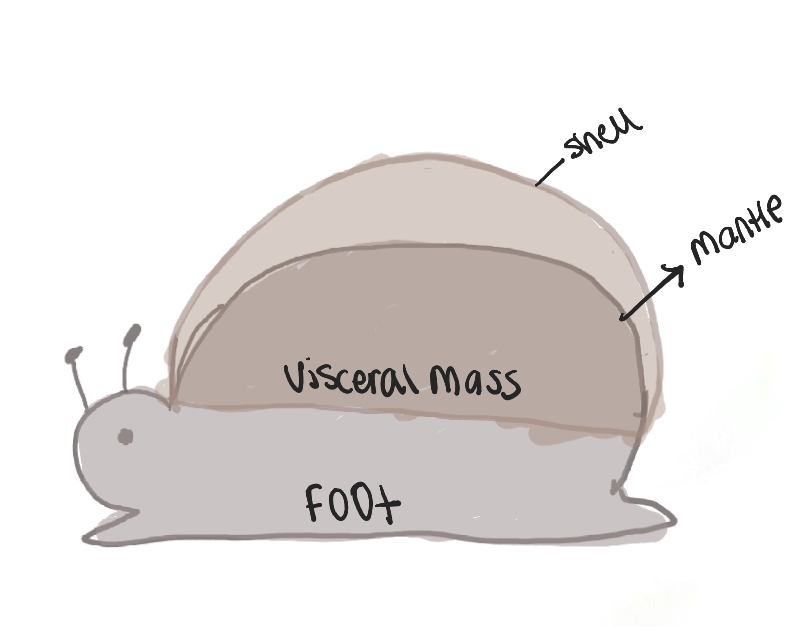
All mollusks have variation on 3 main body parts
The foot is a muscular structure that’s used for locomotion or suction (to hold on to the rocks)
muscles in the foot contract in a wave, gives them a smooth gliding motion
The visceral mass is the main central part of the body. It has most of the internal organs
Ex: gonads, intestines, heart brain, nephridia
The mantle that is a heavy tissue that drapes over the visceral mass. In most species, the mantle secretes, a calcium carbonate solution. This calcium liquid hardens and becomes the shell
Snails and many other gastropods twist their bodies (torsion). They fold back on themselves (has nothing to do with spiraling shell). Torsion means the posterior back end folds up and over the animal and forward (anus is above the head)
How do they eat?
Most mollusks (except bivalves) feed by using an organ on the tongue called radula (scraping tongue)
works like a nail file, moving back and forth to saw off pieces of food
Gastropods have either 0 or 1 shell
Chitons are similar to snails, except their shell has 8 plates
called polyplacophora (many plated)
Bivalve (2 shells or 1 shell with 2 valves. Both shells/valves are hinged on one side so that they can open and close)
bivalves don’t have a radula, they feed more like sponges (filter food particles out of the water, but in a more complex way)
filter with their gills, trap bits of food on their gills that are covered in mucus
gills have a double use, breathing and feeding
Some bivalves just sit there and filter, but some like clams and scallops can use their foot to move a little. Some clams can dig through the sand really fast
Cephalopods don’t really have a shell (although squids do have an internal one)
the only one with a good shell is the chambered nautilus
has 0 or 1 shell
they have complex brains (probably most intelligent vertebrates)
excellent eye sight
they are fast
problem solvers
capture prey using suckered arms/tentacles (modified from the foot) (help pull food towards their mouth [like the beak of a parrot]) (help with movement)
octopus prefer to stay on the bottom, squid can go around
to help them move off of the bottom, they are jet propelled (have a little syphon to squirt water out)
very good at changing their color (for camouflage and communication)
flash colors to talk to each other (sacks of pigment in skin called chromatophore)
sacks of pigment surrounded by muscles, all under nervous system control
includes most massive invertebrates (colossal and giant squids)
have a closed circulatory system (blood is always staying within the blood vessels, blood can stay under higher pressure)
flow rate is faster, faster oxygen delivery, faster delivery of food, faster removal of waste
also in slow animals like annelids, but mostly in fast creatures
other mollusks and arthropods have an open circulatory system (blood is free to flow out of the vessels and into the coelom)
Phylum 5: Annelid (segmented worms)
Sedentaria : earthworms, leeches, marine filter feeders (extend fan into the water to trap tiny bits of food [ex: feather duster])
got this name because they tend to be slower
Errantia : marine animals (some hunt with sharp jaws [fireworm])
Some annelids don’t eat at all. They live around thermal vents where there are cracks in the ocean floor, exposed to the hot mantle underneath the ocean, and are fed by internal chemosynthetic bacteria.
Chemosynthesis is like photosynthesis (making sugar) but using energy of H2S
Bacteria use chemical and heat energy instead of sunlight to make their own glucose (some bacteria live inside other organisms)
Segmented worms got their name due to their body which is divided into repeated spaces.
an earth worm has lines going across its body, those are its segments
the body is divided by septa (walls that isolate chambers )
within these chambers, some organs are repeated in multiple segments
ex: nephridia (for flushing out waste) is in multiple segments
ex: multiple hearts in multiple segments
no respiratory system
They have 2 types of muscles:
circular muscles : squeeze the front end forward and the back end backward. little bristles on the bottom, they anchor the belly into the soil so the worm doesn’t slide backwards. (make them longer) (roundworms do not have circular muscles)
longitudinal muscles : travels across longitudinally. these scrunch the worm into a shorter and fatter shape (pull back end forward )
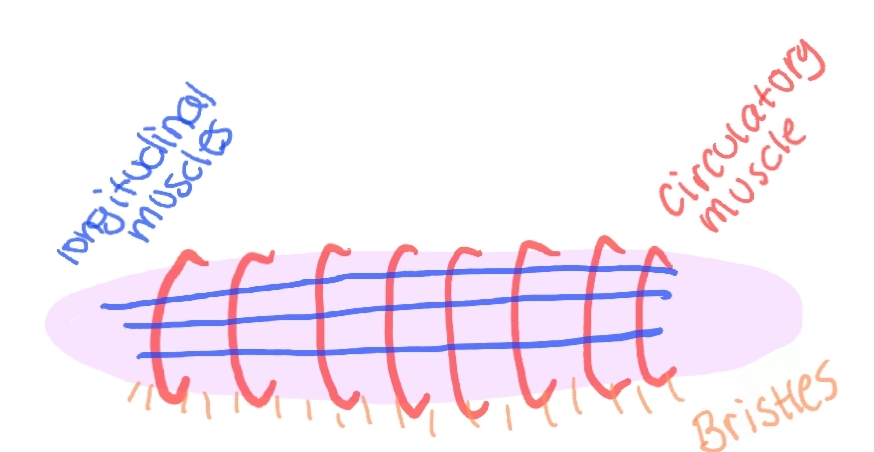
Muscle contraction in one segment doesn’t alter the pressure anywhere else. Each segment can stretch independently. The overall effect is a smooth gliding motion.
Their digestive system is sub-divided into regions
pharynx draws in dirt that earth worms eat
crop is a stomach for storing the dirt
gizzard pulverized dirt
dirt goes down long intestine, absorbing nutrients
Phylum 6: Arthropod
Chelicerates : horseshoe crabs, arachnids (spiders, scorpions, mites, ticks)
Myriapods : centipedes, millipedes (centipedes are carnivores [mildly poisonous bite], millipedes are detritivores [decomposing material])
Pan crustaceans : crustaceans(crabs, shrimp, lobsters, barnacles, microcrustaceans, krill, copepods) and insects
barnacles have feathery legs when water comes over barnacles, they are filter feeders
All arthropods have segmented bodies
head, thorax, abdomen
arthropods are cephalized
bilateral animals tend to show cephalization (good head with well developed senses)
ex: ocelli
A lot of insects and crustaceans have compound eyes (little individual working units that produce smaller dots)
each individual unit has its own lens (able to form true images)
jointed appendages (legs, mouth parts, antennae [modifications of each other])
chitinous exoskeleton (cuticle)
material that is secreted by the underlying skin
it can be molded into any shape, made hard or soft
surgeons have used this to make biodegradable surgical thread
its not only good for protection, but also for support
minimizes desiccation
helps with locomotion because it provides anchor points for muscle attachment points
All of the benefits of an exoskeleton go away temporarily during ecdysis (molting)
arthropods are one of the few phyla that molt
they’re put inside the broader clade of “ecdysozoa”
arthropods have to build gills or airways to breath
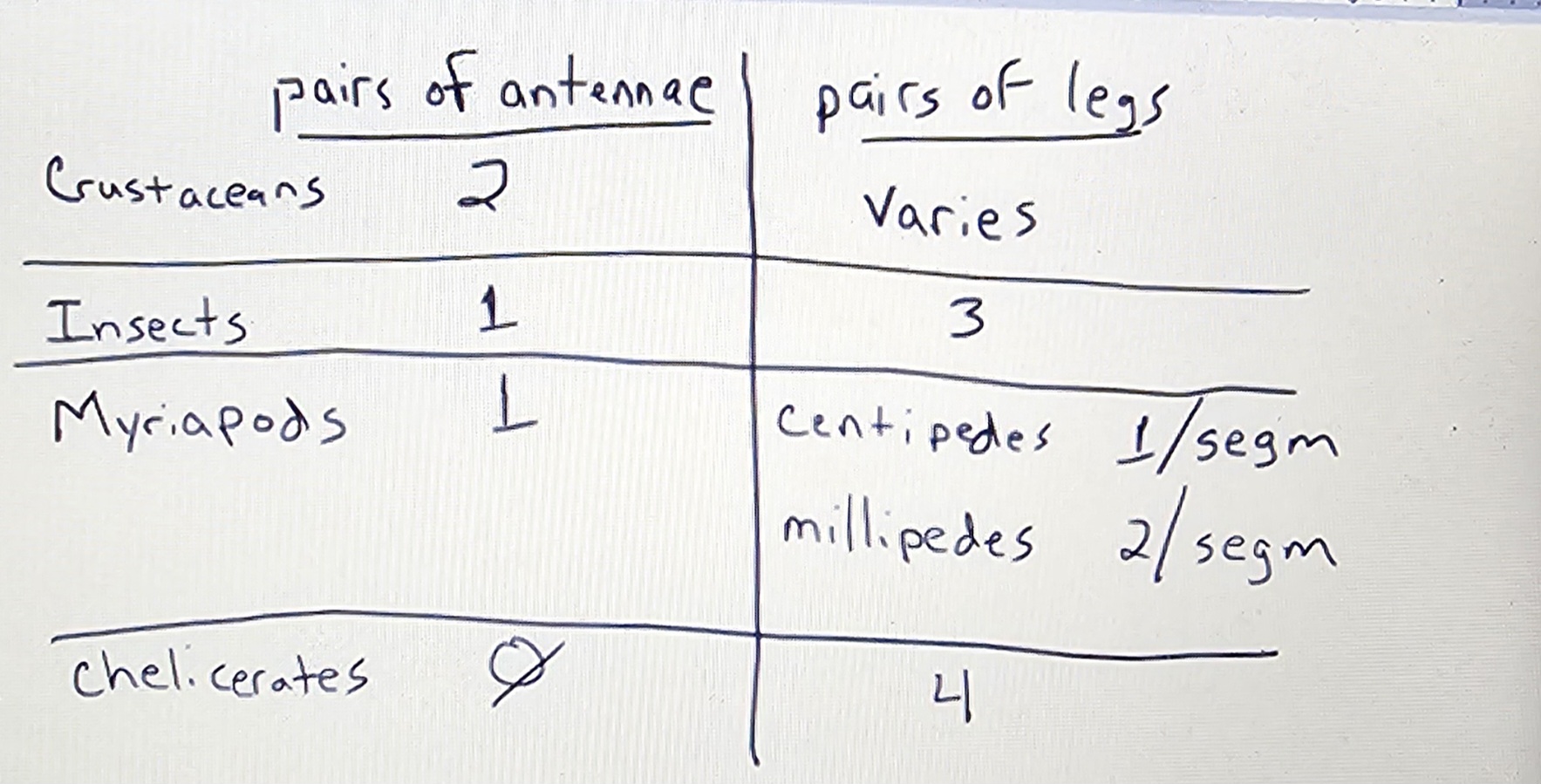
One way to distinguish the arthropod groups is to count the pairs of antennae:
Chelicerate traits:
head and thorax are fused
breathe with “book lungs” which are flattened stacked respiratory systems
get their name due to them all having chelicerae (fangs)
other arthropods use mandible to feed (more jaw like)
Crustacean traits:
head and thorax are fused
appendages are forked at the ends
Female crabs have a broad U shaped abdomen to allow them to carry eggs
Male crabs have a narrow V shaped abdomen
Insect traits:
outnumber all other animals
flight
open circulatory system
holes through skeleton called spiracles
spiracles lead to tracheae (tiny air tubes that branch everywhere)
brings oxygen to all parts of the body
can radically transform themselves when they become adults (metamorphose)
metamorphoses lessens competition between parent and offspring
metamorphoses can be hemimetabolous or holometabolous
Hemimetablous: transition to adulthood is less extreme (incomplete metamorphoses [ young individuals look similar to adults except the larvae have no reproductive organs or wings] )
ex: grasshoppers, dragonflies, termites, and true bugs
Holometabolous: transition to adulthood is more radical and abrupt
ex: butterflies, mosquitoes, bees, ants, fleas, and beetles