MATH LT#2
relations vs functions
a relation is a connection between elements in two sets
these two elements are the…
domain, the x value, the independent variable, the abcissa
range, the y value, the dependent variable, the ordinate
there are 4 types of relations
one to one (no repeating values) function
one to many (repeating x values) not a function
many to many (repeating x vales) not a function
many to one (no repeating values of x) function
different ways to express relations
ex. {(1, 1), (2, 3), (3, 5), (4, 7), (5, 7)}
domain = {1,2,3,4,5}
range = {1,2,5,7}
type of relation? many to one

a function
a rule or a machine that pairs one element in a set with exactly one in another
pairs one x to a y value.
all functions are relations, but not all relations are functions
ways to check if they are functions
through writing a roster and table
if there is no repeating x value
if it is on a graph
vertical line test.
make sure the vertical line does not pass the function in two parts
only one part.
no. if there is a hollow circle, it still passes the test.`
determining domain and range
no. if the graph has period/dots at the end of the functions

the rules of domain and range
in sets and mapping
put inside brackets
domain = {-3, -2, 0} / range = {5, 8, 10}
non horizontal linear functions
domain = (-∞,+∞) / range (-∞, +∞) any real number
horizontal linear functions (slope of 0)
domain = (-∞, +∞) / range {c}
bounded graphs (graphs with the ending wiht periods)
domain = { x | -3 ≤ x ≤ 3} / range = { y | -3 ≤ y ≤ 3}
linear functions
it is a function whos graph is a straight line
therefore, linear
qualifications to be a linear line
must follow the slope-intercept form
y = mx + b
m = the slobe / b = y intercept.
can have the variable in the numerator butnot the denominator
b intercept can be gone because it can be 0
its growth is linear, in constant the same amounts.
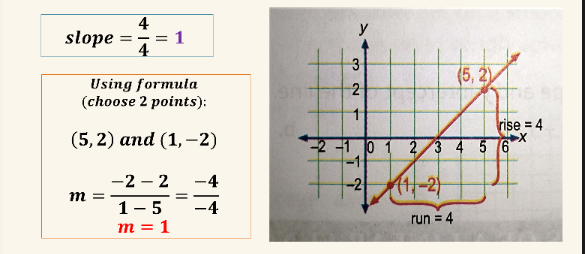
slope as a rate of change
the behavior of slopes
positive slops, left to right, upward
negative slope, left to right downward
zero slope, the slope is 0, the line is horizontal
undefined slope, the light is vertical
parallel lines, equal slopes
perpendicular lines, negative reciprocal slopes
the arrangement of linear functions
horizontal linear functions
domain = { x | x ∈ ℝ } all real numbers
range = {c} or { y | y = C} one constant
non horizontal linear function
domain = { x | x ∈ ℝ } all real numbers
range = { y | y ∈ ℝ } all real numbers
formulas
m = (y2 - y1) / (x2 - x1)
or slope = change in y / change in x
no. the larger number fraction is steeper.

zeroes of a linear function
this is where y or f(x) is equal to 0.
we are trying to solve 0 = ax + b.
this is where there slope crosses the x axis.