WEEK 1 lecture
Pages 14- 27
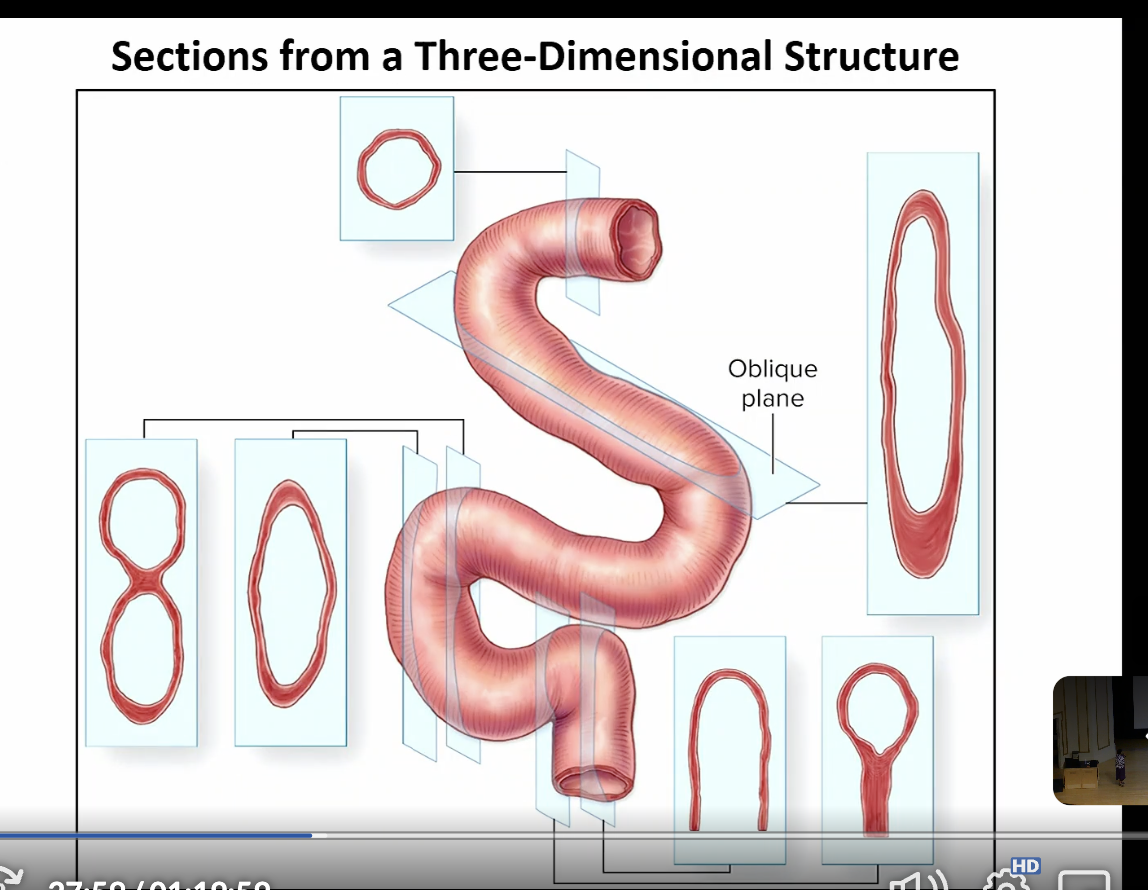
There are numerous minor planes called oblique planes that pass through a structure at an angle. we need to interpret these dimentisla imagines into three dimentual structures to compare and unerstand histlogic and gross anatomic views of the same organ.
LECTURE -
Antatomy - studies the forma and structure of the body
Physiology - examines how the body functions.
Scientific study -
DIVISIONS OF ANATOMY
microsopic anatomy - structure that cannot be observed by unaided eye
divisions:
cytology - strudy of the body cells and interal strucutre
histology - study of the tissue
Gross (microsopic) anatomy (no need for microscope)- investigates strucutre visble to the unaided eye
divisions:
Systemic anatomy - studies the anatomy of each body system ( focusing on one system at a time like the nervous system, the skeletal system, etc)
Regional anaomy - examines the strugure in a body region(looking at the head region
surface - looking at the outer areas of the interal body structures
comparitive - looking at the similarities and differences in different speciies
embryology - looking at the changes of the fetus/embryo
DIVISION: diagnosis or research
Pathological - looks at microscopic anatomic changes from diseases
Radiogrpahic anatomy - looks at interla strutures by scanning procedures
PHYSIOLOGY: details of function
Anatomy : study of structure
Sub dicisplines -
cardiovasvular - functions of the heart, blood vesels, and blood
Neurophysiology - looks at function of nervs and nervous system organs
respiratory- function of respiratory
reproductive - functiong of reproductive hromones and reproductive cycle
Patholophsiology - focuses on the function of body system during dieases or injury to the system.
STUDY TOOL -
anatomy is the study of the body structure and physiology is the study of the structures function
well u see
Cardiovascular phsiololgy examines the heart blood vessels and blood function
Anatomy and phsiology are integrated understand infromation from one to the other.
characteristics common to living things -
properties common to all organims:
organizaiton : all organizimes echibit a structure and order
Mentabolism: the sum of all chemical reactions that occur withing the boyd so like … anabolism: small molcules to form large ones
And catabolism large molcules broken down into small ones
Growth and development: organims assimilate materials from envbiromentL growth and develop
Responsibess: ability to sense and react to stimuli
regulationL ability to adjust internal odily function
homoestatsis is a sub division of regulation; the ability to maintain body structure and fucntion
reproduction - production of new cells for growth maintence
view from simplest to most complex =
chemical level: atoms, molecules, macromolcules
biologica macromolcules are proteins, carb, lipids, nucleic acids to form organelles
Cellcular level: cells, basic unit of life
tissue level: tissues, simlar cells perfroming commong function
Rogan level: orgtans multiple tissues working together
organ system level: related organs working together
Oranims level: organ systems function together to form the organism.
atoms - molcueles - macro - organel - cell - tissue - organ - organ system
11 organ systems of the human body -
integrumatry, skeletal, mucular, nervous, and endocrine
know each what system is and know what its purpose
but know also cardio, lympathic, repsitory, urinary, digestive, and reproductive
—
organ systems -
integumentary system - SKIN - provieds protection, prevents water loss and gain, syntehzies viamin d, releases secretion, regulatoes body temjpy, and houses sensory receptors.
Skeletal - bones - provide suport and protection, sies hematopoiesis (blodd cell production), stores calcium and phosphorus, provies sites for ligament and muscle attachment
Musclular systerm - body movemtns, and generates heart when muscle contracts
Nervous system - regulatory system repsonds to sesnroy stimuli, controls muscles and glands, repsonsible for consciousness, intelligence memory
endocrine - glands, cell clusters that secrete hormones for reulation of groth and mentaolism and development, maintin blood composition and volume, controls digestive processes and regulate repodutive functions
cardiovasuclar. system - consist of the heart and blood vessles that move blood through vessels to distrubute nutrients, hormones, gasses, and pick up waste
lymphatic system - transports and filters lympth ( intersttial fluid that collected in and trampoter through lymp vessels) participate in an immune reponses
resporaotyr - echange of gasses ( o2 and co2) between blood and hte air in the lungs
circulation - bv- heart- bv
urinary - filters blood to remove waste products, concentrates waste
digestive - mechanimall and chemically digest food, absorbs nutrients, expells waste
Reproductive - gonands (testes or overies) produce sex cells ( sperm or oocytes) and sex horomnes (andogen, estrogen, progesterone).
Anatomic position - uprught, feet parallel , flat, upper limbs at the sides, palms facting anteriorly (front) head is levele eyes forward. falms facing towards the front
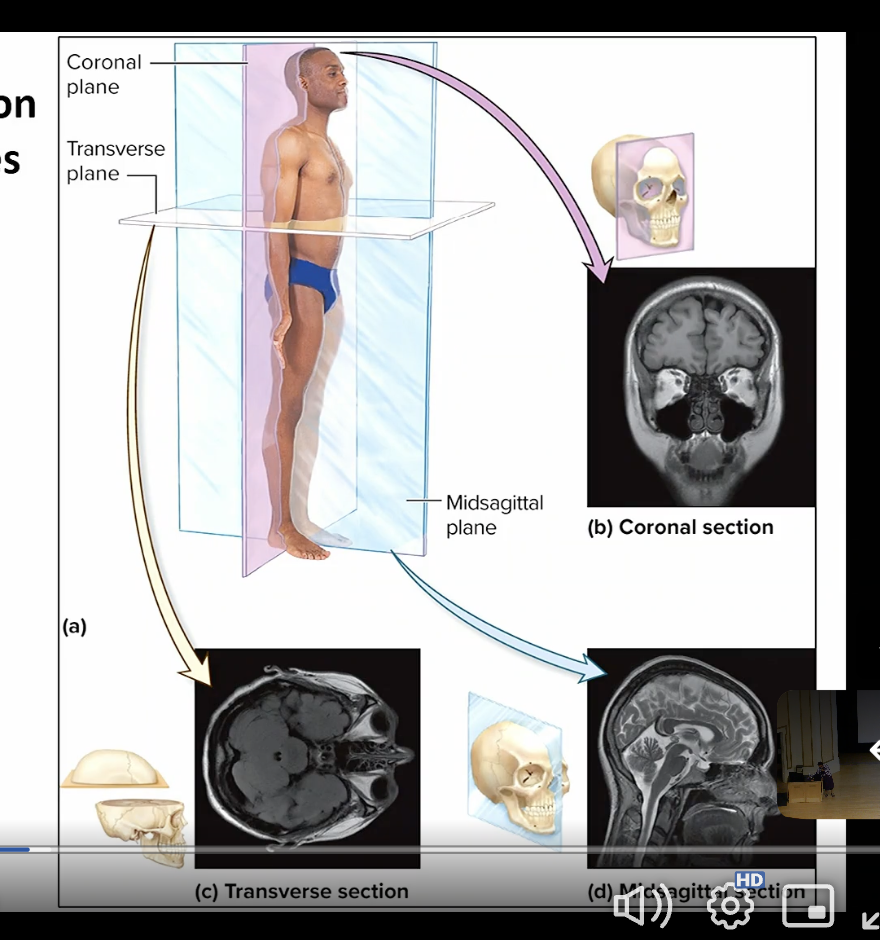
Slices of the body is calledsections or planes -
section is a cute or slice that exposes interal anatomy
SECTION - Internal atomogy
Plane is the iamgery flat surface passing through body ; three types
coronal plane (front) - dividing the body between anterior (front) and posterior (back)
Transverse (cross sectional) plane - horizontal plane divising the superior (top) and inferior (bottom)
Midsagittal (medium) plane - vertical plan diving the body into the right halve or left halve. (equal!!!)
Sagittal plane: paralle to midsagital - unequal
oblique plane - passes through strucutre at an angle
anterior is the FRONT surface
Posterior is the BACK surface
ventral is the Front inside
dorsal is the back inside
Superior is closer to the head (top)
inferior is the closer to the feet (bottom)
Carnial (towards the head end)
Caudal (towards the rear end)
rostral - towards the nose or mouth
medial - towards center of body
Lateral - away from center of body
proximal - is going up the body from feet to head
distal - going down the body from head to feet
regional anatomy - human body is partioned into two main regions -
axial - head, nefck, andtrunk vertical acis
and appendicular regioni s the upper and lower limbs