GAT / Quadrat Tricks
Tricks and Tips to easily solve the GAT questions quickly without wasting time. There will be questions at the end for practice with the answer and explanation
★ positives and negatives
these are really important to know in the GAT quantitative because of how often they show up (mostly negative numbers to mix you up)
positive x positive = positive
positive x negative = negative
negative x positive = negative
negative x negative = positive
a negative number² = positive
any number to the power of 0 = 1
★
positive + positive = positive
negative + negative = negative
positive + negative = the sign of the bigger number
negative + positive = the sign of the bigger number
★ formulas to remember:
formula for rows/seats: (b+a)-1
formula for amount of pages: (b-a)+1
formula for finding amounts of numbers between two other numbers (how many numbers are between # and #?): (b-a)-1
a - b / b - a = -1 (this formula shows up a lot in comparison questions)
distributive property: y(b) + y(a) = y(a+b)
circumference of a circle: 2() r
area of a circle: ( )r²
area of a square: s² or a²
area of a triangle: ½ bh
area of a parallelogram: b(h)
sum of angles in a polygon: 180(n-2)
perimeter: add up all the lengths of the sides of the shape
negative number to the power of an even number: positive
negative number to the power of an odd number: negative
★ prime numbers
numbers thats factors are only 1 and itself
2, 3, 5, 7, 11, 13, 17, 19, 23, 29, 31, 37
91 is not a prime number
101 is a prime number
2 is the only even prime number (so an easy way to go back to prime numbers is to remember them as all odd except 2)
★ tricks/things to remember with questions
★ hidden zeros (memorize):
2 ⋅ 5 = 10
4 ⋅ 25 = 100
8 ⋅ 125 = 1000
example question (hidden zeros):
4 ⋅ 5462 ⋅ 25
A. 5462000 B. 56400
C. 546200 D. 54620
explanation: notice how 4 and 25 are present in the problem, since we already know that 4 × 25 = 100, all we need to do is add two more zeros to 5462 to get our answer
answer: C. 546200
.
★ the ones digit of a large number with an large exponent:
when asked the ones digit of a big number, the answer is always the ones place of the base if the ones place of the number is 0, 1, 5, 6.
example question:
find the ones digit the number of 786^87
A. 4 B. 6
C. 8 D. 7
explanation: since this number is too big to solve/display, just remember that if the base is one of the numbers mentioned above, the ones digit of the base won’t change. so in this case, the answer is 6.
answer: B. 6
.
★ finding the average in a graph/set:
to find the average when given a graph or set, remember to always add up all the numbers and get the sum, then divide the sum by the total count of numbers in the set.
example question (it’s not letting me add a graph or set so i’m writing it manually):
the number of studying hours for sameh and majed throughout 5 days
name day sun mon tue wed thur
sameh 7 5 7 2 3
majed 4 5 6 7 2
find the average number of studying hours for sameh and majed:
A. 1:2 B. 2:1
C. 1:1 D. 2:3
explanation: solve as mentioned above; add up all the numbers and get the sum
(sameh: 7 + 5 + 7 + 2 + 3 = 24)
(majed: 4 + 5 + 6 + 7 + 2 = 24)
in this case, we won’t divide by the numbers in the set though since the given choices of answers are ratios. so we simply find the difference between both sums (none between sameh and majed since they are equal) and apply it as a ratio.
answer: C. 1:1
.
★ to find the shaded area:
when given a question to find the shaded area, it may look confusing and even scary to solve. but these are quite easy once you get the hang of it.
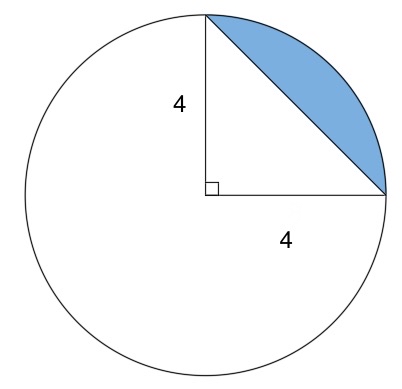
in the given circle, the shaded area is…
A. 2 - 3 B. 4 - 8
C. 4 - 2 D. 16( - 2 )
explanation: if there’s one thing you should notice about this picture is that the right triangle inside it takes up ¼ of the circle. this lets us know that, when solving, we should multiply ¼ by the area of the circle.
first step is to find the area of the circle, a = r²
a = (4)² = 16
16 ⋅ ¼ = 4
then find the area of the triangle, a = ½ (bh)
½ (4⋅4) = ½ (16)
½ (16) = 8
last, you minus the area of the circle and the area of the triangle to find the shaded area.
answer: B. 4 - 8
.
another ‘find the shaded area’ question:
find the shaded area of the black filled in spots (the bottom left corner is supposed to be filled in for this question):
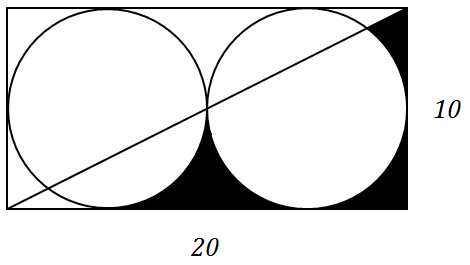
A. 100 B. 314
C. 100 D. 100 - 25
explanation: this question is similar to the previous one, you just need to minus the area of a circle from the area of a triangle
minus the area of the circle and triangle: r² - ½ (bh)
what might confuse you in this question is that you can’t find any radius for the circle. but in reality, the height of the rectangle is equal to the diameter of the circle. so the diameter of the circle is 10 and the radius is 5.
also, you might think it’s hard since there’s a line that passes through both circles, but if you notice carefully, both parts that are split in half make up one circle.
so,
(5)² = 25
½ (20 ⋅ 10) = 200 ⋅ ½ = 100
answer: D. 100 - 24
.
★ the 10% rule for comparison
in some comparison questions, you might find percentages a lot. if these questions look like, example: 50% of 60, then you can use the 10% rule. the 10% rule is to get 10% of the given number, then multiply it by the tens digit of the percent you want to find or also get 10% of the percentage.
example question:
value A | value B
40% of 60 | 30% of 80
A. value A is greater B. value B is greater
C. both values are equal D. insufficient information
(hint: majority of the time in comparison questions, you shouldn’t choose ‘insufficient information’ unless you’re fully sure that there is no way to solve the problem given, which is rare in the GAT)
explanation: using the 10% rule:
value A → 40% of 60
first get 10% of 60 and multiply it by 10% of 40%
10% of 60 = 6
10% of 40 = 4
6 ⋅ 4 = 24
then do the same for the other value
value B → 30% of 80
10% of 80 = 8
10% of 30 = 3
8 ⋅ 3 = 24
both values = 24, so,
answer: C. both values are equal
.
★ more questions to solve with their answers and explanations ★
a number is multiplied by 15 and the result is 810, what’s the number?
A. 50 B. 54
C. 52 D. 60
explanation: the fastest way to find the answer to these type of questions is to find the common factor. since 810 ends with a 0, we know that it’s a factor of 5, just like 15.
all you need to do is divide both numbers by 5, then divide both answers to get the answer
15 divided by 5 = 3
810 divided by 5 = 162
162 divided by 3 = 54
answer: B. 54
.
4/5 = x/6, find x
A. 4.8 B. 8
C. 6 D. 3
explanation: you just need to cross multiply
4(6) = 5(x)
24 = 5x
divide both sides by 5, or just find the closest number that would allow 5 to equal 24
answer: A. 4.8
.
which of these can be written as 3k, where k is an integer?
A. 3200 B. 3140
C. 703 D. 234
explanation: to solve this easily without taking a lot of time, just add the digits of the given choices and see if they’re divisible by 3
A. 3 + 2 = 5
B. 3 + 1 + 4 = 8
C. 7 + 3 = 10
D. 2 + 3 + 4 = 9
answer: D. 234 (because it’s the only one divisible by 3)
.
we need to equally distribute 20kg of salt and 35kg of paprika into containers, so, what is the largest number of containers that we need?
A. 55 B. 7
C. 4 D. 5
explanation: for a question like this, you can easily find the common factor, 5 in this case since both numbers end in 0 and 5. or, if you want to solve it in a different way, if you have more time, you can turn the given numbers into a fraction.
20kg and 35kg becomes 35/20 = 5.7/5.4 = 15/20
even though you might think A. 55 is the right answer because it’s the biggest number and the question is asking for the largest number of containers, but the right answer is D. 5 because we relate the greatest common factor to the number of containers.
answer: D. 5
.
compare
value A | value B
4^125 | 3^1000
A. value A is greater B. value B is greater
C. both values are equal D. insufficient information
explanation: we’ve seen these numbers before. these are the hidden zeros that I mentioned to memorize
4^125 and 3^1000
2 × 5 = 10
4 × 25 = 100
8 × 125 = 1000
so, 3^1000 is (3^8)^125
answer: B. value B is greater
.
how many prime numbers are less than 37?
A. 7 B. 8
C. 9 D. 11
explanation: for this question, just list down the prime numbers (remember them) on a paper or the drawing tablet with you during the exam, and count how many there are that are less than 37.
prime numbers: 2, 3, 5, 7, 11, 13, 17, 19, 23, 29, 31, 37
answer: D. 11 (there are 11 prime numbers less than 37)
.
if x/y = 5, find x+8y/y
A. 8 B. 5
C. 12 D. 13
explanation: in questions like these, if they give you x/y as an integer, it’s always the integer over 1.
so, x/y = 5
5/1 = 5, then x = 5 and y = 1
then just substitute x and y into the problem
5+8(1)/(1) = 13/1 which is just 13
answer: D. 13
.
compare
value A | value B
b - c / c - b | -1
A. value A is greater B. value B is greater
C. both values are equal D. insufficient information
explanation: this is an formula we’ve seen before! b - c / c - b is the same as a - b / b - c, which always equals -1.
answer: C. both values are equal
.
compare
value A | value B
(1 + ½ ) | (1 + ¼ )(1 + 1/5)
(1 + 1/3) |
A. value A is greater B. value B is greater
C. both values are equal D. insufficient information
explanation: you don’t need to solve these type of questions, all you need to remember is that, the higher the denominator, the lower the value. so,
answer: A. value A is greaterB
.
the area of the circle is 25, then the area of the square is?
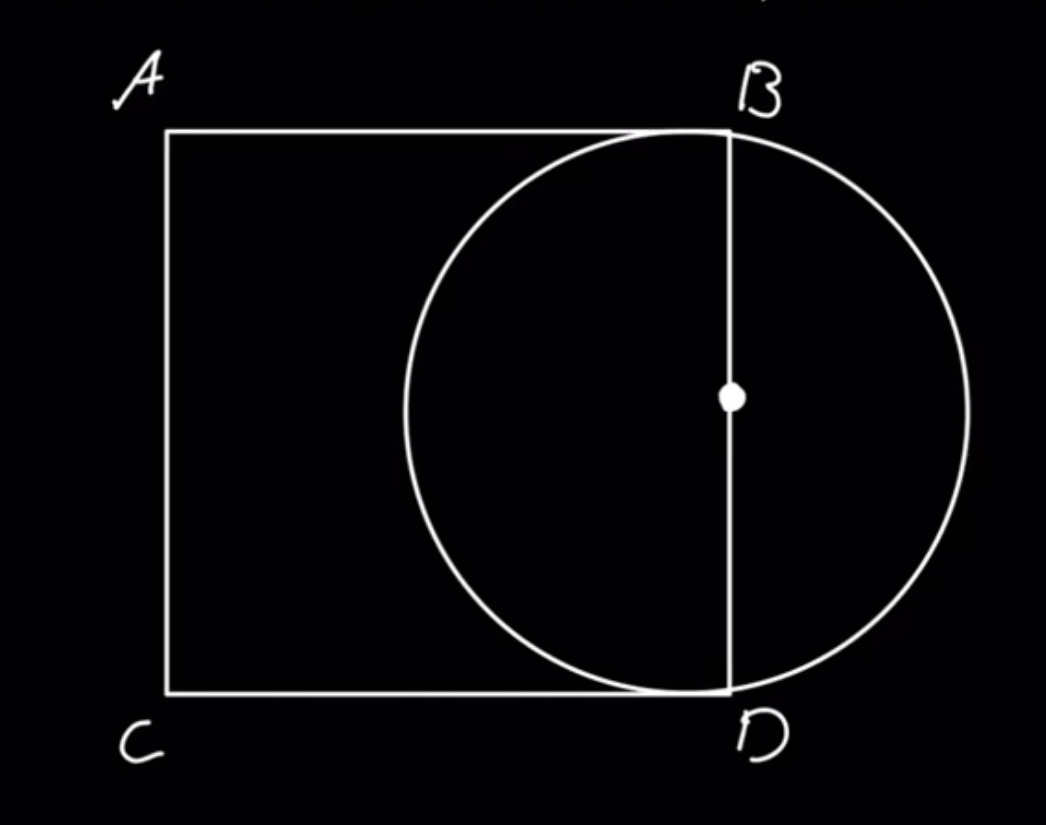
A. 100 B. 20
C. 74 D. 50
explanation: since the area of the circle is 25, then the radius is 5 and the diameter is 10. the area of the square would be s², since the diameter of the circle is 10 and it’s intersecting the square, then all the sides of the square is 10.
s² = 10² = 100
answer: A. 100
.
if x = √7 + √3, then y = √28 + √12, then x = ?
A. y B. ½ y
C. 2y D. y + 2
explanation: this is simple! ignore x for now, look at y
y = √28 + √12 is the same as √4 ⋅ 7 + √4 ⋅ 3
the 4 can be cancelled out as 2, writing the equation as 2√7 + 2√3
so, x = √7 + √3 and y = 2√7 + 2√3
x is ½ of y
answer: B. ½ y
.
three workers produce 1500 cans in 4 days, how many cans can four workers produce 4000 cans?
A. 11 B. 10
C. 9 D. 8
explanation: this is also easy but you need to make sure you can multiply and divide quickly so you don’t waste time.
first, take the given and make it into a set with days, workers, and cans.
workers —— cans —— days
3 1500 4
4 4000 x
then cross multiply like so,
3(4000)(4) = 4(1500)(x)
to solve this without wasting time, start by cancelling out zeros from 4000 and 1500, and cancel out both 4’s.
the equation would look like this: 3(40) = (15)(x)
120 = 15x → divide by 15 on both sides
x = 8
answer: D. 8
.
continue the sequence: 1, 3, 9, 27, 81, …
A. 243 B. 345
C. 234 D. 199
explanation: this is a simple question, you just need to figure out if the sequence is arithmetic (+) or geometric (x)
in this case, the sequence is geometric. each number is multiplied by 3, so the last number (81) should be multiplied by 3.
answer: A. 243
.
x - y = 5, xy = 15, find (x² + y²)
A. 55 B. 29
C. 20 D. 30
explanation: square both sides of the first given equation
(x - y)² = 5²
factor the (x - y)² → x² + 2xy + y² … xy in 2xy becomes 30 since the question gives us xy as 15 ( 2(15) )
x² + 30 + y² = 25 + 30 + y²
25 + 30 = 55 = (x² + y²)
answer: A. 55
.
1^100 + 100^0
A. 2 B. 10
C. 3 D. 5
explanation: this is also an easy question because 1 raised to any power will always be 1, and any number to the power of 0 is 1.
so, 1^100 + 100^0
= 1 + 1 = 2
answer: A. 2
.
find x, 1 + 1/ 1/x -2 = 5/3
A. 2 B. 5
C. 3 D. 8
explanation: all you need to do is solve for x
first, take +1 to the other side, so it becomes -1
1/ 1/x -2 = 5/3 -1
-1 becomes 1/1, then multiply the numerator and denominator by 3 so it has the same denominator as 5/3
5/3 - 3/3 = 2/3
for the other side, you want to flip 1/ 1/x -2 so that the denominator is 1 and cancelled out
so the equation will become: 1/x - 2 = 3/2
take 2 to the other side and put it over 1 and multiply it by 2 on the numerator and denominator
1/x = 3/2 + 2/2
1/x = 5/2
answer: A. 2
.
how many numbers are between 87 and 131?
A. 43 B. 44
C. 76 D. 74
explanation: this question needs one of the formulas that I wrote in the beginning! for this type of problem, the formula is (b - a)-1
(b - a)-1, this is the formula for finding the number of pages between two, not for finding the number of pages in total, which is why we minus 1.
(131 - 87)-1 = 43
answer: A. 43
.
if a book chapter starts from page 32 to page 66, how many pages does the book’s chapter have?
A. 34 B. 35
C. 32 D. 36
explanation: this is the other formula, similar to (b - a)-1 in the question above, but the difference is that we’re going to +1 instead of -1 because we’re finding the number of pages in total from number a to number b.
(b - a)+1
(66 - 32)+1 = 35
answer: B. 35
.
if z is even, which one of these are odd?
A. z/7 B. 3z - 2
C. z² D. 2z - 3
explanation: before I explain this question, remember that in these type of problems, you should cancel out fractions right away because we want a whole number, not a decimal or fraction. so option A is automatically cancelled out for you.
to solve this problem, you already know that z is an even number. so all you need to do is substitute z for an even number in all the options given. the easiest, smallest even number is 2 to substitute.
B. 3z - 2 → 3(2) -2 = 4
C. z² → (2)² = 4 (an even number squared is always even)
D. 2z - 3 → 2(2) - 3 = 1
answer: D. 2z - 3
.
ali is sitting in a row. he is in the 7th place in the row if we count from the beginning. also, he is in the 10th place in the row if we count from the end. how many people are sitting in the row?
A. 14 B. 15
C. 16 D. 17
explanation: this is a long question but it’s really simple to solve without needing those a_n and a_1 formulas (taken in the 11th grade in high school). all you need to do is use the (b + a)-1 formula that I wrote in the first page with all the formulas. it’s not the same as the (b - a)+1 and (b - a)-1, so don’t get mixed up.
(b + a)-1 = (10 + 7)-1 = 16
answer: C. 16
.
(-2)(-2)(-2)(-2)(-2)-2
A. 4 B. -4
C. 12 D. - 12
explanation: for these type of questions, just be reminded of the positive and negative rules. in this case, negative x negative is positive. you’ll multiply the numbers in the parentheses. so the first four sets of (-2) will equal 4 since, (-2)(-2) = 4 and you’ll be left with two 4’s.
there’s one (-2) left with -2 next to it, (-2)-2 = -4
we put them all together → 4 × 4 -4 = 12
answer: C. 12
.
the average of ages of 5 students is 25. one student left and now the average is 26, how old is that student?
A. 19 B. 20
C. 21 D. 25
explanation: to solve this question, all you need to do is multiply 5 and 125 and then multiply 4 and 26.
we’re multiplying 26 by 4 because we’re minusing the student that left.
after we get both answes, we minus them to get the answer.
5 × 25 = 125
4 × 26 = 104
so, 125 - 104 = 21
answer: C. 21
.
how many 50s are there in the number 1079?
A. 17 B.17
C. 21 D. 79
explanation: all you need to do for this question is to divide both numbers and you’ll have your answer.
50 divided by 1079 = 21 with a remainder of 29 (the remainder is unimportant)
answer: C. 21