Week 5: Anxiety and Anxiety Disorders
Chapter 14: Anxiety and Anxiety Disorders
Introduction to Anxiety
Definition of Anxiety:
A vague feeling of dread or apprehension.
Response to external or internal stimuli.
Symptoms of Anxiety:
Behavioral, emotional, cognitive, and physical symptoms.
Distinction from Fear:
Fear is a response to a clearly identifiable external stimulus.
Normal Anxiety:
Appropriate to the situation.
Dissipates when the situation is resolved.
Anxiety Disorders:
Characterized by excessive anxiety.
Includes panic without reason, unwarranted fear, and overwhelming worry.
Impact of Anxiety Disorders:
Significant distress over time.
Impairs daily routines, social lives, and occupational functioning.
Anxiety as a Response to Stress
Stress:
Defined as the wear and tear caused by life situations.
Varies from person to person.
Examples of stressors include public speaking, marriage, new jobs.
Hans Selye's General Adaptation Syndrome:
Identified physiological aspects of stress through studies on laboratory animals.
Stages of Reaction to Stress:
Alarm reaction.
Resistance stage.
Exhaustion stage.
Alarm Reaction Stage
Body's Response to Stress:
Messages are sent from the hypothalamus to glands and organs.
Adrenal glands release adrenaline and norepinephrine.
The liver reconverts glycogen stores to glucose.
Prepares body for potential defense needs with increased fuel and food supply.
Resistance Stage
Physiological Changes:
Digestive system reduces function.
Blood shunted to areas needed for defense.
Increased activity of lungs and heart.
More air intake and faster heartbeats.
Circulation of oxygenated and nourished blood to muscles to adapt to stress.
Relaxation of body responses if stress is managed.
Exhaustion Stage
Negative Response to Anxiety and Stress:
Depletion of body stores occurs.
Continual arousal of physiological responses leads to little reserve capacity.
Autonomic Nervous System Responses
Autonomic Nervous System:
Involuntary activities vital for self-preservation.
Sympathetic Nervous System:
Activates the body in response to danger (fight or flight).
Adrenal glands release adrenaline, increasing heart rate and blood pressure.
Parasympathetic Nervous System:
Reverses the process to return the body to normal conditions.
Physiological Responses to Anxiety
Responses Include:
Difficulty with logical thought.
Increased agitation in motor activity.
Elevated vital signs (heart rate, blood pressure).
Adaptive behaviors to reduce discomfort, such as relaxation and imagery techniques.
Maladaptive Behaviors: May manifest as tension headaches, pain syndromes, and other stress-related symptoms.
Levels of Anxiety
Four Levels of Anxiety:
Mild Anxiety (Level 1):
Sensation of something different; increased sensory stimulation.
Motivates change and goal-directed activity.
Moderate Anxiety (Level 2):
Disturbing feelings, nervousness, or agitation.
Difficulty in independent concentration.
Severe Anxiety (Level 3):
Trouble thinking and reasoning with increased muscle tension and vital signs.
Focus on self-defense.
Panic Anxiety (Level 4):
Characterized by fight, flight, or freeze responses with an adrenaline surge.
Table 14.1: Levels of Anxiety
Anxiety Level
Mild:
Psychological Responses: Wide perceptual field, sharpened senses, increased motivation.
Physiological Responses: Restlessness, fidgeting, GI "butterflies."
Moderate:
Psychological Responses: Perceptual field narrowed to immediate task, selectively attentive.
Physiological Responses: Irritability, muscle tension, high voice pitch.
Severe:
Psychological Responses: Perceptual field reduced to one detail, ineffective problem-solving.
Physiological Responses: Nausea, trembling, rigid stance.
Panic:
Psychological Responses: Inability to process environmental stimuli, distorted perceptions, possible delusions and hallucination.
Physiological Responses: Dilated pupils, increased blood pressure and pulse, may bolt and run or be immobile.
Interventions for Clients with Anxiety
Assessing Anxiety Level:
Determines effective nursing actions.
For mild anxiety, no direct intervention is needed; effective teaching should suffice.
For Moderate Anxiety:
Ensure the client follows the information presented; use short, simple sentences.
Management for Severe and Panic Anxiety:
For severe anxiety, lower the anxiety level before proceeding, remain with the client, and speak calmly.
For panic anxiety, prioritize safety by moving to a quiet environment.
If the client is in a panic, we have the right to meditate to ease their panic.
Stress-Related Illnesses
A broad spectrum of illnesses arises from chronic stress, including:
Eating disorders such as anorexia nervosa and bulimia.
Post-Traumatic Stress Disorder (PTSD) from traumatic stressors.
Somatic symptom disorders.
Exacerbation of medical conditions such as hypertension and ulcerative colitis.
Overview of Anxiety Disorders
Definition:
Diagnosed when anxiety becomes chronic and pervasive, resulting in maladaptive behaviors and emotional disability.
Types of Anxiety Disorders:
Agoraphobia: Fear of being in situations where escape might be difficult.
Panic Disorder: Most common; characterized by panic attacks.
Specific Phobia: Intense, irrational fear of a specific object or situation.
Social Anxiety Disorder: Fear of social situations.
Generalized Anxiety Disorder (GAD): Excessive, uncontrollable worry (diagnosed when it results over 6 months).
Assessment Data for Anxiety Disorders
Common Indicators:
Decreased attention span, restlessness, irritability, feelings of discomfort or helplessness, hyperactivity, and perceptual field deficits.
May see these be laced in with symptoms of psychosis or delusion when mixed with a diagnosis such as schizophrenia or other mental disorders.
Expected Outcomes:
Immediate: Free from injury; discuss feelings within 24 to 48 hours.
Stabilization: Demonstrate relaxation techniques; manage anxiety response to stress effectively.
Community: Remain free from anxiety attacks, maintain a healthy anxiety response to stress.
Learn about what is in your toolbox.
Medications for Anxiety Disorders
Benzodiazepines:
Examples: Diazepam (Valium), Alprazolam (Xanax)
Side Effects: Dizziness, sedation; high potential for abuse.
Nonbenzodiazepines:
Examples: Buspirone (BuSpar), Meprobamate (Miltown).
SSRIs and Other Medications:
Examples: Fluoxetine (Prozac), Paroxetine (Paxil) for treating panic disorder, GAD, and social phobia.
First line of treatment, as it has the least amount of side effects.
Related Disorders
Anxiety Disorder Due to Another Medical Condition:
Symptoms stem from physiological issues, e.g., endocrine dysfunction.
Substance/Medication-Induced Anxiety Disorder:
Caused directly by drug misuse or exposure to toxins; requires therapy and anxiety management techniques alongside medication.
Separation Anxiety Disorder:
Excessive anxiety over separation from attachment figures, diagnosed before age 18.
Etiology of Anxiety Disorders
Should always make note of whether our patients have had trauma/what type/to what extent.
Biologic Theories - Genetics:
Anxiety has an inherited component; higher rates of anxiety in first-degree relatives.
High Heritability:
Greater than 0.6; suggests genetic influences dominate.
Moderate Heritability:
Ranging from 0.3 to 0.5; indicates a balance of genetic and non-genetic factors.
Low Heritability:
Less than 0.3; indicates negligible genetics as a primary cause.
Neurochemical Theories of Anxiety Disorders
GABA:
Inhibitory neurotransmitter, dysfunctional in anxiety disorders.
Norepinephrine:
Suspected excess in panic disorder, generalized anxiety disorder, and PTSD.
Serotonin:
Affects anxiety, aggression, and mood; implicated in OCD and GAD.
Psychodynamic Theories
Freud's Perspective on Anxiety:
Anxiety is an innate stimulus for behavior; may lead to defense mechanisms that inhibit emotional growth.
Behavioral Theory of Anxiety
Anxiety as a Learned Behavior:
Fear can be learned and unlearned through experiences, behavior modification can help.
Cultural Considerations in Anxiety Disorders
Cultural Differences:
Various cultures may express anxiety through somatic symptoms.
Cultural humility in nursing focuses on understanding these differences (avoid stereotypes).
Treatment for Anxiety Disorders
Combination of Medication and Therapy:
Produces better results than either alone; includes CBT for anxiety management.
Medications:
SSRIs, benzodiazepines, and others, as listed in Table 14.3.
Therapeutic Techniques:
Includes decatastrophizing and assertiveness training.
Age-Related Considerations in Anxiety Disorders
Children:
Issues with selective mutism and separation anxiety disorder may persist into adulthood.
Older Adults:
Anxiety is often associated with depression and dementia; SSRIs are preferred for treatment.
Community-Based Care for Anxiety Disorders
Treatment Settings:
Many clients are encountered in community settings rather than inpatient settings.
Knowledge of community resources facilitates appropriate referrals.
Mental Health Promotion
Anxiety as a Warning Sign:
Indicates ineffective stress management; provides an opportunity for necessary change.
Tips for Managing Stress
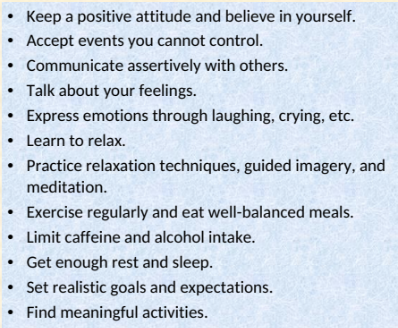
Positive Attitude:
Embrace relaxation techniques, regular exercise, and realistic goal setting to manage stress effectively.
Panic Disorder and Panic Attacks
Panic Disorder:
Characterized by episodes lasting 15 to 30 minutes with intense anxiety symptoms.
Diagnostic Criteria for Panic Disorder:
Recurrent panic attacks without environmental triggers; persistent concern about attacks; significant behavioral changes.
Symptoms: palpitations, sweating, tremors, SOB, chest pain, nausea, dizziness, chills, or hot flashes.
Panic Attacks: Early trauma may contribute to this and should be addressed.
Onset: peaks in late adolescence to mid-30s
Treatment for Panic Disorder
Cognitive-Behavioral Therapy (CBT):
Includes deep breathing and relaxation techniques; medications can include SSRIs and antihypertensives.
Change the way a person thinks and channel positive thoughts.
Safety and Comfort:
Providing a safe environment, remaining with the client during panic attacks, and using calm communication.
Evaluation in the Management of Anxiety Disorders
Ongoing Assessment:
Individualized evaluations for each client; perception of treatment success is essential.
Hamilton Rating Scale for Anxiety (used universally).
History of panic attacks and their impact
General appearance and motor behavior
Mood and affect
Thought processes and content
Sensorium and intellectual processes
Judgement and insight
Self-concept
Roles and relationships
Physiological and self-care concerns
Social Phobia (Social Anxiety Disorder)
Definition: An illogical, intense, and persistent fear of a specific object/social situation. People usually recognize that it is irrational.
Diagnosis: Made when phobic behavior significantly interferes with life.
Symptoms and Common Triggers:
Severe anxiety in social situations, fear of judgment; common triggers include public speaking and social engagements.
Conclusion
Anxiety disorders encompass a wide range of symptoms that impact individuals across varying stages of life. Understanding causes, symptoms, and management techniques is crucial for effective treatment and support.