Principles of Ecology and Evolution
Introduction
The first few lessons of the course helped us to develop a common vocabulary to use as we discuss the physical environment of marine habitats. This lesson will help develop a common vocabulary as we begin to include discussions of the biotic structure of ecosystems.
Ecology is the study of the interactions between organisms and their environment and how these interactions determine the distribution and abundance of the organisms. When we speak of organisms and their interactions with each other, we are speaking of the biotic factors in the environment. In addition to biotic factors, we also describe the environment in terms of its abiotic factors. Abiotic factors are the non-living parts of an environment. These include things such as sunlight, temperature, waves, salinity, and naturally occurring events such as storms.
Ecological Hierarchy
Marine Biologists seek to understand spatial and temporal patterns found in the living world. Scientists describe the biosphere in terms of a hierarchical structure so they can more easily characterize patterns and understand physical and biological context at different scales. The list below defines the levels of hierarchy we will use most in the course. As you review the list, remember that interactions occur between and within levels.
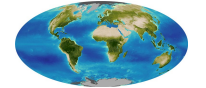
• Biosphere = Entire set of living things on Earth and the environment with they interact. The image below captures the scale of the biosphere.
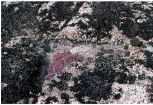
• Ecosystem = Entire habitat including all the abiotic features and all the living species within it that interact. Marine ecosystems are complex and scalable in size. Below is a picture of a marine ecosystem in a rocky habitat that contains many types of organisms.

• Community = Group of populations, each belonging to a different species and all living in the same place (geographical area). Below is a picture of a community of mussels and other species.
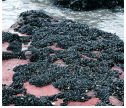
• Population = Group of individuals of the same species in an area responding to the same environmental factors and freely mixing with one another. Below is a picture of a population of mussels.
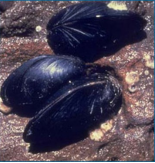
• Individual = Physiologically independent organism. Below is a picture of three individual mussels.
• Species = Natural group of actually or potentially interbreeding individuals isolated from other such groups.
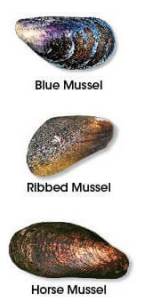
Below are pictures of three mussel species common on the east coast of the US - Mytilus edulis (blue mussel), Geukensia demissa (ribbed mussel), and Modiolus modiolus (horse mussel)
Other Terms to Know
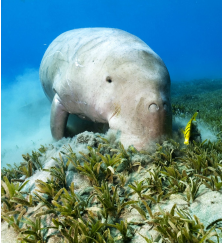
Niche is a term used in a couple of different ways in marine biology. It can mean the role of an organism in a community. When it is used in this way you will often see it modified as either:
• Narrow, meaning the role of the organism is specialized and the organism is a specialist, or
• Broad, meaning the role of the organism is generalized and the organism is called a generalist.
Niche can also mean the range of environments over which a species is found. As you read and study, make sure you look for context clues to indicate which way the word is being used.
Diversity within a community or an ecosystem is a measure of the variety of species that live there. The diversity of species in a particular area depends not only on the number of species found, but also on how many individuals of each species are there. Ecologists call the number of species in an area its richness, and the relative abundance of species its evenness. They are both measures of diversity.
Abundance is the number of individuals within a unit area or volume. Numerically abundant species are called dominants and may define the community (e.g. mussel bed, kelp forest, sea grass bed,…).
Ecological Control
Populations, communities and ecosystems are regulated by these controlling factors:
• Energy
• Climate and the physical environment, and
• Interactions among species.
Interactions
Ecological interactions can occur at the scale of ecosystems, communities, populations and individuals. They are typically motivated or driven by needed access to resources such as space, mates and food. Resources are materials whose abundance or availability can limit survival, growth or reproduction. Limitation of resources scales to the life span of the organisms needing the resource and the time scale over which the resource is replenished after use.
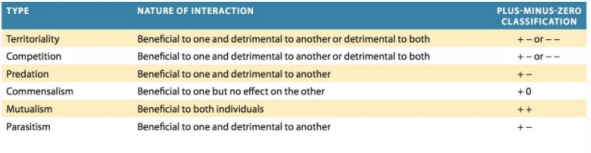
The rest of the lesson will primarily focus on describing the main types of interactions we have observed in the marine environment. We'll start with interactions between individuals as they are the most familiar. At the individual level, we use symbols to classify interactions as having a positive effect (+), a negative effect (-), or no effect (0).
Individual Level Interaction: Territoriality
Territoriality is commonly defined as the defense of an area or home range. Functions of territoriality include the protection of food or feeding sites, nests, shelter, and interactions with mates. Territorial interactions can be classified as + - or - -.
Example: Damselfish cultivate and feed on turf algae. They aggressively fend off other fish who try to eat the cultivated algae. When they successfully defend the area we say the damselfish has had a positive interaction and the herbivore has had a negative interaction. If the herbivore successfully feed on the algae, then the herbivore is labelled as + and the damselfish is labelled as -.
Watch this video of a large school of non-territorial herbivores (barred silver fish) overwhelm the defenses of territorial damselfish (black fish).
https://sites.google.com/site/coralreefsystems/videos/short-movies/living-in-groups
Individual Level Interaction: Predation
In predation, one organism kills and consumes another. Individuals must both feed and avoid being eaten to survive and reproduce. Predation provides energy to prolong the life and promote the reproduction of the organism that does the killing, the predator (+), to the detriment of the organism being consumed, the prey (-). The prey organism has an abrupt decline in fitness, as measured by its lifetime reproductive success, because it will never reproduce again.
Marine predators exhibit traits such as sharp teeth and venom that enhance their ability to catch food. They also possess extremely acute sensory organs that help them to forage (foraging is the act of searching for food resources). This video highlights the diversity of traits marine predators possess to increase predation success. https://www.youtube.com/watch?v=QlUlEDXWgNE
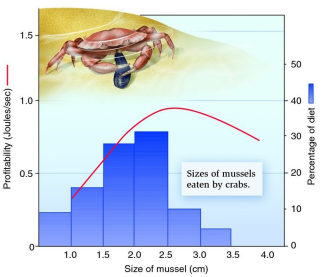
Optimal foraging theory is a behavioral ecology model that helps predict how an animal behaves when searching for food. Although obtaining food provides the animal with energy, searching for and capturing the food require both energy and time. To maximize fitness, an animal adopts a foraging strategy that provides the most benefit (energy) for the lowest cost, maximizing the net energy gained. Optimal foraging theory can be used to create models that predict prey choices for predators. A predator encounters different prey items and decides whether to eat what it has or search for a more profitable prey item. Foraging models predict that foragers should ignore low profitability prey items when more profitable items are present and abundant.
Shore crabs foraging on abundant mussels provides a test of the theory. The model predicts selectivity in the size of mussel foraged. The plot below graphs the expected energy reward (profitability) of a mussel as function of size using a curve. Crabs should ignore smaller mussels because the energy yield is less than that obtained from larger mussels. The crabs will also ignore larger mussels that are difficult to crush or risk potential damage to the crab’s claws. Data from observations of feeding mussels are graphed in the bar chart (percent of the crab's diet from different size classes of available mussels). As predicted, crabs will selectively identify and feed on mid-sized mussels (provided the mussel supply is in abundance)
Individual Level Interaction: Predator Avoidance
When a predator chases after potential prey, the predator is swimming for its dinner. The prey is swimming for its life. If the predator fails to capture the prey, it goes hungry, but it will not experience a large decline in fitness as a result of the interaction. In contrast, if the predator catches the prey, the captured individual loses any future opportunities to reproduce. This “life-dinner principle” sets up an evolutionary arms race between the two species. In this race, the prey experience strong selective pressure to evolve better adaptations to avoid being eaten.
We’ll review a few traits and behaviors that help prey avoid detection or capture.
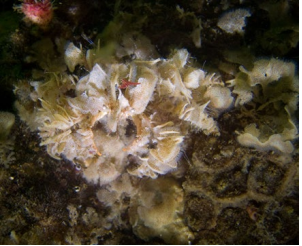
Cripsis: Many prey are cryptically colored to make them more difficult to see. Behaviorally, they freeze after detecting the presence of a predator. This lack of movement helps them better blend in with their background and inhibits the ability of the predator to find them. Decorator crabs (pictured below) use materials from their environment to decorate themselves by sticking mostly sedentary animals and plants to their bodies as camouflage.
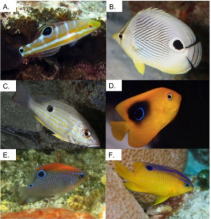
Deceit: A number of species exhibit deceptive coloration and behavior. Many smaller reef fishes have large posterior spots. Predators are fooled into attacking the posterior of the fish as it is swimming to escape in the opposite direction. You can see examples of eyespots in damselfish below.
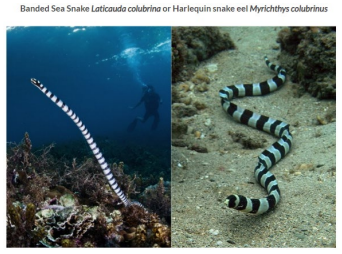
Mimicry: Some prey resemble other species to avoid predation. Mimicry is an evolved morphology or behavior that allows an organism to resemble another species, which serves the function of reducing attacks by predators. Batesian mimics may be harmless and yet resemble a model species that is dangerous and avoided by typical predators on the mimic. For example, in the southwest Pacific, species of relatively harmless snake eel (right panel in image below)have striping patterns that strongly resemble highly venomous sea snake species (left panel).
Escape response: When predators venture too close, prey will take flight. When a chase ensues, prey will typically survive if they stay out of reach until the predator tires. Some species buy extra time by distracting the predator. Such actions surprise the predator and give the prey time a few extra moments to escape.
Watch this short Science Friday video about an octopus. https://www.sciencefriday.com/videos/wheres-the-octopus-2/
Mechanical and Chemical Defense
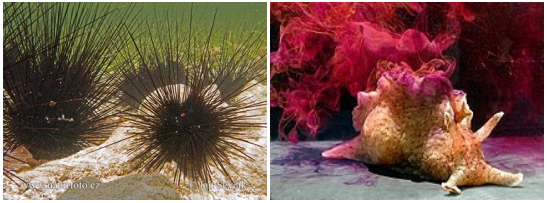 Mechanical defenses, such as the presence of spines or hard shells, discourage predators by causing physical pain to the predator or by physically preventing the predator from being able to eat the prey. These sea urchins are an example of an animal that uses spines to discourage predators. Many marine organisms are defended chemically by toxic compounds, distasteful secretions and toxic metals. An example is the sea hare pictured below. Sea hares feed on algae in shallow water and if disturbed can produce a toxic ink to deter and escape from predators. The purple or pink ink that many species produce is a byproduct from eating red algae.
Individual Level Interaction: Commensalism
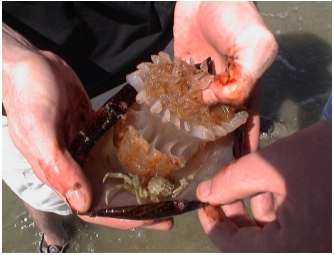
Most of the interactions occurring in the natural world affect both organisms in some way, however, commensalism (+/0) is defined as a unilateral relationship between two species that benefits one species without consequence to the other. Commensal relationships may be facultative or obligatory. A facultative commensal species does not completely depend on a certain single species but may live on one of a variety of species. Barnacles, for example, may settle and live on a variety of species of mussel or on other barnacles, seaweeds, or even rock. On the other hand, obligatory commensals can live only with certain other species.
Cannonball jellyfish form symbiotic relationships with marine species, including ten species of fish and the juvenile long-nosed spider crab, Libinia dubia (photo below). The crab uses the jellyfish for protection and feeds on the zooplankton that the jellyfish take in, as well as zooplankton that are on the medusa itself.
Individual Level Interaction: Mutualism
Mutualism describes the ecological interaction between two or more species where each species has a net benefit (++). Many mutualisms are a trade-off between protection against predation on the part of one species and some other benefit on the part of the other participant. One of the most remarkable mutualisms in coral reefs occurs between cleaner wrasse and large predatory fish. Cleaner shrimp and fishes feed by picking ectoparasites off fishes, which approach them regularly. The Pacific cleaning fish Labroides dimidiatus maintains cleaning stations that are visited by about 50 species of fishes each day. “Customers” are attracted to the undulating movements of the cleaning fish. Interactions with cleaner fish result in reduced predatory attacks, and cleaner fish that compete tend to do a better job than when cleaner fish are less dense.
Watch L. dimidiatus in action in this short video. https://www.youtube.com/watch?v=V5EszU8yuA8
Individual Level Interaction: Parasitism
Parasitism occurs when members of one species live at the expense of individuals of another species (+-). A parasite is physiologically dependent upon its host for nutrition. While the host is negatively affected by the loss of nutrients to the parasite, parasitism rarely leads directly to the host's death. Ectoparasites live attached to or embedded within gills, body walls, and other surfaces. Endoparasites live within the body and may occupy circulatory vessels or ramify within certain organs or tissues. Parasites often have complex life cycles that depend on more than one host species.
Here is an example of a fish parasite that inspired a movie back in 2012. The text below is modified from this interview. https://www.aaas.org/tongue-eating-parasites-inspire-new-horror-movie
Cymothoa exigua is a type of parasitic isopod also known as the tongue-eating louse. Isopods Cymothoa exigua belongs to the cymothoids, an isopod family, which often parasitizes bony (teleost) fish. Specimens of Cymothoa exigua enter the fish via the gills and become attached to the base of the tongue of the host fish with their legs. The isopod does not actually eat the fish's tongue, but sucks blood from the tissue, so that the tongue eventually withers and degenerates. The isopod remains attached to the tongue base and in that way becomes a living substitute.
Specimens of Cymothoa exigua have a short free-living (pelagic) juvenile phase and a "stationary" adult parasitic phase. First, juveniles enter the fish's gill and become males. Cymothoids, like Cymothoa exigua, are protandric hermaphrodites; that is, adult males switch to female. The first male, which enters the gills, typically develops into a female, and the other males remain males. It is not quite clear what impedes this shift from one sex to another, but possibly pheromones released from the female prevent the other males from changing their sex. Only the females inhabit the fish's buccal cavity and become a tongue replacement. There are some doubts about the life span of tongue-eating isopods. Some consider that they produce only one brood. This, however, can contain more than 400 eggs, which they carry in a ventral brooding pouch (like all isopods). Given the hugely different size ranges across Cymothoa specimens, it is suggested that they potentially have several broods and can survive up to three years.
Population Level Interaction
A population is a group of individuals that are affected by the same overall environment and are relatively unconnected with other populations of the same species. A species can be divided into a series of geographically localized populations. The individuals in a population share the same general influence of the physical and biological environment. Within the population, it is much more likely that individuals of a given species will breed with each other as opposed to members of other populations.
Population size is defined as the number of individuals present in a subjectively designated geographic range. Despite the simplicity in its concept, locating all individuals during a census (a full count of every individual) is nearly impossible, so ecologists usually estimate population size by counting individuals within a small sample area and extrapolating that sample to the larger population.
Populations display distinctive behaviors based on their size. Small populations face a greater risk of extinction. Individuals in these populations can have a hard time finding quality mates so, fewer individuals mate and those that do risk inbreeding. Additionally, individuals in small population are more susceptible to random deaths. Events like storms and disease have a greater chance of killing all individuals in the population when the population is small.
Large populations experience their own problems. As they approach the maximum sustainable population size, known as carrying capacity, large populations show characteristic behavior. Populations nearing their carrying capacity experience greater competition for resources, shifts in predator-prey relationships, and lowered fecundity. If the population grows too large, it may begin to exceed the carrying capacity of the environment and degrade available habitat.
Population Density and Growth
A more complete description of a population's size includes the population density — the size of a population in relation to the amount of space that it occupies. Density is usually expressed as the number of individuals per unit area or volume. For example: the number of plankton per liter of seawater or the number of anemones per square meter of rocky substrate. Like all population properties, density is a dynamic characteristic that changes over time as individuals are added to or removed from the population. Birth and immigration — the influx of new individuals from other areas — can increase a population's density, while death and emigration — the movement of individuals out of a population to other areas — can decrease its density.
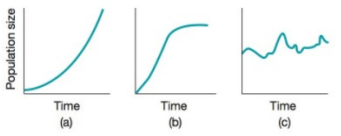
This figure from the textbook shows types of population growth.
• In exponential growth (panel a), the population increases by the same proportion with the passing of a given amount of time, which might continue indefinitely if resources were limitless.
• In resource-limited growth (panel b), there is a limit, or carrying capacity, to the maximum population size that the environment’s limited re- sources can sustain. As the population size approaches the carrying capacity, the rate of population growth decreases. When above carrying capacity, the population is too great for the available resources, and it declines. These situations involve intraspecific (within-species) competition for resources.
• In random growth (panel c), the factors regulating population size are too complex to show any simple pattern.
Population growth is often modeled for resource management purposes (e.g. fisheries).
Community Level Interaction: Competition
Whenever two niches overlap, competition ensues between organisms. If two organisms have the same requirements - for food, water, space - there will not be enough of that resource to go around. Competition can limit the growth, and ultimately the reproductive success, of individuals.
Intraspecific competition occurs within the species. Individuals of the same species compete for the exact same things in the environment, therefore this is the strongest type of competition. Interspecific competition is waged between species. It can be fierce, if the competing species are similar, but it is never as strong as intraspecific competition. Whatever the type of competition, it will be strongest at high population densities. The more organisms there are, the more strongly they will compete for the remaining resources.
Competition may occur through two possible mechanisms: exploitation and interference. In exploitation competition, organisms fully consume resources directly. Once used, the resource is no longer available for other species to use. In interference competition, one organism prevents other organisms from using the resource. Interference competition is more common in areas where the resource occurs in discrete patches and can be more easily defended.
Competitive exclusion, sometimes referred to as Gause's Law, states that two species that compete for the exact same resources cannot stably coexist. One of the two competitors will always have an advantage over the other that leads to local extinction of the second competitor or to an evolutionary shift of the inferior competitor towards a different ecological niche. Zonation on rocky shorelines often show the results of competitive exclusion (see image).
Resource partitioning occurs when species divide up a limiting resource, such as food, water, or habitat (in other words the resource "pie"), by using different slices or even using the same "slice" but in different places or at different times. This means resource partitioning reduces interspecific competition and therefore promotes coexistence. Many reef fish partition resources through the use of temporal niches- nocturnal fish are active at night (panels A & B) while diurnal fish are active during the day (panels C & D).
Community Level Interaction: Disturbance and Succession
Disturbance is any event, usually abiotic, in the environment that shifts a community from its equilibrium. Disturbance events are an irregular occurrence that can include the removal of biomass or mortality. Disturbance opens space within the community.
Succession is change in community composition over time. Succession in marine habitats may occur as resources are consumed as in algal blooms, or in habitats following a disturbance.
The image below shows a portion of the seafloor decimated by a physical disturbance (left) and the successional community that established after the disturbance (right).
Community Level Interaction: Disease
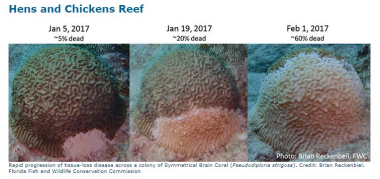
Infectious diseases have long been known to cause devastating illnesses in humans, crops, and livestock, but until recently pathogens were assumed to have little impact on wild populations, except in rare and sometimes spectacular die-off events. It is now apparent that parasitic organisms and pathogens are not only a common and integral part of ecosystems, but they also influence the abundance of wild populations, can cause extinctions of their hosts, and serve as drivers of evolution.
Pathogen impacts on host populations depend on the virulence of the pathogen and the reduction in host fitness (survival or reproduction). In general, for pathogens that lower host survival, those with intermediate virulence tend to have the largest negative impacts on host populations. This is because hosts infected with highly virulent pathogens tend to die quickly, thus cutting short the infectious period of parasite transmission.
This video (https://www.youtube.com/watch?time_continue=22&v=5egT9g7oOxM&feature=emb_logo) shows the high prevalence of diseased brain corals on a small reef outcrop at Hen and Chickens Reef in the Florida Keys National Marine Sanctuary. The disease causes necrosis of the coral tissue and multiple lesions can be seen in the video. The corals that are completely white in the video have lost all or nearly all of their tissue leaving only the white, dead skeleton visible.
Ecosystem Level Interactions
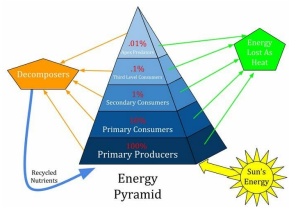
An ecosystem consists of a group of communities that interact with the physical-chemical environment within a specific geographic area. Within the ecosystem, nutrients cycle between organisms and the environment, some of the species manufacture organic molecules using only solar energy and inorganic chemical sources (e.g., algae), and the interactions among species within the system are very strong.
At the ecosystem level we organize organisms into functional groups. Functional groups are defined as sets of species showing either similar responses to the environment or similar effects on major ecosystem processes. Functional groups are sometimes called guilds. Examples of functional groups organized around food webs would be:
• primary producers that use the sun's energy to create organic matter
• primary consumers who consume primary producers, and
• secondary consumers who prey upon primary consumers.
Ecosystem studies focus on topics such as the movement of energy through food webs, nutrient and carbon cycling, the impact mankind has on the environment and the impacts of climate change.
Check your understanding by matching the correct type of competition with its description.
Genetic Variation and Evolution
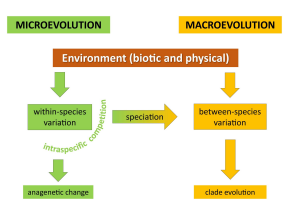
Evolution is a process that results in changes in the genetic content of a population over time. There are two general classes of evolutionary change: microevolution and macroevolution. Microevolutionary processes are changes in allele frequencies in a population over time. Three main mechanisms cause allele frequency change: natural selection, genetic drift, and gene flow. Macroevolution, on the other hand, refers to change at or above the level of the species.
Population ecologists are most directly concerned with microevolutionary processes. These include shifts in the values and frequencies of particular traits among members of populations, often due to ecological processes such as the movement of organisms and changing environmental conditions as well as interactions with members of different species (e.g. predator-prey interactions, host-parasite interactions, competition) or the same species (e.g. sexual selection, competition). These processes can, but do not necessarily, lead to the formation of new species over time but instead result in fluctuating frequencies of traits within populations tracking ever-changing selective pressures. Since some microevolutionary processes may occur over just a few generations, they can often be observed in nature or in the laboratory.
Usually macroevolutionary changes cannot be observed directly because of the large time scales involved. Instead, studies of macroevolution tend to rely on inferences from fossil evidence, phylogenetic reconstruction, and extrapolation from microevolutionary patterns.
Speciation
Often the focus of macroevolutionary studies is on speciation: the process by which groups of previously-interbreeding organisms become unable (or unwilling) to successfully mate with each other and produce fertile offspring.
For new species to originate, it is usually necessary for a geographic barrier to isolate a species into two or more populations. If the barrier is short lived, the populations will reconnect. If the barrier is longer lived, and especially if the populations diverge genetically, they may be relatively incompatible when reconnected.
Phylogenetics
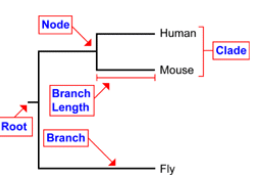
Phylogenetics is the study of the evolutionary history that underlies biological diversity. Scientists use branching diagrams to represent this history and the evolutionary relationships among organisms. These diagrams are called phylogenetic trees (see example below). The branching patterns represent patterns of evolution through common ancestors. These trees may be based on morphologic, behavioral or genetic information. Statistical methods are used to analyze the information (data) and infer similarity and difference between groups. The tips of the tree represent the taxa being considered (e.g. species, family, order,…). The lines are called branches and the nodes and root represent common ancestors. An ancestor and all of its descendants is called a clade.
Check your understanding: Macroevolution happens quickly in response to environmental change.